Vendor fraud is when a seller on a multi-vendor marketplace scams buyers or the marketplace itself. Common forms include selling fake goods, taking payment and never shipping, and cashing out before refunds land. The marketplace usually ends up covering the losses, so stopping it is the owner’s job.
Vendor fraud works by abusing the trust a marketplace lends to every seller on it. Shoppers buy because they trust your site, not the stranger behind the listing. A fraudulent vendor borrows that trust, takes the money, and leaves you holding the complaints.
Think of a farmers market. Shoppers assume the market organizer checked every stall. If one stall sells rotten fruit and vanishes, angry customers go to the organizer, not the missing seller.
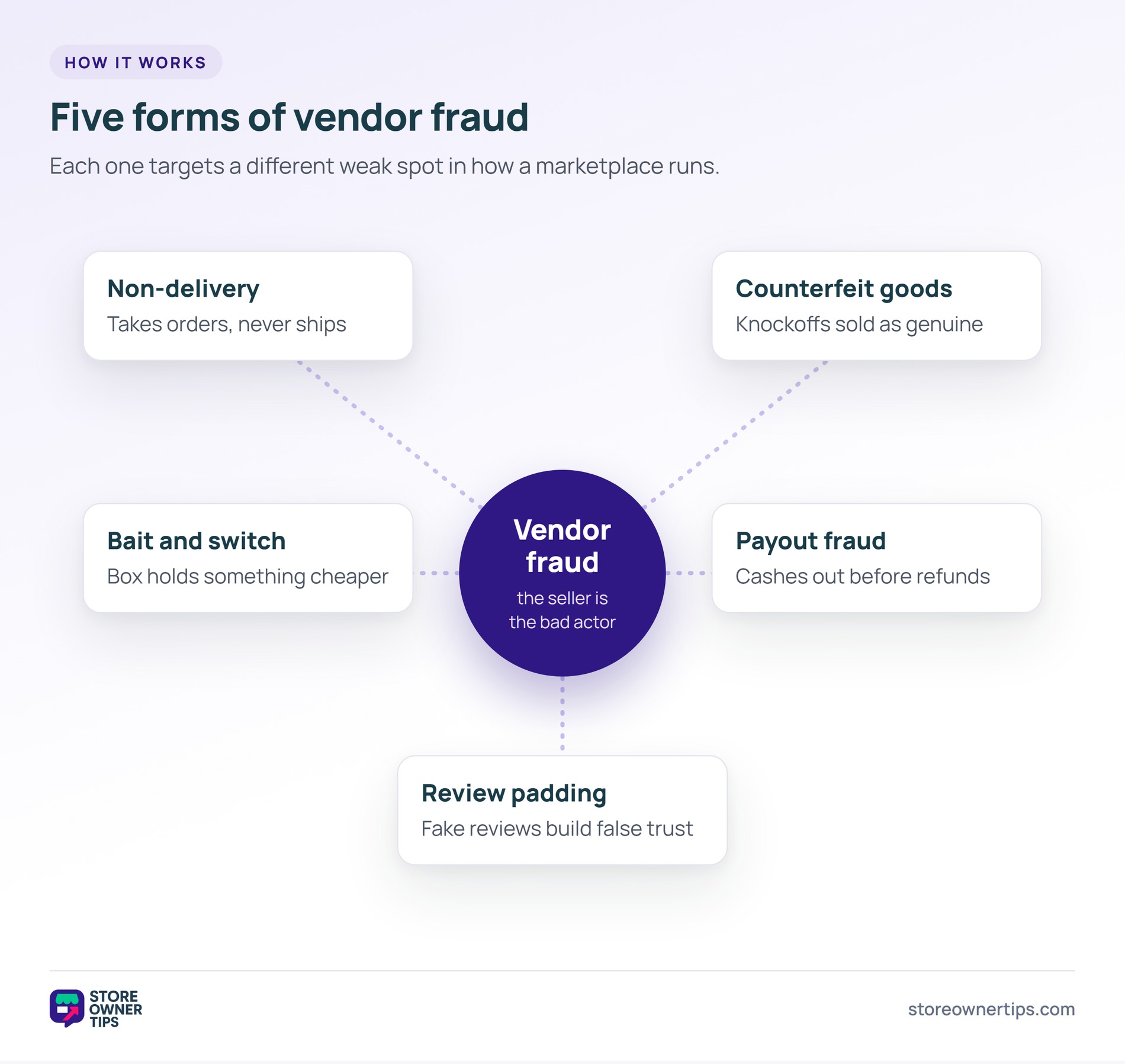
Vendor fraud shows up in a handful of repeat forms. Each one targets a different weak spot in how a marketplace runs.
Vendor fraud hurts the marketplace because the money flows through you first. On a WooCommerce marketplace, the buyer checks out on your site and pays your payment gateway. The vendor gets their share later as a payout.
So when a buyer disputes the charge, the bank pulls the money from your account. If the vendor already cashed out, you’ve lost the sale and paid the refund. On top of that, each chargeback usually adds a fee and counts against your merchant account.
Vendor fraud costs more than the refunded orders. Your support team spends hours answering angry buyers and chasing tracking numbers that don’t exist. Meanwhile, payment processors watch your dispute rate, and a spike can mean higher fees or a frozen account.
The quieter cost is trust. Buyers who get scammed rarely separate the vendor from the marketplace, so they blame you and leave bad reviews. Honest vendors suffer too, because shoppers grow wary of every new listing.
Vendor fraud is common enough that US law now asks marketplaces to know their big sellers. The INFORM Consumers Act covers sellers with 200 or more sales and $5,000 in revenue within 12 months. Marketplaces must collect and verify those sellers’ bank, tax, and contact details.
Sellers above $20,000 a year must also show buyers a way to contact them. The goal is simple: a scammer is harder to hide when the platform knows who they are. Ask a lawyer whether the rules apply to your own marketplace.
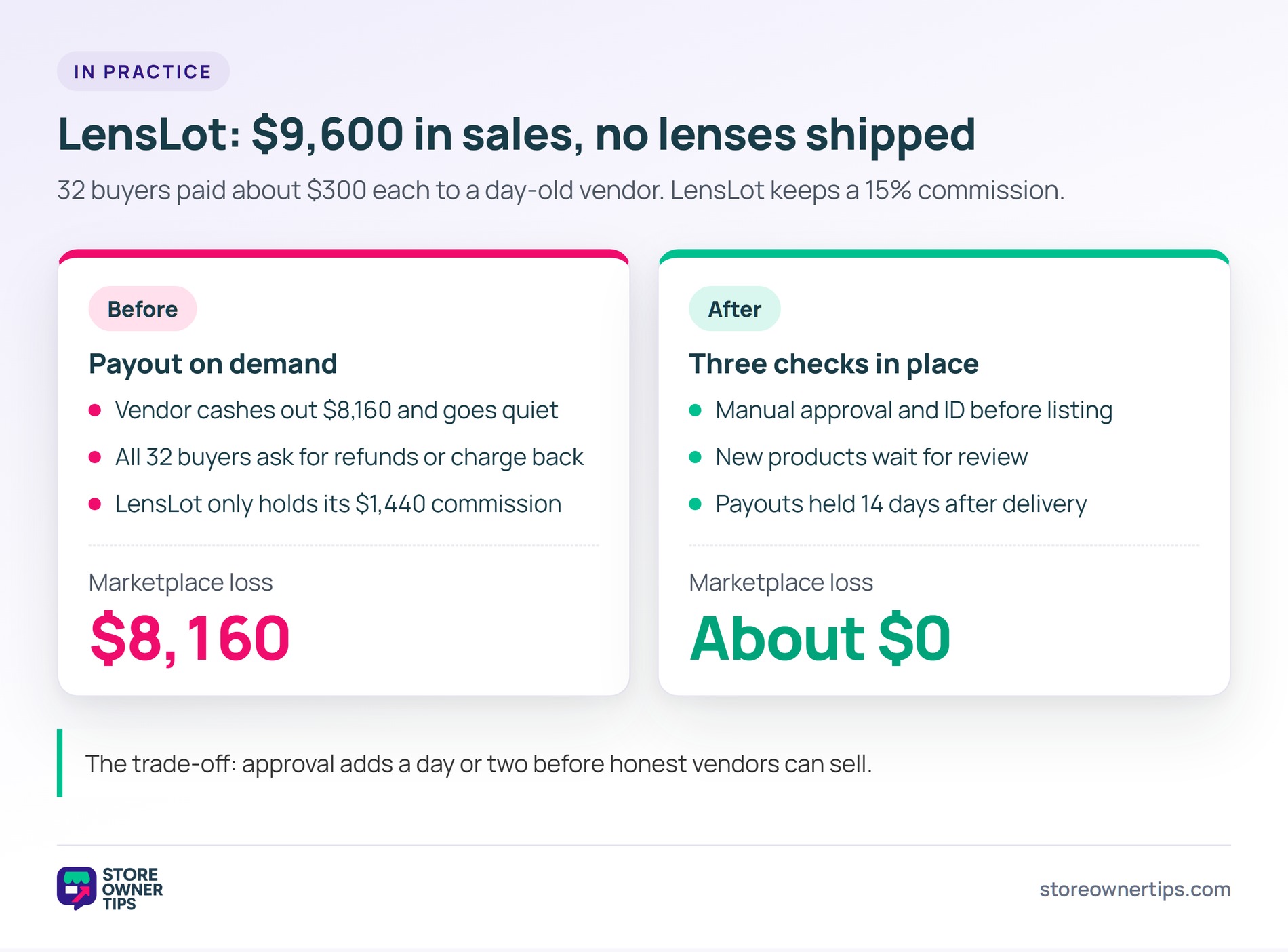
Vendor fraud is hard to measure directly, but related crime data shows its scale. The FBI’s Internet Crime Complaint Center logged 49,572 non-payment and non-delivery complaints in 2024. Victims reported about $785 million in losses from that category.
Fake goods are a big part of the picture too. The OECD and the EU’s intellectual property office studied customs seizures. They put global trade in fakes at $467 billion, or 2.3% of world trade, in 2021.
Shoppers also struggle to spot fakes on their own. An EUIPO survey found 39% of Europeans have wondered whether a purchase was genuine. Only 15% said they’d bought a fake after being misled, which shows how often shoppers can’t tell.
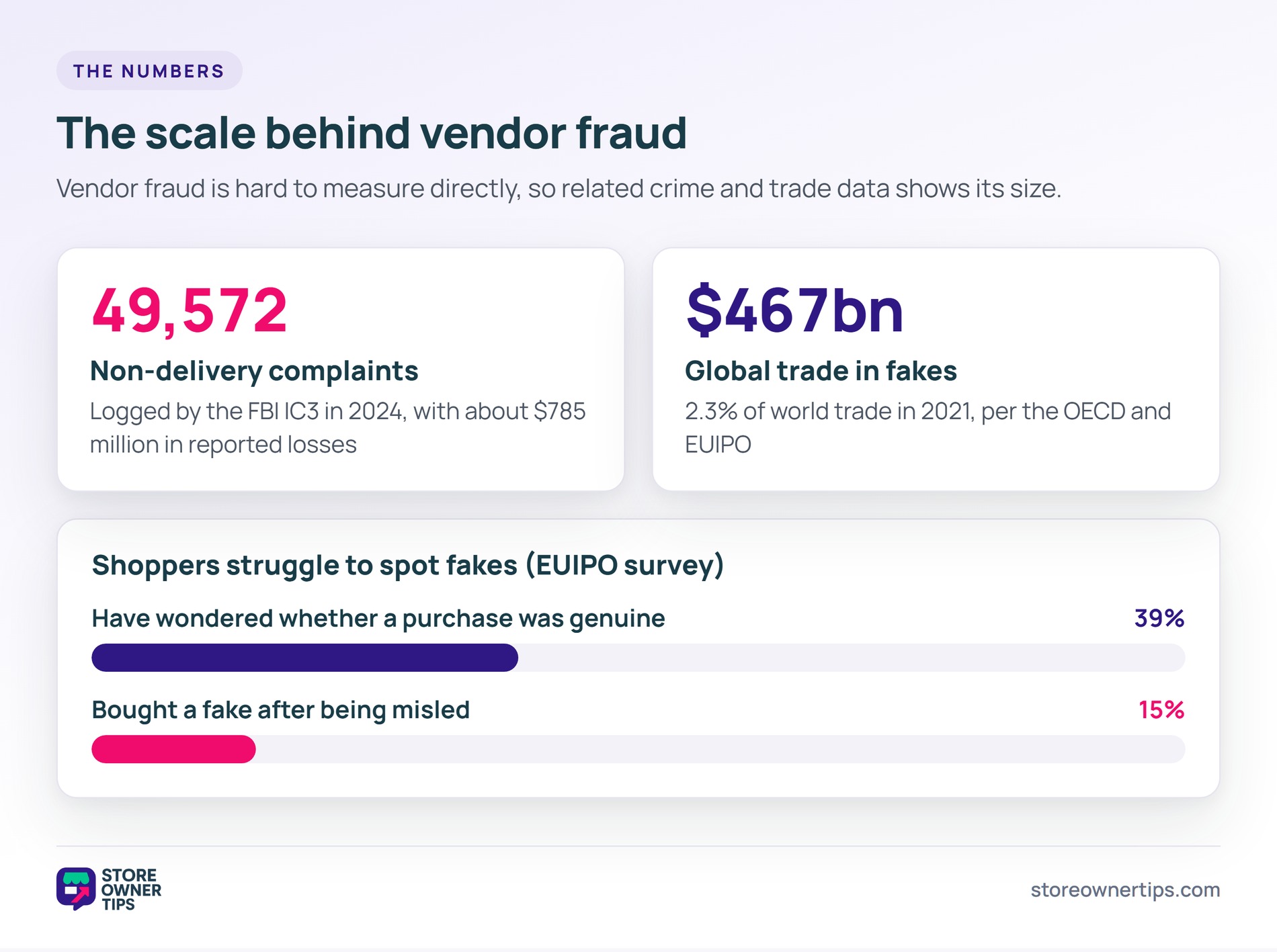
Vendor fraud in practice often looks like a great new seller for the first two weeks. Here’s a hypothetical example. Imagine a marketplace for used camera gear called LensLot, which takes a 15% commission on each sale.
A new vendor signs up with a free email address and a polished storefront. Within days, they list 40 popular lenses at about 30% below the going rate. The deals sell fast, and 32 buyers pay an average of $300 each.
That’s $9,600 in sales. LensLot’s commission is $1,440, and the vendor’s share is $8,160. Then the vendor asks for an early payout and stops answering messages.
No lenses ever ship. If LensLot pays out on demand, the vendor walks away with $8,160. All 32 buyers then ask for refunds or file chargebacks.
LensLot owes buyers the full $9,600 but only holds its $1,440 commission. That leaves $8,160 to cover from its own pocket, before chargeback fees. Worse, 32 burned buyers are unlikely to shop there again.
Now picture LensLot with three checks in place. First, new vendors need manual approval and ID before they can list. Next, every new product waits for review, so 40 underpriced lenses from a day-old account raise a flag.
Finally, payouts sit on a 14-day hold after delivery. Even if the scammer slips through, the $8,160 is still in LensLot’s account when the refund requests arrive. The loss drops from $8,160 to roughly zero.
The checks cost LensLot something too. Approval adds a day or two before honest vendors can sell. Still, that delay is cheap next to an $8,160 hole and 32 lost customers.
You prevent vendor fraud by adding a check at each stage a scammer has to pass. One layer alone leaks, but three or four together stop most attempts. Start with these.
Track a few numbers to see whether your checks work. Watch refund and dispute counts per vendor, not just store-wide totals. A new vendor with several refund requests in their first month deserves a closer look before their next payout.
For a fuller checklist, including 2FA and payment settings, see this guide to WooCommerce marketplace security. A clear vendor agreement also helps, since it spells out what happens when a seller breaks the rules.
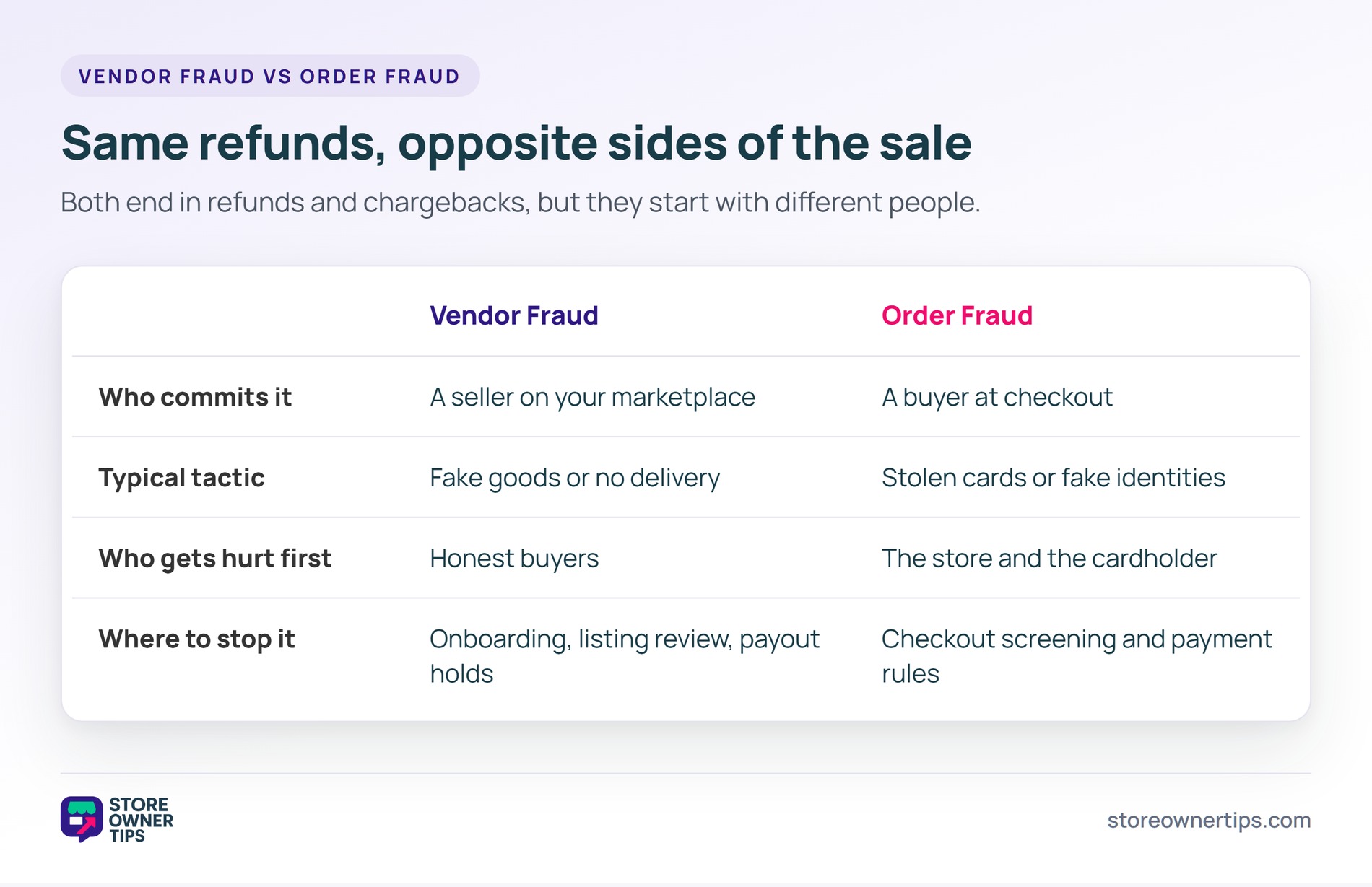
| What you’re comparing | Vendor Fraud | Order Fraud |
|---|---|---|
| Who commits it | A seller on your marketplace | A buyer at checkout |
| Typical tactic | Fake goods or no delivery | Stolen cards or fake identities |
| Who gets hurt first | Honest buyers | The store and the cardholder |
| Where to stop it | Onboarding, listing review, payout holds | Checkout screening and payment rules |
Vendor fraud and order fraud both end in refunds and chargebacks, but they start on opposite sides of a sale. Order fraud is a buyer problem that any online store faces. Vendor fraud only exists on marketplaces, so it needs controls a single-seller store never has to think about.
In practice, usually yes. The buyer paid the marketplace, so refunds and chargebacks come out of the marketplace’s account. Your vendor agreement can let you recover money from the vendor, but only if you can still reach them.
Watch for brand-new accounts with prices far below market, sudden sales spikes, and early payout requests. Vague product photos and copied descriptions are warning signs too. A vendor who avoids ID checks is the biggest red flag.
Suspend the vendor account right away and freeze any pending payouts. Then review their recent orders and refund affected buyers. Finally, tell your payment processor and keep records of everything in case you need legal help.
Vendor fraud matters because a marketplace sells trust as much as products. One scam vendor can cost real money and drive away buyers who blame your brand. Strong onboarding, listing review, and payout holds protect both your margins and your honest sellers.
Copyright © StoreOwnerTips.com. All Rights Reserved.
