Weekly ecommerce tips, deals & news.
Multichannel selling is a retail method where a store owner sells products on several different platforms at the same time. Instead of relying only on one website, you list your items on social media, third-party marketplaces (like Amazon or eBay), and in physical stores.
This strategy helps you reach customers wherever they prefer to shop. Since most people visit multiple sites before making a purchase, being in more places makes your brand easier to find. By spreading your presence across different channels, you reduce the risk of relying on a single source of customers and can significantly increase your total sales.
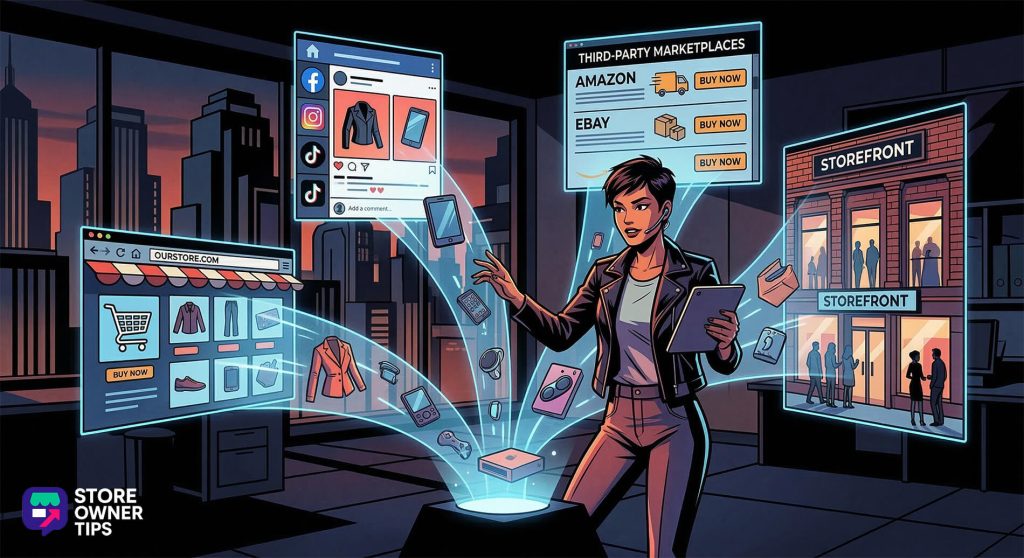
In the early days of online shopping, businesses focused only on their own websites. However, as people started spending more time on various apps and social media, it became expensive to drive all that traffic to just one site. Multichannel selling solved this by allowing brands to sell directly where customers were already hanging out.
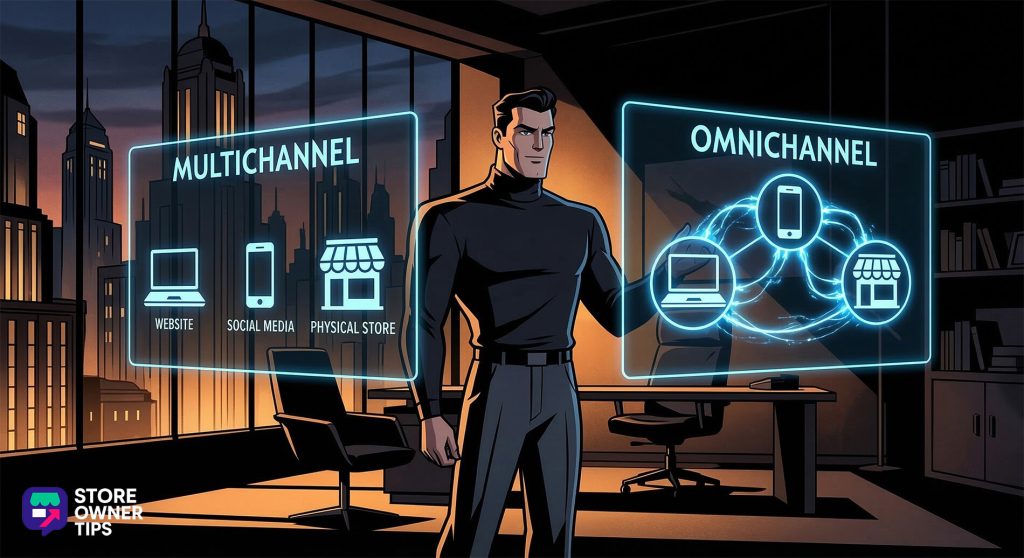
While they sound similar, there is a key difference:
Think of multichannel selling as the foundation. You must first list your products on different sites before you can move toward omnichannel selling, which links all those platforms into one seamless, connected experience.
Below are the stages of commerce evolution.
| Stage | Main Focus | How it Works |
| Single Channel | Your Own Website | You rely on search engines and ads to bring people directly to your site. |
| Multichannel | Web & Marketplaces | You list items on big sites (like Amazon) to find customers where they already shop. |
| Omnichannel | Unified System | All platforms are linked so the customer has a smooth, connected journey. |
| Social Commerce | Social Media | Customers buy products directly inside social media feeds without leaving the app. |
The data shows that selling on more than one platform is a smart financial move. Customers who shop across multiple sites have a 30% higher “lifetime value” (the total amount of money they spend with you over time) compared to those who only shop in one place. Because these shoppers see your brand more often, they’re more likely to trust you and spend more money.
Social commerce is also changing the game. Social media apps are no longer just for looking at photos; they have become popular places to buy things. Now, many people make purchases directly within an app while they’re scrolling through their feeds.
| Market Category | 2024 Value | 2025 Estimate | Future Projection |
| Global Multichannel Marketing | $181.8 Billion | $192.9 Billion | Over $315 Billion by 2034 |
| Multichannel Retail Software | $1.83 Billion | $1.95 Billion | Over $3.5 Billion by 2034 |
| U.S. Social Commerce Sales | $71.6 Billion | $87.0 Billion | Over $100 Billion by 2026 |
To reach the most customers, a successful strategy uses multiple sales channels. Using a mix of different platforms ensures that if one site is slow, another might be busy. Each one serves a different purpose, so it’s important to balance having your own site with using big marketplaces.
Your website is the heart of your business. Using platforms like WooCommerce, Shopify, or Wix gives you full control over your brand and customer data. This allows you to build loyal relationships and run your own marketing without following another company’s rules.
Marketplaces like Amazon, eBay, and Walmart already have millions of shoppers.
Social media is no longer just for likes; it’s for shopping. Platforms like TikTok Shop, Instagram, and Facebook allow customers to buy products without ever leaving the app. Therefore, they’re perfect for “discovery”—showing your items to people based on their specific hobbies and interests.

Comparison shopping sites like Google Shopping let customers compare prices and see if an item is in stock nearby. Showing up here is essential for catching shoppers who are looking for the best deal and are ready to purchase immediately.
| Platform Type | Best Examples (2026) | Main Goal |
| Your Website | WooCommerce, Shopify, Wix | Building your brand and keeping customer data. |
| Marketplaces | Amazon, eBay, Etsy | Reaching a massive audience quickly. |
| Social Media | TikTok, Instagram, Pinterest | Finding new customers through videos and trends. |
| Search/Comparison | Google Shopping, AI Answer Engines | Winning over shoppers who are comparing prices. |
To succeed at multichannel selling, you need a way to keep your information organized across many sites at once. The most important tool for this is your product feed. This is a master file that contains all your product details, like prices, descriptions, and images.
Updating this information by hand on every site would take way too much time. Instead, businesses use automated software to sync their master list with every sales channel. This makes sure customers never see an old price or try to buy something that is actually out of stock.
Every website (like Amazon or Google) has its own “language” for organizing products. To make sure your data fits their rules, you use two types of “mapping”:
You don’t have to sell everything everywhere. With advanced rules, you can choose exactly what to list. For example, you might decide to only show your best-selling items on sites where you have to pay for clicks, ensuring you don’t waste money on products that don’t sell well.
| Tool | What it Does | Why it Matters |
| Category Mapping | Matches your store’s categories to the platform’s system. | Helps customers find your items in the right “aisle” or search results. |
| Field Mapping | Lines up your data (like “Price”) with the platform’s specific rules. | Makes sure your items aren’t rejected by the site for having the wrong format. |
| Dynamic Rules | Automatically changes details based on certain conditions. | Lets you set different prices or titles for specific websites without manual work. |
| Auto-Updates | Refreshes your product info on a regular schedule. | Stops customers from trying to buy items that are actually out of stock. |
Keeping track of your stock for multichannel selling across five or more different sites is a big challenge. If you don’t track your items correctly, your business can quickly run into trouble.
Overselling happens when two different people buy your very last item on two different sites at the same time. This leads to canceled orders, unhappy customers, and—most importantly—marketplaces like Amazon might suspend your account if it happens too often.
To prevent this, businesses use:

An Order Management System (OMS) acts like a “control center.” Basically, it pulls all your sales from every website into one single dashboard. This allows your team to print labels and handle returns in the exact same way, no matter where the customer bought the item.
Three common ways to ship include:
| Fulfillment Model | Cost Structure | Scalability (Growth) | Control |
| Self-Fulfillment | Low starting costs, but takes a lot of your time. | Low. It’s hard to pack hundreds of boxes by yourself. | High. You control the packaging and the “unboxing” experience. |
| Marketplace Storage (e.g., FBA) | High fees for storage and referrals. | High. The marketplace handles the heavy lifting for you. | Low. You must follow the marketplace’s strict packaging rules. |
| 3rd Party Logistics (3PL) | You pay for every item stored and shipped. | High. You can grow quickly without needing a bigger warehouse. | Medium. You work with a partner, but can still set standards. |
| Dropshipping | No upfront costs for inventory. | Unlimited. You can list thousands of items without buying them first. | Very Low. You never see the product or the shipping quality. |
Transitioning to multichannel selling brings new risks as you expand your reach to every platform. To succeed, you must manage your business with strict discipline to avoid common pitfalls.
It’s difficult to keep your brand looking and sounding the same on a professional website and a casual social media app. If your product descriptions or photos look different on every site, the customer experience suffers because people get confused. A bad experience often leads to more returns and fewer repeat buyers.
Price parity means selling your product for the exact same price on every site. This is hard because every platform (like Amazon or eBay) charges different fees. However, some large marketplaces use algorithmic price surveillance systems. If they find you selling the same item for a lower price on your own website or a competitor’s site, they may algorithmically penalize your listing by suppressing your ‘Buy Box’ or ‘Featured Offer’ status, severely reducing your visibility.
| Challenge | The Main Cause | How to Fix It |
| Weak Brand Image | Different rules for every app. | Use one central folder for all your approved photos and logos. |
| Shrinking Profits | Hidden fees and high shipping costs. | Review your costs regularly and set prices based on each platform’s fees. |
| Slow Customer Support | Getting messages from five different sites. | Use “Help Desk” software that puts all your messages into one inbox. |
| Incorrect Stock Levels | Delays in updating your inventory. | Use real-time syncing and keep a “safety stock” of a few items. |
Don’t try to be everywhere all at once. Expanding too fast can overwhelm your business and hurt your customer service. Instead, take it one step at a time.
Today, multichannel selling is a must-have for online business success. Instead of hoping people find your specific website, you’re putting your products right where they’re already shopping.
When you list your items on different marketplaces and social media apps, you get to experience the true benefits of multichannel selling. These include:
Ready to get started? Try auditing your current product catalog on your WooCommerce store to see how easily you can prepare your data for new external marketplaces.
Copyright © StoreOwnerTips.com. All Rights Reserved.
