Weekly ecommerce tips, deals & news.
A free shipping threshold is a minimum spending target your customers must hit to get their order delivered for free. Instead of paying an out-of-pocket delivery fee, shoppers just need to add enough items to their cart to reach a specific dollar amount, like “$75 to unlock free shipping.” It’s a clever pricing strategy that encourages people to buy more while helping you cover rising delivery costs.
Running an online store today means balancing what your customers demand with what your wallet can actually handle. Giant retail companies have trained shoppers to expect highly subsidized delivery. Industry experts call this the “Amazon Effect.”
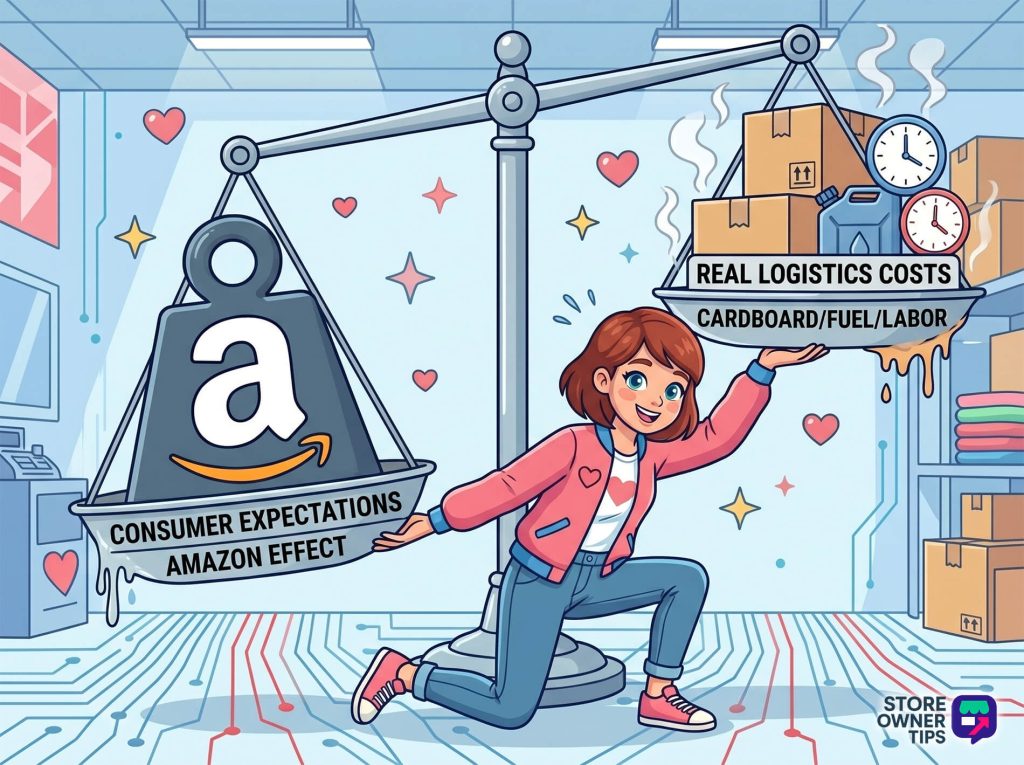
The numbers behind this shift are wild. A massive 75% of consumers now care more about getting free shipping than fast shipping. Even more surprising, 57% of shoppers would rather have free shipping than find the absolute lowest price for the product itself. Many shoppers feel that avoiding delivery fees is a basic consumer right. However, for an independent online store, eating these logistics costs is impossible. Cardboard packaging alone has jumped from $60 to $75 per ton due to supply chain hiccups, not to mention the rising costs of fuel and warehouse labor.
To bridge the gap between demanding customers and rising costs, smart store owners use the free shipping threshold.
This strategy works because human brains don’t treat the word “free” logically. We react to it emotionally. There are three big psychological rules at play here:
Behavioral economists, like Dan Ariely, found that people go crazy for things that cost exactly zero. If you drop a shipping fee to a tiny fraction of a dollar, people still hate it. But when it hits absolute zero, our brains stop seeing any risk.
On top of this, humans hate losing money more than we love gaining things. We see a physical product as a “gain,” but we see a shipping fee as a painful “loss” or penalty. Dodging a $7 shipping penalty feels much better to us than getting a $7 discount on a t-shirt.
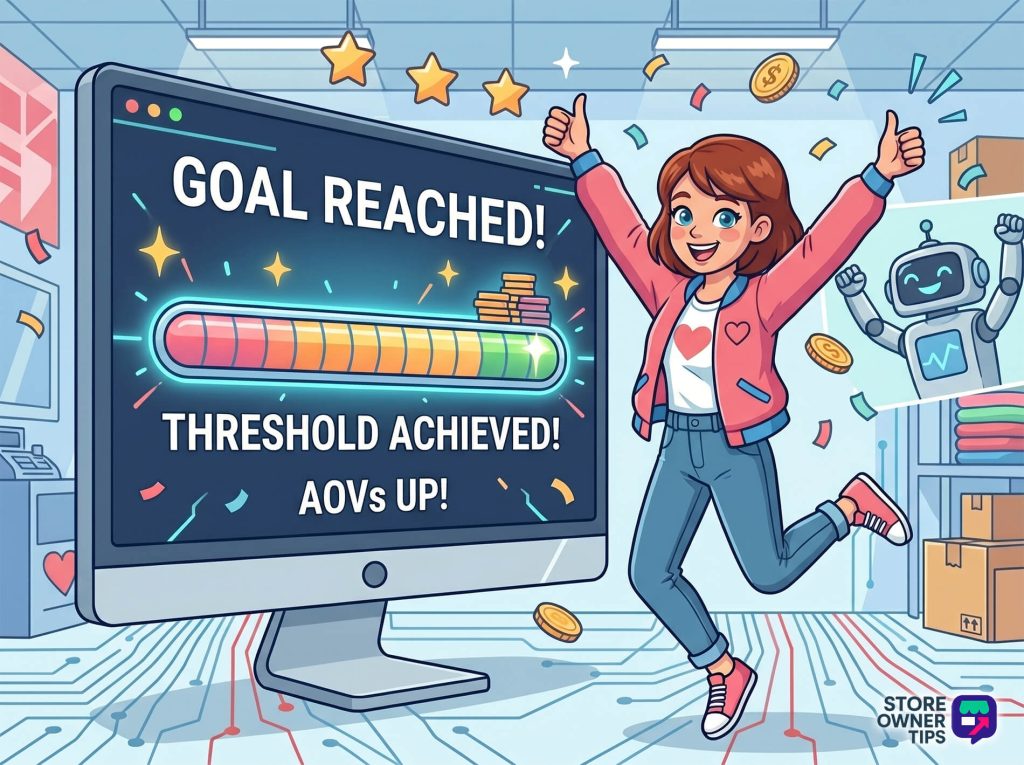
This is a fancy term for a simple idea: the closer we get to a finish line, the harder we run. If you use a dynamic cart progress bar that tells a shopper, “You’re only $15 away from Free Shipping!”, it turns shopping into a game.
Visual progress bars increase cart additions by 22% because people don’t want to “lose” the progress they just made.
When a shopper visits your website, they usually don’t have a strict budget in mind. However, if you show a massive banner that says “Free Shipping Over $65,” you plant a number in their head. That $65 becomes their mental “anchor.” Even if they only planned to spend $35, they’ll naturally aim closer to your $65 target just because you set that expectation early on.
All this psychology needs reliable software to run smoothly. Here’s how the two biggest platforms handle it:
Let’s walk through exactly how this works. Imagine a mid-sized online apparel brand. They’re trying to figure out how to offer free shipping without going bankrupt.
We need to look at three important numbers for this hypothetical store:
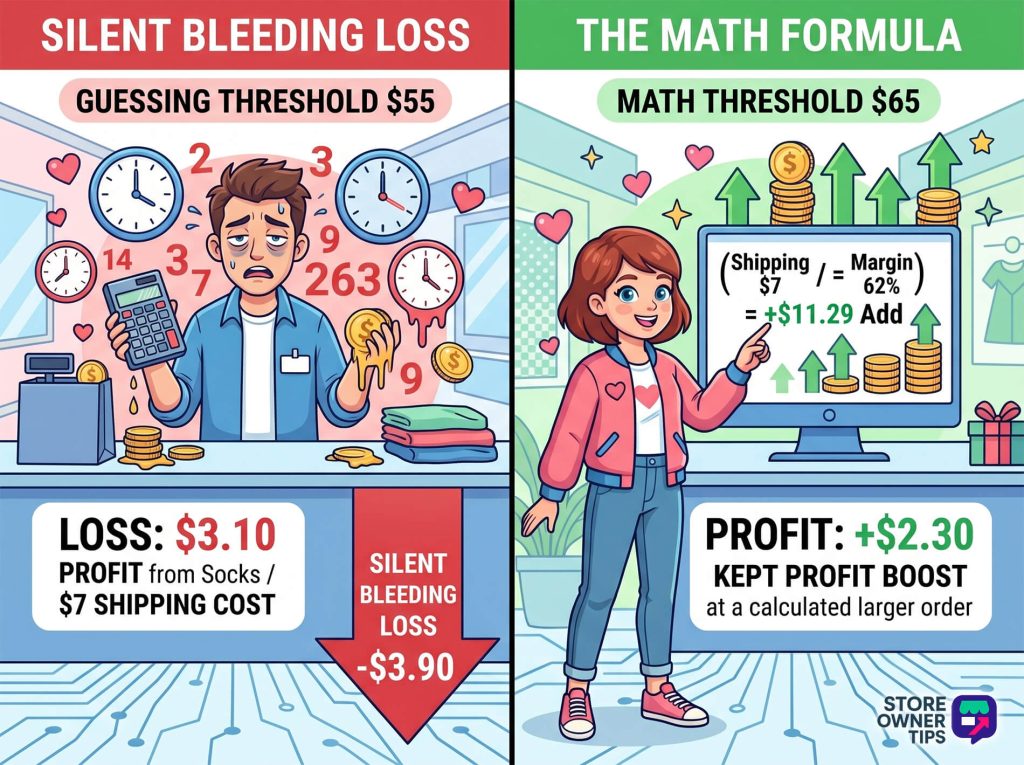
The store owner simply guesses and sets the threshold at $55. A customer who usually spends $50 will add a $5 pair of socks to reach the $55 goal. The store makes a 62% profit on those $5 socks, which is $3.10.
But wait! The store now has to pay the $7 shipping fee for the customer. The store only made $3.10 extra, but paid $7 out of pocket. They just lost $3.90 on that order. If they do this thousands of times, the business will collapse. This is called “silent bleeding.”
To safely absorb that $7 shipping cost, the store owner needs to force the customer to buy enough extra items to generate exactly $7 in pure profit.
By dividing the shipping cost ($7) by the profit margin (62%), we find the magic number: $11.29. The customer must spend an extra $11.29 to cover the shipping.
If we add that to the current $50 average order, the absolute break-even point is $61.29.
Knowing this, the store owner safely sets their free shipping threshold at $65.
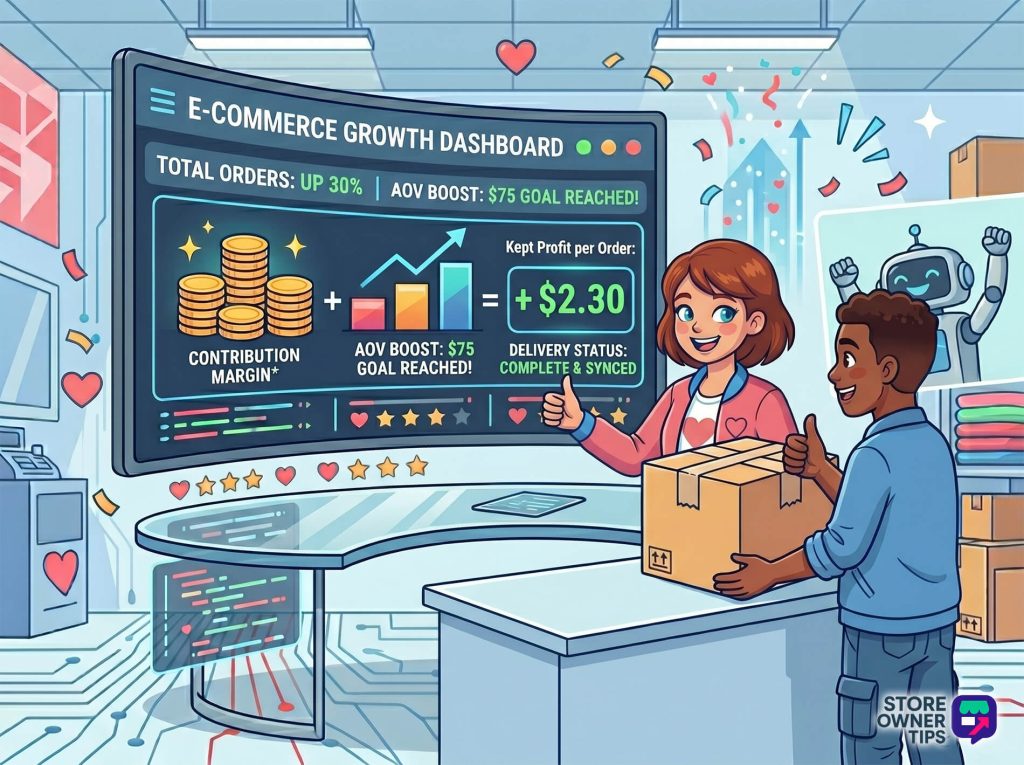
Now, a customer spends $15 extra to reach the goal. The store makes $9.30 in profit on that extra $15. The store uses $7 of that profit to pay the delivery driver, and keeps an extra $2.30 in pure profit for themselves.
The customer is thrilled to get “free” shipping, and the store makes more money. That is the power of a perfect threshold! It boosts your Contribution Margin—which is simply a business term for the actual money you have left over after paying for the product and the delivery box.
A static threshold (like a fixed $75 for everyone) is great, but it isn’t your only option. You need to know your alternatives.
A static threshold is simple but blind. It assumes shipping a box next door costs the same as shipping it across the country. A dynamic threshold changes based on real-time rules.
Flat-rate shipping ignores cart totals entirely. You charge a flat $9.95 fee whether the customer buys one t-shirt or ten t-shirts. This is wonderful for your accounting team because costs are totally predictable. However, it completely ruins the fun psychological game. There’s absolutely no incentive for the customer to add more items to their cart. This is usually only best for stores selling really heavy, bulky items.
Unconditional free shipping means every single order ships for free, no minimum required. About 20.4% of top retailers do this. It heavily boosts your overall conversion rate because there is zero friction. The massive downside? It destroys your profits on small orders. Unless you’re a massive giant that can absorb the losses, you have to secretly hide the shipping cost by raising the base price of every product on your site.
Like any powerful tool, setting a spending target has serious benefits and hidden dangers.
If your shipping costs are almost as high as the product itself, a standard threshold will fail. If you set the target high enough to be profitable, customers will abandon the site. The best fix is to raise the base price of the item slightly (e.g., to $39) to secretly absorb some of the shipping cost. Or, switch to a quantity target, like “Buy 3 or more for Free Shipping,” which guarantees you have enough volume to cover the heavy shipping fee.
To prevent a returning customer from getting angry that they’re suddenly $2 short of a new threshold, use a smart upsell app. Place high-margin, cheap items (like a $1 decal or a $4 accessory) right in the checkout flow. This lets the customer easily grab a cheap item to cross the finish line, turning their frustration into an easy victory.
This happens because of a psychological rule called loss aversion. Humans view acquiring a physical product as a positive “gain,” but we view a shipping fee as a totally arbitrary, painful “loss.” Our brains process financial penalties with much more emotional intensity than we process the base price of a physical item.
If your target is failing, you will see a massive spike in cart abandonment right at the final shipping step. If you set your free shipping threshold way too high (like $100 when your average order is only $45), shoppers will view it as totally unreachable and give up. A good rule of thumb is to test thresholds that are exactly 10% to 30% above your current Average Order Value.
Implementing a mathematically sound free shipping threshold transforms a universally hated delivery fee into a powerful, gamified marketing tool. When you carefully balance human psychology with strict profit margins, you can permanently increase your average order size while building long-term goodwill with your customers.
Copyright © StoreOwnerTips.com. All Rights Reserved.
