Weekly ecommerce tips, deals & news.
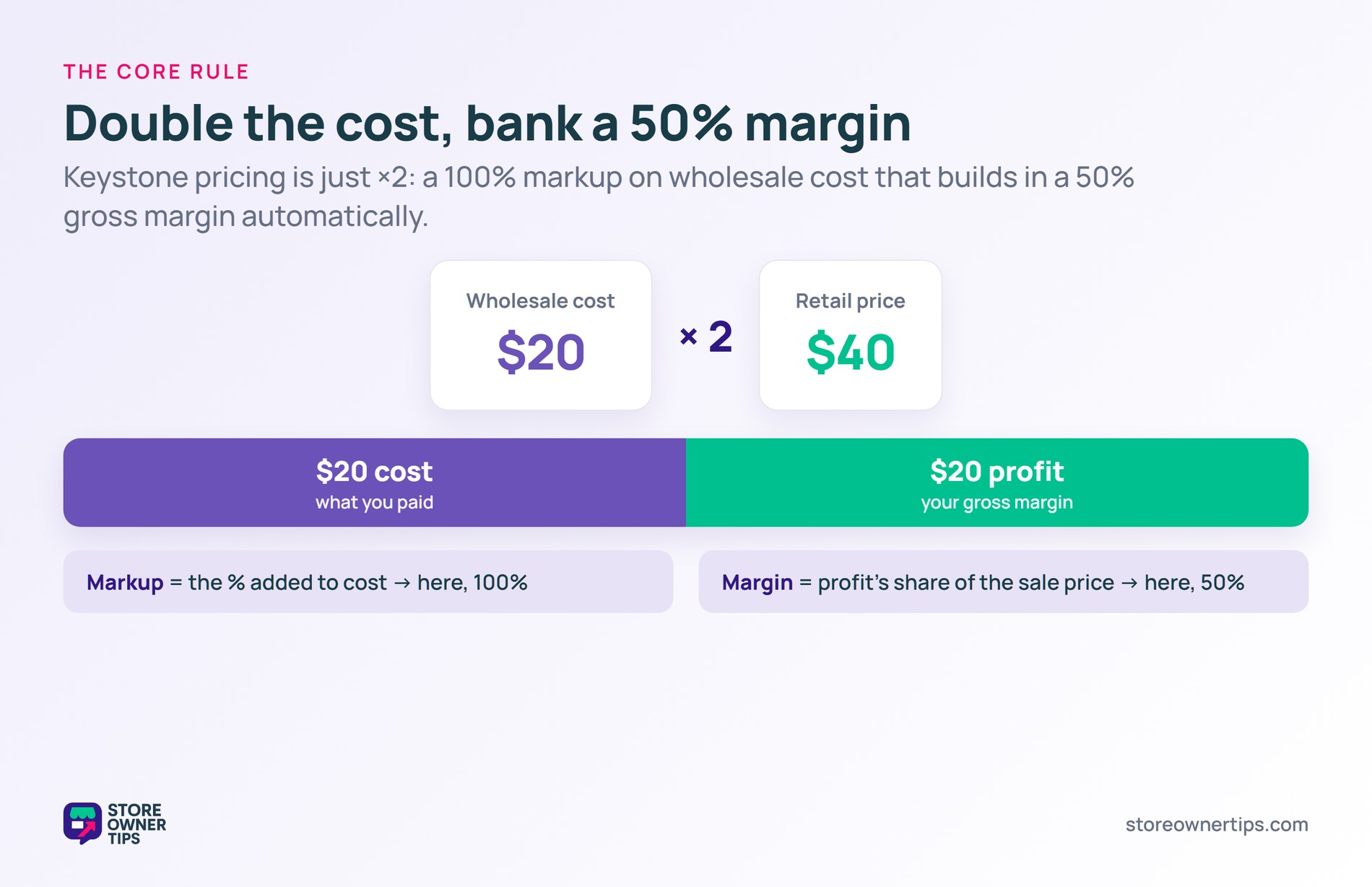
Keystone pricing is a simple rule where a store owner sets the retail price of a product by exactly doubling its wholesale cost. In retail math, this means applying a 100% markup to the cost of the item. If you buy a shirt from a supplier for $20, you sell it to your customer for $40. This strategy automatically builds in a 50% gross profit margin, giving e-commerce store owners a built-in safety net to cover their hidden business expenses.
To truly understand how this works, we have to look at the history, the math, and the underlying technology of modern online stores.
The strategy actually started back in the late 19th century in the American jewelry trade. A popular magazine for jewelers, called The Keystone, told shop owners to simply double their costs. This kept their wholesale catalogs a secret from customers and guaranteed they made enough money to keep the lights on without doing tedious accounting.
Today, it remains one of the most popular pricing strategies for apparel, sporting goods, and specialty consumer items. But to use it correctly, you must understand the difference between two easily confused terms: markup and margin.
Think of markup as the fuel you pump into your car, and margin as the actual distance you get to drive. They are related, but they measure entirely different things. If you buy an item for $50 and use the keystone method, you add a 100% markup (another $50). The final price is $100. Because your $50 profit is exactly half of the $100 total revenue, your gross profit margin is 50%.
When store owners want to calculate this using specialized software, they rely on a specific retail algorithm:
$$Retail\ Price = \left( \frac{Cost\ of\ Item}{100 – Margin\ Percentage} \right) \times 100$$
In modern e-commerce, you aren’t doing this math with a calculator. Huge stores with thousands of products (known as SKUs) use database rules to automate the process.
If you use Shopify, the platform has a basic cost_price field. When you import a giant list of products from your supplier, you can set a global rule. The software simply multiplies that cost_price by 2.0 and displays the new price to your customers. If you use WooCommerce, it’s slightly different. WooCommerce stores data in a post_meta table, so store owners usually install plugins like “WooCommerce Dynamic Pricing” to handle the math automatically.
Think of these automated rules like a smart thermostat for your house. You set your ideal temperature once, and the system automatically turns on the AC when it gets hot. With automated keystone pricing, if your manufacturer suddenly raises the cost of their materials, your store immediately raises the retail price. Your 50% margin is perfectly protected without you lifting a finger.
Why do we need that 50% margin? It’s a “survival buffer.” Beginners often forget about operating expenses (OPEX). If you have to pay 15% for marketing, 3% for credit card fees,
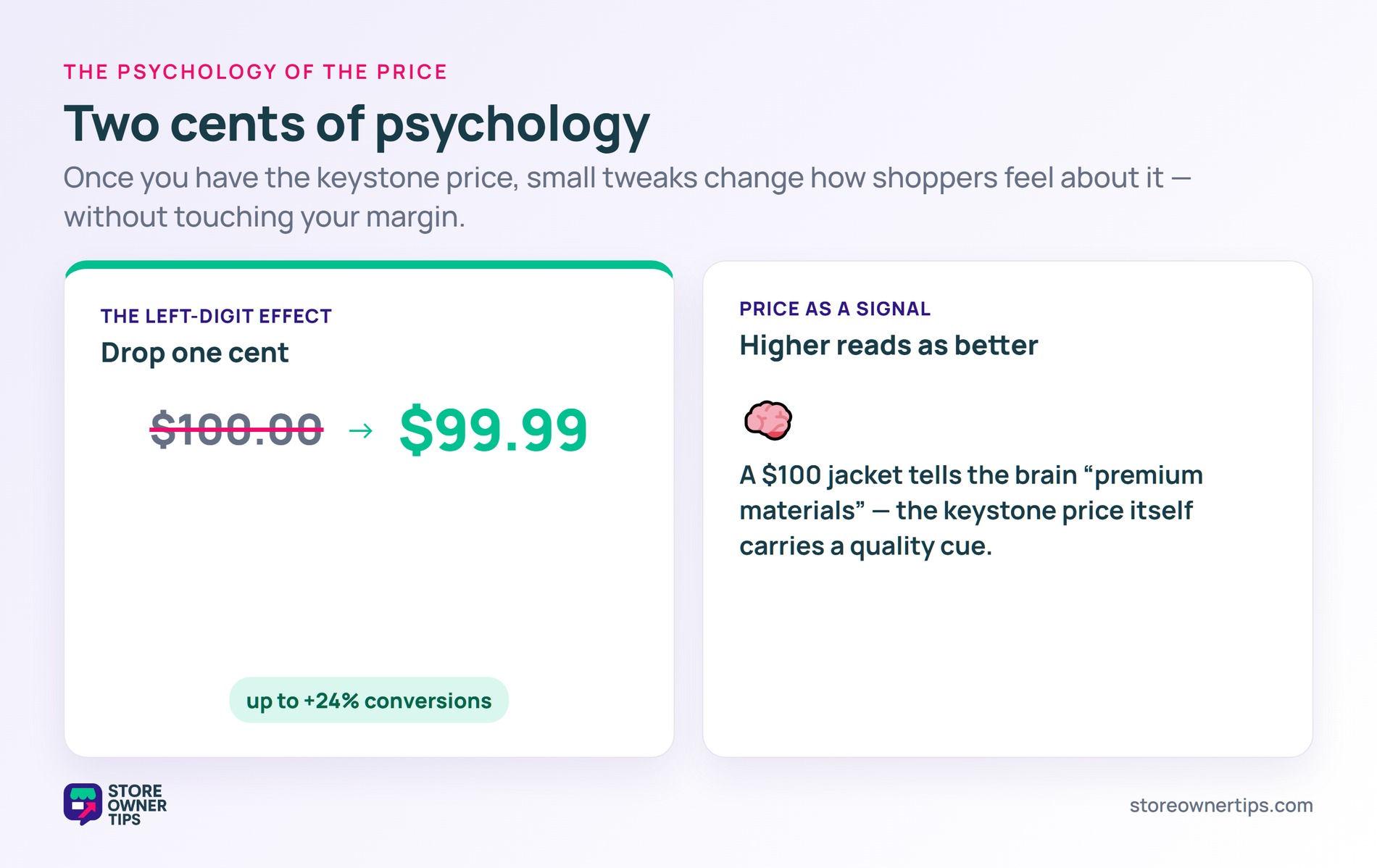
Psychologically, higher keystone prices also tell the customer that your item is high quality. If a jacket costs $100, the human brain assumes it uses premium materials. However, human brains also have a glitch called the “left-digit effect.” Because we read from left to right, we process $99.99 as significantly cheaper than $100.00. Elite store owners take their raw keystone price and change the ending to .99.
Imagine a mid-sized, hypothetical apparel brand called “River Thread Co.” that sells casual jackets.
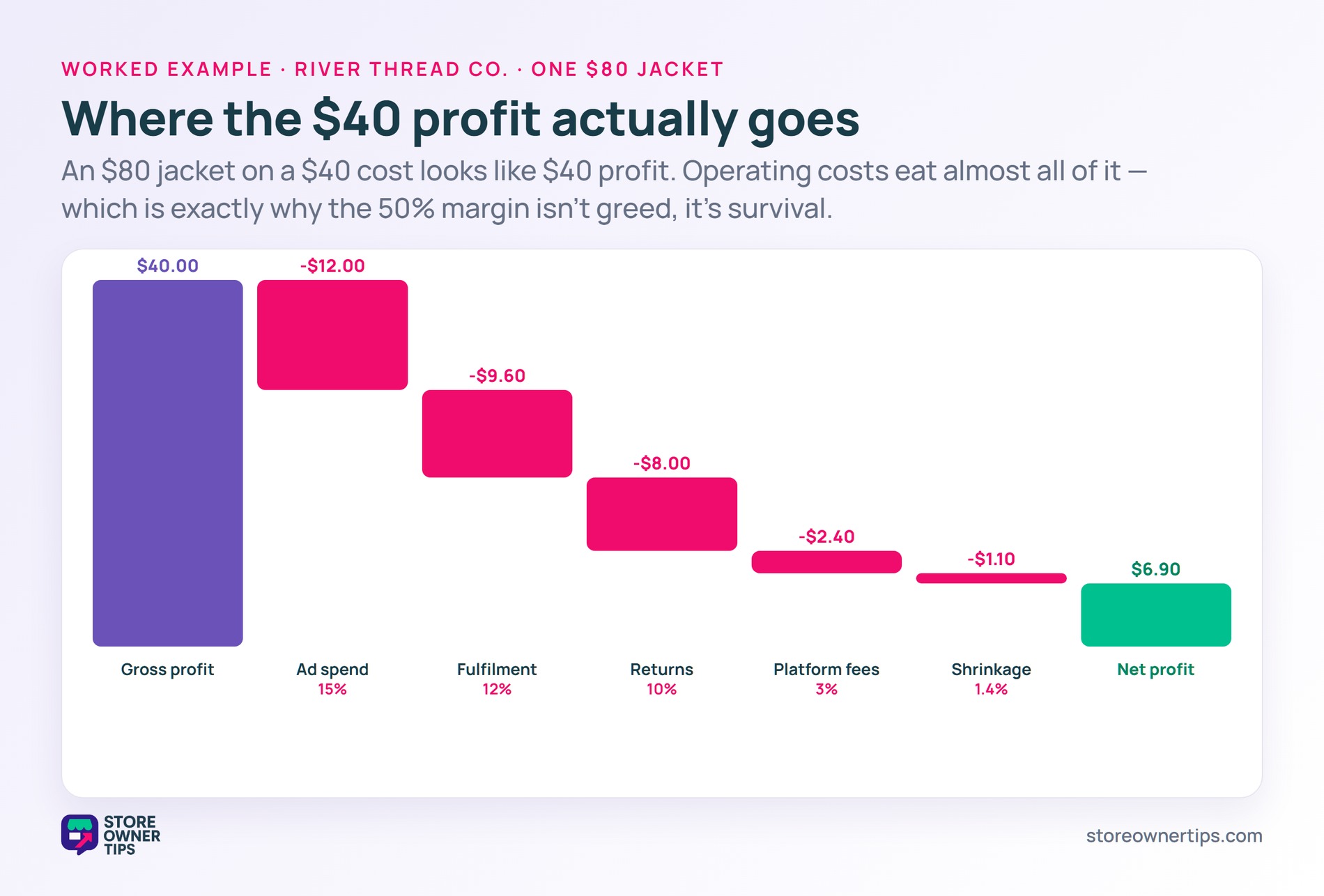
River Thread buys a new batch of jackets from their supplier for $40 each. Using the keystone method, they double the price and list the jackets on their website for $80.
Why do they need to double it? According to business data, the average gross margin in the apparel industry is 56.88%. Clothing stores need this massive margin because fashion is heavily based on trends. If a style goes out of fashion, River Thread will have to put it on a clearance rack. Every year, U.S. retailers lose $300 billion in revenue simply by marking down dead inventory. The high keystone margin protects River Thread when they eventually have to put those jackets on sale for 40% off.
Let’s look at the math on a single $80 jacket sale to see how fast that $40 profit vanishes:
Out of the original $40 profit, River Thread has spent $33.10 just to keep the business running. They only take home $6.90 in true net profit to grow the company. This shows exactly why the 50% margin isn’t greedy—it’s essential for survival.
If River Thread was a hardware store selling tools instead of an apparel brand, their strategy would change. The average gross margin for general retail is much lower, sitting at 33.18%. Tools don’t go out of style, so hardware stores don’t face massive markdown losses.
Finally, River Thread’s owner knows that a flat $80.00 feels too expensive. They apply the left-digit effect and change the price to $79.99. This tiny adjustment—known as odd-ending pricing—gives them an 24% increase in sales compared to the flat $80 price tag.
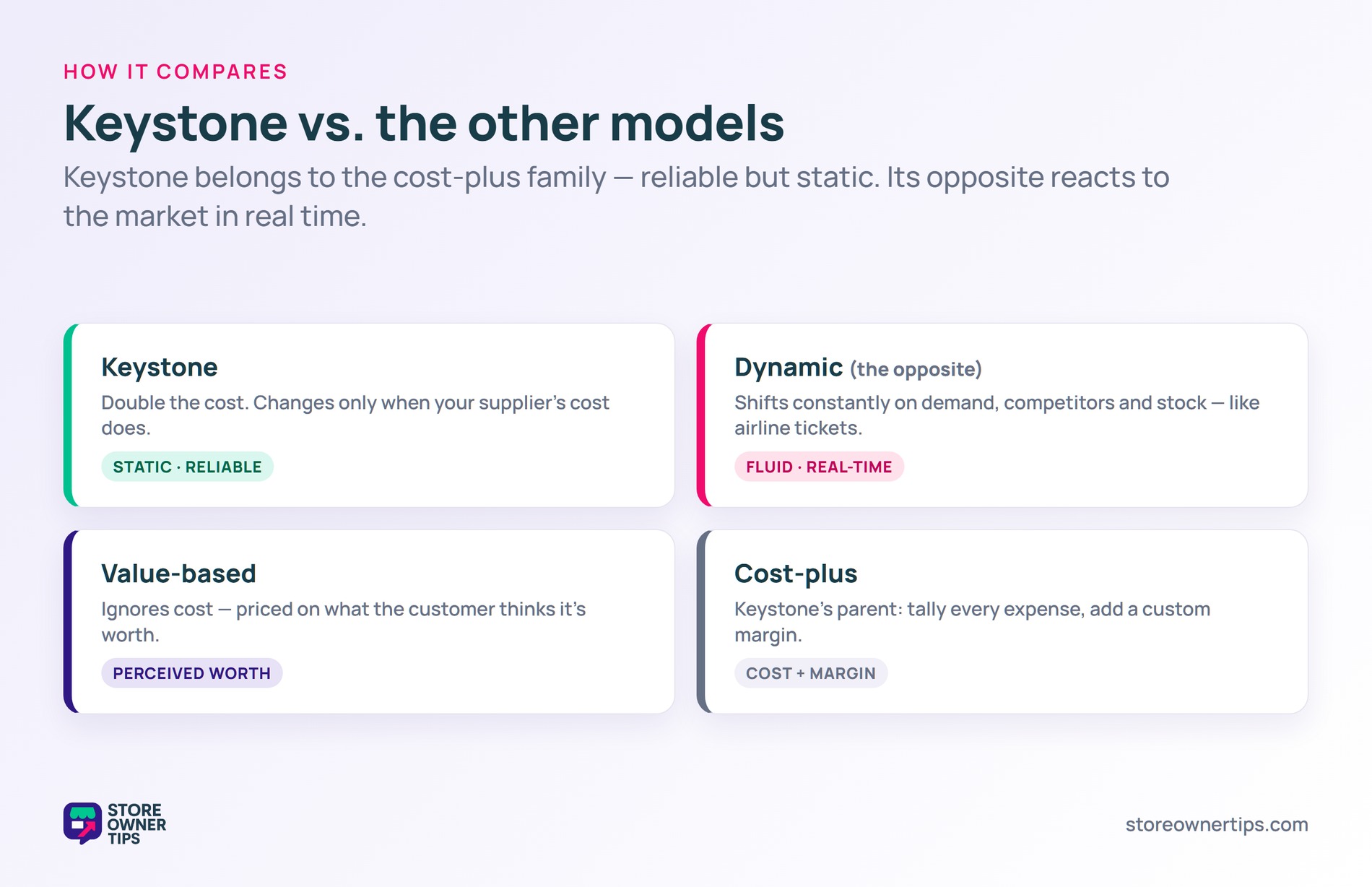
Keystone pricing doesn’t exist in a bubble. As software has improved, new pricing frameworks have emerged.
While it is an incredible tool for beginners, this strategy has distinct strengths and weaknesses.
No, they represent entirely distinct financial concepts, and conflating them causes massive accounting errors. Markup refers to the percentage added to the wholesale cost. Margin refers to the percentage of the final sale price that constitutes profit. If an item costs $10, and a 100% markup is applied, the item is sold for $20. The profit is $10. Because $10 is exactly half of the $20 final sale price, the gross profit margin is 50%. A 100% profit margin is mathematically impossible in retail unless the cost of goods sold is zero.
Industry standard dictates utilizing keystone pricing in reverse to structure wholesale B2B tiers. If a brand sells a product DTC for $50 (Retail Price), a prospective wholesale buyer (like an independent boutique) expects a 50% discount to achieve their own keystone margin on resale. Therefore, the wholesale price offered must be $25. To remain profitable, the original manufacturer must ensure their actual production cost does not exceed $12.50. This creates a supply chain cascade where the manufacturer makes a 100% markup selling to the wholesaler, and the wholesaler makes a 100% markup selling to the end consumer.
Beginners frequently underestimate the vast network of “hidden costs” required to operate a viable e-commerce business. Stores utilize keystone pricing because the wholesale cost of the physical item is often only a fraction of the total operational burden. The 50% margin generated acts as a financial umbrella that must cover platform subscription fees, payment gateway percentages (usually 2.9% + $0.30), digital marketing acquisition costs, warehouse storage, shipping materials, commercial insurance, and employee payroll. Without doubling the base cost, businesses lack the free cash flow required to maintain solvency.
Keystone pricing isn’t just an arbitrary mathematical formula; it’s a fundamental survival mechanism that provides the financial breathing room your store needs to cover hidden operating costs. By using this strategy as a sturdy foundation and combining it with smart psychological tweaks like odd-ending prices, you can confidently scale your product catalog and ensure your brand’s long-term profitability.
Copyright © StoreOwnerTips.com. All Rights Reserved.
