Weekly ecommerce tips, deals & news.
A loss leader pricing strategy, or simply loss leader strategy, is when a store intentionally sells a product for less than it costs to make. It’s not an accidental mispricing; it’s a carefully budgeted marketing expense designed to attract new shoppers. The goal is to lose money on that first item, but make a long-term profit by selling those shoppers higher-margin products and keeping them loyal over time.
To truly grasp how a loss leader works, you have to stop looking at it like a traditional accountant. Normally, selling a product for less than its manufacturing, marketing, and shipping costs seems like a terrible idea. But a loss leader is actually a customer acquisition tool.
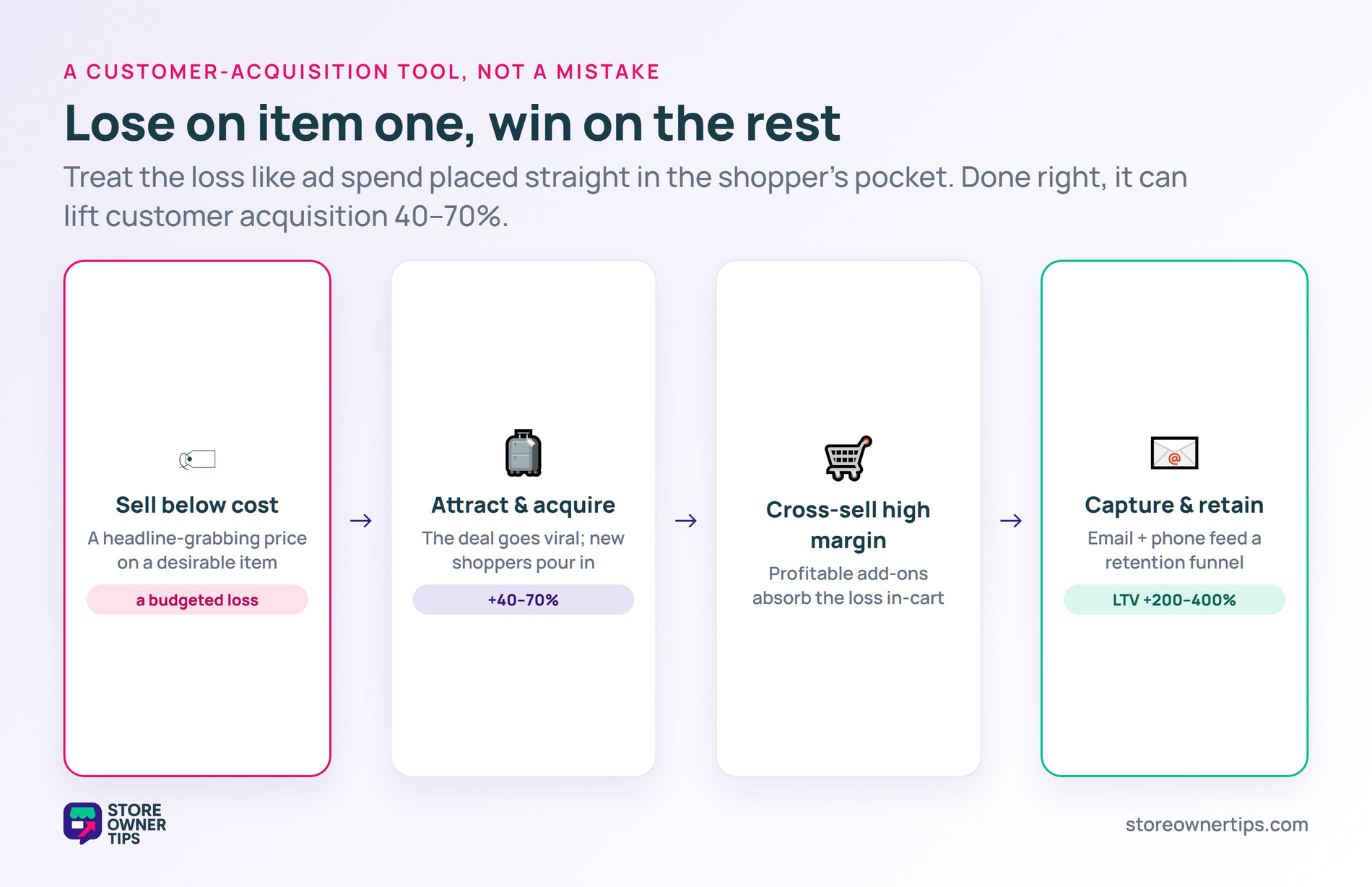
Think of the financial loss on that specific item exactly like paying for a click on a search engine or a view on a social media app. You are simply taking your advertising budget and putting it directly into the customer’s pocket via a product subsidy. Research from the Wharton School of Business shows that when you do this correctly, you can boost your customer acquisition rates by 40% to 70%.
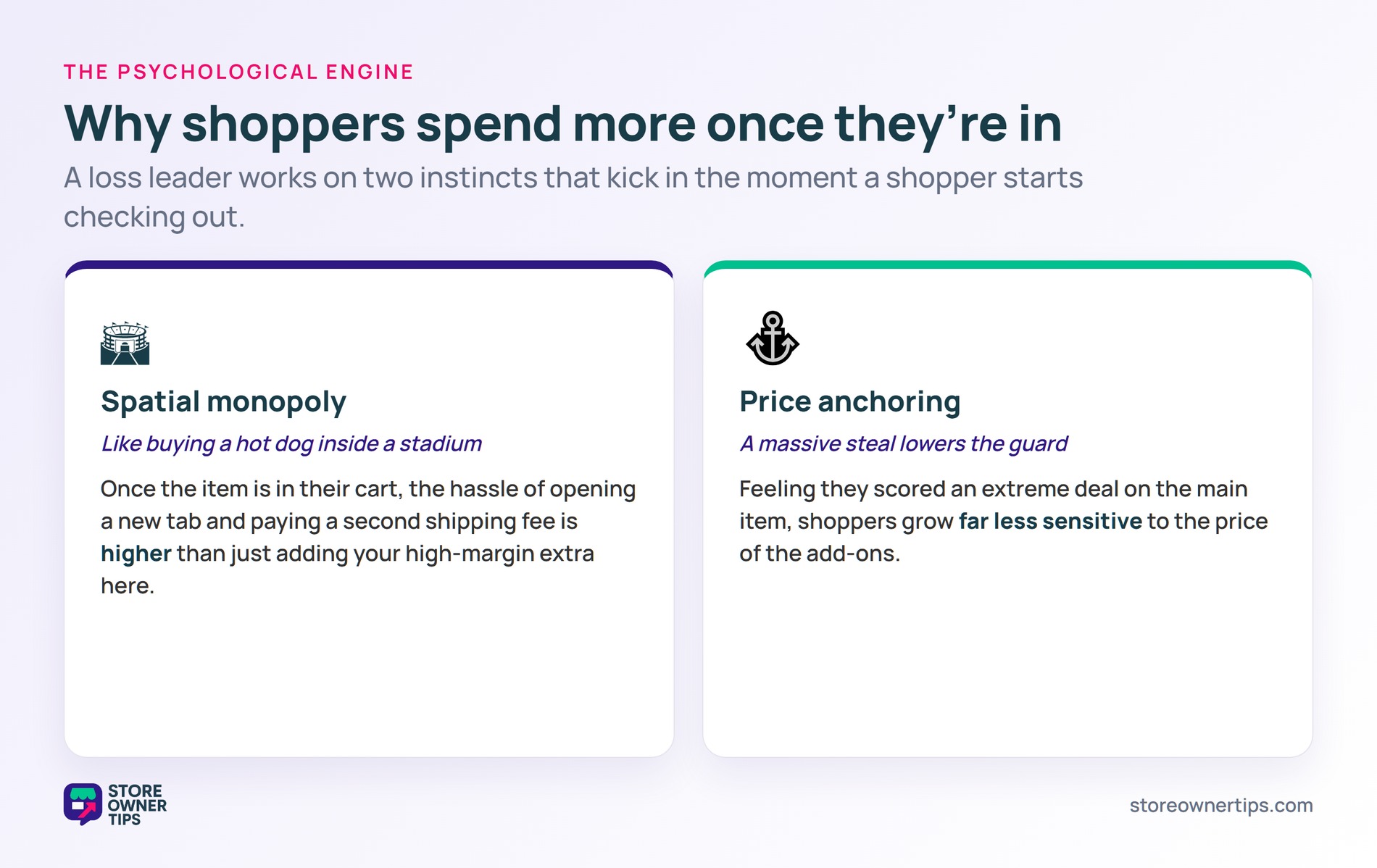
The success of a loss leader strategy relies heavily on behavioral psychology. The biggest factor is the Spatial Monopoly.
Analogy: Think of a Spatial Monopoly like being inside a massive sports stadium. Once you pay for your ticket, walk inside, and find your seat, the stadium has a monopoly on your wallet. You will gladly pay for an overpriced hot dog because the effort of leaving the stadium, driving to a grocery store, and coming back is simply too high.
In e-commerce, once a consumer spends the time to navigate to your store, add the heavily discounted loss leader to their cart, and start the checkout process, you have a digital spatial monopoly. The hassle of opening a new tab, searching for an accessory on another site, and paying a second shipping fee is much higher than simply adding your high-margin accessory to their current cart.
This also creates Price Anchoring. When you offer an extreme discount on a core item, it anchors a feeling of “extreme value” in the shopper’s brain. Because they feel they are getting such a massive steal on the main item, their defenses drop. They become much less sensitive to the price of the add-on items in their cart.
Translating the psychology of a loss leader strategy into a real store requires serious technical safeguards. If a customer manages to combine your loss leader with a 10% welcome discount and a free shipping code, your strategic loss becomes a financial disaster.
If you use Shopify, you must use their Checkout Extensibility architecture. The core tool here is the Discounts Allocator API (specifically the purchase.discounts-allocator.run function).
Analogy: Think of the Discounts Allocator API as a strict, heavily armed bouncer at a nightclub. The bouncer checks every single coupon code at the door. Even if you have 25 different promotions running, the bouncer ensures that absolutely no extra discounts are applied to your loss leader, protecting your profit margins.
Store owners also use “Buy X Get Y” (BXGY) dynamic bundling. Using Shopify Met
If you use WooCommerce, developers rely on Action and Filter Hooks like woocommerce_get_price. These hooks act like digital tripwires. When a shopper adds the cheap SKU to their cart, the tripwire triggers a custom pop-up (using Cart Notice extensions) that says, “Add our premium cleaning kit to qualify for this special pricing!”
Imagine a direct-to-consumer brand that sells premium coffee equipment. They are struggling with the global e-commerce standard conversion rate, which hovers right around 1.4%. Even worse, their average cart abandonment rate is 70.22%. Seven out of every ten shoppers are bailing out before making a purchase. Because their espresso machines are so expensive, paying for search ads to get new customers is draining their cash.
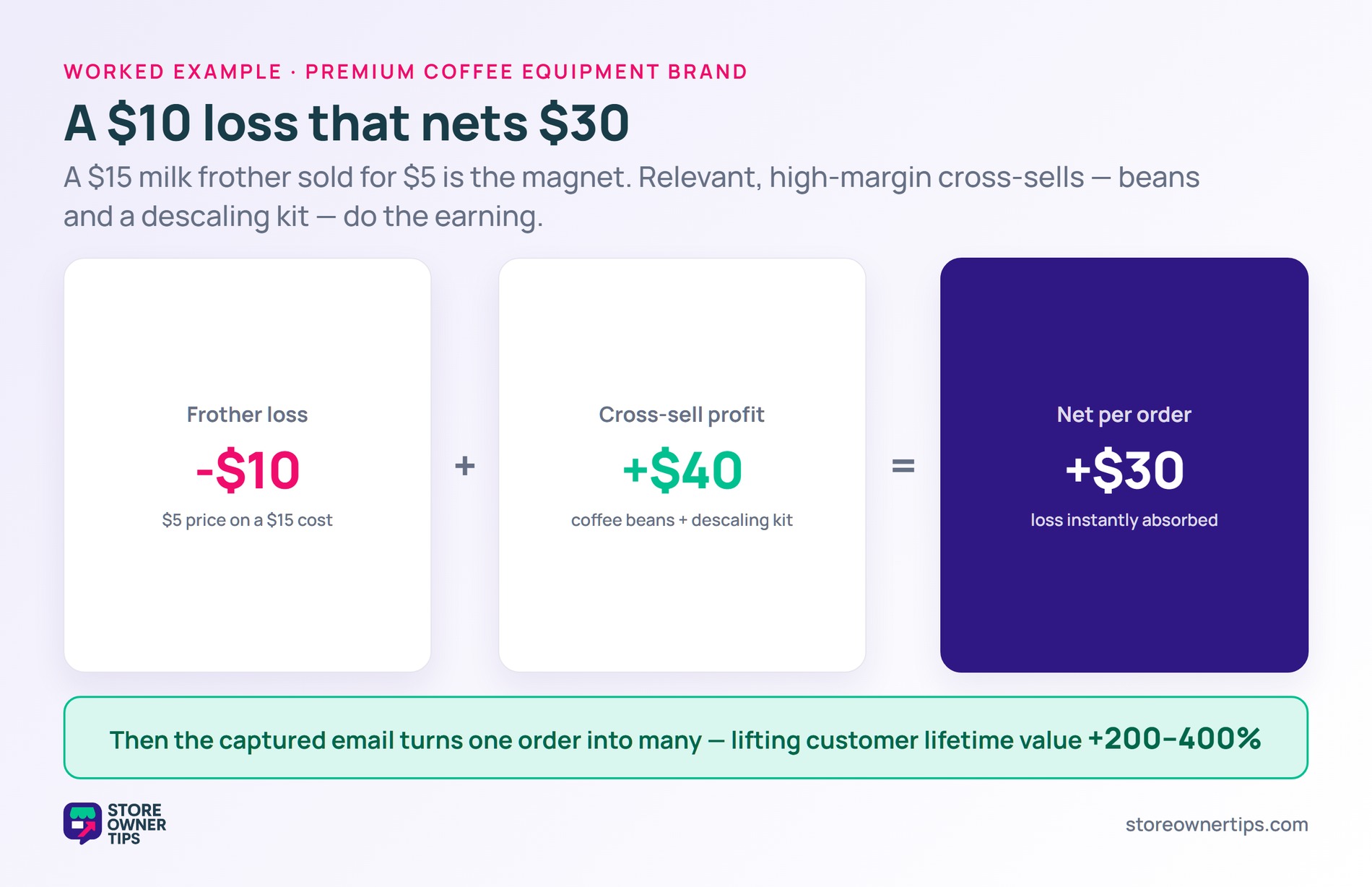
To break out of this slump, they launch a meticulously planned loss leader pricing strategy centered around a highly desirable product.. They design a beautiful, premium milk frother. It costs the brand $15 to manufacture, package, and ship. They list it on their store for an aggressively low, headline-grabbing price of $5.
The brand models a strict $10 financial loss on every frother sold.
As Wharton’s research predicted, this incredible deal acts as a viral magnet. Unpaid word-of-mouth marketing and organic traffic skyrocket, boosting their customer acquisition rate by 40% to 70%.
But how do they survive losing $10 an order? They rely entirely on elevating their Average Order Value (AOV) via smart cross-selling. The brand knows that 52% of desktop sites fail because they show irrelevant, confusing cross-sells in the cart. So, they program their checkout to only show highly relevant, high-margin items: a proprietary coffee bean subscription and an aesthetic descaling kit.
Before this strategy, their mobile shoppers had an AOV of $85 to $98, while their desktop shoppers sat at an AOV of $155.75. By forcing shoppers to add the high-margin coffee beans to unlock the $5 frother, they successfully push their mobile order values closer to that profitable desktop number.
The $10 loss on the frother is instantly absorbed by the $40 net profit they make on the beans and cleaning kit. (This strategy scales up, too. If this were a B2B e-commerce store with massive AOVs of $500 to $1,000+, a single loss leader could easily drive hundreds of dollars in cross-sell profits).
Most importantly, the coffee brand captures the shopper’s email address and phone number during checkout. They move the shopper into a retention funnel, sending them automated emails to restock their coffee beans every month. By capturing this data, they increase the customer’s lifetime value (LTV) by 200% to 400%, transforming a one-time $10 marketing loss into hundreds of dollars over the next few years.
It’s very common to confuse a loss leader pricing strategy with penetration pricing. While both use low prices to get attention, their goals and lifespans are completely different.
Like any aggressive business tactic, executing a loss leader strategy comes with massive upside and terrifying risks.
Yes, there’s a distinct and dangerous risk of permanently devaluing your brand, especially if the deeply discounted item at the center of your loss leader strategy is your core flagship product. It heavily anchors the consumer’s perception of its worth. Experienced strategists advise keeping your main product at a premium price and absorbing higher advertising costs instead of cheapening your brand’s core identity.
No. While highly commoditized spaces (like sports nutrition or basic electronics) have incredibly low prices, they are rarely true loss leaders. Most of these direct-to-consumer brands do not have enough high-margin secondary products to offset a real loss. Instead, they survive on razor-thin, non-zero margins sustained by massive scale and manufacturing efficiency.
Only if you can survive the cash flow impact. Founders often find that big-box wholesale ties up all their manufacturing cash, leaving no room to grow their direct-to-consumer channels. If wholesale is cannibalizing your margins without boosting your brand awareness, it is a dangerous “cash trap.” You should rigorously analyze your SKUs, kill lagging inventory, and renegotiate for net-90 payment terms with your manufacturers.
The biggest mistake is failing to set up technical safeguards like minimum cart thresholds or mandatory bundles. If you just offer a cheap item without forcing or heavily encouraging a cross-sell, ‘cherry-pickers’ will buy the cheap item and leave, rapidly draining your operating capital.
A loss leader pricing strategy isn’t just a heavy discount; it’s a meticulously engineered customer acquisition mechanism designed to trade short-term unit profitability for long-term customer equity. When paired with strict technical safeguards and smart cross-selling, it remains one of the most potent ways to bypass rising ad costs and scale an e-commerce brand.
Copyright © StoreOwnerTips.com. All Rights Reserved.
