Weekly ecommerce tips, deals & news.
Social proof is a psychology principle: people copy what others do when they aren’t sure what to choose. In e-commerce, social proof shows up as reviews, ratings, testimonials, trust badges, and visible customer counts. Shoppers use these signals as shortcuts when deciding to buy. The effect is one of the strongest, cheapest conversion boosters available. Done right, social proof turns hesitation into action without dropping prices or buying more ads.
Social proof isn’t a single tactic. It’s a category of signals. They all answer the same shopper question: have other people done this before, and did it work out? On a store page, that question gets answered in milliseconds.
Robert Cialdini coined the term in his 1984 book Influence: Science and Practice. He framed it as one of six principles of persuasion. The idea: when people don’t know what to do, they copy what others around them are doing.
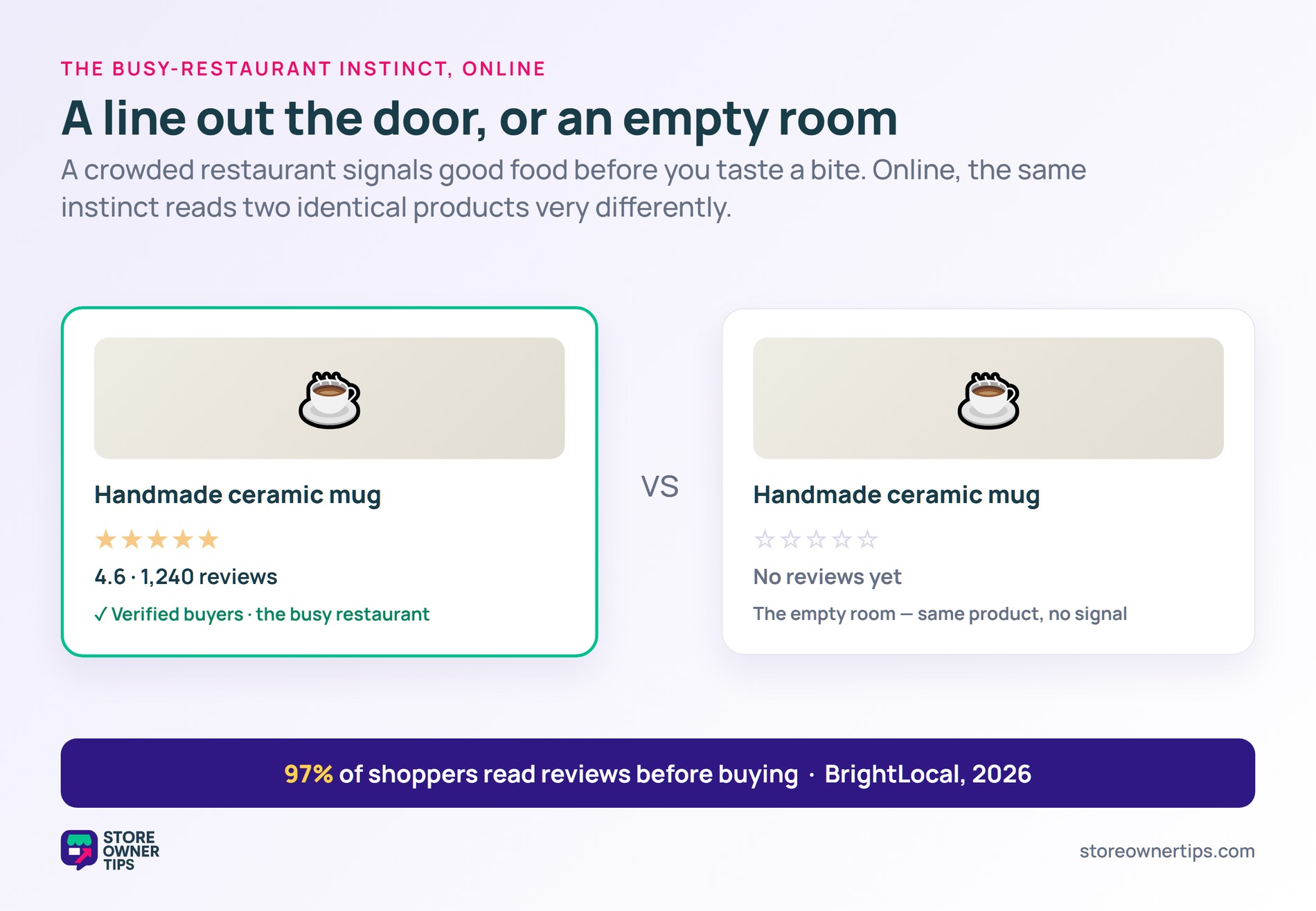
The classic example involves a busy restaurant. A line outside one place and an empty room next door tell you which has better food. That’s true even if you’ve tried neither. The same logic plays out across every shopping decision online.
Move that same instinct online and the busy restaurant becomes a product page with 200 reviews. The empty restaurant becomes a product page with none.
Most stores use a mix of these formats together:
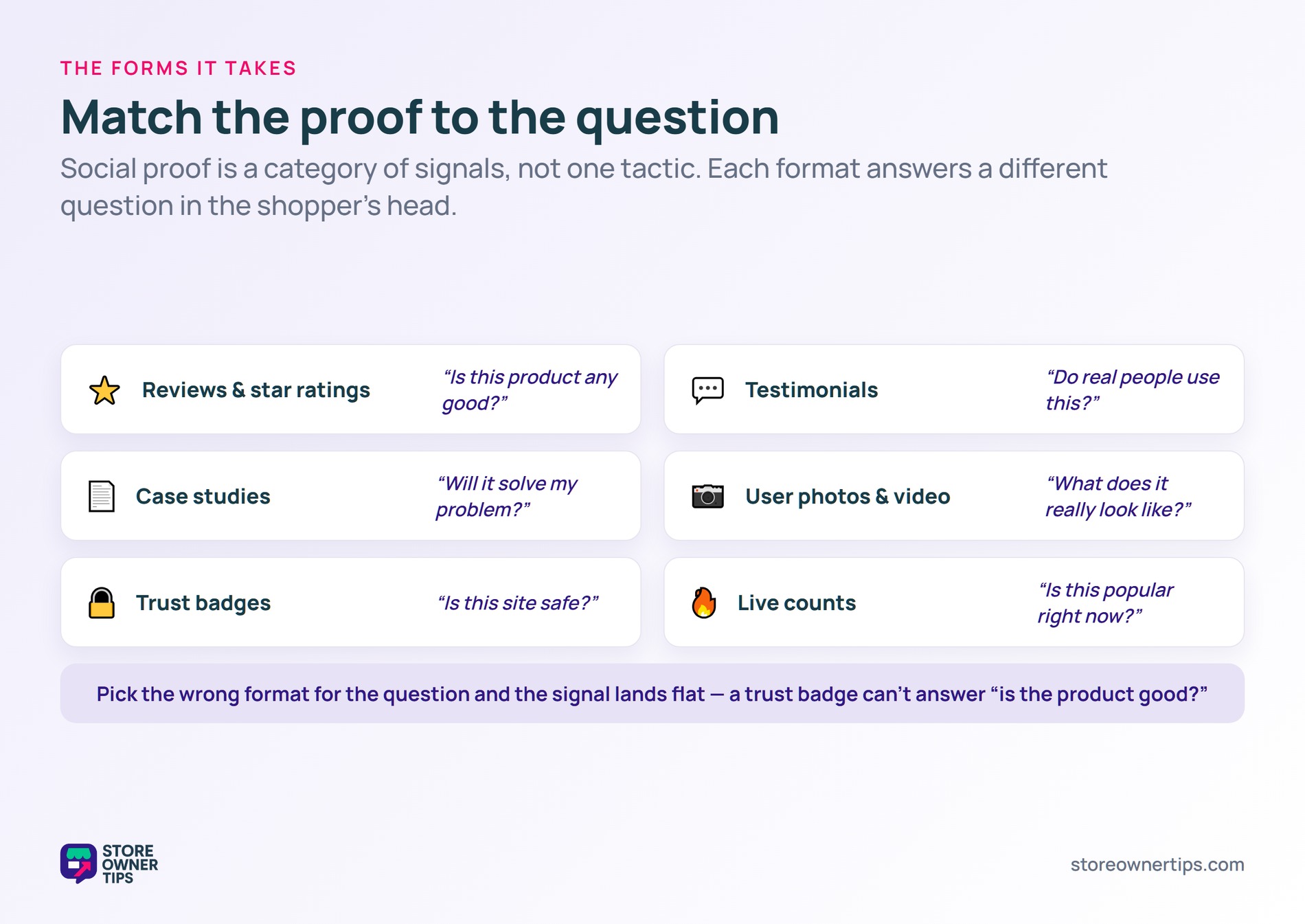
Each format hits a different shopper question. Reviews answer “is this product any good?” Testimonials answer “do real people use this?” Trust badges answer “is this site safe?”
Live counts answer “is this popular right now?” Pick the wrong format for the wrong question and the signal lands flat. To make this proof work, you need to match it to the shopper’s intent; for example, slapping a trust badge on a sparse product page doesn’t help if the page has zero reviews. The shopper’s real question is about the product, not the site.
Social proof works because it short-circuits the work of evaluating a stranger’s product. Reading dozens of reviews is slow. Trusting that “other shoppers liked this” is fast. In short, the brain treats a stranger’s review as a low-cost shortcut to a decision that would otherwise take research, relying on the success stories of past buyers to guide the way.
Nielsen’s global trust survey found that 88% of people trust re
BrightLocal’s 2026 survey shows the same pattern. 97% of consumers still lean on reviews when deciding what to buy. That’s true even though they know reviews can be gamed.
Walk through a fully hypothetical scenario showing how a small store builds social proof from scratch. The numbers below come from real industry benchmarks, not the store itself.
Imagine a mid-sized boutique selling handmade ceramic mugs on WooCommerce. Call it ClayCraft. The store does 20,000 monthly sessions and a 2% conversion rate. Average order value is $45.
That works out to 400 monthly orders and $18,000 in revenue. The team notices most product pages have zero or one review. The shop has been running long enough that several hundred real customers exist. Few have been asked to leave a review.
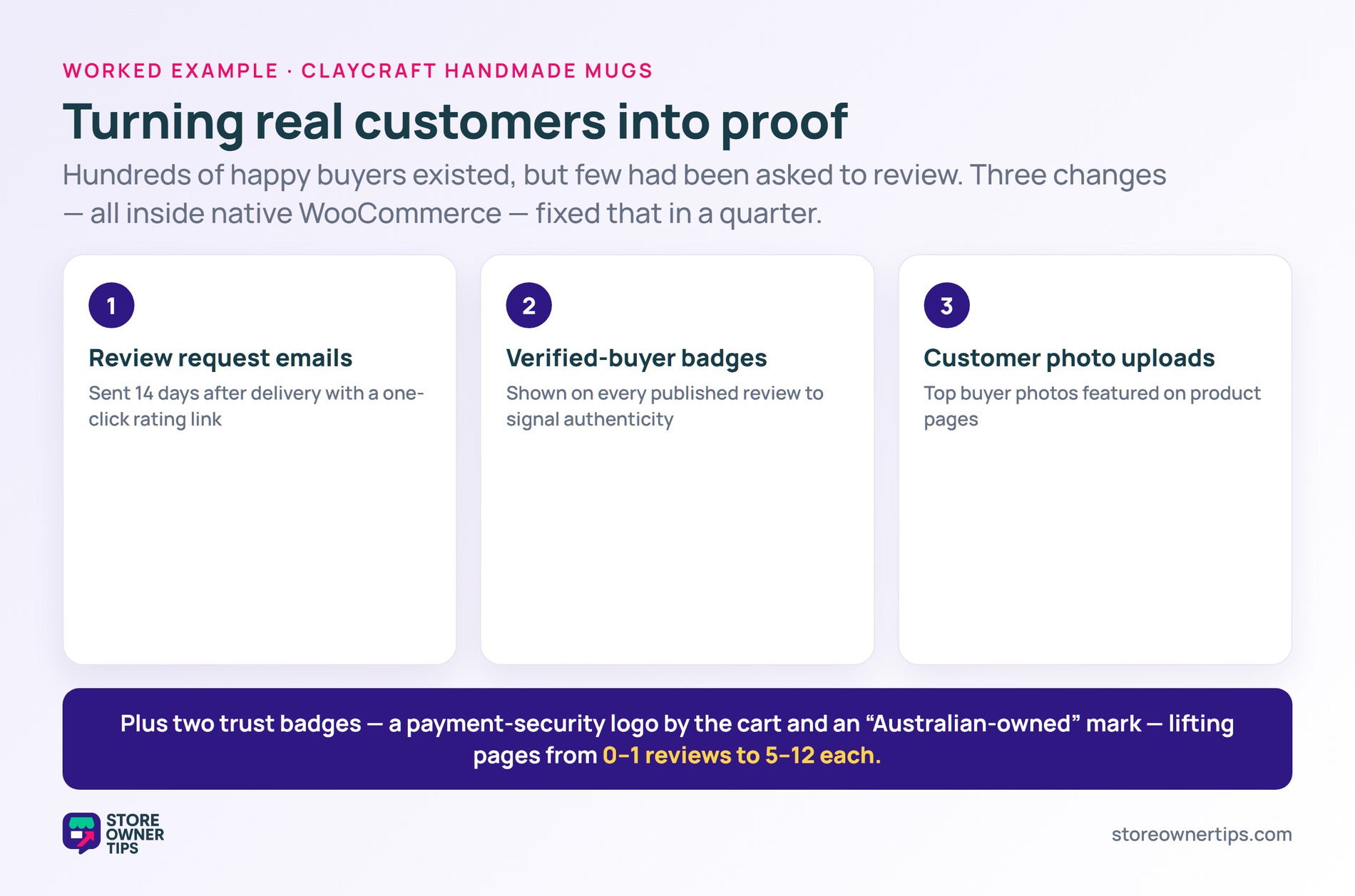
ClayCraft rolls out three changes over a single quarter:
Three months in, most products now show 5 to 12 reviews each. The team also adds two trust badges. A payment-security logo sits near the cart button. An “Australian-owned” badge appears in the footer.
All three changes ran inside the existing WooCommerce review system. No extra plugins were needed for the basic version.
Conversion rate climbs from 2% to 2.7%. Sessions stay the same. Mo
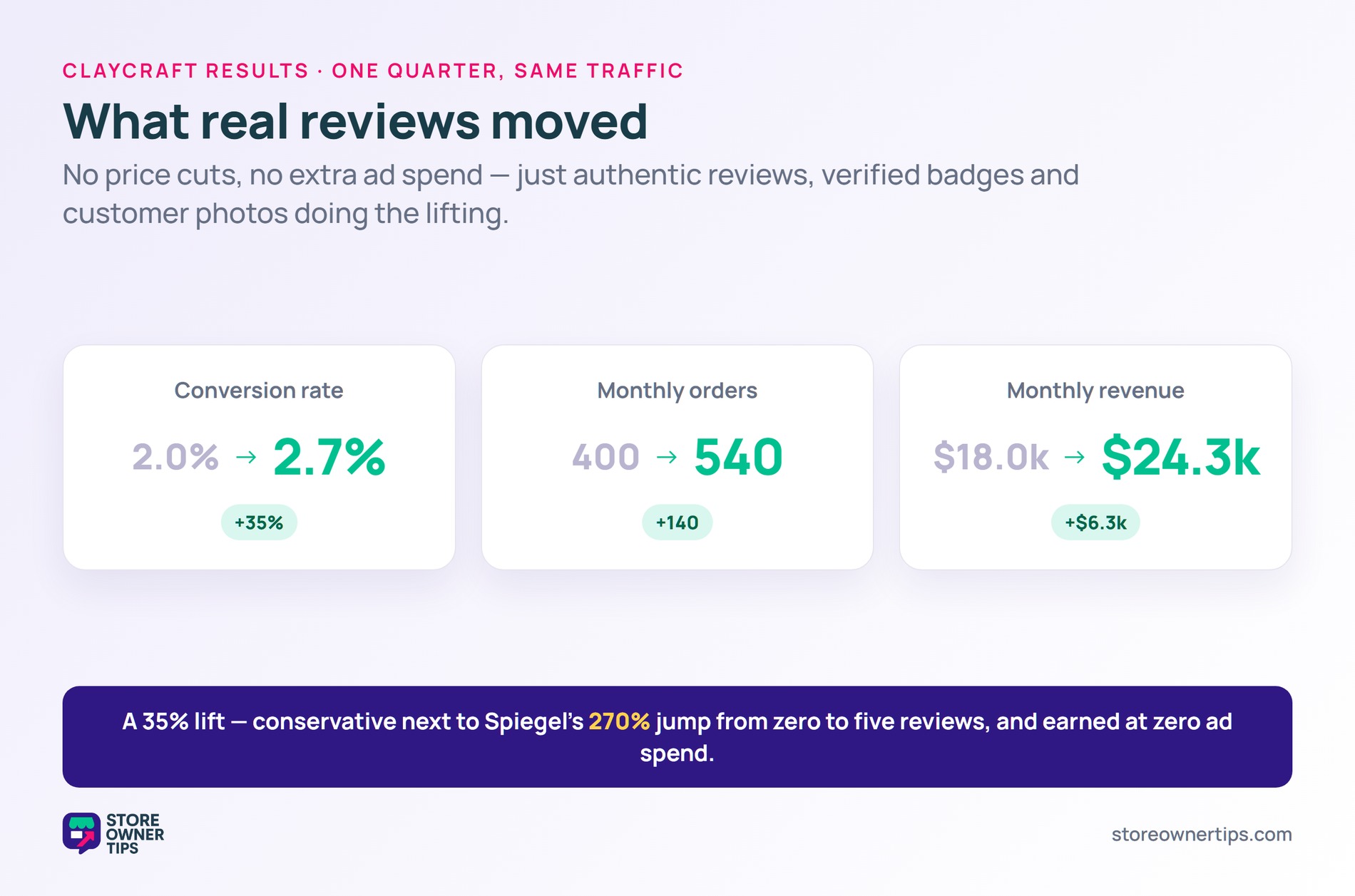
Spiegel’s research suggests this lift is conservative. Their data shows a 270% conversion increase when going from zero to five reviews. ClayCraft’s mix of new reviews, badges, and verified-buyer signals brought in a 35% conversion bump. That’s well below Spiegel’s upper bound but well above zero ad spend.
The six common formats are customer reviews, star ratings, testimonials, user-generated content, trust badges, and live counts. Most stores use a combination, not just one.
The strongest forms are reviews from verified buyers and photos uploaded by real customers. They’re hardest to fake, which makes shoppers trust them more.
Trust badges and live counts work best as supporting signals. They reinforce credibility but rarely close a sale on their own.
Influencer endorsements are a newer category worth flagging. Audiences increasingly trust user-generated content from creators they follow over polished brand testimonials. The format works best when the creator’s audience matches your buyer persona.
Spiegel Research found that five reviews is the inflection point. A product with five reviews has 270% higher purchase likelihood than one with zero. After five, additional reviews still help but at a smaller margin.
That doesn’t mean you stop at five. Volume keeps growing trust for higher-priced or higher-risk products. Spiegel’s data showed conversion lifts of 380% on higher-priced products with reviews. The lift on lower-priced products was 190%.
The practical answer: aim for at least five real reviews on every product before pushing paid traffic to it.
No. Deleting bad reviews wrecks trust faster than the bad reviews themselves. Shoppers know real products get some criticism. Stores with only five-star reviews trigger suspicion, not confidence.
A mix of positive and constructive feedback signals authenticity. Most readers seek out the negative reviews on purpose to understand the downside.
Respond to the negative ones publicly. A polite, helpful reply turns the bad review into another piece of social proof. It shows you care about your customers.
BrightLocal’s 2026 data backs this up. 80% of consumers say they’re likely to use a business that responds to every review. Less than half would use one that ignores them.
Using social proof in marketing is one of the highest-ROI levers in e-commerce. It costs little, scales with your customer base, and lifts conversion across nearly every category. Stores that ask for reviews, respond to them, and display them prominently consistently outperform stores that don’t. Start asking for reviews today, even if you only have a handful of customers. The first five matter most.
Copyright © StoreOwnerTips.com. All Rights Reserved.
