Weekly ecommerce tips, deals & news.
Net profit margin is the exact percentage of your total sales that you get to keep as actual profit after paying every single business expense.
To calculate net profit margin, you take your total revenue and subtract the cost of your products, shipping, marketing, software, and taxes.
While gross profit only looks at what it costs to make a product, your net profit margin tells you if your entire store is actually making money.
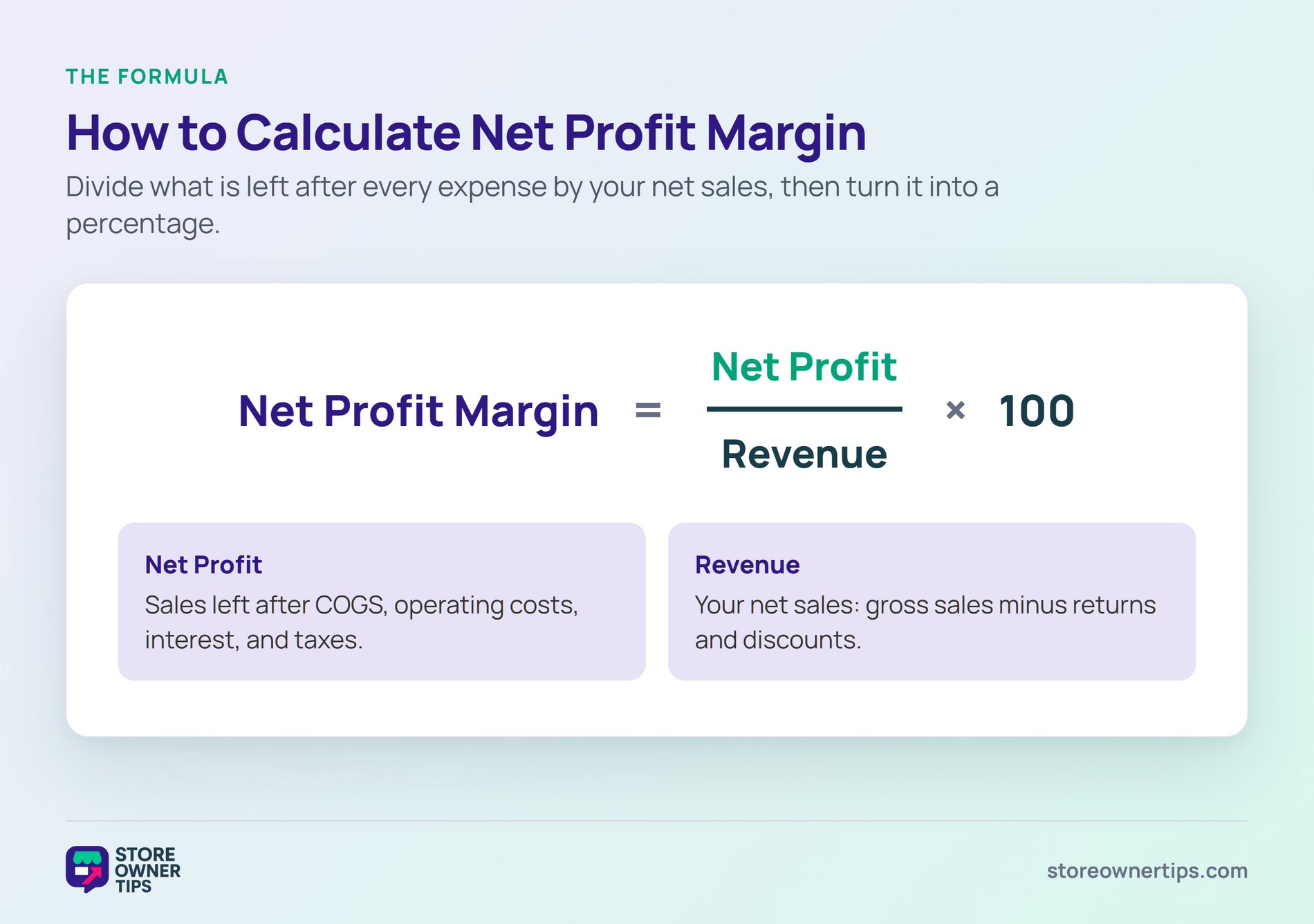
In the fast-paced world of e-commerce, there is a famous saying: “Revenue is vanity, profit margin is sanity.” It is incredibly easy to get addicted to the psychological thrill of a high-sales day. However, looking only at your total sales hides the reality of your business. To calculate your true net profit margin, you must walk down your entire profit and loss statement. You start with your net sales (which means gross sales minus returns and discounts) and subtract everything else. This includes your Cost of Goods Sold (COGS), which is the direct cost of making your product.
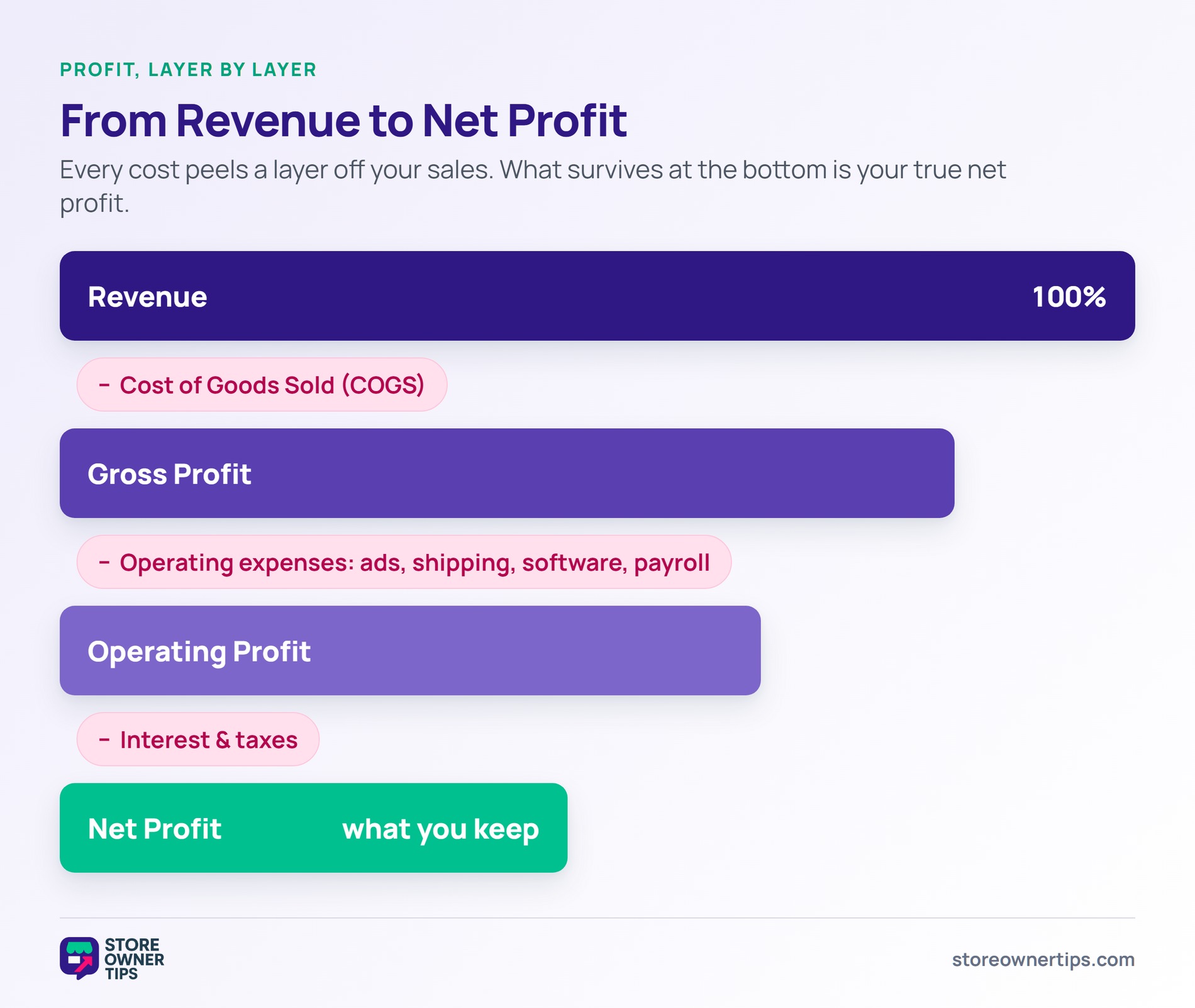
But you cannot stop there. You must also subtract your operating expenses. This means taking away the costs of shipping carriers, third-party logistics (3PL) warehousing, monthly app subscriptions, and performance marketing on platforms like Google or Meta. You even have to deduct the hidden fees, like the standard 2.9% plus $0.30 transaction fee charged by payment gateways like Stripe or PayPal.
The biggest reason store owners misunderstand their net profit is due to how e-commerce software is built. Both WooCommerce and Shopify have a major blind spot known in the industry as the “profit gap.” If you pull up the native “Profit Margin” report in Shopify, it only takes your net sales and subtracts your product costs. By strict accounting rules, this math uses the basic gross profit margin formula, meaning it ignores your outside expenses entirely. The platform completely ignores your external ad spend, your payroll, and your shipping materials.
WooCommerce works the same way. Its built-in revenue reports track sales, taxes, and shipping, but it does not have a native tool that automatically deducts all your outside operating costs.
To see the real truth, store owners have to use specialized third-party apps. Shopify users often install tools like Bloom Analytics, TrueProfit, or Sellerboard. WooCommerce users rely on plugins like MarginMinds Analytics or ProfitMetrics. These tools use API connections to pull in your daily costs.
Think of an API connection like a digital pipeline. Instead of you carrying buckets of water (your daily ad costs) from one tank (Facebook Ads) to another tank (your store’s dashboard) by hand, the API pipeline automatically pumps the data over in real-time.
These apps grab your ad spend, sync your exact payment gateway fees, and let you type in your fixed overhead costs like rent. They rebuild your math to show you a fully loaded, real-time net profit margin. By focusing on this accurate number, you force yourself to run a smarter business. You stop throwing endless money at unprofitable ads and start focusing on keeping the customers you already have.
Imagine a mid-sized beauty and cosmetics brand called “Glow Basics.” According to industry benchmarks from OpenSend, the beauty category is famous for having fantastic gross margins, usually between 50% and 70%. Glow Basics sells a popular skincare bundle for $100.
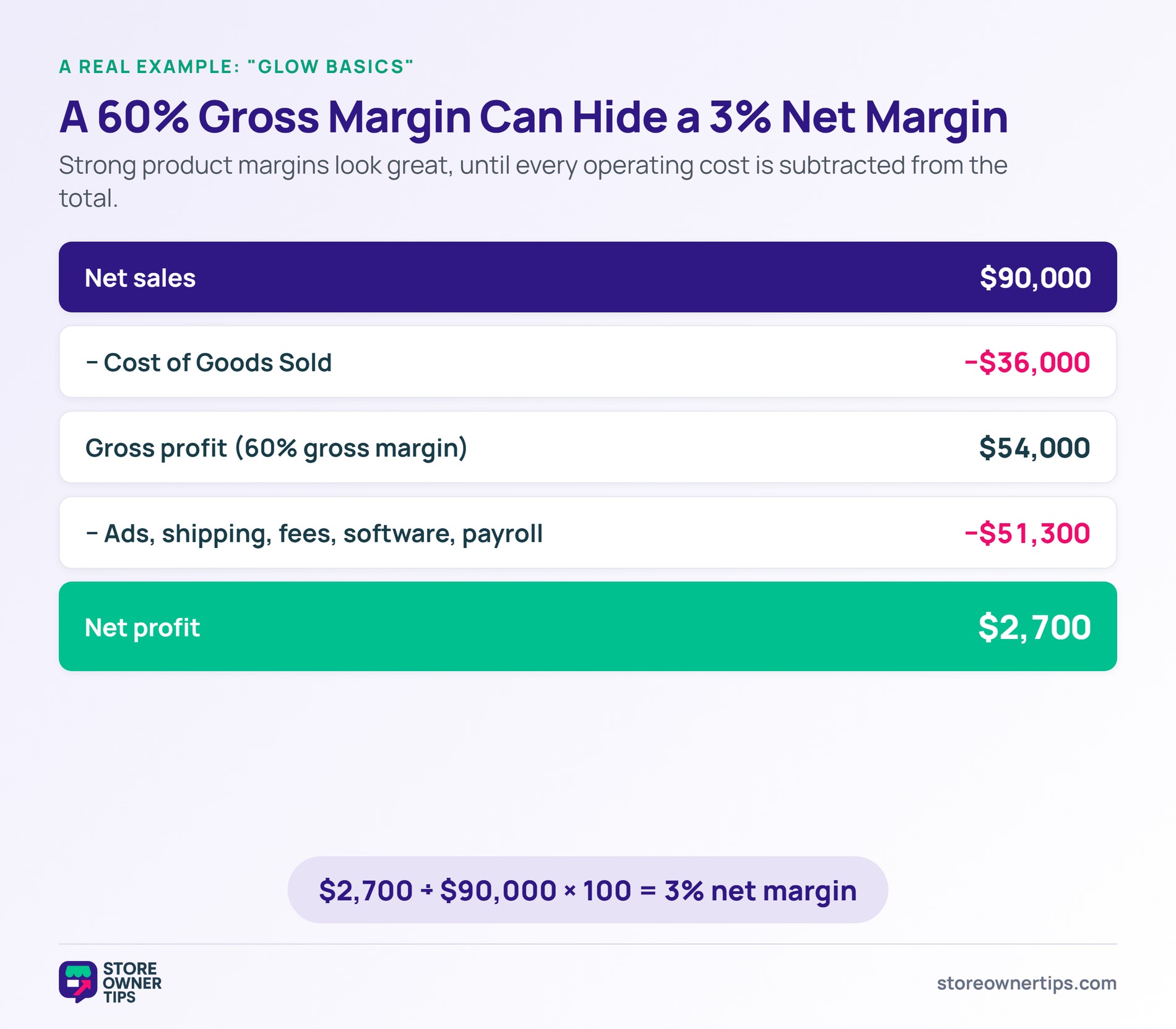
Let’s look at their math for a typical month. Glow Basics does $100,000 in gross sales. However, we have to look at the real data. Industry metrics from Finaloop show that healthy brands keep their net sales above 88% of their gross sales. Glow Basics had some returns and used some discount codes, bringing their actual Net Sales down to $90,000.
Their skincare products are relatively cheap to manufacture. Their Cost of Goods Sold (COGS) for that $90,000 in sales is $36,000. That leaves them with $54,000. If the owner looks at their standard Shopify dashboard, it will excitedly report a 60% Gross Margin. The owner might feel rich, thinking they have $54,000 to put in their pocket.
Now, we have to calculate the real net profit margin. The owner must pay for their operations. First, they spend $20,000 on Meta and TikTok ads to acquire those customers. Then, they pay $15,000 in pick-and-pack fulfillment and shipping fees. They also pay $2,600 in Stripe payment gateway fees. Furthermore, they spend $5,000 on customer service software, hosting, and office rent. Finally, they pay $8,700 in employee payroll.
When you add up all those operating expenses, they total $51,300. We subtract that from the $54,000 gross profit. Glow Basics is left with just $2,700 in actual cash.
Using the standard net profit margin formula, we divide that $2,700 by their $90,000 in net sales, giving us 3%. Despite making $100,000 in top-line revenue and having an amazing 60% gross margin on their products, their heavy operational costs squeezed their final net profit margin down to 3%. This is a highly realistic scenario; in fact, Finaloop’s data shows that 3% is the exact median net profit margin for modern 7- and 8-figure online brands.
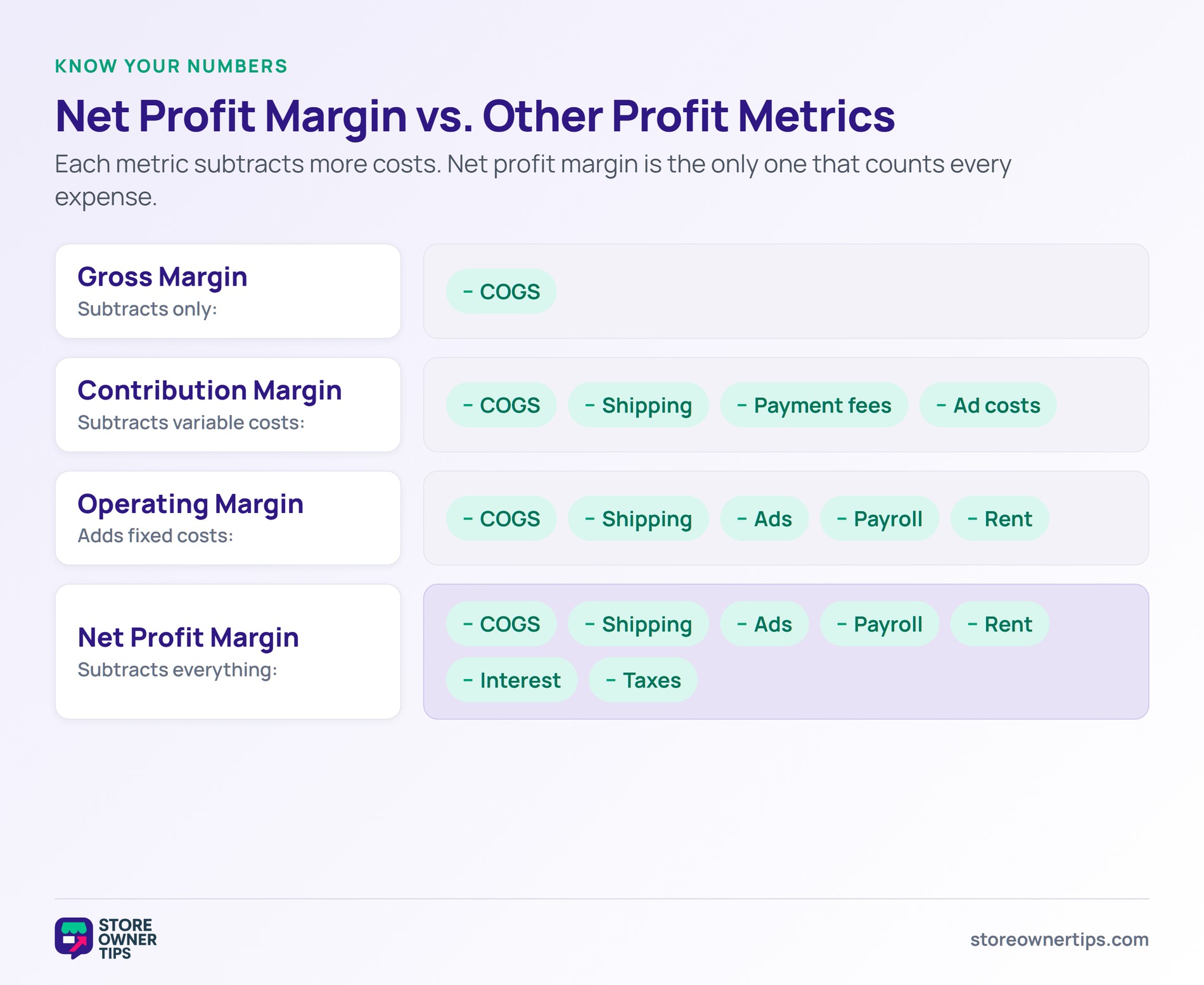
It is easy to get your financial numbers confused. To master your store’s money, you need to know how net profit differs from other popular accounting terms, like your operating profit margin.
| Metric | Simple Definition | How It’s Different from Net Profit |
| Gross Profit Margin | The percentage of revenue left after paying strictly for the product itself (COGS). | It ignores shipping, ads, software, and payroll. It is always a much higher, more flattering number than your net margin. |
| Contribution Margin | Revenue minus all the variable costs to sell one item (COGS, shipping, payment fees, and ad costs). | It ignores fixed costs like your yearly software subscriptions or facility rent. It simply tells you if selling one more item makes or loses money. |
| Operating Margin (EBIT) | Earnings Before Interest and Taxes. It accounts for products, ads, payroll, and rent. | It stops right before the finish line by ignoring how much you owe the government in taxes or the bank in loan interest. |
| Seller’s Discretionary Earnings (SDE) | The final net profit, plus the salary and perks the owner took out of the business. | SDE is the number used to sell a small business. Think of SDE like a whole pizza; net profit is the slice left for the company bank account, but SDE includes the slices you already ate as your salary. |
While making a profit is obviously good, running your store with a strict, obsessive focus on pushing your net profit margin as high as possible comes with unique trade-offs.
According to extensive data from top-performing brands, a highly sustainable net profit margin ranges between 10% and 20%. The broad industry average sits right around 10%. However, real-world data shows that many mid-sized brands actually operate much closer to a 3% or 5% margin due to expensive marketing and shipping costs. If you can consistently hold your net margin above 15%, your store is performing exceptionally well.
Yes. A true net profit margin mathematically subtracts every single expense you have. This explicitly includes all of your advertising spend and any formal salary you pay yourself. Many beginners just pull cash from the business account without logging it as payroll, which artificially inflates their margin. Once your ads and your salary are subtracted from the gross profit, the leftover cash is your true net income.
This happens because of the “profit gap” in standard software reporting. By default, Shopify’s margin report only subtracts the cost of manufacturing your goods from your sales. It gives you a Gross Margin, not a Net Margin. It completely ignores your thousands of dollars in Google Ads, your Stripe processing fees, and your monthly app charges. You have to use third-party apps or detailed spreadsheets to see the real, lower number.
Net profit margin is the ultimate truth-teller of your e-commerce store’s financial health, cutting straight through the tempting illusion of high gross revenue. By accurately tracking this specific metric and managing your hidden expenses, you can transition your store from a fragile, cash-burning hobby into a highly resilient, valuable business asset.
Copyright © StoreOwnerTips.com. All Rights Reserved.
