Weekly ecommerce tips, deals & news.
A credit limit is the maximum a trade customer is allowed to owe you at any one moment. Once their unpaid invoices reach that ceiling, new orders are held until they pay something down. It is the control that keeps offering payment terms from turning into an unlimited loan.
So terms decide when a buyer pays, and the credit limit decides how much they can owe first.
Selling on terms means shipping goods before you get paid. Most suppliers accept that trade because it wins business. However, very few decide in advance how much unpaid exposure they can carry.
The credit limit is where that decision gets made.
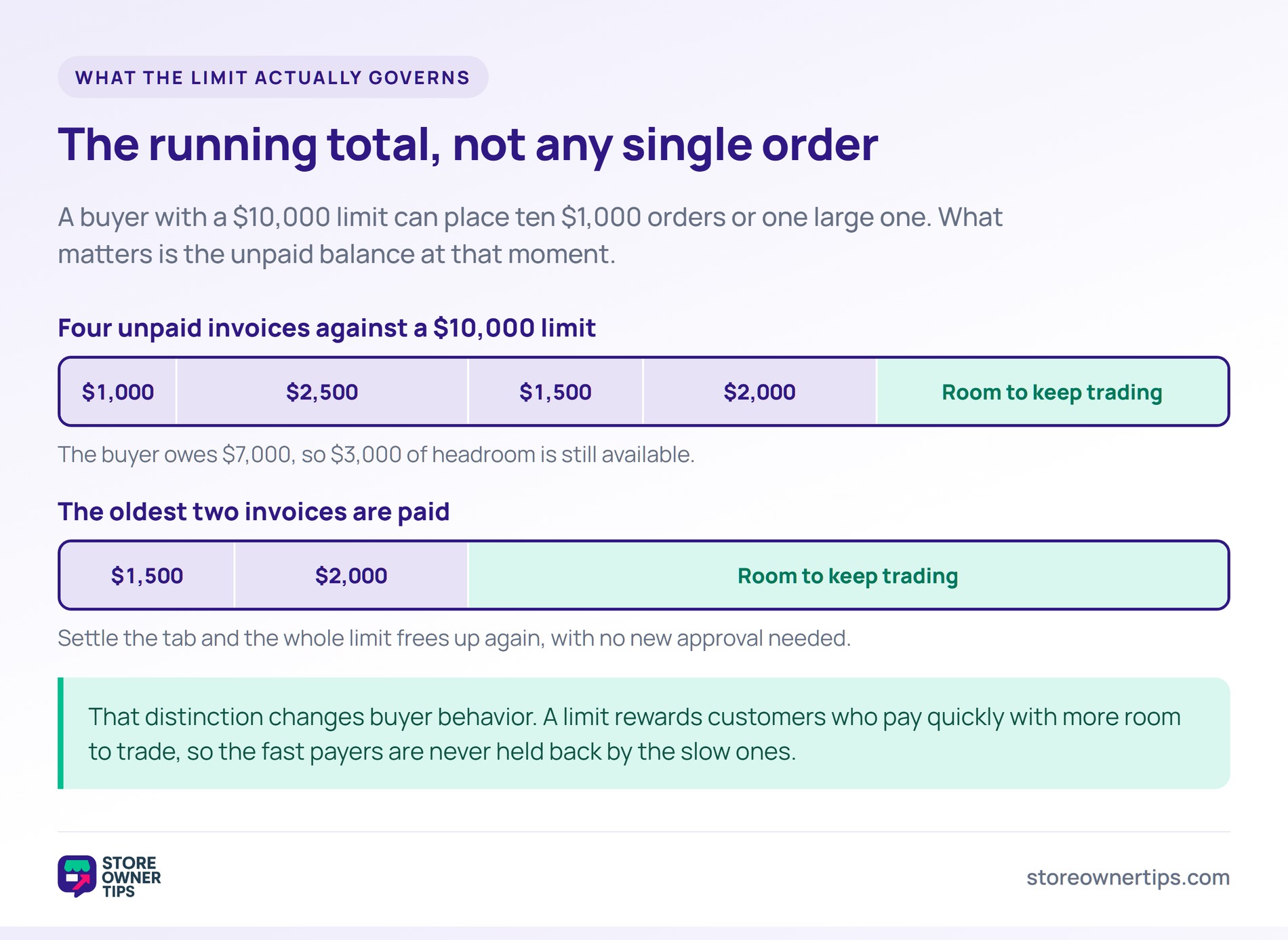
It governs the running total, not any single order. A buyer with a $10,000 limit can place ten $1,000 orders or one large one. What matters is the unpaid balance at that moment.
Think of it like a bar tab rather than a spending cap. You can keep ordering while the tab stays under the line. Meanwhile, settle the tab and the whole limit frees up again.
That distinction matters because it changes buyer behavior. A limit rewards customers who pay quickly with more room to trade. So the fast payers are never held back by the slow ones.
It also pairs with, rather than replaces, your net terms. Terms set the deadline and the limit sets the ceiling. In practice, you need both or neither works.
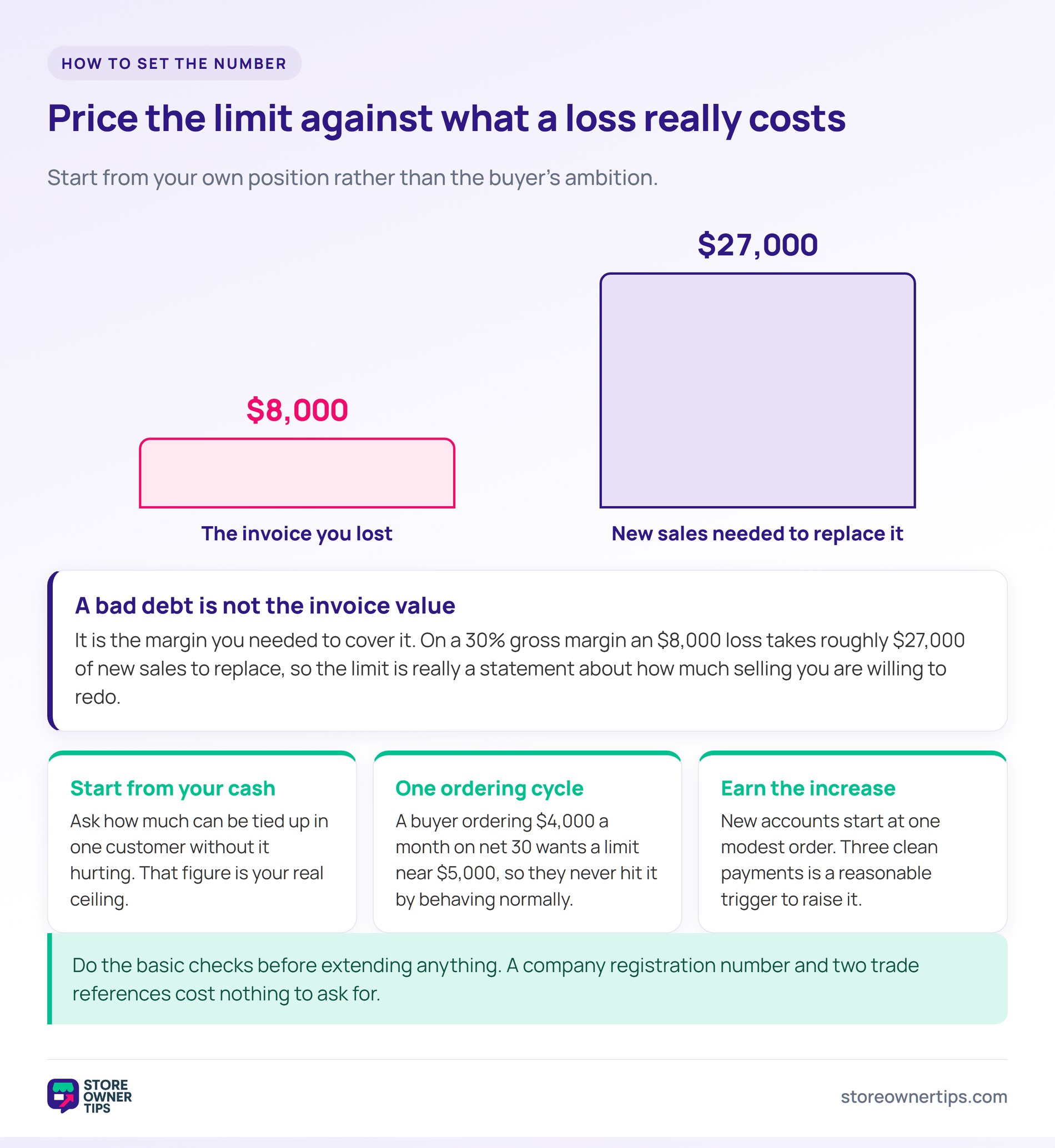
Start from your own position, not the buyer’s ambition. Ask how much cash you can have tied up in one customer without it hurting. That figure is your real ceiling.
A common starting point is one ordering cycle. Say a buyer orders $4,000 a month on net 30. A limit near $5,000 then covers normal trading with headroom. So they never hit the ceiling by behaving normally.
New accounts should start small and earn their way up. A first limit of one modest order is not an insult, it is standard practice. Meanwhile, raising it after three clean payments costs you nothing.
One more sanity check is worth doing. A bad debt is not just the invoice value, it is the margin you needed to cover it. If you run a 30% gross margin, an $8,000 loss takes roughly $27,000 of new sales to replace.
So the limit is really a statement about how much selling you are willing to redo. Do the basic checks before extending anything. Verifying who you are actually dealing with is the same discipline as know your customer in finance. For example, a company registration number and two trade references cost nothing to ask for.
Credit is not a favor in business-to-business trade, it is the norm. Buyers plan their own cash flow around supplier terms, and B2B procurement teams expect it. So a supplier offering none is quietly harder to work with.
Friction in that process costs deals. Forrester reported that nearly 90% of global business buyers had a purchase process stall. A credit application sitting unanswered for a week is exactly that kind of stall.
The scale of the channel explains why the discipline matters. U.S. merchant wholesalers moved $11.38 trillion in a recent survey year. Meanwhile, e-commerce accounted for 33.3% of merchant wholesaler sales.
So the answer is not to refuse credit. It is to grant it deliberately, with a number attached.
Imagine a packaging supplier called Corrugate selling boxes to small manufacturers. It offers net 30 to any approved trade account. Previously it set no ceiling at all.
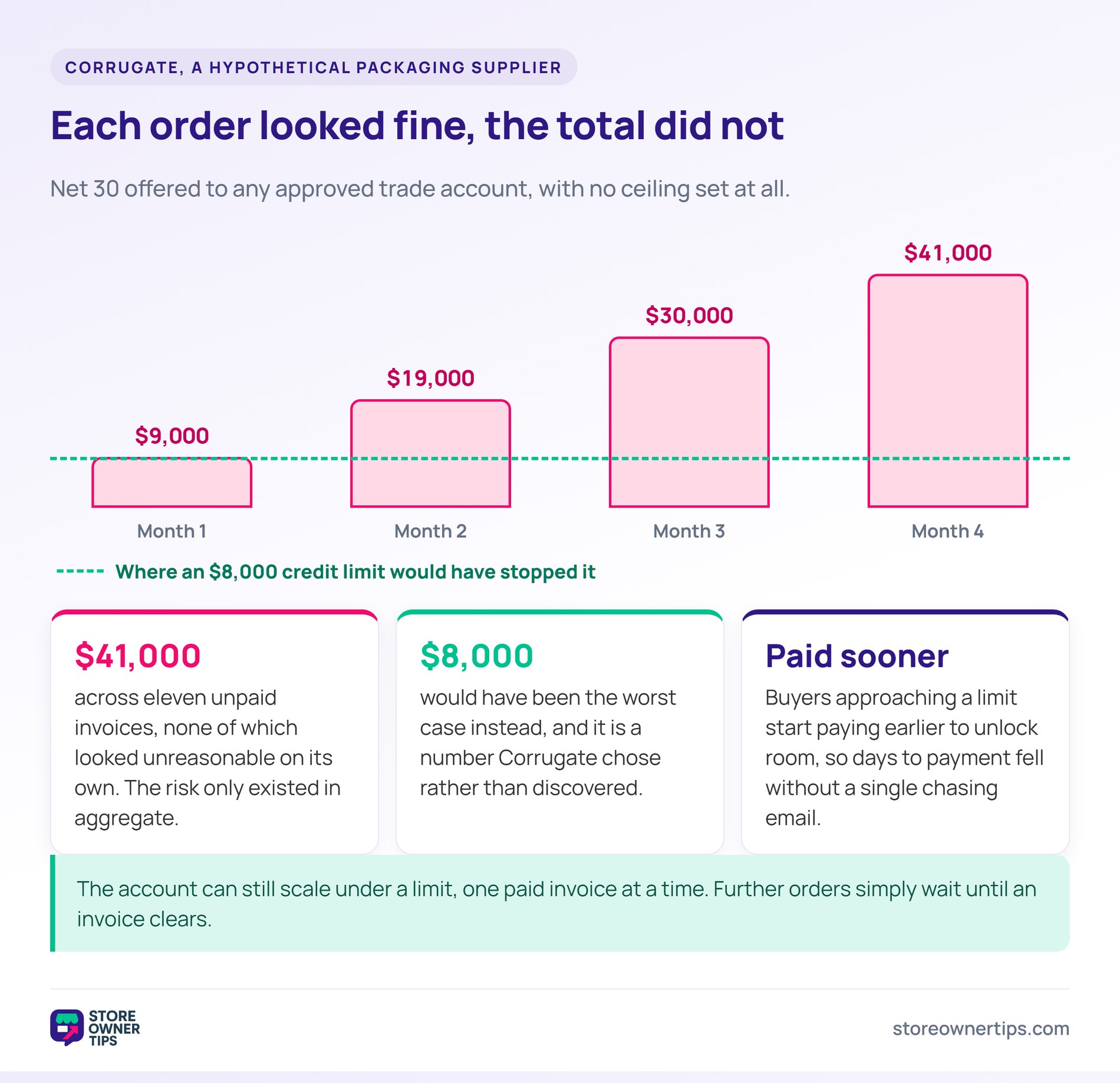
One customer grows fast and orders heavily on terms. By month four they owe $41,000 across eleven unpaid invoices. Corrugate never approved that exposure, because nobody was tracking a total.
Each individual order looked reasonable in isolation. The problem only existed in aggregate. So the risk was invisible right up until it was large.
When that customer hits their own cash trouble, Corrugate is an unsecured creditor for $41,000. Meanwhile, the boxes are long gone and cannot be recovered.
Corrugate sets limits per account based on trading history. New accounts start at $2,000, and the figure rises after three clean payments. The fast-growing customer would have been capped at $8,000.
That does not stop them growing. It simply means further orders wait until an invoice clears. So the account can still scale, one paid invoice at a time.
The exposure is now a number Corrugate chose. If the worst happens, the loss is $8,000 rather than $41,000. In practice, that is the whole point of the control.
The change also tightens the whole order-to-cash chain. Corrugate now checks the balance before approving an order rather than after invoicing. That sequence is what quote-to-cash describes.
There is a second benefit nobody expected. Buyers approaching their limit start paying earlier to unlock more room. Over time, the average days to payment falls without a single chasing email.
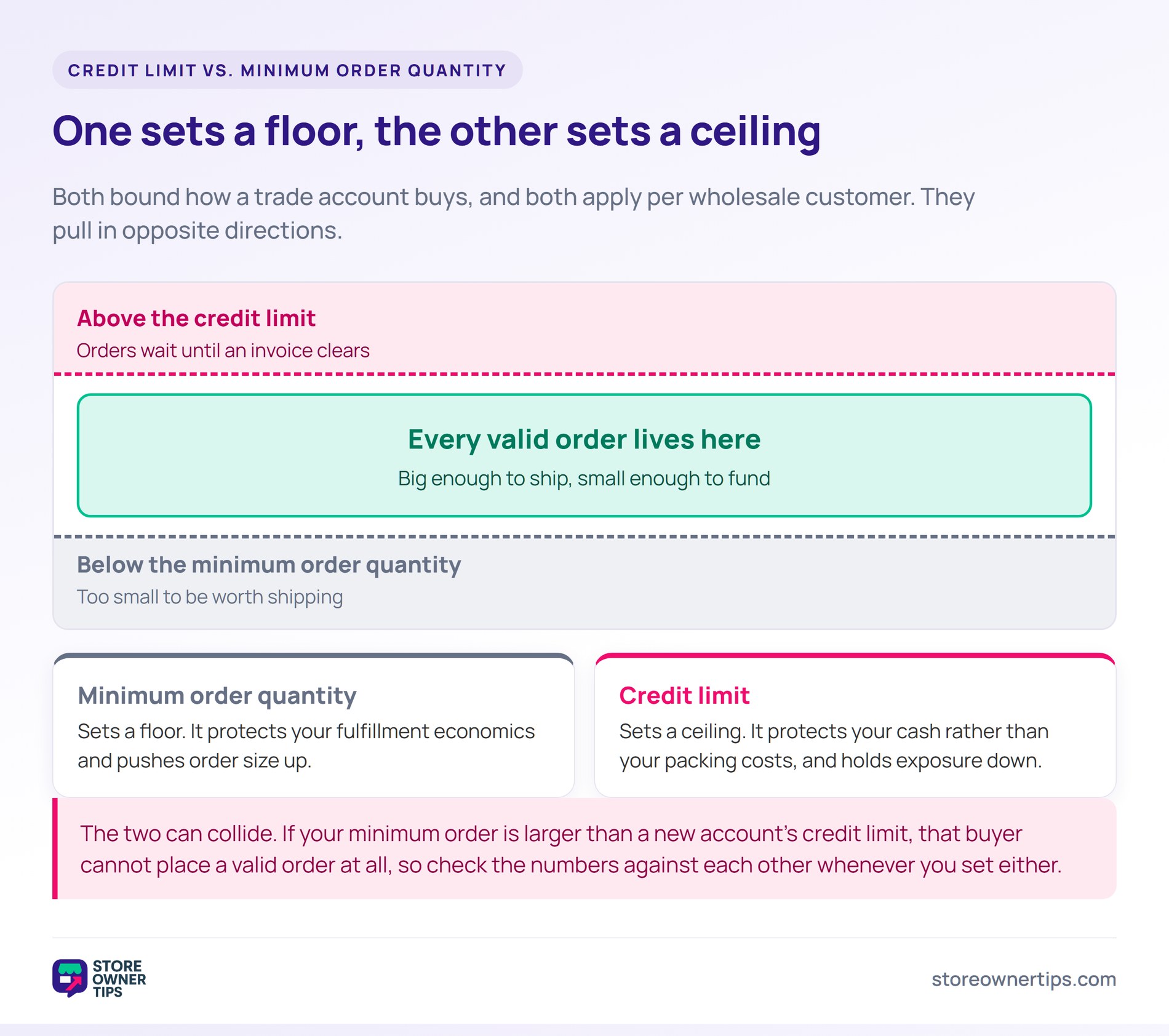
Both put a boundary on how a trade account buys, so they get grouped together. Both apply per wholesale customer, not across your whole book. Even so, they pull in opposite directions. One sets a floor and the other sets a ceiling.
A minimum order quantity says an order must be at least this big to be worth shipping. It protects your fulfillment economics. Meanwhile, it pushes order size up.
A credit limit says your unpaid balance cannot exceed this. It protects your cash rather than your packing costs. By contrast, it holds exposure down.
The two can collide, and that is worth watching. If your minimum order is larger than a new account’s credit limit, they cannot place a valid order at all. So check the two numbers against each other whenever you set either.
Small enough that losing it would not hurt. For many suppliers that is roughly one typical order. So the first transaction doubles as the credit check.
Then raise it on evidence rather than on request. Three invoices paid on time is a reasonable trigger for an increase. Meanwhile, tell the buyer that path exists so the low starting point does not read as distrust.
New orders should pause rather than fail silently. The cleanest handling is to let them check out by paying upfront instead. So the sale is not lost, only the credit is.
Warn them before it happens. A message at eighty percent of the limit turns a hard block into a decision. In practice, that single notice prevents most of the awkward conversations.
Especially then, because concentration is the risk. With five accounts, one failure is twenty percent of your trade revenue. So the smaller your customer base, the more a single bad debt hurts.
The limit does not need software at first. A spreadsheet listing each account’s ceiling and current balance is enough to start. Then automate it once the account count makes manual tracking unreliable.
A credit limit turns payment terms from an open-ended risk into a decision you made on purpose. Set it from what your own cash can absorb, start new accounts low, and raise it on proven payment behavior.
Then warn buyers before they reach it. For how limits sit alongside the terms themselves, see this guide to net payment terms in WooCommerce.
Copyright © StoreOwnerTips.com. All Rights Reserved.
