Weekly ecommerce tips, deals & news.
Order fraud is an order placed with payment details the buyer is not entitled to use. The order looks completely normal at checkout. It passes, it gets picked, and it ships.
The bill arrives weeks later as a dispute, and the goods are already gone. So order fraud is a decision problem rather than a payment problem. You have to judge an order before you have any proof either way.
Order fraud works because your checkout can verify a card without verifying a person. Think of a card approval as a bouncer checking that a ticket is real. Still, nobody checks whether the person holding it bought it.
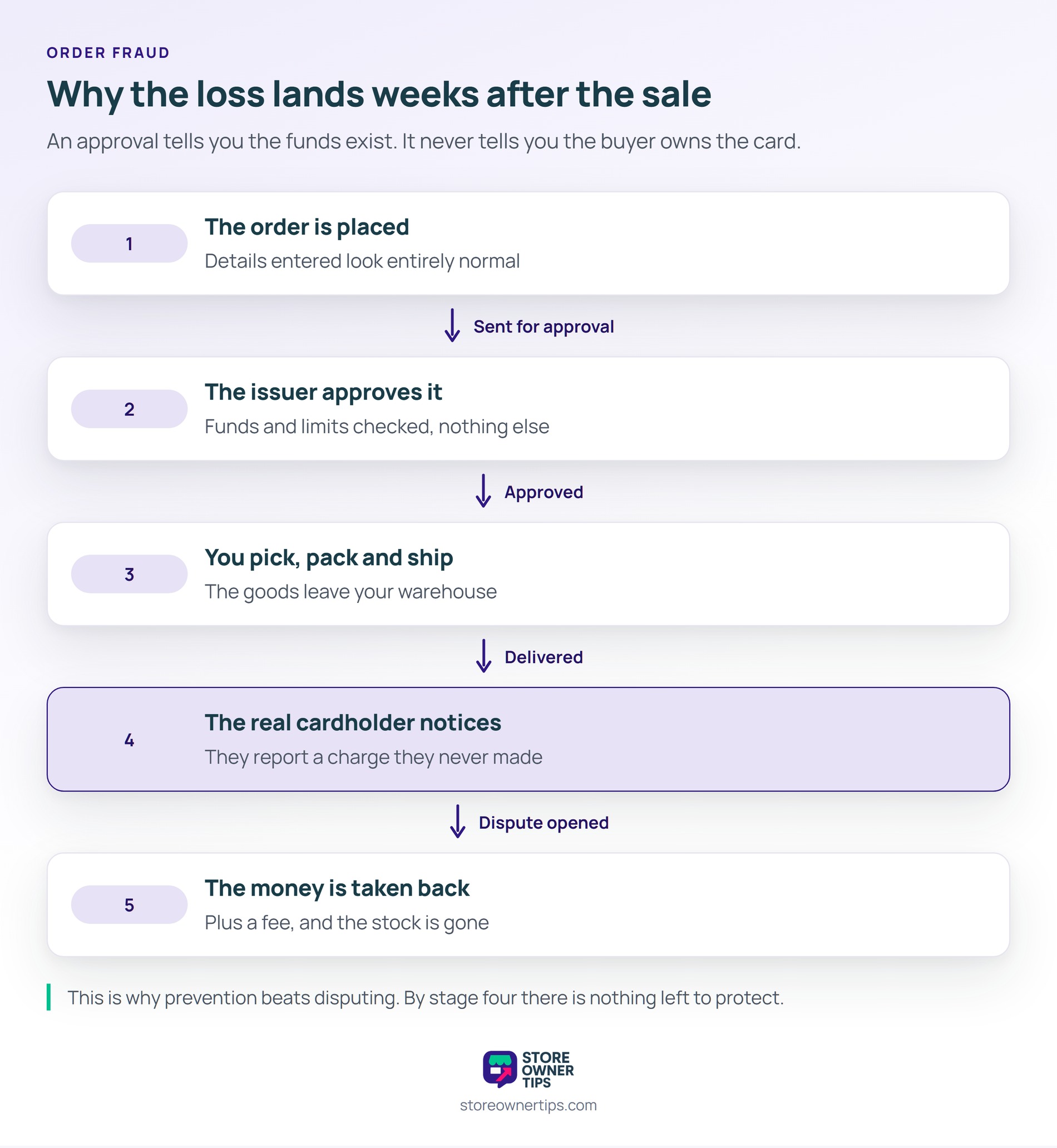
An approval on a fraudulent order proves only that the account had room for the charge. In practice, the issuer answers a narrow question about funds and limits. It is not confirming that the buyer is the cardholder.
Even so, extra checks narrow the gap without closing it. Address verification compares the billing address to the one on file. Meanwhile a card security code proves the buyer had the card, or a copy of its details.
In some regions, bank authentication can also shift liability for a fraud dispute to the issuer. So the same order can be your loss in one market and the bank’s in another. That makes your payment gateway settings worth reading properly.
Account takeover is the variant that fools everyone. The order arrives from a real customer’s saved account, with a real address history. So every signal you would normally trust becomes the attacker’s cover.
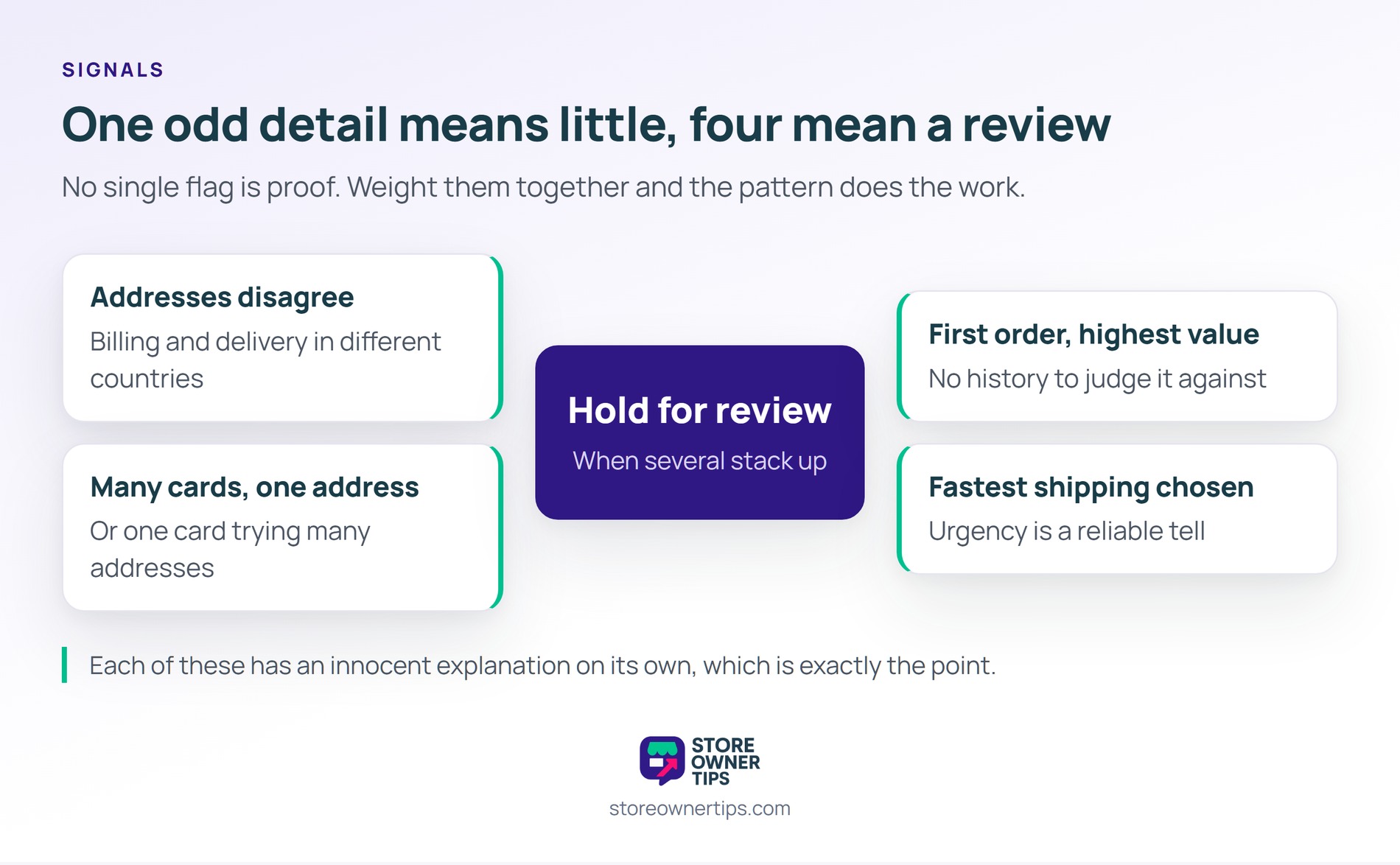
Order fraud rarely announces itself with one obvious flag. Instead it shows up as several small mismatches on the same order. For example, a billing address in one country and a delivery in another is the classic pair.
Then there are the patterns across orders rather than inside one. First, several different cards shipping to one address is a strong signal. So is one card trying many addresses in a short window.
Urgency is the other reliable tell. A first-time buyer taking the highest-value item on the fastest shipping is worth a look. Still, each of these has an innocent explanation, which is exactly why you weigh them together.
Digital goods change the maths completely. There is no delivery address to check and no parcel to intercept. As a result, stores selling downloads or gift cards lean on velocity limits instead of address rules.
Order fraud tempts every store into rules that are too strict. For example, block every mismatched address and you also block people buying gifts. Then block every new high-value order and you block your best new customers.
Those rejections are called false declines, and they are invisible in a way fraud is not. By contrast, a chargeback arrives with paperwork and a number attached. By contrast, a wrongly blocked shopper simply leaves and never tells you.
Meanwhile shoppers are already wary at this exact moment. Baymard finds that 19% of abandonments come from not trusting a site with card details. So the friction you add for fraud lands on those people too.
Order fraud is common enough that most retailers treat it as a standing cost. The National Retail Federation reports that 93% of retailers call retail fraud a significant issue.
The screening side has been measured too. A merchant survey by Aite Group, commissioned by ClearSale, asked stores how often they wrongly reject orders. Most landed in a narrow band, with 61% of merchants reporting false decline rates between 1.1% and 5%.
Read those two together and the shape of the problem changes. Fraud is near-universal, and so is over-blocking. Meanwhile only one of the two shows up in your reports.
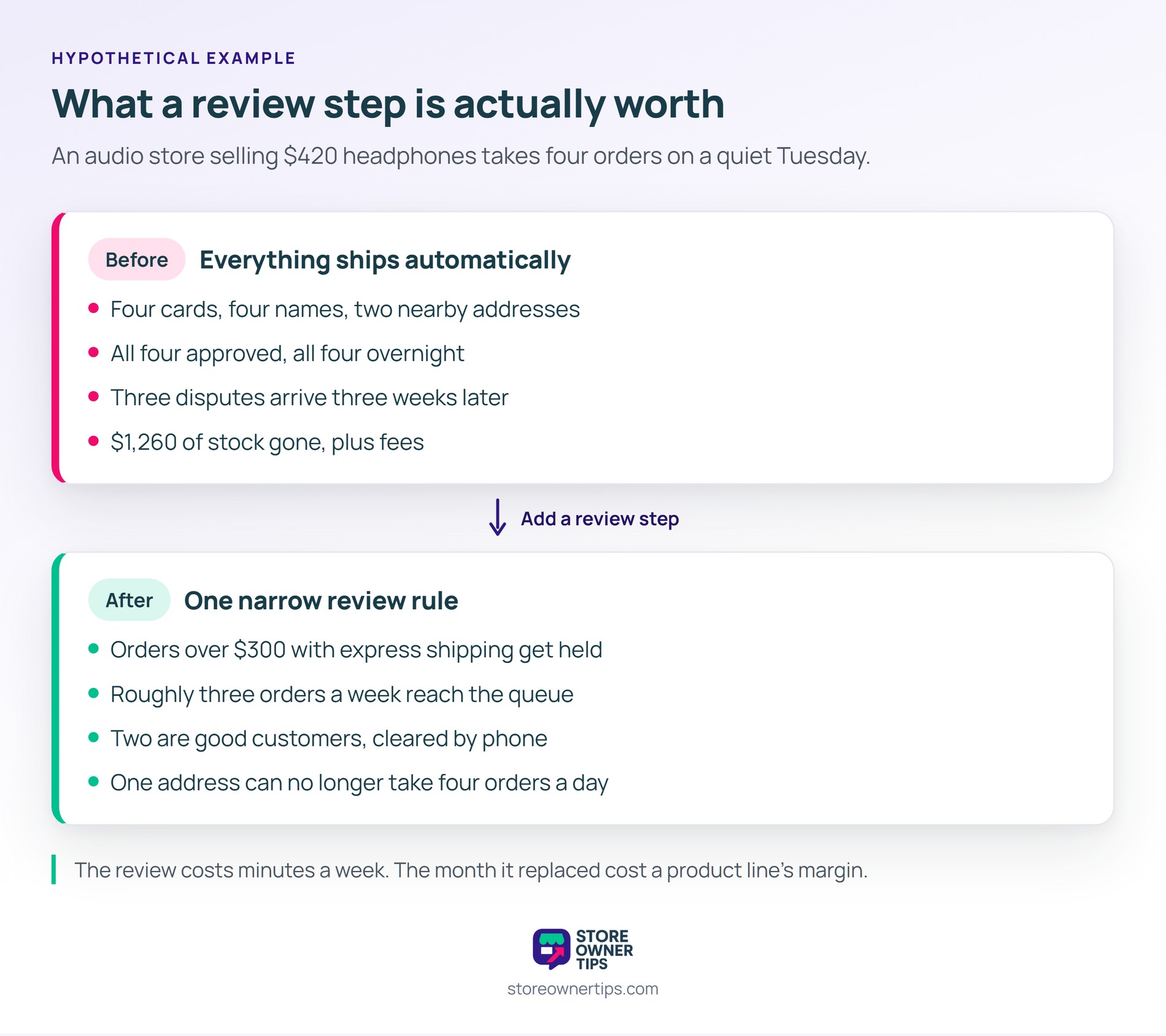
Order fraud in practice usually arrives as a small cluster, not a single order. Here is a hypothetical example. Imagine a store selling audio equipment, with headphones at $420 a pair.
On a quiet Tuesday the store takes four orders for the same headphones. Each uses a different card and a different name. All four ask for overnight delivery to two addresses in the same suburb.
In this scenario, every payment is approved without a murmur. The store has no review step, so the orders drop straight into the picking queue. By Wednesday morning all four are in transit.
Then, three weeks later, three disputes arrive on the same day. The store loses $1,260 of stock plus the overnight shipping it paid for. Then each dispute adds its own fee on top.
Nothing can be recovered, because the goods went to addresses nobody will answer at. As a result the month’s margin on that product line disappears entirely. Worse, the store now knows the pattern will be tried again.
First, the store adds a review step rather than a blanket rule. Orders over $300 that combine express shipping with a first-time buyer get held for a look. Everything else ships as before.
That queue catches perhaps three orders a week. Two of them turn out to be perfectly good customers, and a quick phone call clears them the same day. Even so, the review costs minutes rather than the margin on a product line.
Next, the store caps how many orders one address can take in a day. It also stops storing card details it has no use for, because less data held is less worth stealing. Practical guidance on preventing fraud and policy abuse covers the same idea applied to discounts.
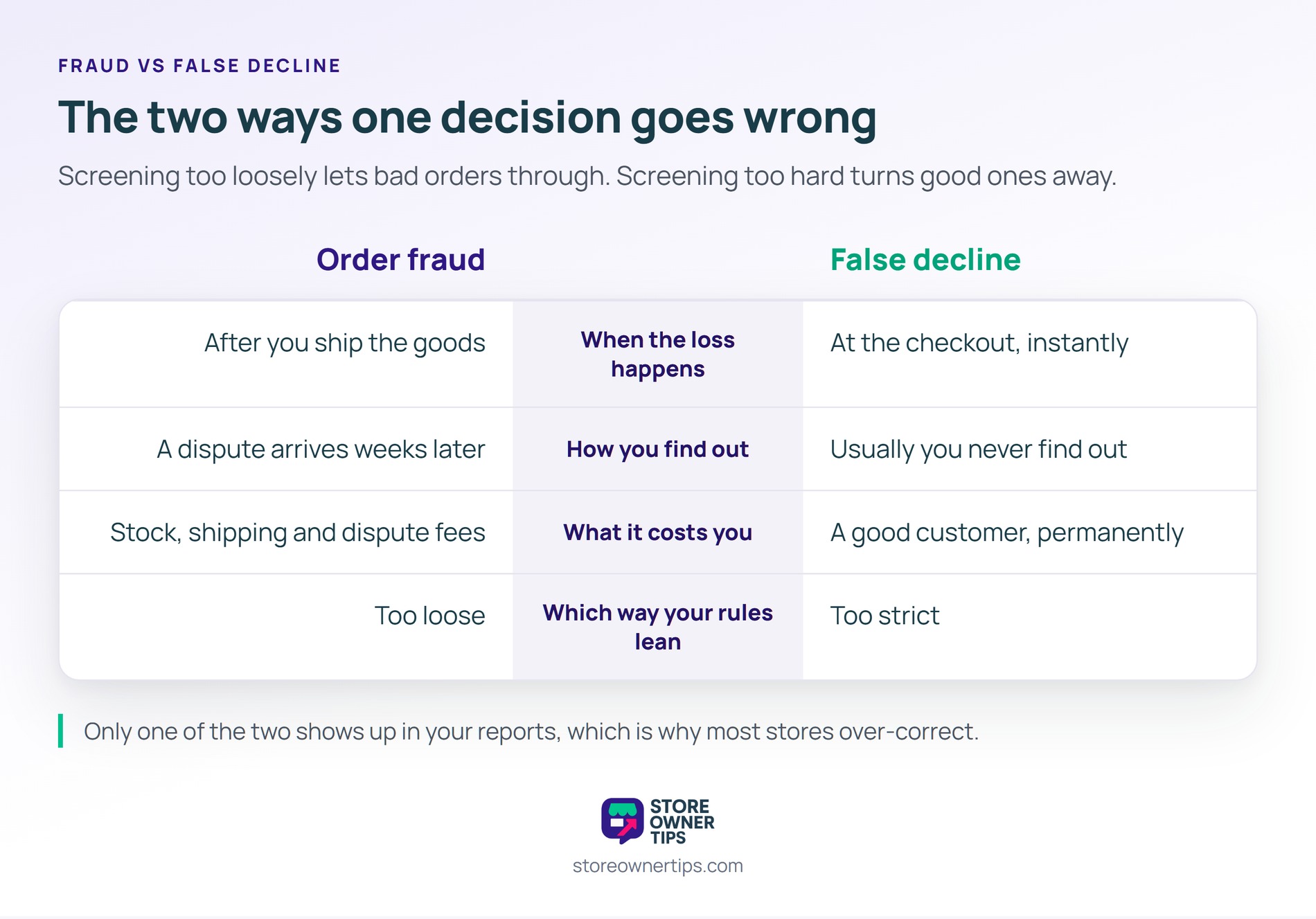
| What you are comparing | Order fraud | False decline |
|---|---|---|
| When the loss happens | After you ship the goods | At the checkout, instantly |
| How you find out | A dispute arrives weeks later | Usually you never find out |
| What it costs you | Stock, shipping and dispute fees | A good customer, permanently |
| Which way your rules lean | Too loose | Too strict |
Order fraud and false declines are the two ways the same decision goes wrong. One lets a bad order through. The other turns a good one away.
Treating them as one number is what keeps stores stuck. In practice you cannot drive fraud to zero without pushing false declines up. So the goal is a defensible balance, reviewed with real figures rather than instinct.
First, look for several weak signals stacking up on one order. A billing and delivery address in different countries is the most common pair. Add express shipping, a first-time buyer and a high-value item, and it earns a review.
Then check across orders, not just inside one. Several cards pointing at a single address is worth more attention than any single detail.
For a card-not-present order, the merchant usually carries the loss. You refund the amount, you have already lost the goods, and a fee is often added. That is why prevention beats disputing after the fact.
There is one common exception. Where bank authentication was completed successfully, liability for a fraud dispute can sit with the issuer instead. Your gateway documentation will say which of your regions this covers.
Contact the buyer before you cancel anything. A short call or email clears most flagged orders within a day, and genuine customers rarely mind. Cancelling first turns a maybe into a lost sale and a bad review.
Cancel when the buyer cannot be reached and the signals still stack up. Refund promptly and keep a note of the pattern, because the same setup tends to come back.
Order fraud matters because it is the one loss where you pay twice, once in stock and once in fees. Every other bad order can at least be restocked and resold. Plus the fix is a review step rather than a rebuild. Meanwhile the same queue protects your dispute ratio, which your payment provider watches closely.
In short, screen enough to protect your margin, and no harder than that.
Copyright © StoreOwnerTips.com. All Rights Reserved.
