Weekly ecommerce tips, deals & news.
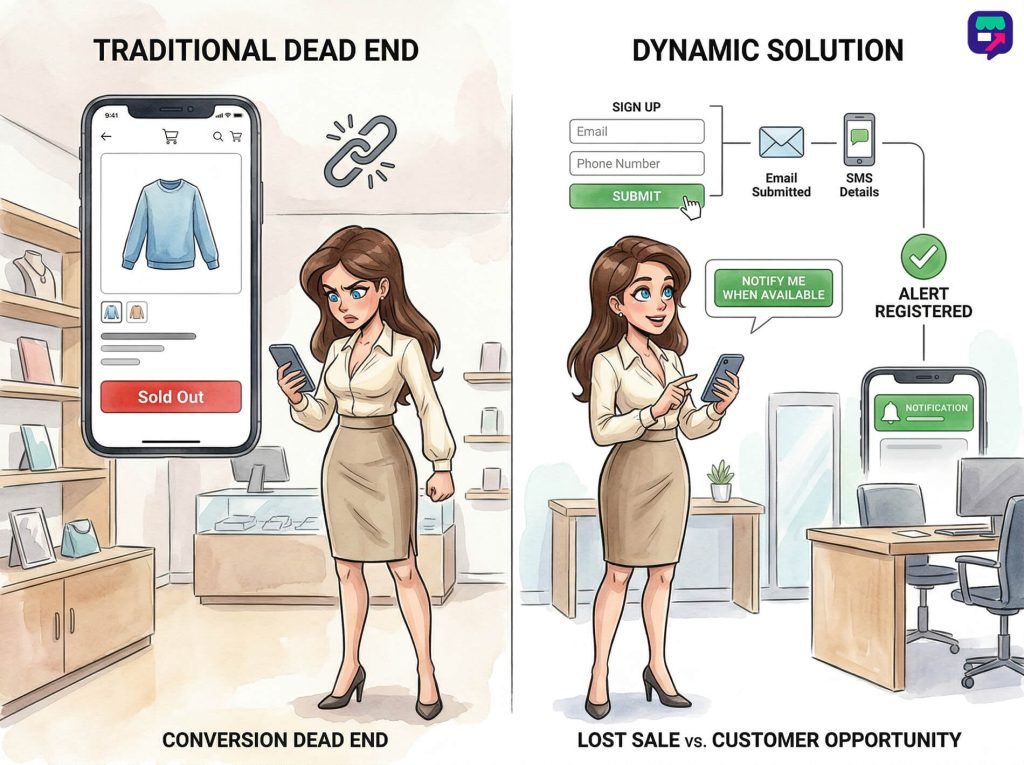
A back-in-stock notification is an automated alert system that lets shoppers know when a sold-out item is available to buy again. Instead of hitting a frustrating “Sold Out” dead end, customers can enter their email or phone number on the product page. The moment the store’s inventory updates, the system automatically sends an instant message to that shopper. This simple tool saves lost sales and stops highly interested buyers from jumping over to a competitor.
To truly understand why this tool is vital, you have to look at how temporary stockouts damage a growing e-commerce brand. In the fast-paced online world, poor inventory management can cost a business up to 11% of its annual revenue.
Historically, when a product dropped to zero inventory, the website simply displayed a static “Sold Out” button. This was a massive roadblock. Data shows that 40% of shoppers who hit this roadblock will instantly leave to buy from a competitor, permanently killing their relationship with your brand. Only 15% to 25% of shoppers will ever bother to remember to check your site again.
A back-in-stock system flips this dead end into a massive opportunity. It swaps out the static button for a form that says, “Notify Me When Available.” When a shopper enters their email or mobile number, the system securely saves this request.
Running this system smoothly requires your storefront, your database, and your email provider to talk to each other perfectly in real-time. On platforms like WooCommerce, this is usually done through something called a webhook.
Think of a webhook like a bell in a restaurant kitchen. Instead of a waiter walking into the kitchen every five minutes to ask if the food is ready, the chef simply rings the bell the exact moment the dish is plated. A webhook does the same thing for software. When you update your stock numbers, the platform “rings the bell” to instantly tell your notification app that new items have arrived.
For massive events, like limited-edition sneaker drops, standard setups aren’t enough. Brands use serverless cloud technology to put thousands of messages into a digital waiting line. This ensures that sending out thousands of texts at once doesn’t crash the entire website.
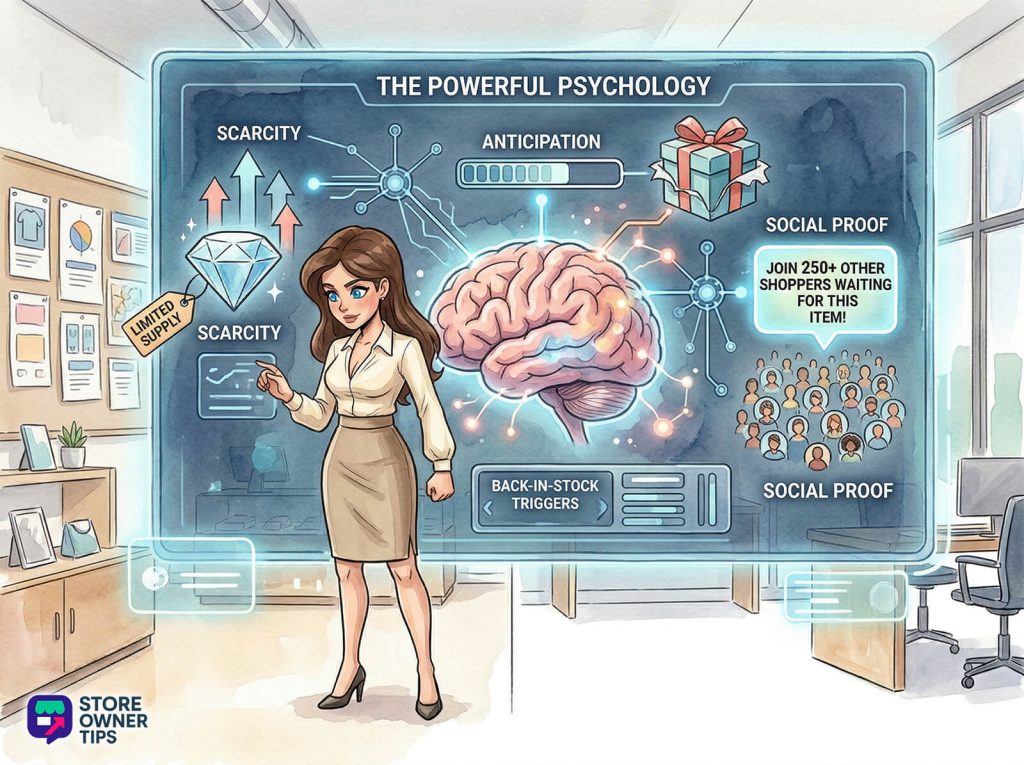
Beyond the technology, these alerts work because they tap directly into human psychology:
Let’s look at exactly how this works using a hypothetical, mid-sized apparel brand called Aura Athletics.
Aura Athletics generates $5,000,000 in annual revenue, and their average customer spends $100 per order. Like many growing brands, routine supply chain delays mean that about 10% of their catalog is temporarily out of stock at any given time. Without any notification system in place, that 10% inventory gap equals roughly $500,000 in uncapturable demand walking out the door every year.
Aura Athletics decides to install a smart back-in-stock notification system. Over the course of the year, 10,000 unique shoppers land on sold-out jackets and leggings. Instead of bouncing off the website, 25% of those users (2,500 shoppers) fill out the form to receive an SMS text or email stock alert.
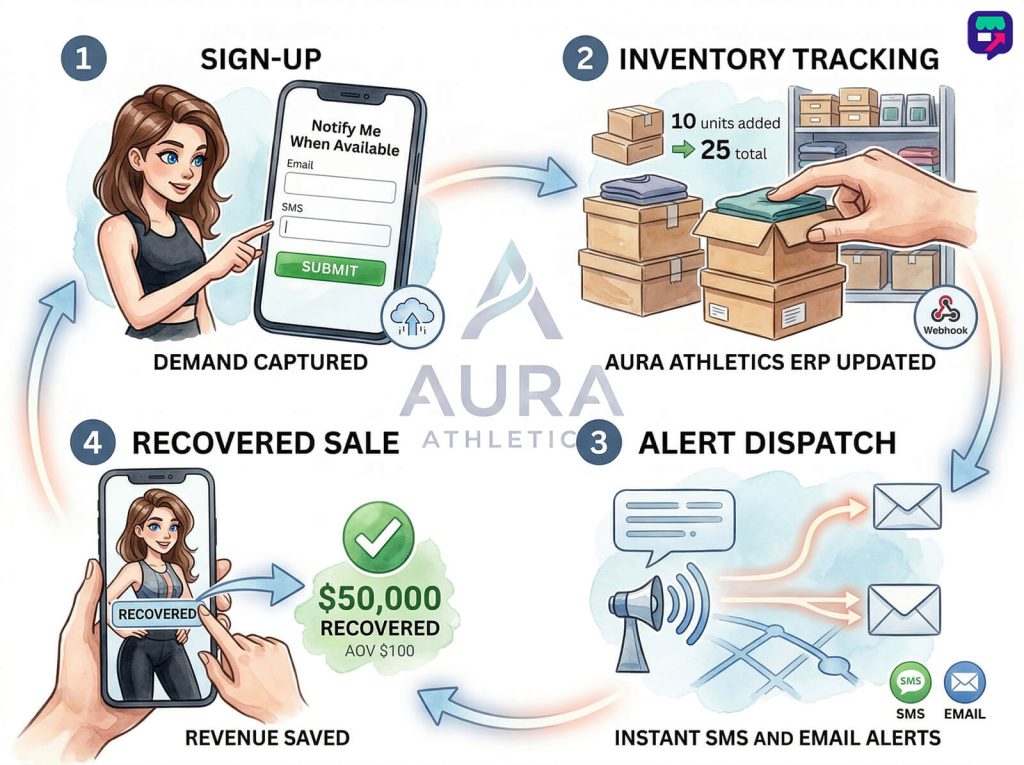
When the shipping containers finally arrive and the items are back in stock, the system springs into action. Following industry standards, the campaign sends an instant SMS (which boasts a lightning-fast 90-second response time) followed by a richer email.
Operating at the standard industry benchmark, this campaign achieves a 20% conversion rate. Out of the 2,500 notified shoppers, exactly 500 customers immediately click through and buy the item.
At a $100 average order value, Aura Athletics successfully recovers $50,000 in top-line revenue that would have otherwise gone straight to their competitors. Even better, the remaining 2,000 shoppers who didn’t buy right away are now sitting in the brand’s email system, ready to receive future marketing campaigns.
When you run out of an item, you generally have a choice between capturing a customer’s Dynamic Commitment (taking their money now) or their Static Intent (taking their email now).
Pre-Orders require high financial commitment. The customer pays upfront before the physical item exists. Because they’ve already paid, products available for presale convert at a massive 47% higher rate than standard waitlists. Customers also tend to buy 38% more items in a presale order. However, pre-orders are dangerous. If your factory has a three-month delay, you’re holding the customer’s money. This leads to angry support tickets, chargebacks, and a ruined reputation.
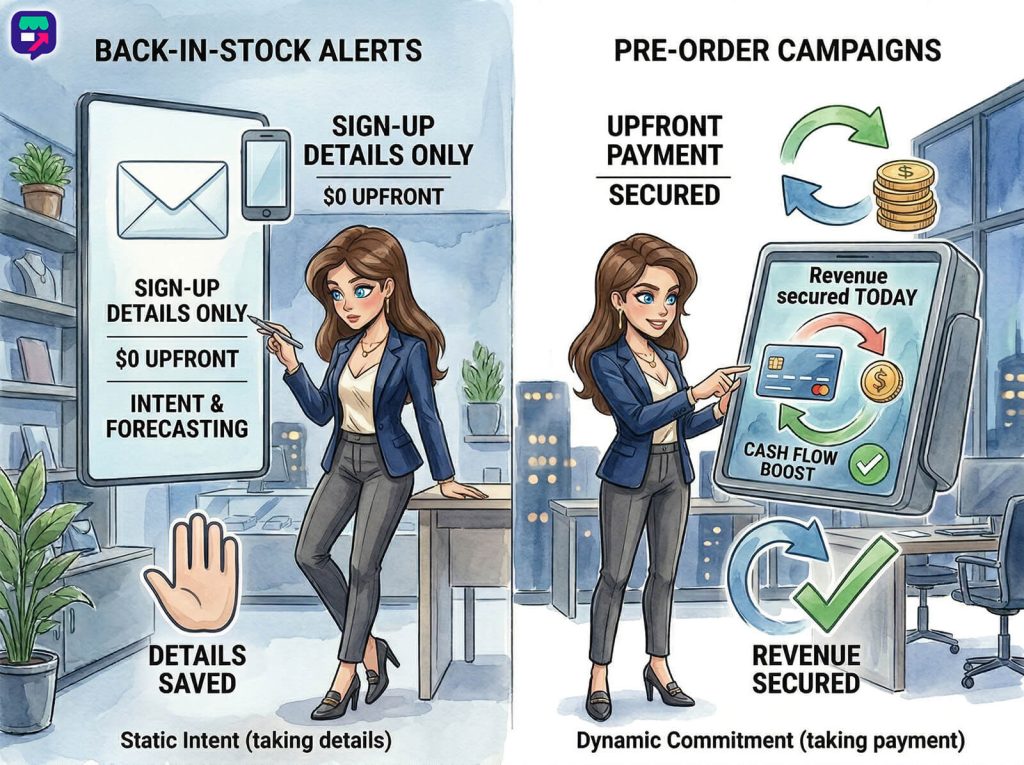
Back-in-Stock Notifications, on the other hand, require zero financial commitment. The customer pays nothing today. If your supplier is late, you hold no financial risk and don’t have to issue mass refunds. The trade-off is that revenue isn’t guaranteed. A shopper on a waitlist might simply change their mind or buy from someone else while they wait.
Like any powerful business strategy, setting up restock alerts comes with specific advantages and unique risks that you need to manage.
The Pros:
The Cons:
Yes, they generate highly measurable revenue that easily covers the software cost. Because the shopper asked for a specific item, these alerts carry massive purchase intent. Standard marketing emails convert at roughly 2% to 5%. However, optimized back-in-stock campaigns reliably convert between 12% and 30% of subscribed demand. For any growing store, the recovered cash exponentially outweighs the monthly app fee.
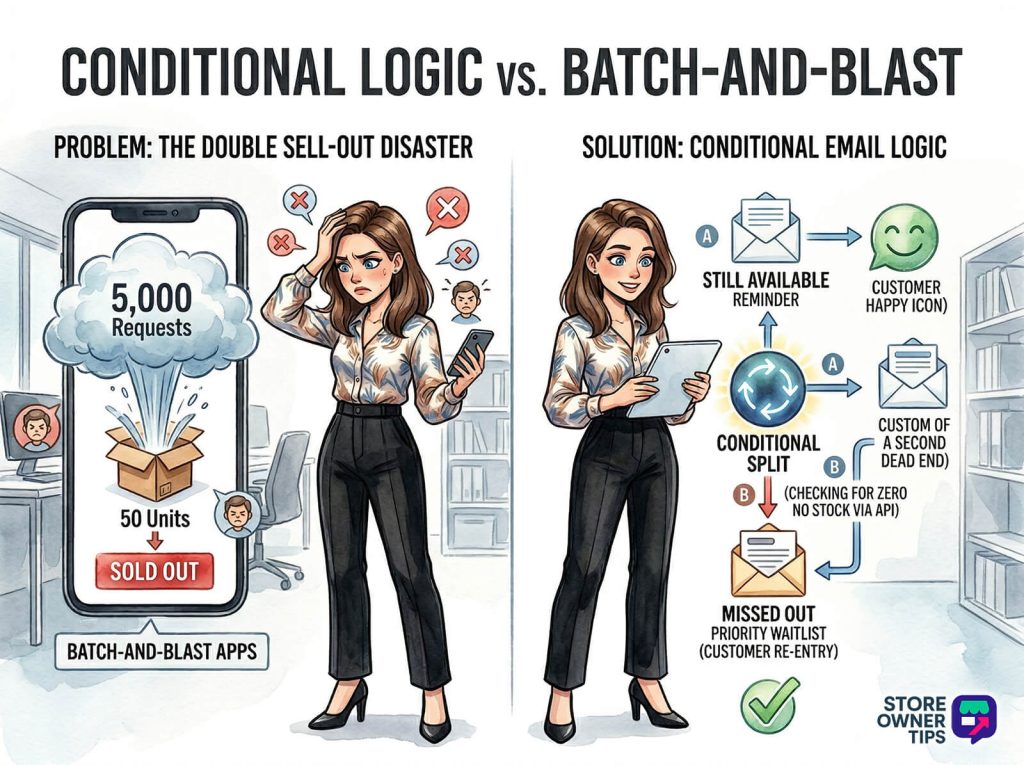
You must step away from basic “batch-and-blast” apps and use smart delay loops in your email software. If you have low stock, set the system to wait 48 hours after the first alert. Before it sends a reminder email, it should check your live inventory. If the stock is zero, it automatically switches the message to a polite “Missed Out” email that offers priority access for the next drop, rather than sending them back to a sold-out page.
Major platforms intentionally focus all their processing power on core stability, secure checkouts, and basic inventory tracking. Sending thousands of instant emails and SMS texts takes heavy computing power. To keep their platforms lightning-fast, they offload complex demand generation and messaging tasks to specialized third-party app developers.
A back-in-stock notification system is an absolute necessity for turning supply chain failures into high-converting revenue opportunities. By capturing shopper intent the exact moment they experience scarcity, you protect your digital search rankings. Moreover, you gather vital purchasing data and build a highly profitable safety net for your online storefront.
Copyright © StoreOwnerTips.com. All Rights Reserved.
