Weekly ecommerce tips, deals & news.
Churn Rate is the percentage of customers who stop buying from you over a set period. You take the number of customers lost, divide it by the number you started with, then multiply by 100. It is the flip side of retention, showing how many people slip away. A high churn rate quietly drains the growth you work so hard to build.
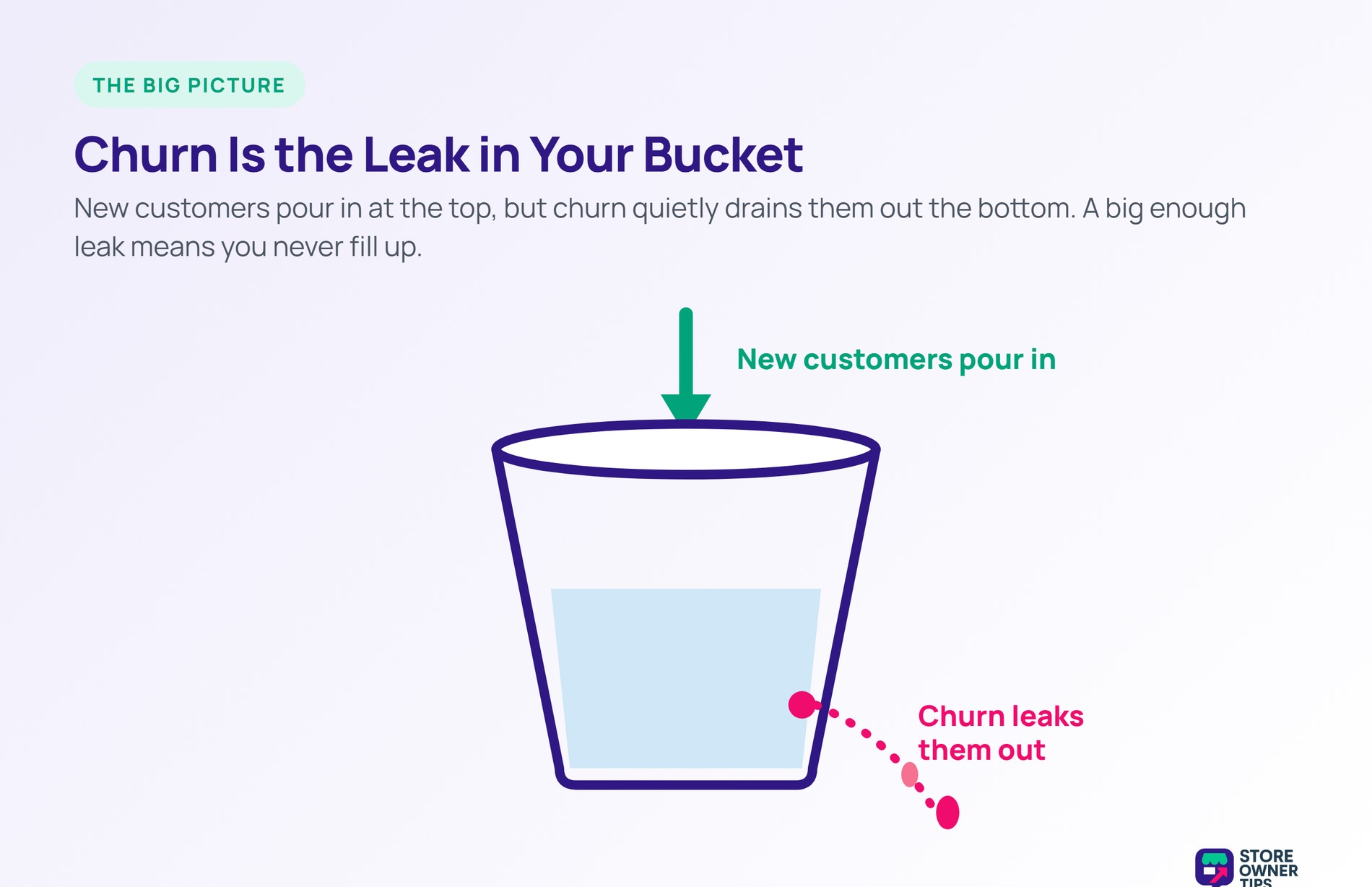
Think of your customer base as a bucket of water. New customers pour in at the top, which feels like growth. But churn is the leak at the bottom, quietly draining the bucket. If the leak is big enough, you can pour forever and never fill it.
The formula is simple once you pick a time window. Take the customers you lost during that period, then divide by the count you started with. Multiply by 100, and you have your churn rate as a percentage. So losing 50 of 500 starting customers is a 10% churn rate.
Subscription stores measure churn most precisely, since cancellations are obvious. For one-time product stores, churn is fuzzier but still real. There, you might count a customer as churned after months of no orders. The key is to pick a clear definition and stick with it.
There are actually two churn numbers worth watching. Customer churn counts how many people leave. Revenue churn counts how much money walks out with them. The two can tell very different stories.
Losing ten small customers hurts less than losing one big spender. So revenue churn shows the true financial damage. A store can have low customer churn but high revenue churn. Tracking both keeps you from being fooled by the headline number.
Churn quietly decides whether your growth is real or an illusion. Winning new customers is expensive, so losing old ones doubles the pain. The profit math is striking here. Raising retention by just 5% can lift profits by 25% to 95%.
The reason is that loyal customers carry most of the load. In fact, repeat buyers can drive 44% of total revenue while being a small share of the base. Every churned customer chips away at that valuable group. So cutting churn protects your most profitable revenue.
Customers leave for reasons you can often fix. Poor product quality and weak support top the list. Surprise costs, a clunky experience, or simply being forgotten also push people away. On WooCommerce or Shopify, a thoughtful follow-up plan can plug many of these leaks.
Often the cause is silence rather than a single bad event. A customer who never hears from you slowly drifts away. They do not rage-quit, they just forget you exist. Staying gently in touch is one of the simplest churn fighters.
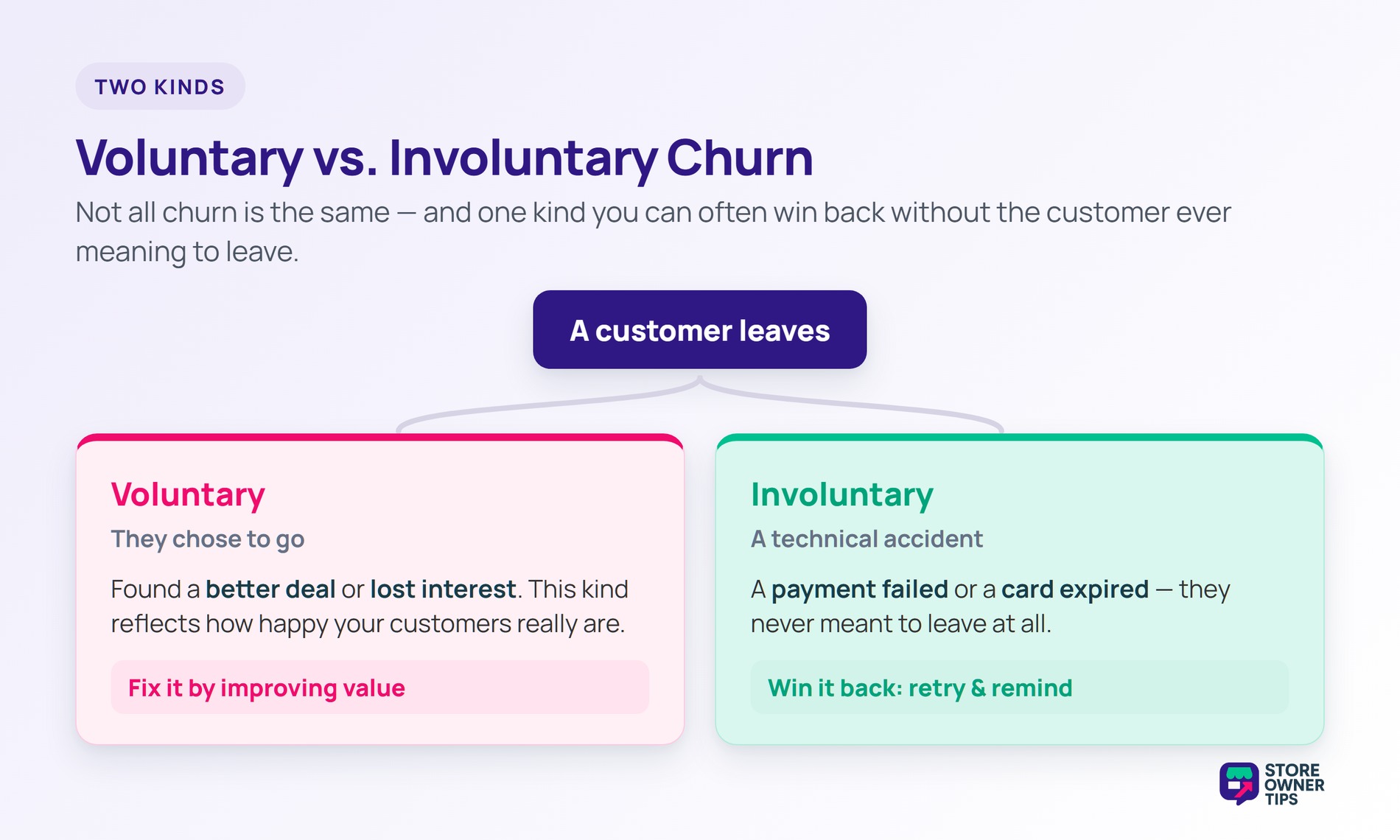
Not all churn happens for the same reason. Voluntary churn is when a customer actively chooses to leave. Maybe they found a better deal or lost interest in the product. This kind reflects how happy your customers truly are.
Involuntary churn is more of a technical accident. It happens when a payment fails or a card simply expires. The customer never meant to leave at all. A quick payment-retry or update reminder often saves these sales.
Lowering churn is one of the highest-return moves in e-commerce. The goal is to give customers more reasons to stay than to go. A strong tiered loyalty program rewards people for sticking around. Helpful onboarding and steady value keep the relationship warm.
The payoff shows up in lifetime value, not just this month’s sales. Stores often aim for a 3:1 value-to-cost ratio, and low churn makes that far easier. A few proven tactics tend to move the needle most:
Imagine a mid-sized brand called Cedar and Sage that sells monthly tea boxes on WooCommerce. Growth looks fine on the surface, but profit feels stuck. So they decide to measure churn for the first time.
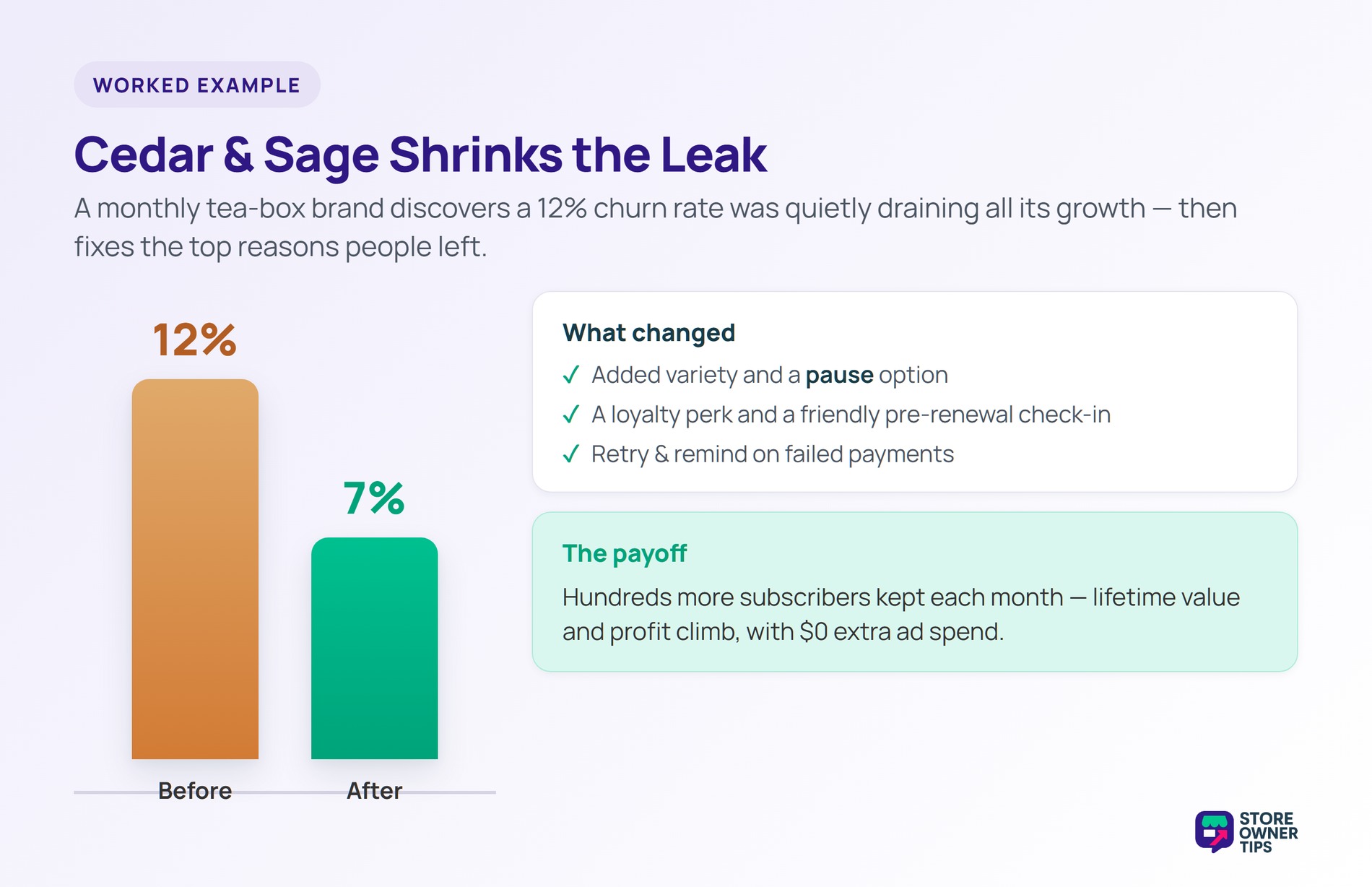
Cedar and Sage start the month with 1,000 subscribers. By month’s end, 120 have canceled their boxes. That works out to a 12% monthly churn rate. At that pace, they lose most of their base within a year.
The number stops them in their tracks. All their growth was just refilling a leaky bucket. They had been celebrating new signups while ignoring the exits. The churn rate finally shows where the real problem hides.
They survey leavers and learn boxes felt repetitive and pricey. So they add variety, a pause option, and a loyalty perk for staying. They also send a friendly check-in email before renewal. Each change gives customers a reason to stick around.
Crucially, they fix the failed-payment problem too. Many cancellations were just expired cards, not unhappy customers. A simple retry-and-remind flow recovers those quietly. That alone trims a surprising slice of the churn.
Within a few months, monthly churn drops from 12% to 7%. That small shift keeps hundreds more subscribers every month. Because those customers keep paying, lifetime value climbs and profit follows. Cedar and Sage grow faster while spending nothing extra on ads.
Cedar and Sage did not guess at the problem. They asked leaving customers directly and listened to the answers. Repetition and price were the real sticking points. Fixing both removed the top reasons people were canceling.
The pause option also caught a hidden group of leavers. Some only wanted a short break, not a full goodbye. Giving them that choice kept the relationship alive. Many returned within a month or two, instead of vanishing for good.
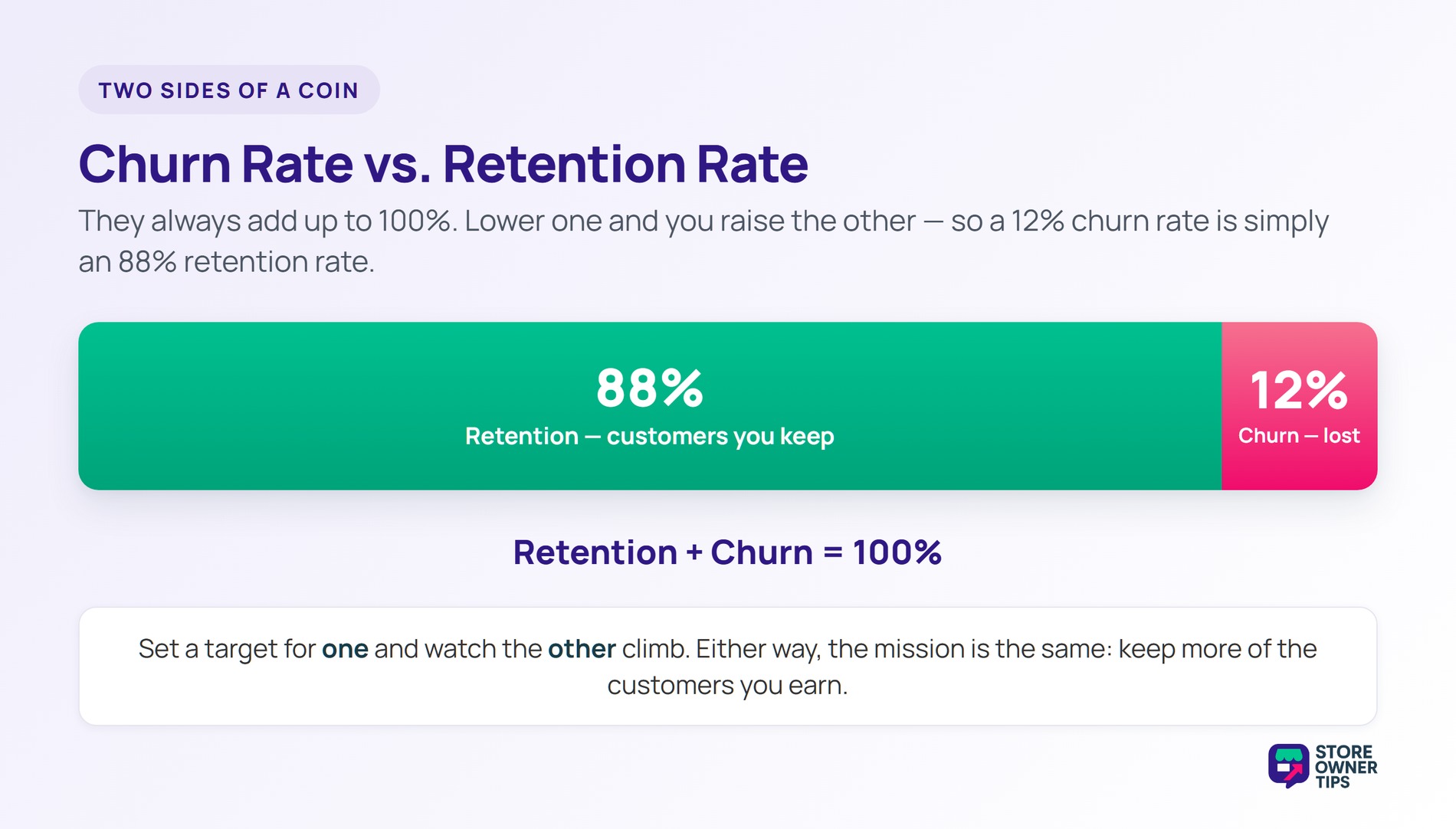
Churn rate and retention rate are two sides of one coin. Churn measures the customers you lose, while retention measures the ones you keep. Together they always add up to 100%. So a 12% churn rate means an 88% retention rate.
Tracking both keeps your focus where it belongs. Churn highlights the problem you need to fix. Retention celebrates the loyalty you are building. Watching them side by side gives you the full picture of customer health.
The practical move is to set a target for one and watch the other. Most teams pick a churn goal, since it names the problem plainly. Then they celebrate the matching retention number as it climbs. Either way, the mission is the same: keep more of the customers you earn.
It depends heavily on your business model and industry. Subscription stores often aim for low single-digit monthly churn. One-time product stores naturally see higher numbers, since repeat buying is rarer. The best goal is simply to lower your own churn over time.
Compare yourself to your own past, not a rival in another niche. A steady downward trend is the real win to chase. Even a point or two of improvement compounds over time.
Start by asking why customers leave, then fix the top reasons. Great support and a strong loyalty program keep people engaged. Timely targeted email marketing reminds them why they signed up. Small, caring touches add up to fewer cancellations.
Do not forget the technical side either. Recovering failed payments can quietly save a chunk of your churn. It is often the easiest win of all.
No, though subscriptions make it easiest to measure. Any store can track how many customers stop buying over time. For product stores, you set a window that signals a customer has lapsed. The concept of lost customers applies to every business.
So even a one-time product shop benefits from watching churn. It simply tells you how well your repeat business is holding. A falling repeat rate is an early warning worth heeding.
Churn rate is the leak that decides whether your growth holds or drains away. Even a small reduction protects your most profitable customers and lifts long-term value. Measure it, learn why people leave, and fix those reasons, and your store grows on a much steadier base.
Acquisition gets all the attention, but retention quietly wins the long game. Keep your churn low, and every other number gets easier to grow. A loyal base is the steadiest foundation a store can build on.
Copyright © StoreOwnerTips.com. All Rights Reserved.
