Weekly ecommerce tips, deals & news.
Conversational checkout is a smart ecommerce feature that lets your customers go from finding a product to paying for it entirely within a single chat window. Instead of clicking through confusing menus and filling out long web forms, shoppers just type or speak what they want to an AI assistant. It’s like having a helpful, lightning-fast store clerk inside their phone, making buying fast, easy, and completely frictionless.
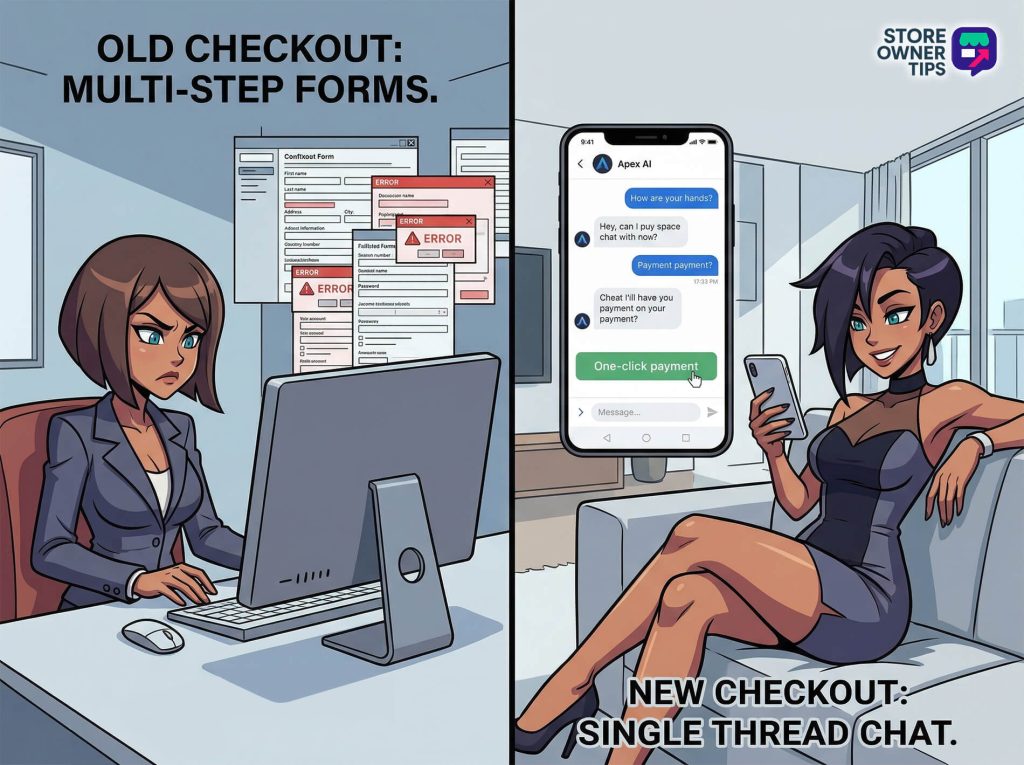
To see why this is such a game-changer, we first need to talk about conversational commerce, which is just the industry term for using chat apps and AI to help your customers shop. For years, stores have used basic chat widgets to answer questions and guide shoppers. But those early bots had a huge flaw. If a customer actually wanted to buy a jacket, the bot would just drop a link and force them to fill out a regular, multi-page checkout form.
Conversational checkout fixes this. It’s a “closed-loop” system. This means the entire transaction happens right there in the chat. A customer can type, “I need a pair of waterproof running shoes, size 10, delivered to my house by Friday.”
In a normal store, this takes a dozen clicks. You have to use search bars, click size filters, read shipping pages, and type in your credit card. With a conversational setup, the AI does all the heavy lifting for you. It finds the item, checks the shipping, and asks for payment approval (like using FaceID) in one smooth flow.
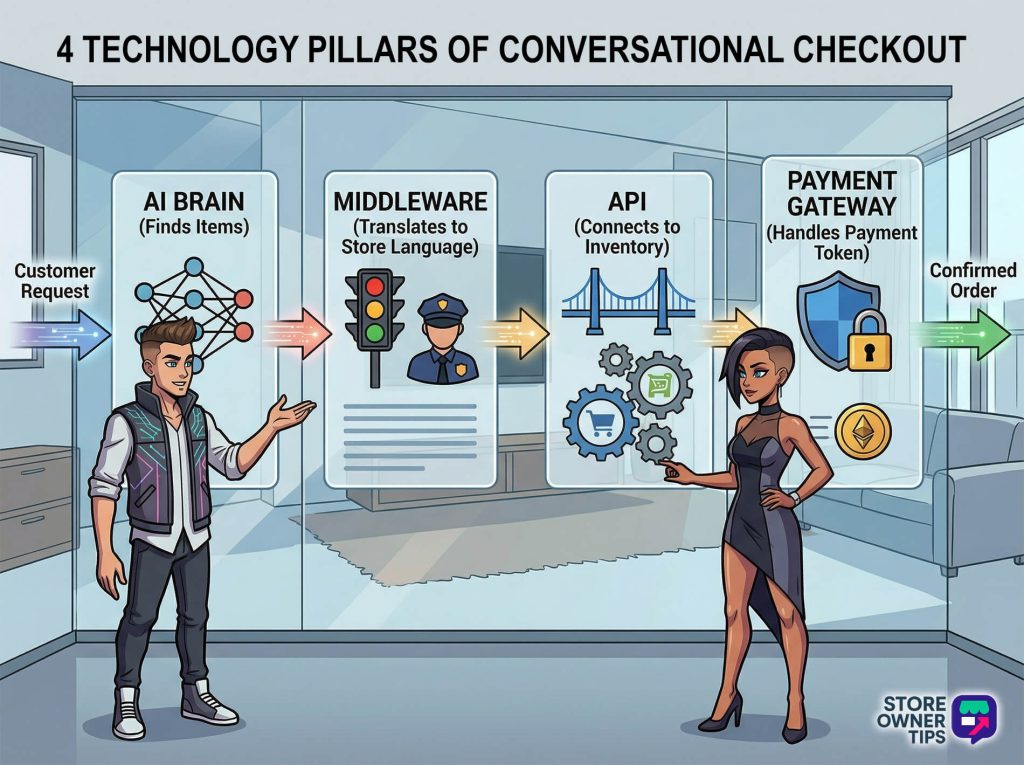
Making this work requires some impressive technology working behind the scenes. Think of it as a four-part team:
Why does this work so well? It comes down to saving brainpower. Experts call this cognitive load. Basically, humans only have so much mental energy to use at one time. Normal checkouts drain this energy fast. You have to scan busy pages, remember passwords, and fix annoying typing errors.
Conversational checkout fixes this by letting people just talk or type naturally. It takes way less mental effort. It also cures “decision fatigue” during product discovery. Instead of throwing a catalog of 500 items at a shopper, the AI listens to what they want and shows them the two or three best options. This makes the customer feel expertly guided and much more likely to buy.
To see how this actually impacts a business, let’s look at a highly realistic, hypothetical store called Apex Apparel Co.
Apex Apparel is a mid-sized clothing brand. They get exactly 1,000,000 unique visitors to their website every year. Under their old, traditional website design, their baseline conversion rate is 2.0%. With an average order value of $100, they make $2,000,000 from those initial buyers.
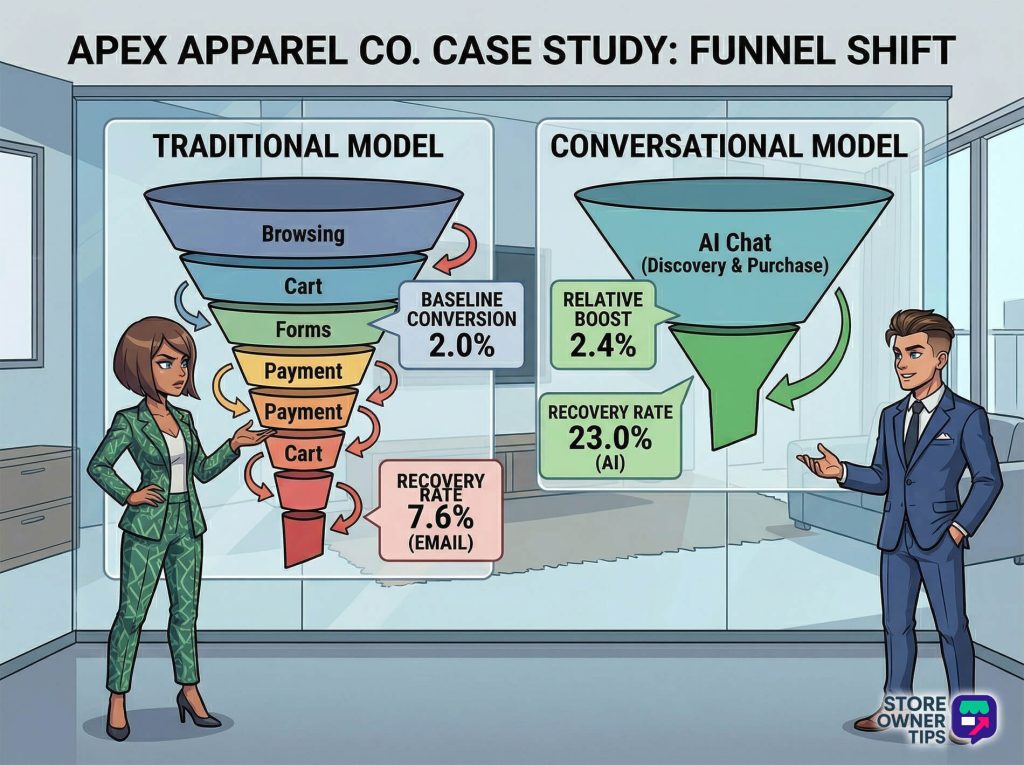
However, a lot of people drop out at the last second. Like most of the internet, Apex suffers from a massive 70% cart abandonment rate. That means 32,600 carts are left behind. Apex uses standard reminder emails (which usually get about a 10.7% success rate) to win back roughly 2,500 orders.
Now, let’s look at what happens when Apex Apparel installs a conversational checkout system.
Because the new chat interface is so much easier to use—especially on mobile phones—their baseline conversion rate gets a 20% relative boost. It goes from 2.0% up to 2.4%. Right out of the gate, they’re getting 24,000 initial orders.
But the real magic happens with the abandoned carts. People still hesitate when they see the final price. But instead of waiting a day to send an email, the AI assistant jumps in immediately. If a shopper pauses, the bot might say, “Hey, I noticed you’re looking at that jacket. I can offer free shipping if you buy it right now.”
Because this happens in real-time, their cart recovery rate skyrockets from the old email average of 7.6% up to a massive 23.0%. The AI successfully closes almost 9,000 extra sales right inside the chat.
Even when Apex Apparel pays a premium 4% fee for the AI software to process some of those orders, the absolute profit is staggeringly higher. They generated over $1 million in extra revenue using the exact same amount of website traffic, simply by making it easier to buy.
How does this new method stack up directly against the old way of doing things? Here is a simple breakdown.
| Feature | Traditional Multi-Step Checkout | AI-Driven Conversational Checkout |
| How You Use It | Clicking through static web pages and filling out long forms. | Typing or speaking into a single, flowing chat window. |
| Finding Products | Manually clicking categories, filters, and pages. | The AI curates and finds exact items based on your plain-English request. |
| Mental Effort | High. You have to read, remember passwords, and fix form errors. | Low. You just state what you want naturally. |
| Mobile Experience | Poor. Typing on small glass screens is frustrating and leads to typos. | Excellent. It feels exactly like texting a friend. |
| Customer Support | Slow. You have to leave the cart to read an FAQ page or send an email. | Instant. The AI answers your questions right in the middle of the checkout. |
While this technology is powerful, store owners need to look at both the good and the bad before diving in.
The Pros:
The Cons:

The AI actually never sees your raw credit card number. It uses a secure process called tokenization. When it’s time to pay, the chat connects to a secure gateway (like Stripe). The gateway handles the card and hands the chat a secure, encrypted “token” to finish the sale. This keeps everyone’s data completely safe.
No, it doesn’t replace your store! Your main website remains the “boss” that handles all your inventory and taxes. This new type of conversational commerce layer just sits on top of your existing site as an extra tool. Basically, you can use it as a chat bubble on your site, giving customers the choice to use the chat or use the normal checkout.
A good ecommerce bot is securely chained to your store’s live database. Before the AI is allowed to answer a customer, it’s forced to check your actual inventory and pricing. If your database says an item is out of stock, the AI has to repeat that exact information. It isn’t allowed to guess.
At the end of the day, conversational checkout isn’t just a fun new feature; it’s how your store will keep growing for years to come. By letting people buy things as easily as texting a friend, you completely remove the frustrating hurdles that cause them to abandon their carts. Making your shopping experience fast, friendly, and totally effortless is the absolute best way to win lifelong customers.
Copyright © StoreOwnerTips.com. All Rights Reserved.
