Weekly ecommerce tips, deals & news.
Coupon abuse is the use of a discount code in ways you never intended. It covers leaked private codes, one-per-customer offers claimed dozens of times, and discounts stacked in combinations you never approved. The shopper is not always a criminal, and often the rules simply left a door open.
So most abuse is a configuration problem before it is a fraud problem.
Discounting works, which is exactly why it attracts exploitation. A code that reliably saves money will be shared, tested and reused. However, most store owners only discover the problem when margins look wrong.
By then the campaign has usually finished.
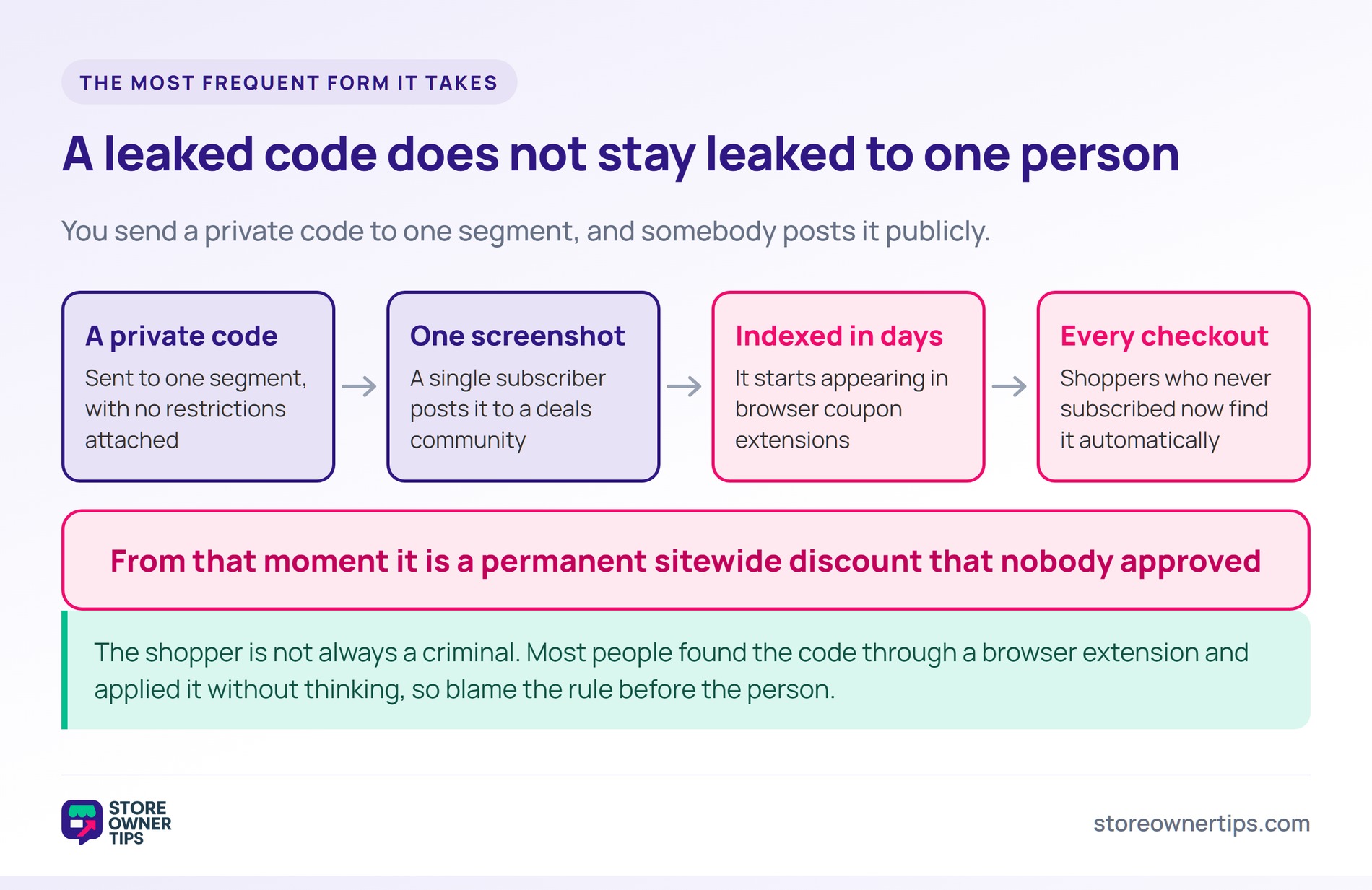
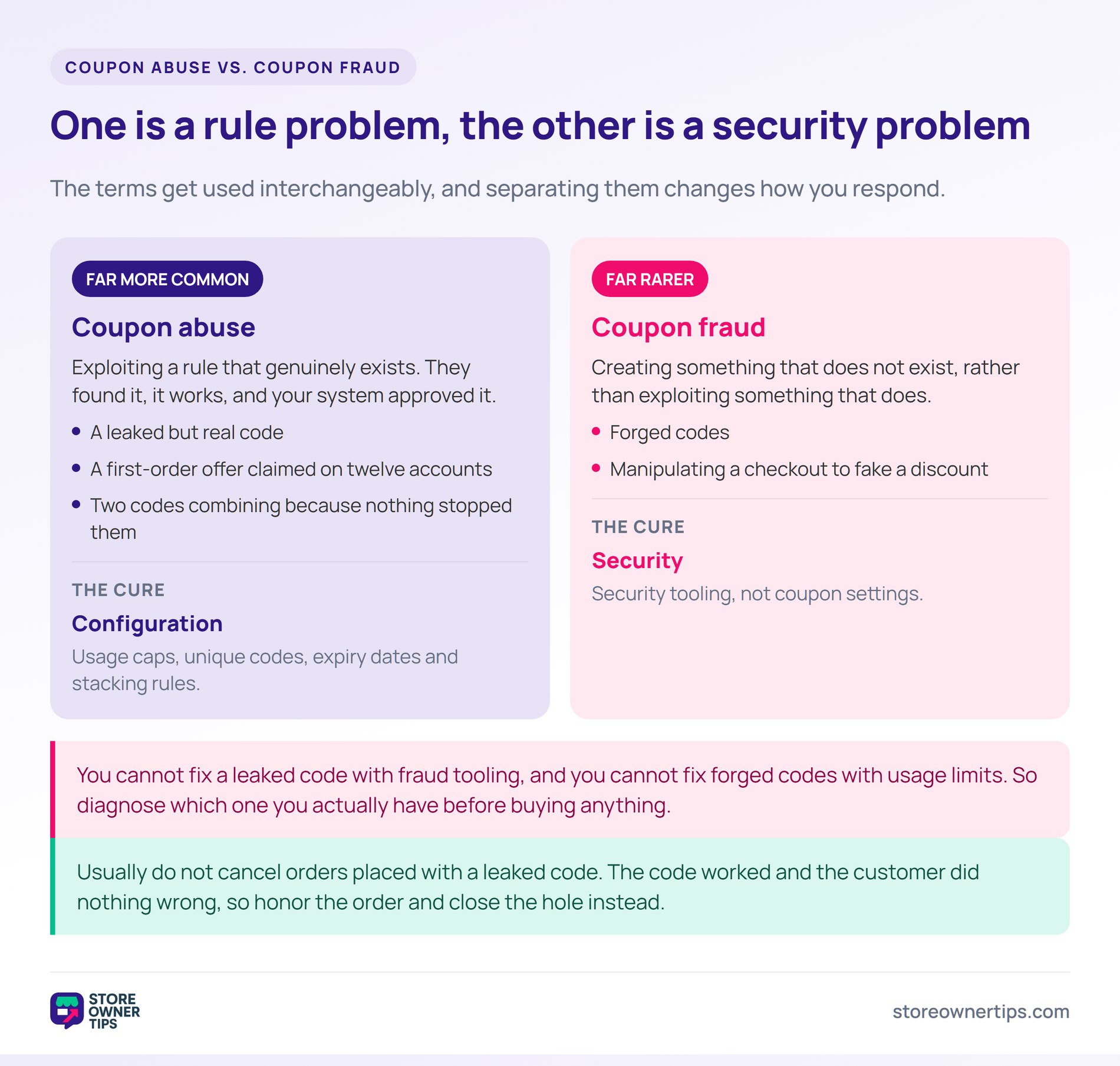
Code leaking is the most frequent. You send a private code to one segment and somebody posts it on a deal forum. From that moment it is effectively a public sitewide discount.
Next comes serial redemption. A first-order offer is meant to win one new customer. Meanwhile, one person creates a dozen accounts with different email addresses and claims it repeatedly.
Stacking is the third. Two codes that were never designed to combine end up applied together, producing a discount far past what you approved. In practice, that usually reveals a missing rule rather than a clever shopper.
Finally there is threshold gaming. A shopper adds cheap filler to reach a free-shipping or free-gift threshold, claims the reward, then returns the filler. So the reward survives and the qualifying purchase does not.
Abuse does not look like a problem on a revenue dashboard. Orders arrive, the checkout works and nothing errors. Meanwhile, the damage sits entirely in gross margin.
Retail loss generally behaves this way. The National Retail Federation put the average shrink rate at 1.6% of sales in one survey year. That represented $112.1 billion in losses. Small percentages hide very large numbers.
Returns show the same pattern. NRF research found that 9% of all returns are fraudulent. So a measurable slice of apparently normal activity is not what it appears.
Coupon abuse hides in the same way. It arrives as ordinary orders at unremarkable values. As a result, it is usually found by someone reading a report rather than by an alert.
It helps to separate the people involved, because they need different responses. Most of them are ordinary shoppers. They found a code through a browser extension and applied it without thinking.
So there is nothing to police there, only a rule to tighten. A smaller group hunts deliberately, reading deal forums and testing old codes. Meanwhile, they are still buying your product at a discount you technically offered.
A much smaller group is systematic. Dozens of accounts and fake addresses get used to claim a first-order discount repeatedly. That group is worth blocking outright.
Coupon sites sit in their own category. They may bring genuine new customers, or they may intercept shoppers who were already buying. So judge them on incremental orders rather than on redemption volume.
Start with usage limits, because they solve most of it. Cap total redemptions and cap uses per customer. So a leaked code burns out instead of running forever.
Use unique codes for anything genuinely personal. A single shared code for a win-back campaign is one screenshot away from being public. By contrast, one code per recipient makes a leak traceable and containable.
Decide explicitly what may combine. Setting a discount as mutually exclusive stops the stacking problem at the source. Meanwhile, a stackable coupon should be a deliberate choice, not an accident.
Add expiry dates to everything. An old code with no end date is a liability sitting in someone’s inbox. Even so, expiry alone will not stop a code being shared while it is live.
Finally, watch the pattern rather than the individual. A sudden spike in one code, many accounts on one address, or repeat returns of filler items all signal something. In practice, the pattern is visible long before any single order looks wrong.
Imagine a store called Harbour Goods selling homeware. It emails a private WELCOME20 code to new subscribers. The code takes twenty percent off with no restrictions attached.
One subscriber posts WELCOME20 to a deals community. It is indexed within days and starts appearing in browser coupon extensions. So shoppers who never subscribed now find it automatically at checkout.
Nothing looks broken from the inside. Orders keep arriving and conversion actually improves slightly. Meanwhile, twenty percent is coming off orders that would have paid full price.
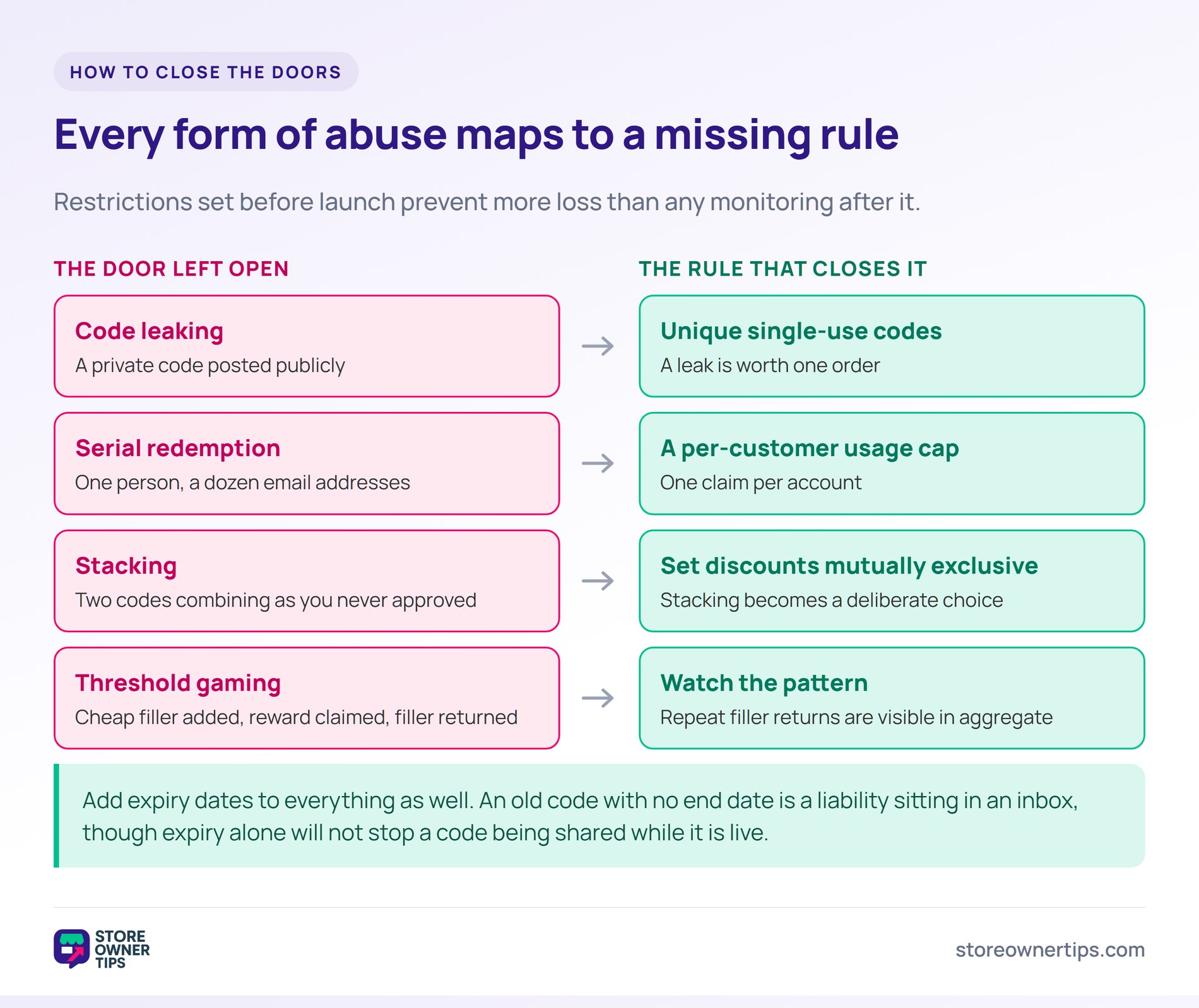
Say Harbour Goods runs a 45% margin on a typical $80 order. That is $36 of gross profit. A twenty percent discount removes $16, leaving $20.
So the discount consumed 44% of the profit on every leaked order. Revenue barely moved, which is precisely why nobody noticed.
Harbour Goods retires the shared code entirely. Each new subscriber now receives a unique single-use code instead. So a leaked code is worth exactly one order to a stranger.
The offer also gains rules it should have had. It expires after thirty days, applies once per customer, and cannot combine with other promotions. Meanwhile, a minimum spend stops it being used on the cheapest item in the catalog.
The team also changes how codes get delivered. A URL coupon that applies on click is easier to trace back to a campaign. Meanwhile, an auto-apply coupon removes the need to publish a code at all.
None of that punishes genuine new customers. They receive the same twenty percent they were always promised. In practice, the only people worse off are the ones the offer was never for.
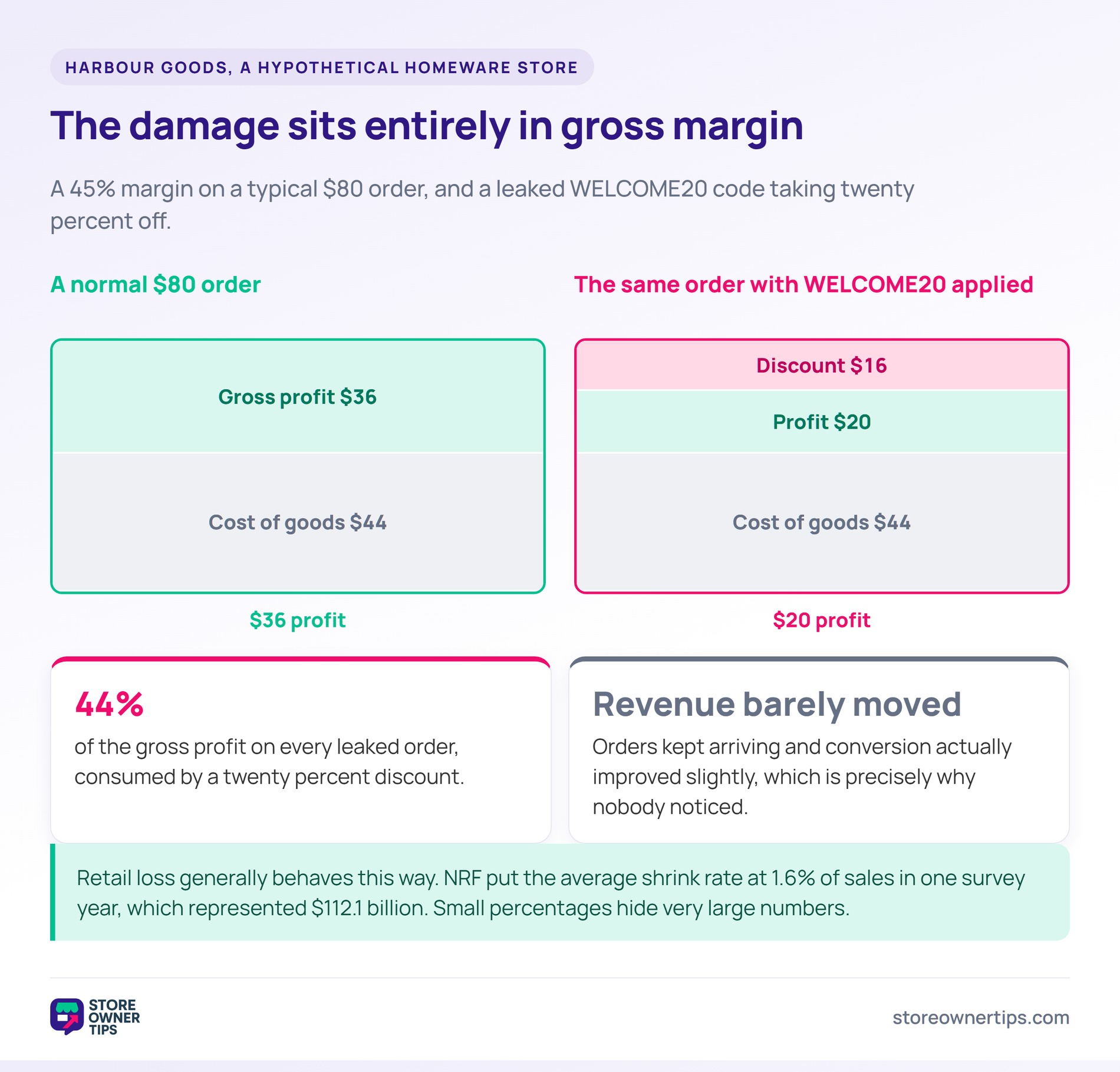
The two terms get used interchangeably, and separating them changes how you respond. Abuse is exploiting a rule that genuinely exists. Fraud involves creating something that does not.
A shopper using a leaked but real code is abusing the offer. They found it, it works, and your system approved it. So the fix is a better rule.
Someone forging codes or manipulating a checkout to fake a discount is doing something else. That is fraud, and the response is security rather than configuration. Meanwhile, it is far rarer than ordinary abuse.
The distinction matters because the cures differ. You cannot fix a leaked code with fraud tooling, and you cannot fix forged codes with usage limits. So diagnose which one you actually have.
Assume every shared code eventually will, and design around that. Unique single-use codes are the only reliable answer for private offers. So a leak costs you one order rather than a season.
Where a shared code is unavoidable, cap total redemptions and set a short expiry. That converts an open-ended liability into a bounded one. Meanwhile, monitor redemption counts so a spike gets noticed early.
Usually not, because the code worked and the customer did nothing wrong. Cancelling creates complaints, disputes and reviews that cost more than the discount. So honor the order and close the hole instead.
Deliberate, repeated exploitation is a different matter. Dozens of orders from one person using fake accounts justify a firmer response. Even then, blocking the pattern beats arguing with the individual.
Compare redemptions against the audience you actually sent the code to. A private offer emailed to 500 people should not have 4,000 redemptions. So that gap alone tells you the code escaped.
Also watch margin per order rather than revenue. A campaign where revenue holds but profit per order slides is the classic signature. In practice, that is the report worth checking weekly.
Coupon abuse is rarely a crime wave. It is usually an offer that shipped without limits, then found an audience it was never meant for.
So set usage caps, expiry and stacking rules before you launch, and use unique codes for anything private. For the practical steps, see this guide to preventing coupon fraud and abuse.
Copyright © StoreOwnerTips.com. All Rights Reserved.
