Weekly ecommerce tips, deals & news.
Customer intent is the specific goal driving a shopper’s actions while they browse your online store. While their demographic profile tells you who they are, intent tells you exactly what they are trying to accomplish right at that very moment. By tracking real-time behavioral signals—like what they search, click, and add to their cart—you can instantly adapt your store to help them learn, compare, or buy.
To truly grasp customer intent, think about the experience of walking into a physical brick-and-mortar store. A highly skilled sales clerk watches your body language. If you’re just browsing, they give you space. If you’re holding two different items and looking confused, they step in to explain the technical differences. And if you have your wallet out, they point you straight to the cash register.
In the digital world, your online store has to do this exact same job automatically. Customers absolutely demand this level of digital empathy. In fact, research shows that 73% of customers expect companies to implicitly understand their unique needs. When a store cannot read intent, it resorts to annoying, blunt tactics. It blasts a 20% off pop-up in your face the second you load the page, interrupting your shopping experience before it even starts.
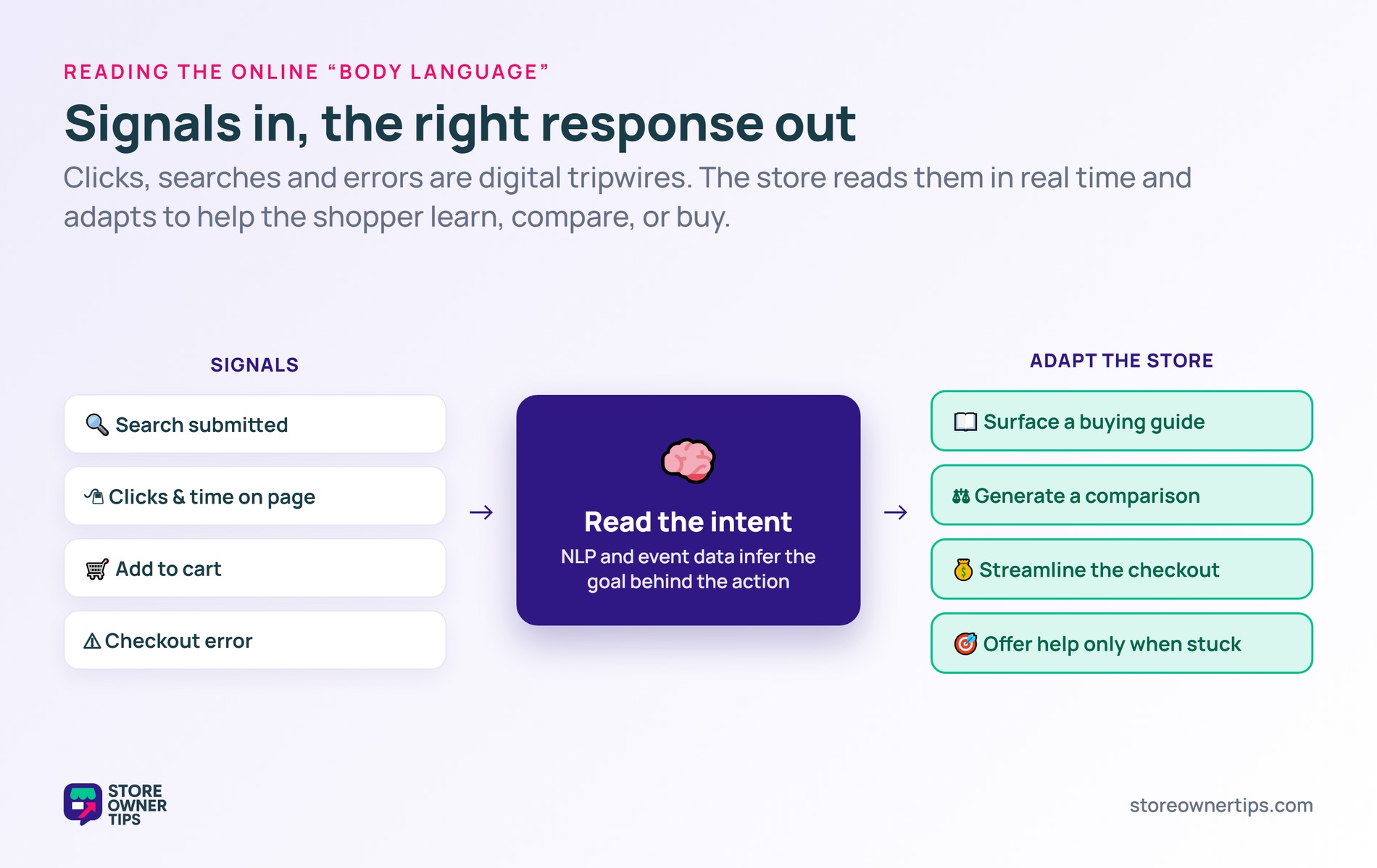
Modern e-commerce platforms read these digital “body language” cues through specific tracking tools. They use things called standard events and pixels.
Analogy: Think of an event pixel like a digital tripwire. Every time a customer takes a specific action—like clicking a search bar or adding an item to a cart—they trip the wire. This sends an alert to your store’s brain telling it exactly what just happened.
These tripwires send packages of data called JSON payloads.
Analogy: Think of a JSON payload as a digital shipping label attached to every click. It tells your system exactly where the customer came from, what language their browser speaks, and the exact dollar amount of the item they are looking at.
For example, when a user types a question into your search bar, they fire a search_submitted event. Advanced artificial intelligence called Natural Language Processing (NLP) reads this.
Analogy: NLP is like a brilliant librarian. If a customer searches for a “laptop stand,” the librarian knows they also might want “ergonomic desk accessories,” even though they didn’t type those exact words.
Later in the journey, if a user gets an error message at checkout (like a declined card or missing address field), an alert_displayed event fires. This tells your engineering team exactly where high-intent buyers are getting frustrated so you can fix the site.
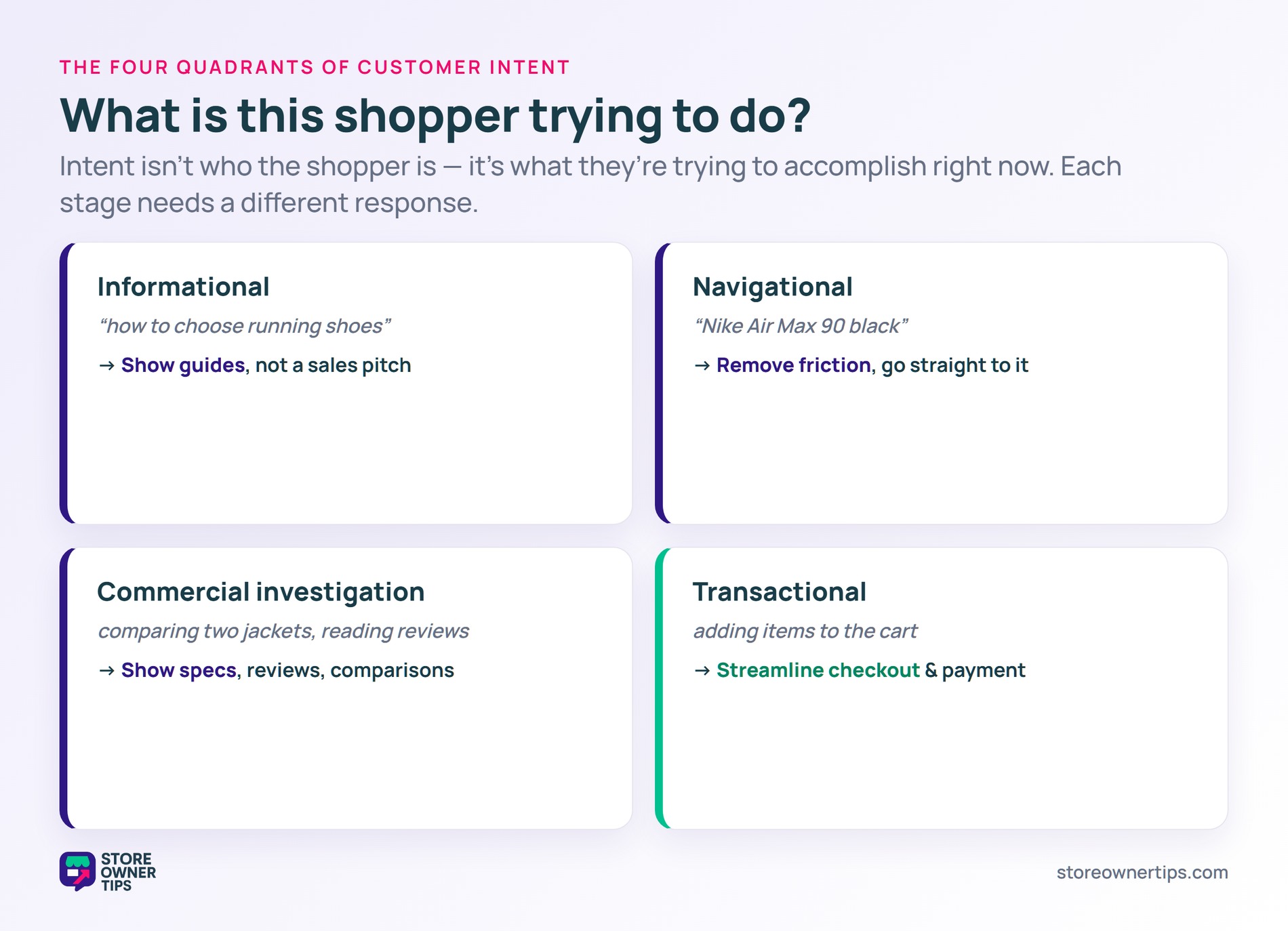
To organize all this, shoppers are broken down into four specific quadrants:
Imagine a mid-sized outdoor apparel brand selling premium winter jackets. We will look at how this store operates with and without customer intent tracking.
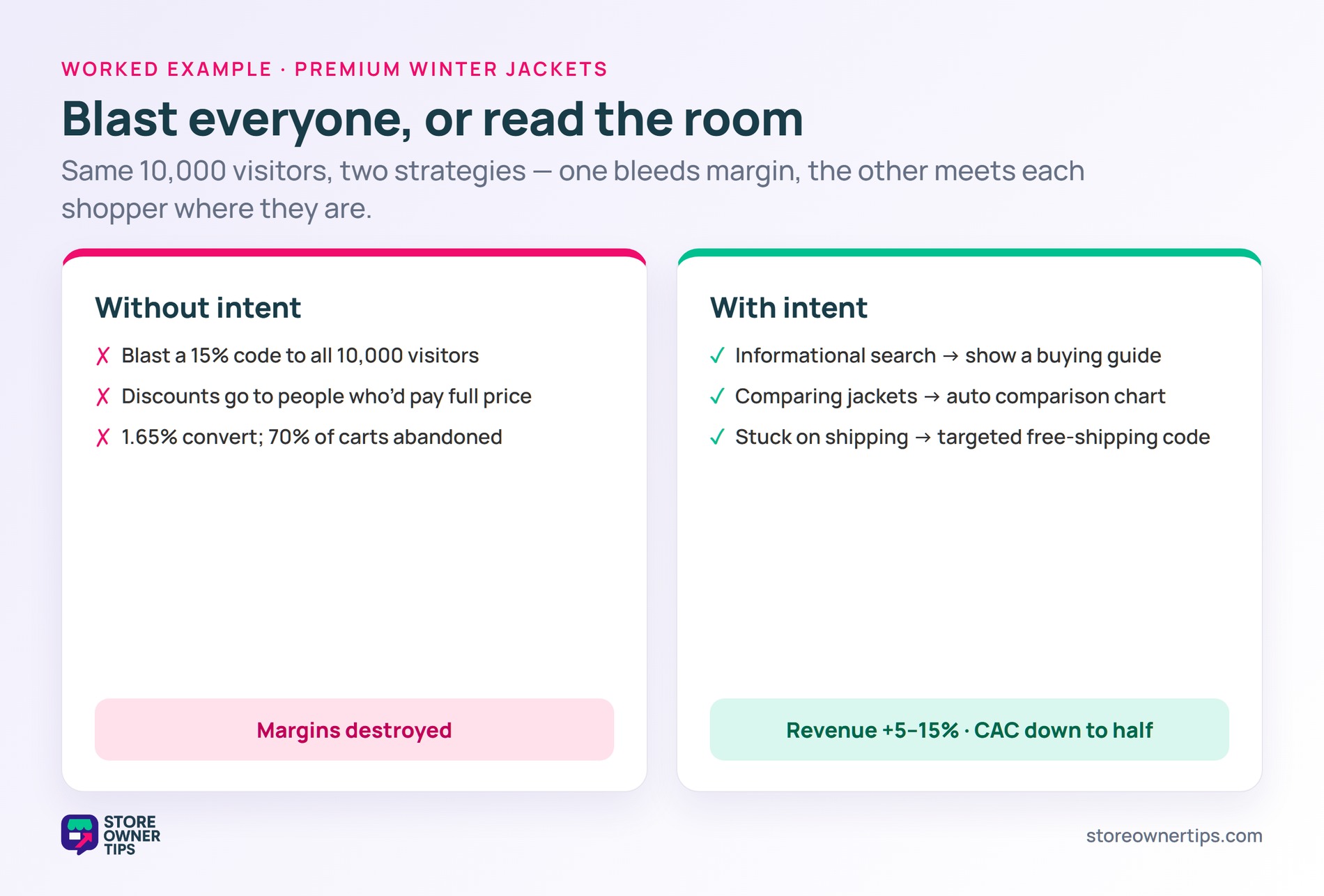
Without intent tracking, the store faces grim, industry-standard numbers. Out of every 10,000 visitors that land on the site, the global e-commerce conversion rate sits at a tiny 1.65%. That means only 165 people actually buy a jacket. Even among the highly interested users who put a jacket in their cart, the global cart abandonment rate is an enormous 70.22%. Furthermore, because the site is not optimized to understand when a mobile user is struggling, mobile users are 5x more likely to abandon their tasks.
To try and fix this, the store blasts a site-wide 15% discount code to all 10,000 visitors. This destroys their profit margins because they are giving discounts to people who would have happily paid full price.
Now, let’s turn on customer intent tracking. The store’s system watches a specific shopper. This shopper searches for “waterproof vs water-resistant jackets.” The site recognizes this as Informational intent and shows them a helpful buying guide instead of a sales banner.
Next, the shopper clicks on two specific jackets and spends five minutes reading reviews. The system recognizes this as Commercial Investigation. It automatically generates a side-by-side comparison chart.
Finally, the shopper puts a $200 jacket in their cart but stops at the checkout page. The system fires a checkout event and sees they are hesitating on the shipping costs. Now the system steps in and offers a targeted free shipping code just to this specific user. This satisfies their Transactional intent without giving away a blanket 15% off to everyone else.
By making these exact changes, the math shifts dramatically. Mastering this level of personalization lifts overall revenues by 5% to 15%. It also slashes Customer Acquisition Costs (CAC) by up to 50%. Because the brand invested heavily in removing friction from the user experience (UX), they see a massive return. Every single dollar they invest in UX results in a return of $100—a staggering 9,900% ROI. Ultimately, by operating like this, the brand joins the ranks of fast-growing companies that derive 40% more of their revenue from personalization than their slower-growing competitors.
For decades, marketers relied on demographic targeting. This means grouping people by static facts like age, gender, or zip code. However, relying on this old method means you risk missing more than 70% of potential mobile shoppers.
Why? Because static demographics completely ignore a person’s real-time needs. A 25-year-old woman and a 60-year-old man look totally different on a demographic spreadsheet. But if they both search for “ergonomic office chairs” at the exact same moment, their shopping intent is mathematically identical. Old models used to assume sporting goods were mostly for men, but intent data proves that almost 50% of people searching for sporting goods online are actually women.
Here is how the two strategies compare:
| Feature | Demographic & Interest Targeting | Customer Intent Orchestration |
| How it groups people | By static, long-term traits like age and income. | By real-time actions, clicks, and explicit searches. |
| Type of data used | Historic, generalized, and bought from third parties. | Dynamic, in-the-moment, first-par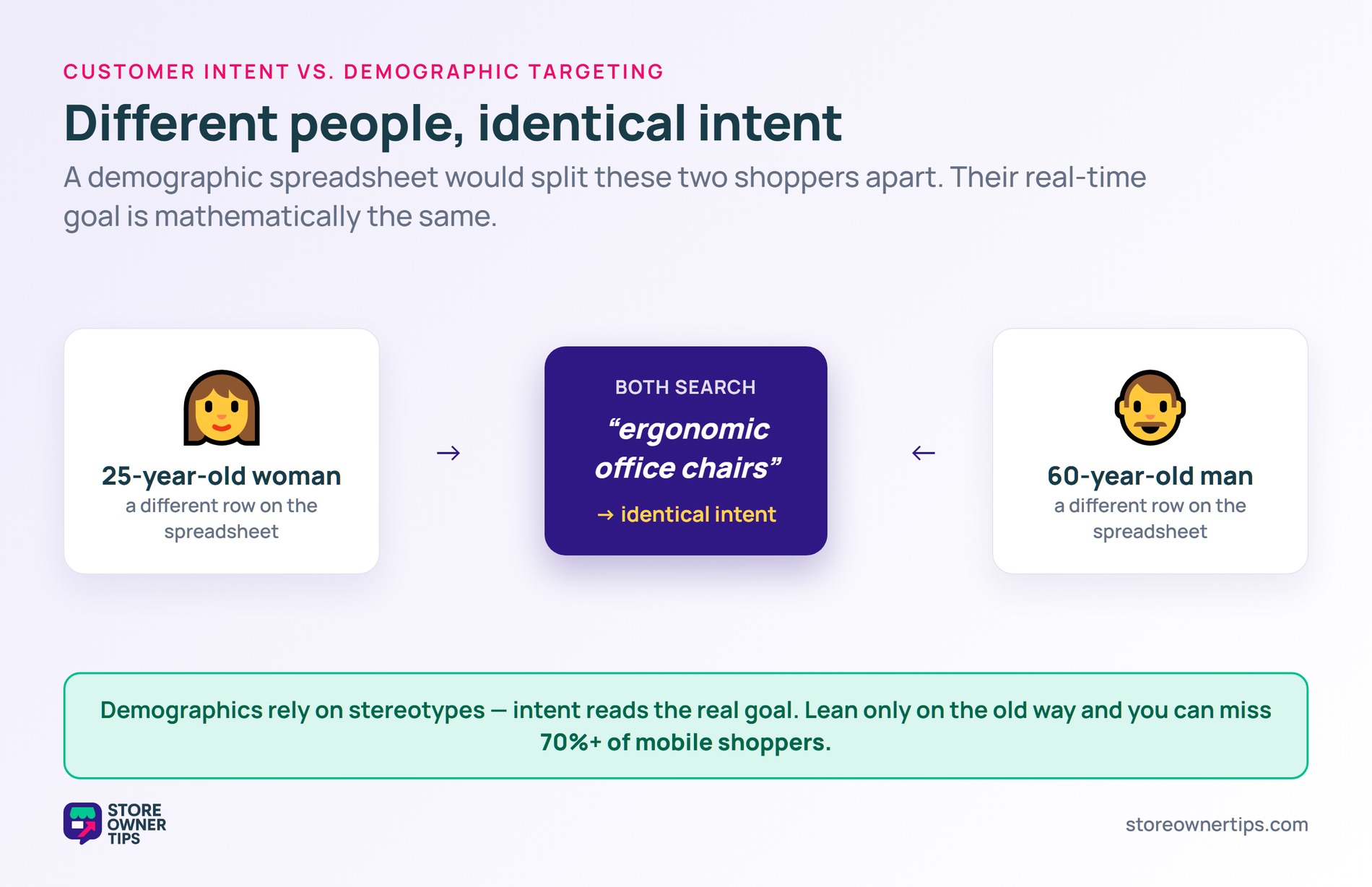 |
| Best used for | Broad brand awareness (like TV or billboard ads). | Immediate conversions, personalized site search, and dynamic pricing. |
| Biggest flaw | Heavily relies on stereotypes and guesses. | Requires complex tech setups and strict privacy compliance. |
Building a store that reacts to customer intent is powerful, but it comes with real operational challenges.
Analogy: A sandbox is like a digital quarantine zone. The code can run safely inside it, but it cannot break out to steal sensitive information from the rest of the website.
Store owners often mistake high interest for high intent. Many shoppers use the “add to cart” button just to figure out the final price. The biggest cause of this is hiding your shipping and tax costs. If you force a user to start the checkout process just to see shipping fees, you engineer your own cart abandonment. Fix this by putting a clear shipping calculator or a “Free Shipping Over $50” banner directly on the product page.
Customers have intense expectations for fast shipping. If a buyer places an order at 4:00 PM on a Friday, and your system promises it by Saturday, you create an impossible situation for your warehouse. You solve this by setting a strict “Daily Cutoff Time” mixed with a “Handling Time” rule in your system. This automatically recalculates the delivery promise based on the exact minute the order was placed, ensuring your digital promises match your physical reality.
Customer behavior analysis tells you exactly what happened. It shows you that a user clicked three links, scrolled down the page, and stayed for five minutes. Customer intent analysis tells you why it happened. It takes all those clicks and understands that the user is in the “Commercial Investigation” phase, allowing your store to dynamically offer them a buying guide rather than just a random pop-up.
Customer intent is the absolute dividing line between an outdated, reactive online store and a highly profitable, predictive e-commerce brand. By understanding and reacting to real-time behavioral signals, you can eliminate the exact friction points that cause 70% of shoppers to abandon their carts. Ultimately, the brands that win aren’t just the ones driving the most traffic; they are the ones who can instantly read and fulfill the exact goals of the traffic that arrives.
Copyright © StoreOwnerTips.com. All Rights Reserved.
