Weekly ecommerce tips, deals & news.
Escrow is holding a buyer’s payment until the seller has delivered what was promised. On a marketplace, the platform keeps the money in the middle instead of passing it straight to the vendor. Once the order is confirmed as fulfilled, the funds are released.
So escrow is how a marketplace lets strangers trade without either side going first on trust.
Every multi-vendor marketplace has the same founding problem. A buyer does not know the seller, and the seller does not know the buyer. However, one of them has to move first.
Escrow is the oldest answer to that, and it predates the internet by centuries.
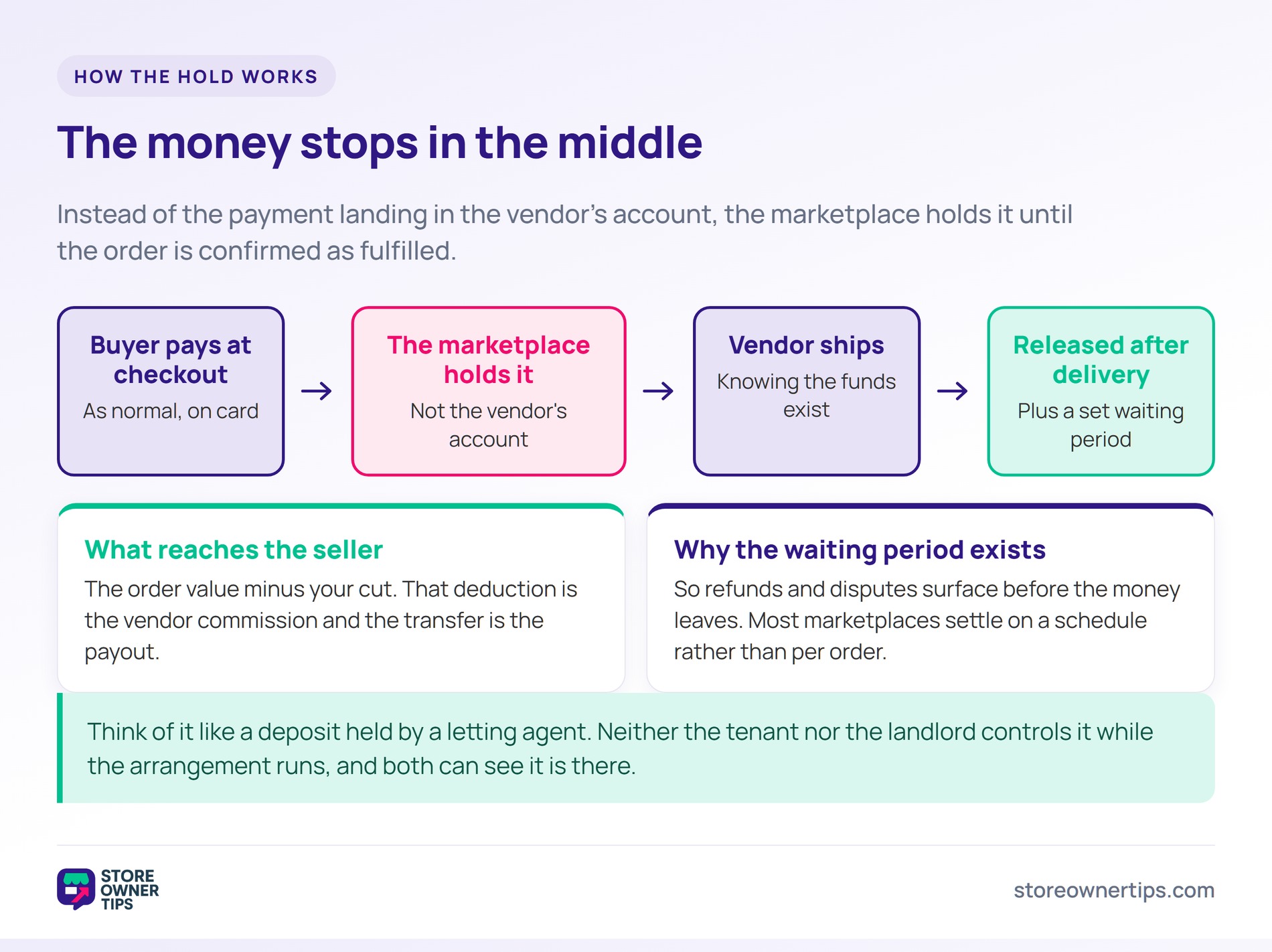
The buyer pays at checkout as normal. Instead of that money landing in the vendor’s account, the marketplace holds it. So the vendor can see the order and ship it, knowing the funds exist.
Think of it like a deposit held by a letting agent. Neither the tenant nor the landlord controls it while the arrangement runs. Meanwhile, both can see it is there.
Release is usually triggered by delivery, or by a set number of days after it. That waiting period exists so refunds and disputes surface before the money leaves. In practice, most marketplaces settle on a schedule rather than releasing per order.
What finally reaches the seller is the order value minus your cut. That deduction is the vendor commission, and the transfer itself is the vendor payout.
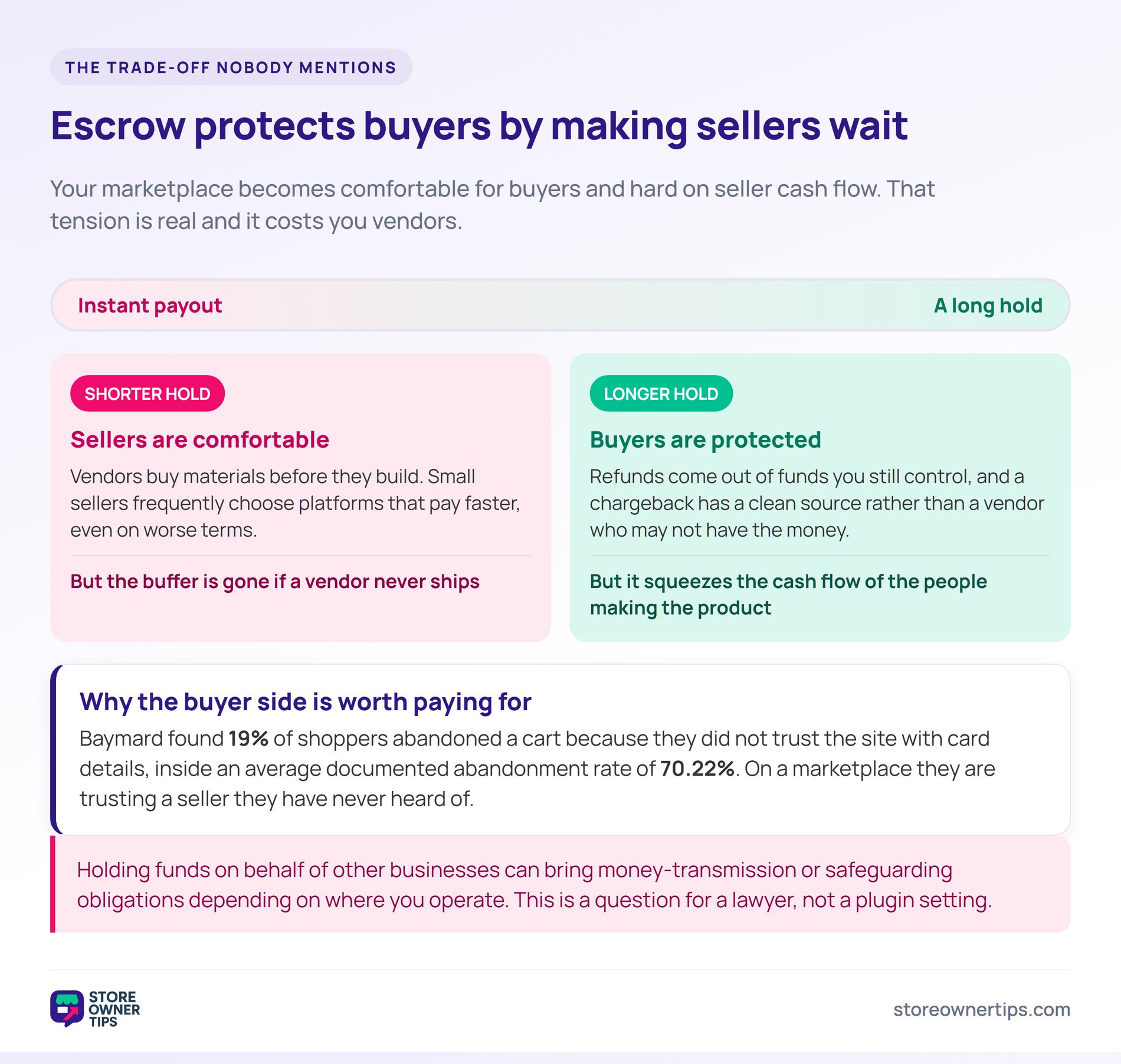
Payment trust is a measurable barrier, not a vague worry. Baymard Institute found that 19% of shoppers abandoned a cart on trust grounds. They did not trust the site with card details. On a marketplace they are trusting a seller they have never heard of.
That sits inside an already brutal funnel. The same research puts the average documented cart abandonment rate at 70.22%. So anything that removes doubt at checkout is worth real money.
The hold protects you as the operator too. If a vendor never ships, the money has not gone anywhere yet. Meanwhile, refunding a buyer from funds you still control is far easier than clawing them back.
Fraud makes that buffer worth having. National Retail Federation research found 9% of all returns are fraudulent. A holding window is when that kind of problem becomes visible.
Escrow also changes how you handle a chargeback. When a buyer disputes a card payment, funds you still hold are the cleanest source of the refund. Meanwhile, a platform that already paid out must recover money from a vendor who may not have it.
Escrow protects buyers by making sellers wait. A vendor who ships on Monday may not see money until the following week. So your marketplace is comfortable for buyers and hard on seller cash flow.
That tension is real and it costs you vendors. Small sellers frequently choose platforms that pay faster, even with worse terms. Meanwhile, a long hold looks like the platform earning interest on their money.
There is also a legal dimension worth naming plainly. Holding funds on behalf of other businesses can bring money-transmission or safeguarding obligations depending on where you operate. So this is a question for a lawyer, not a plugin setting.
That is partly why many WooCommerce marketplaces avoid holding money themselves. They use a payment gateway that splits the transaction, keeping the operator out of the flow of funds. Even so, that choice changes what protection you can offer.
None of this replaces checking who your sellers are. Escrow limits the damage one bad vendor can do, while vendor verification reduces how many you onboard. So the two work together rather than substituting for each other.
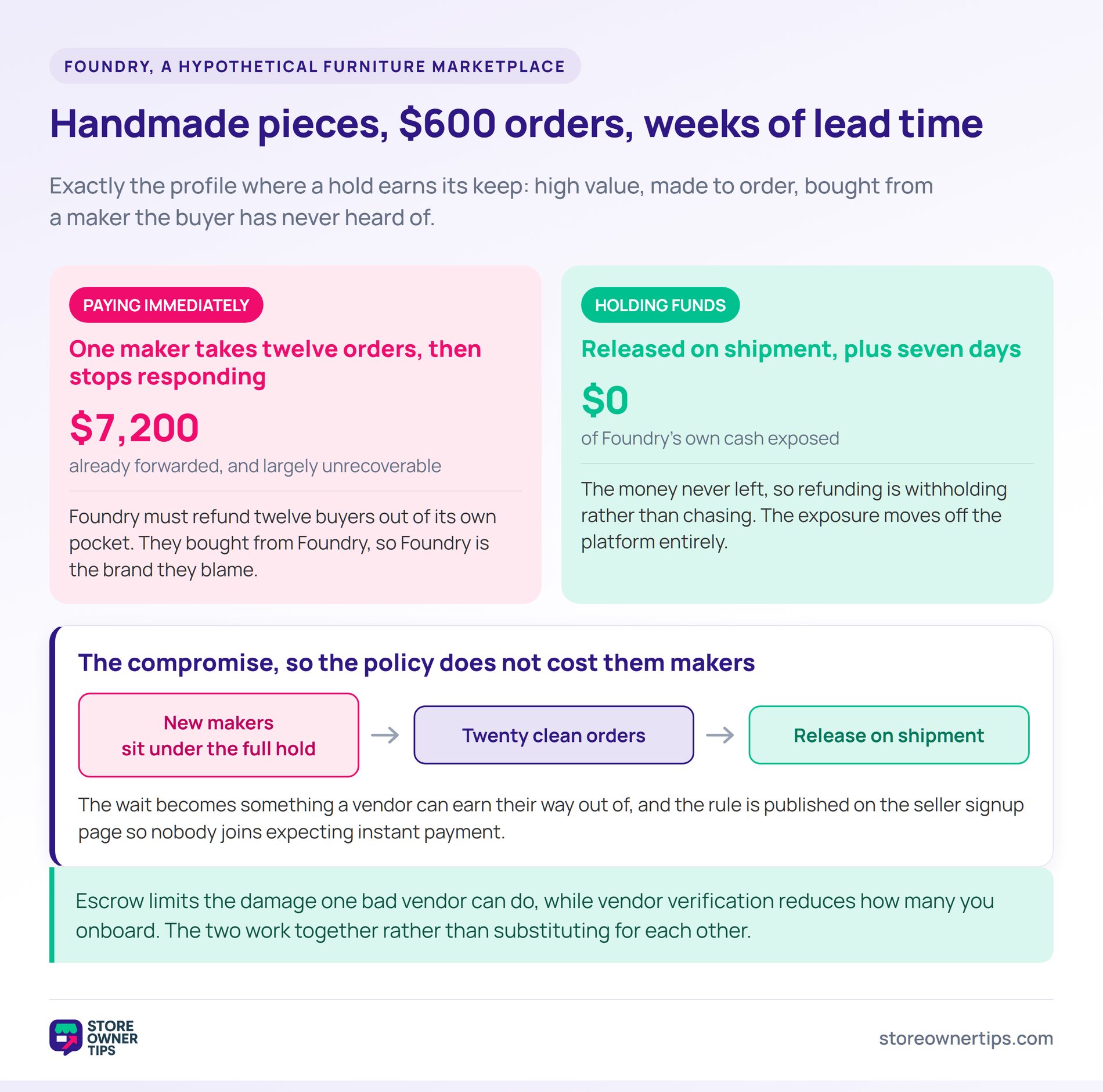
Imagine a marketplace called Foundry selling handmade furniture from independent makers. Orders average $600 and lead times run several weeks. Previously it paid makers immediately at checkout.
One maker takes twelve orders and then stops responding. Foundry has already forwarded roughly $7,200 to them. So the platform must refund twelve buyers out of its own pocket.
Recovering that money is slow and often impossible. Meanwhile, the buyers do not care whose fault it was. They bought from Foundry, and Foundry is the brand they blame.
The reputational cost lands hardest. Twelve unhappy buyers write reviews that every future visitor reads before deciding to trust the platform at all.
Foundry moves to holding funds until the maker marks an order shipped, plus seven days. On $600 orders that means the money sits for a few weeks on made-to-order pieces. So the exposure moves off the platform.
Makers push back immediately, and fairly. They buy timber before they build, so waiting for payment strains their cash. In practice, the policy that protects buyers penalizes the people making the product.
Foundry compromises rather than choosing a side. New makers sit under the full hold, and makers with twenty clean orders move to release on shipment. So the wait becomes something a vendor can earn their way out of.
It also publishes the rule on the seller signup page. Nobody joins expecting instant payment and then feels tricked. Meanwhile, the buyer-facing promise becomes a genuine selling point.
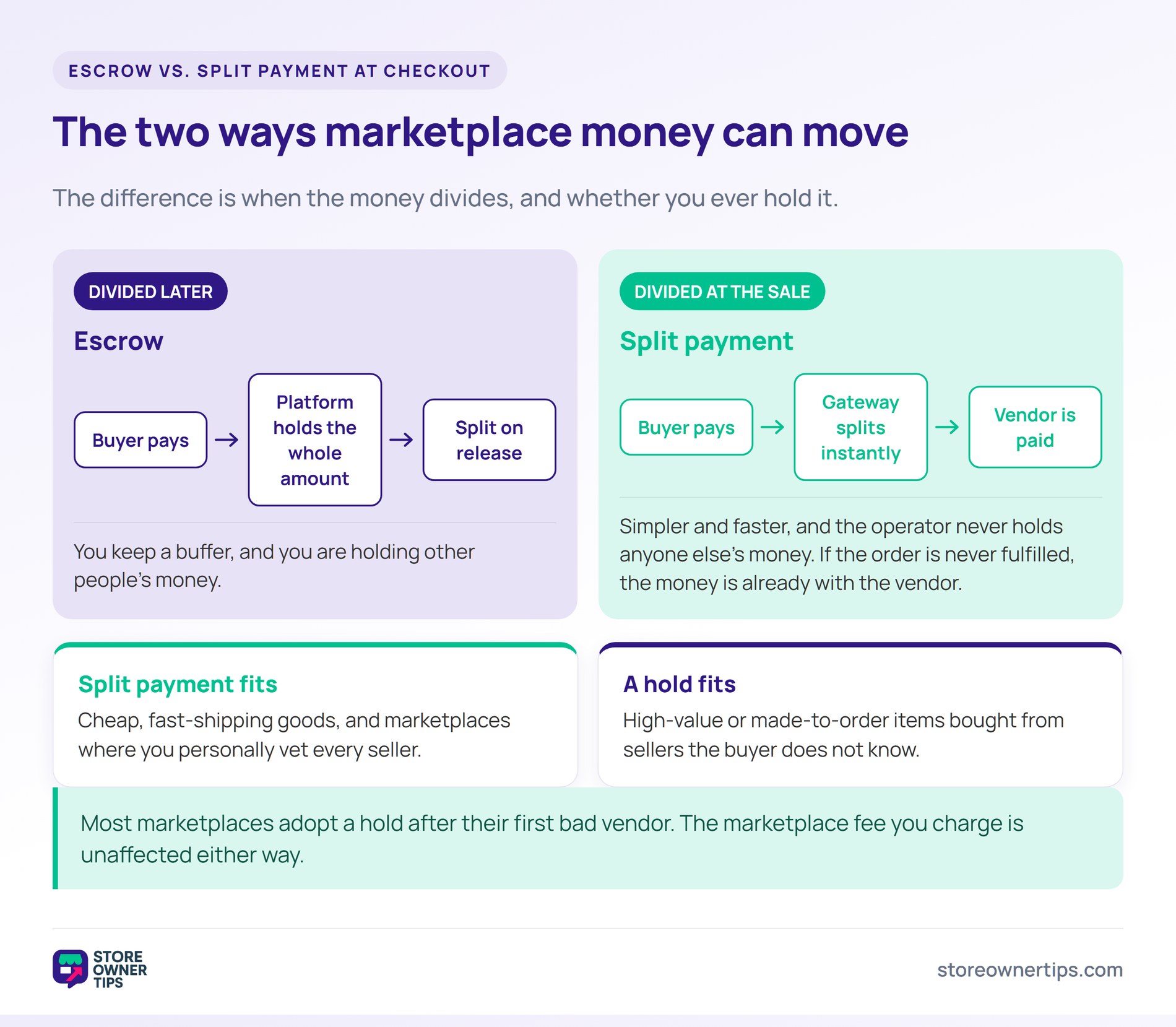
These are the two ways marketplace money can move, and they are genuinely different. Escrow holds the whole amount and divides it later. A split payment divides it at the moment of sale.
Splitting is simpler and faster for everyone. The seller’s share reaches their account almost immediately, and the operator never holds anyone else’s money. Meanwhile, that avoids most of the regulatory complexity.
The cost is that you gave up the buffer. If the order is never fulfilled, the money is already with the vendor. So refunds have to be recovered rather than simply withheld.
Which fits depends on what you sell. Cheap, fast-shipping goods rarely justify a hold, while high-value or made-to-order items usually do. By contrast, the marketplace fee you charge is unaffected either way.
Long enough for problems to appear, short enough that sellers stay. For fast-shipping goods, a few days after delivery is usually plenty. Meanwhile, made-to-order items may justify longer.
Tie the clock to delivery rather than to the order date. A hold that expires while an item is still in transit protects nobody. So the useful window starts when the buyer actually receives something.
Often not, and it is easy to over-engineer this. If you personally vet every seller and order values are low, splitting payment at checkout is usually enough. So the operational cost outweighs the risk.
The calculation changes with order value and seller anonymity. High-ticket items bought from strangers are exactly where a hold earns its keep. In practice, most marketplaces adopt one after their first bad vendor.
You do, and that is the part people underestimate. Escrow moves the decision to the platform, which means you need a written policy and someone to apply it. So budget for the judgment, not just the software.
Publish the rules before you need them. Sellers accept an unfavorable decision far better when the standard was set in advance. Meanwhile, an improvised ruling looks like the platform protecting itself.
Escrow buys buyer confidence with seller patience, and that is the trade every marketplace has to price. Hold funds where order values are high or sellers are unknown, and let good vendors earn a shorter wait.
Get advice before you hold other people’s money. For the mechanics of paying sellers in WooCommerce, see this guide to Stripe Connect vendor payouts.
Copyright © StoreOwnerTips.com. All Rights Reserved.
