Weekly ecommerce tips, deals & news.
Exclusive wholesale pricing is a digital strategy where an online store offers heavily discounted, bulk-order prices only to approved business buyers through a hidden or password-protected portal. Unlike standard public discounts, this setup acts as a VIP club. Regular shoppers see the standard retail price, while verified retailers log in to unlock their specific deals. This protects your brand’s value while securing massive, predictable orders from other businesses.
To really grasp how this works, we first need to look at how businesses sell to other businesses online. This is called B2B (business-to-business) e-commerce. In a standard wholesale model, a manufacturer sells goods in massive bulk quantities to a retailer at a sharp discount. The retailer then marks up the wholesale price and sells it to the public to make a profit.
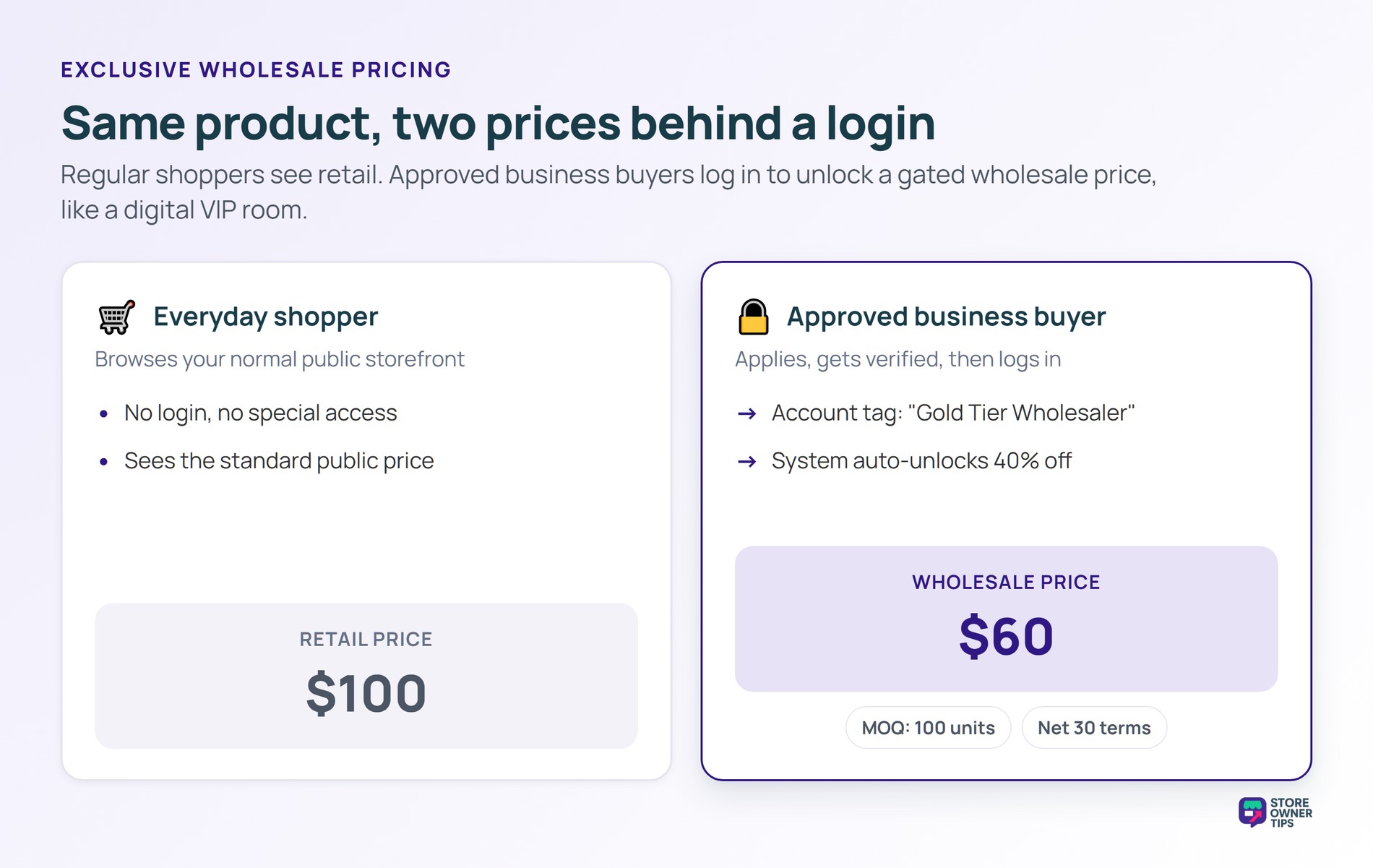
But exclusive wholesale pricing takes this a step further. It isn’t just about selling in bulk. It is the careful gating, hiding, and restricting of those discounted prices on your website. Only buyers who pass your background check get to see them.
Running this setup requires some heavy lifting behind the scenes. On platforms like Shopify Plus, store owners use a dedicated “wholesale channel.” This creates a totally separate, parallel storefront. Regular shoppers navigate your normal site, while business buyers log into a specific portal with its own rules, prices, and tracking data.
Store owners often use third-party apps to control who sees what. A popular app is Locksmith. Think of this app as a digital bouncer standing outside a VIP room. You put a “lock” on your best bulk prices. To get in, the buyer needs a “key.” That key could be a special account tag you gave them, an approved email address, or a secret passcode.
Other platforms like WooCommerce use similar setups to set wholesale prices. They assign “roles” to user accounts. A regular guest sees the $100 price tag. But if a user logs in and their role is “Gold Tier Wholesaler,” the system automatically slashes the price by 40%.
These platforms must also handle complex business workflows. For example, B2B buyers rarely use credit cards for massive orders. They use Net Payment Terms (like Net 30 or Net 60). This means they have 30 or 60 days to pay the invoice after receiving the goods. A good portal will also integrate directly into a company’s ERP (Enterprise Resource Planning) software. Think of an ERP as the “master brain” that holds all of a company’s financial and inventory data in one place.
Why go through all this trouble to hide prices? It comes down to human psychology. Exclusivity triggers the fear of missing out (FOMO). When you put a digital lock on your best prices, you turn a boring business purchase into a status symbol.
Psychologists call this reactance
theory. When people feel restricted from accessing something, they become highly motivated to get it. A buyer isn’t just ordering supplies anymore; they have earned their way into a gated community.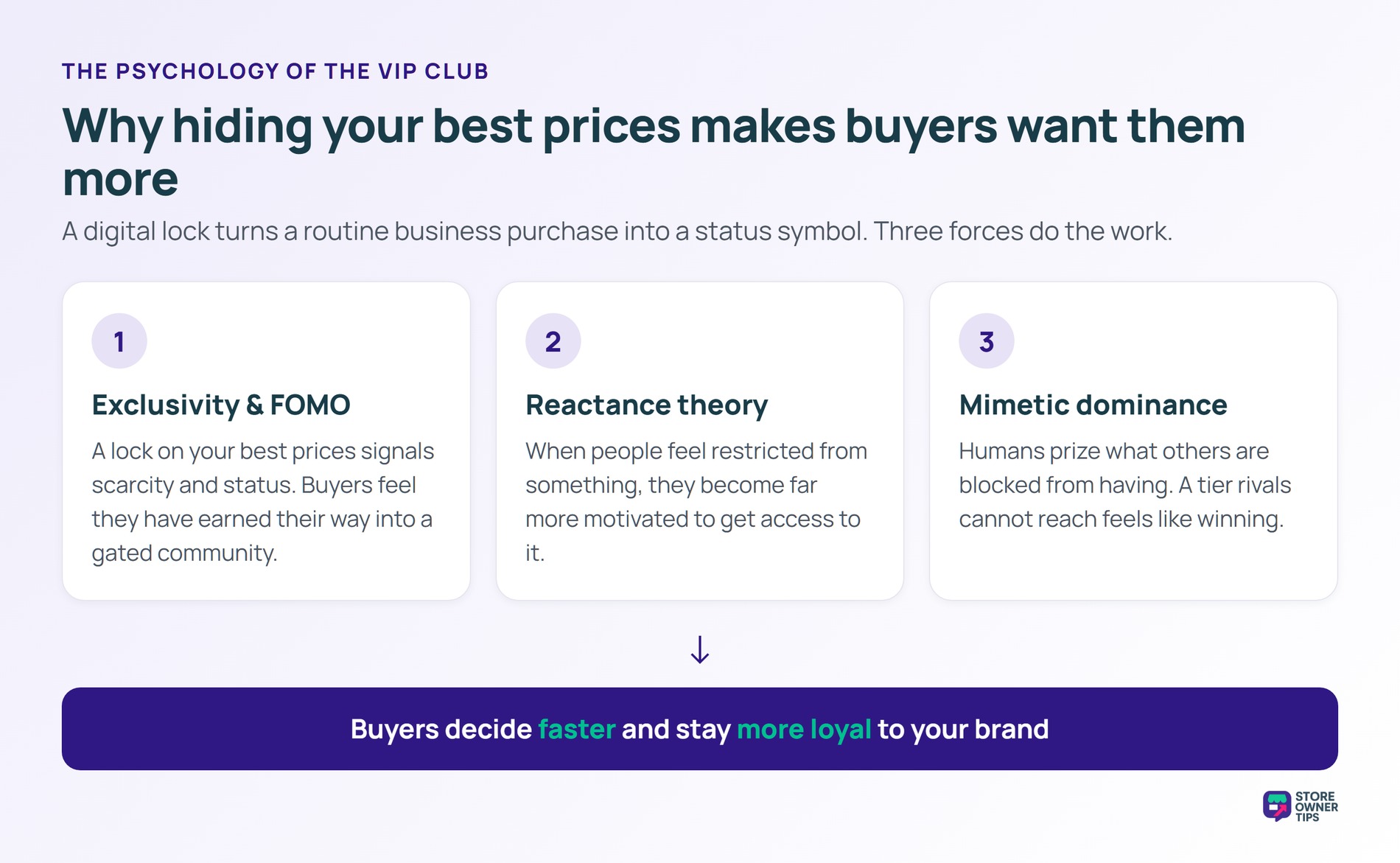
There is also a concept called mimetic dominance-seeking. Simply put, humans highly value things that other people are blocked from having. If a buyer secures a special pricing tier that their competitors cannot access, they feel superior. This emotional attachment speeds up their buying decisions and makes them incredibly loyal to your brand.
Imagine a mid-sized company called “Summit Bean Roasters.” They sell premium coffee. Right now, they sell directly to normal, everyday coffee drinkers on their public website.
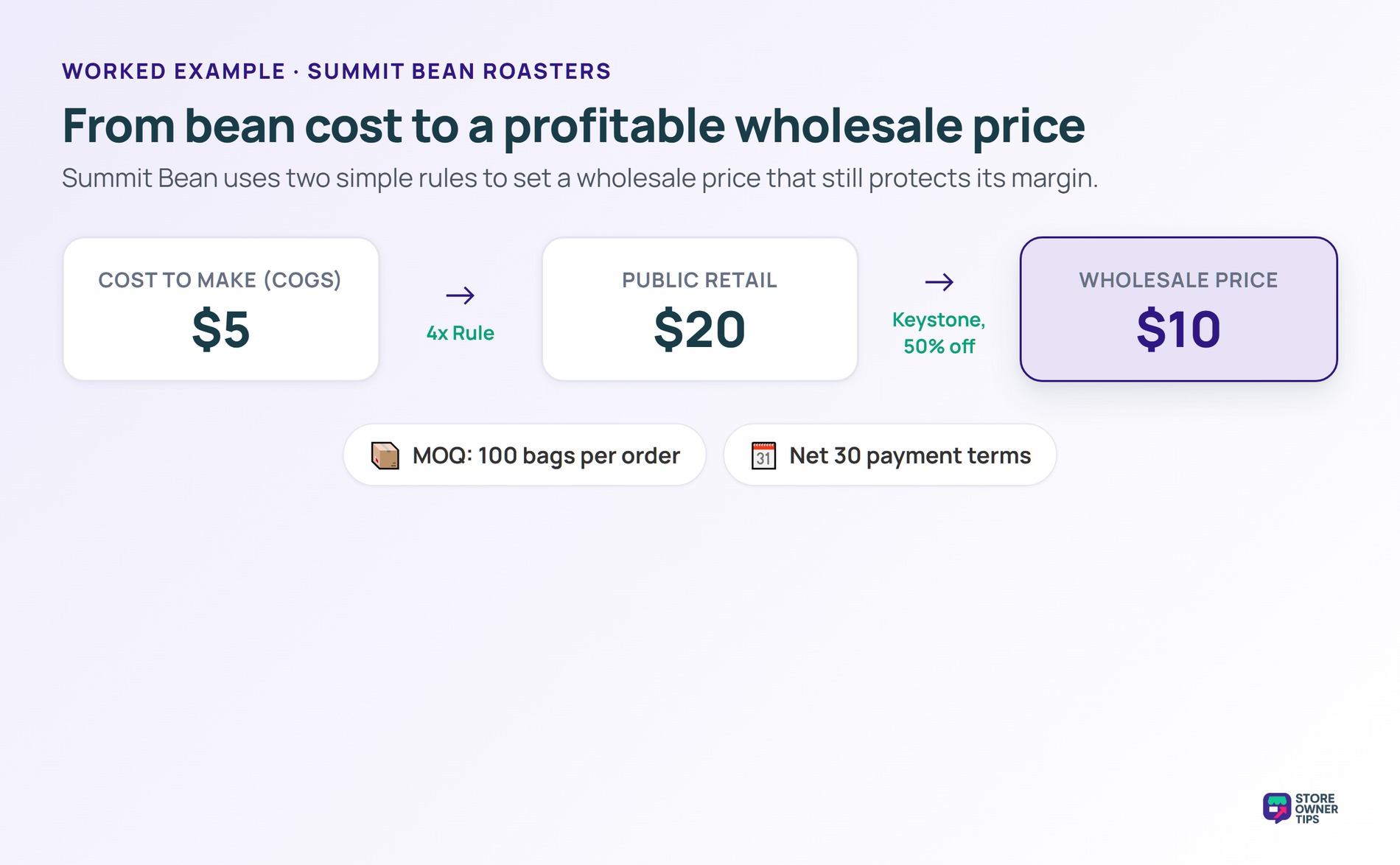
To make sure their pricing strategy stays profitable, Summit Bean uses the 4x Rule. It costs them $5 to source, roast, and package one bag of coffee (this is their Cost of Goods Sold, or COGS). To find their ideal retail price, they multiply that $5 by four. So, the retail price on their public website is $20.
Now, Summit Bean wants to start selling to independent cafes using exclusive wholesale pricing. They spend $75,000 to build a custom mid-market B2B portal. They hide this portal from the public. Cafe owners must submit their tax IDs to apply. Once approved, the cafe gets an account tag that unlocks Keystone Pricing. This is a standard 50% discount off the retail price. So, the cafe buys the coffee for $10 a bag.
However, Summit Bean doesn’t just hand out cheap coffee. They enforce strict rules:
Because this portal is so professional and frictionless, Summit Bean’s wholesale conversion rate hits 2.2% (the exact industry average for a business of their size). But they still face challenges. Their cart abandonment rate hovers around 65%, mostly because cafes are shocked by the high freight shipping costs at checkout. To fight this, Summit Bean sets up automated reminder emails. These emails have a 45% open rate, and half of the buyers who click the link end up completing their massive bulk orders.
When deciding how to price bulk goods, store owners usually weigh the exclusive pricing strategy against dynamic pricing.
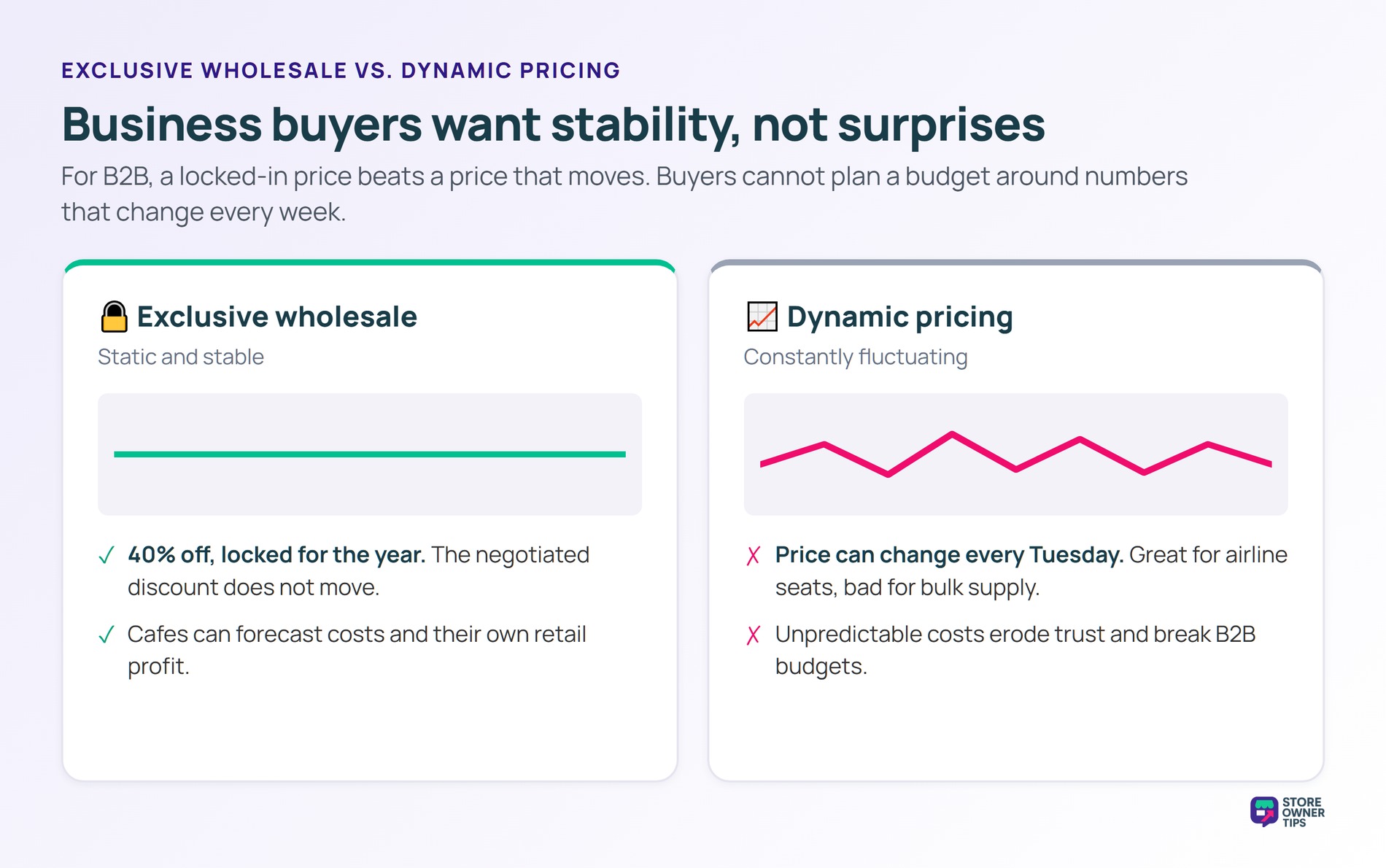
Compared to other wholesale pricing methods, business buyers heavily prefer the exclusive model. Dynamic pricing might squeeze a few extra dollars out of a transaction, but it destroys trust. A cafe owner cannot plan their budget if the price of coffee beans changes every Tuesday. Exclusive pricing gives buyers the security they need to forecast their own retail profits.
Implementing exclusive wholesale pricing through a gated B2B portal is a high-stakes move.
The fastest pricing method is using “Keystone Pricing.” This means your wholesale price should be exactly 50% off your standard retail price. However, to ensure you don’t lose money when you calculate wholesale price discounts, you must use the “4x Rule” first. Multiply the raw cost to make your product (labor, materials, shipping) by four. That final number should be your public retail price, leaving plenty of room to cut the price in half for your B2B buyers.
No, this pricing method is highly irregular. Pure wholesale is a clean break: the buyer purchases your inventory outright at a discount, takes on all the risk of holding that inventory, and keeps 100% of the profit when they sell it to a customer. If they ask for a commission on top, they are trying to set up a consignment deal, not a wholesale deal.
Beginners often focus only on the dollar amount, but the price is tied to strict conditions. You must negotiate Minimum Order Quantities (MOQs), meaning they only get the discount if they buy a massive set amount. You also must negotiate Net Payment Terms, which dictate exactly how many days they have to pay you after you ship the goods (usually 30, 60, or 90 days).
If your product has no direct competition, abandon market-based pricing and use value-based pricing instead. This means you set a higher MSRP based on the product’s unique value, which gives you the freedom to offer a 40% to 50% discount to retailers while still keeping your margins high.”
Exclusive wholesale pricing allows you to secure massive, predictable orders by treating your business buyers like VIPs. While it forces you to sacrifice per-item profit margins and manage complex payment terms, building a gated B2B portal is an incredibly powerful way to scale your brand’s physical footprint and stabilize your long-term cash flow.
Copyright © StoreOwnerTips.com. All Rights Reserved.
