Weekly ecommerce tips, deals & news.
Gross merchandise value (GMV) is the total sales value of everything sold through a marketplace over a set period. It counts the full price buyers pay, before any fees, refunds, or cancellations come out. Think of it as the top-line scoreboard for how much business flowed through your platform.
Gross merchandise value answers one simple question. How much stuff sold through your platform, in dollar terms? You add up the final price of every order over a month, quarter, or year. That total is your GMV.
It is the broadest measure of activity on a sales platform. Imagine GMV as the total value of goods passing through a busy farmers market. The market owner does not pocket every dollar that changes hands. Still, the owner cares about that grand total because it shows how active the market has become.
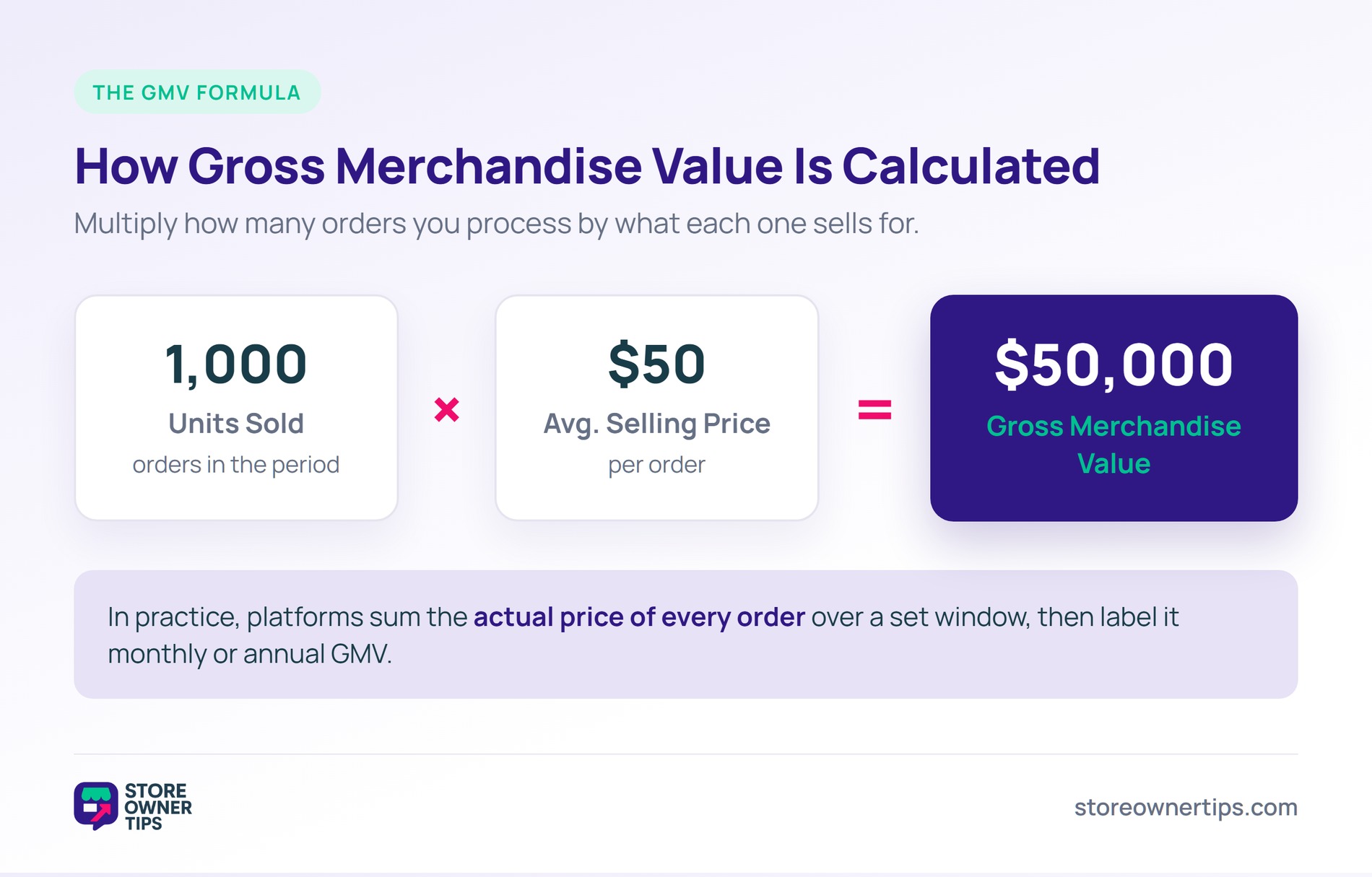
The basic formula is units sold multiplied by the average selling price. For example, 1,000 orders at $50 each gives you $50,000 in gross merchandise value. In practice, platforms sum the actual price of every single order. Most reports also state the time window, such as monthly or annual GMV.
On WooCommerce or Shopify, you can pull GMV from your sales reports. A multi-vendor marketplace tracks it across every seller combined. Definitions vary slightly between platforms. Some count cancelled orders, while others strip them out.
Because of that, you should always read the footnotes on a GMV report. A platform that excludes cancellations will look smaller than one that does not. Comparing two marketplaces fairly means using the same definition for both. Otherwise, you are comparing apples to oranges.
For a marketplace, gross merchandise value is the headline growth number. It signals scale to investors and partners. The bigger the GMV, the more relevant the platform looks. Major marketplaces report it every quarter as a core health metric.
To put the scale in context, eBay handled $73 billion in transactions in a single recent year. That figure is GMV, not the company’s own earnings. The platform keeps only a fraction through its fees. As a result, GMV and revenue tell two very different stories.
Tracking GMV over time also reveals trends. A steady climb suggests more buyers, more sellers, or higher prices. A sudden dip can flag a problem worth investigating. In short, the trend line matters as much as the headline figure.
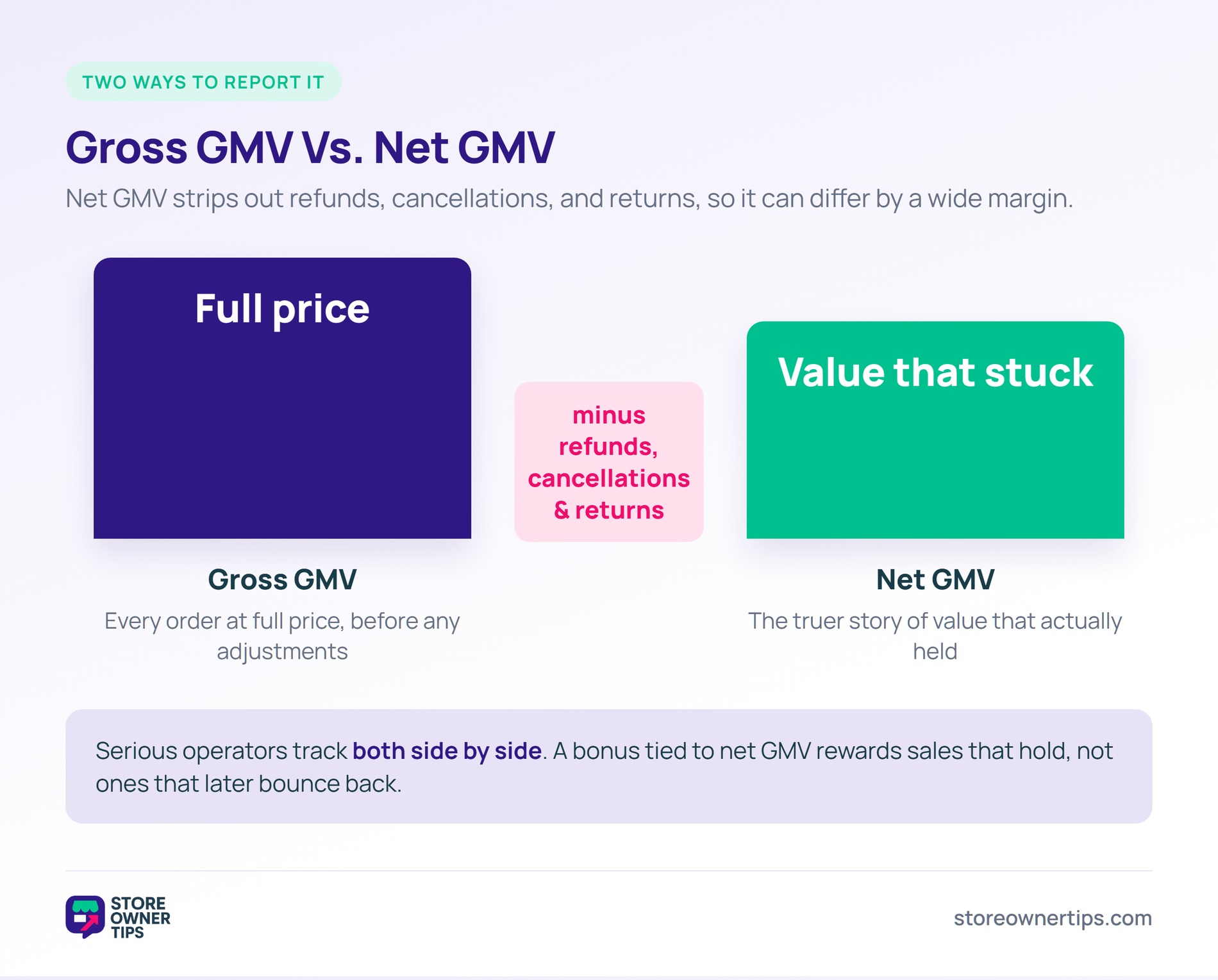
Not all gross merchandise value is reported the same way. Gross GMV counts every order at full price, before any adjustments. Net GMV strips out refunds, cancellations, and returns. The two figures can differ by a wide margin.
Imagine a platform with high return rates in fashion or electronics. Its gross GMV might look strong on paper. Its net GMV tells the truer story of value that stuck. Serious operators track both numbers side by side.
This matters when you set goals for your team. A bonus tied to gross GMV can reward sales that later bounce back. A bonus tied to net GMV rewards sales that actually hold. Choose the version that reflects real, kept value.
Your take rate is the bridge from gross merchandise value to revenue. It is the percentage of each sale your platform keeps. Multiply GMV by the take rate, and you get marketplace revenue. The rest flows through to your sellers.
Take rates vary widely by category and platform. A craft marketplace like Etsy charges a 6.5% transaction fee, while broader platforms sit higher. On WooCommerce, you set this yourself through your vendor commission structure. A small change in take rate moves revenue a lot, even when GMV holds steady.
GMV is powerful, but it has blind spots. It says nothing about profit, costs, or customer loyalty. A platform can post huge GMV while losing money on every order. For that reason, GMV should never travel alone.
Repeat buyers also matter more than raw volume. By one estimate, acquiring a new customer can cost five to 25 times more than keeping an existing one. So a smaller GMV built on loyal shoppers can beat a larger one built on churn. Always read GMV next to retention and margin.
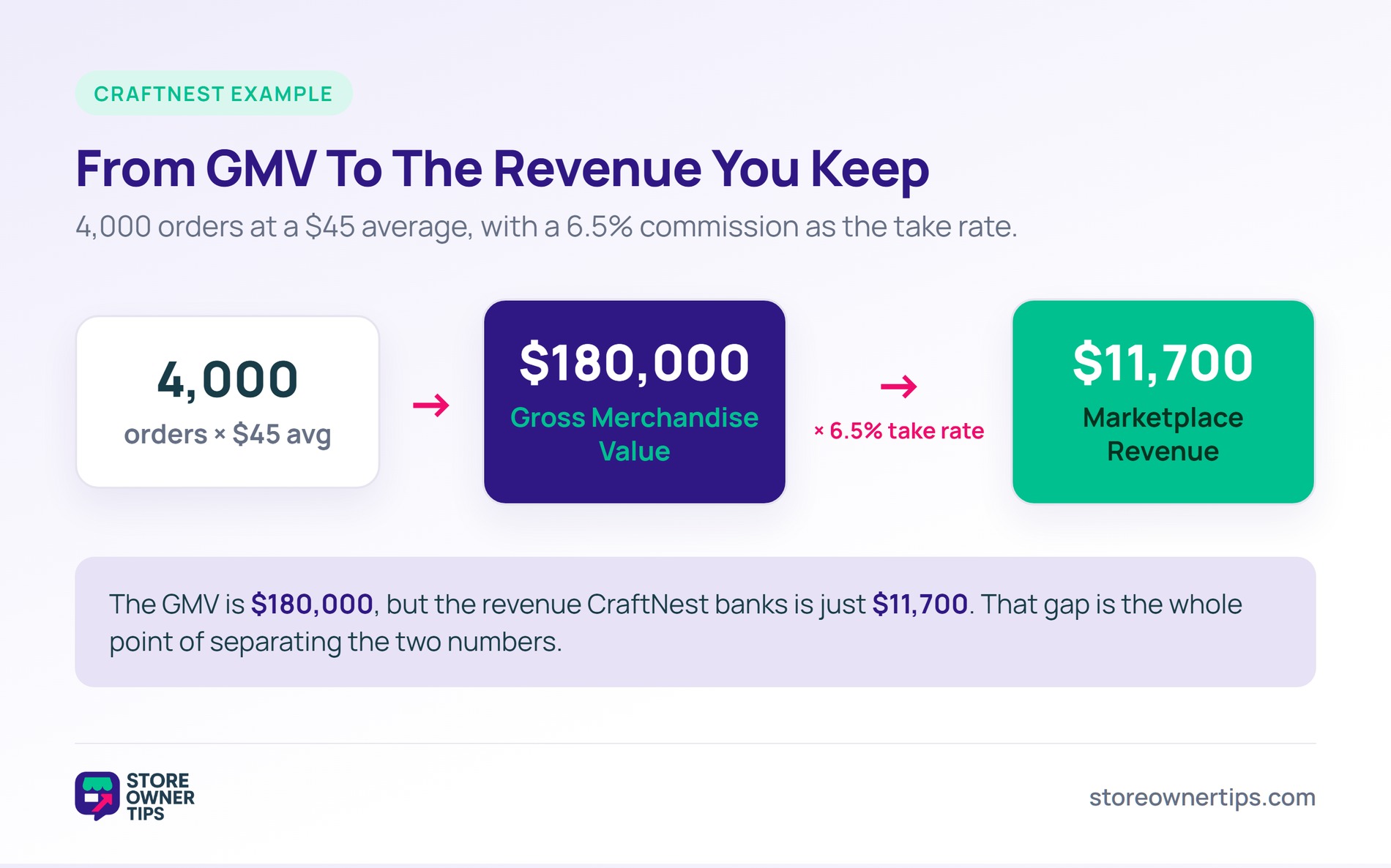
Imagine a mid-sized marketplace called CraftNest. It connects independent makers with shoppers who love handmade goods. In one month, CraftNest processes 4,000 orders. The average order value lands at $45 per sale.
To find gross merchandise value, multiply 4,000 orders by $45. That gives CraftNest a monthly GMV of $180,000. This is the total value of goods sold across all its sellers. However, CraftNest does not keep that full amount.
CraftNest charges sellers a 6.5% commission on each sale, similar to the 6.5% transaction fee used by large craft marketplaces. Applying that take rate to $180,000 gives $11,700 in actual revenue. So the GMV is $180,000, but the net revenue is just $11,700. That gap is the whole point of separating the two numbers.
Now suppose CraftNest lifts its average order value to $55 through bundles. The same 4,000 orders now produce $220,000 in GMV. At the same 6.5% rate, revenue climbs to $14,300. That is a $2,600 monthly gain from one lever.
Real life is messier, though. Say 8% of those orders get refunded or cancelled. That trims roughly $17,600 off the $220,000 gross figure. CraftNest now reports a net GMV near $202,400 instead.
The revenue effect follows the same logic. Applying the 6.5% rate to net GMV yields about $13,156, not $14,300. The refund gap quietly shaves roughly $1,144 off the take. This is exactly why net GMV deserves a place in every report.
This is why a healthy average order value matters so much. Lifting it raises GMV and revenue at the same time. The marketplace fee structure then decides how much of that growth CraftNest actually banks.
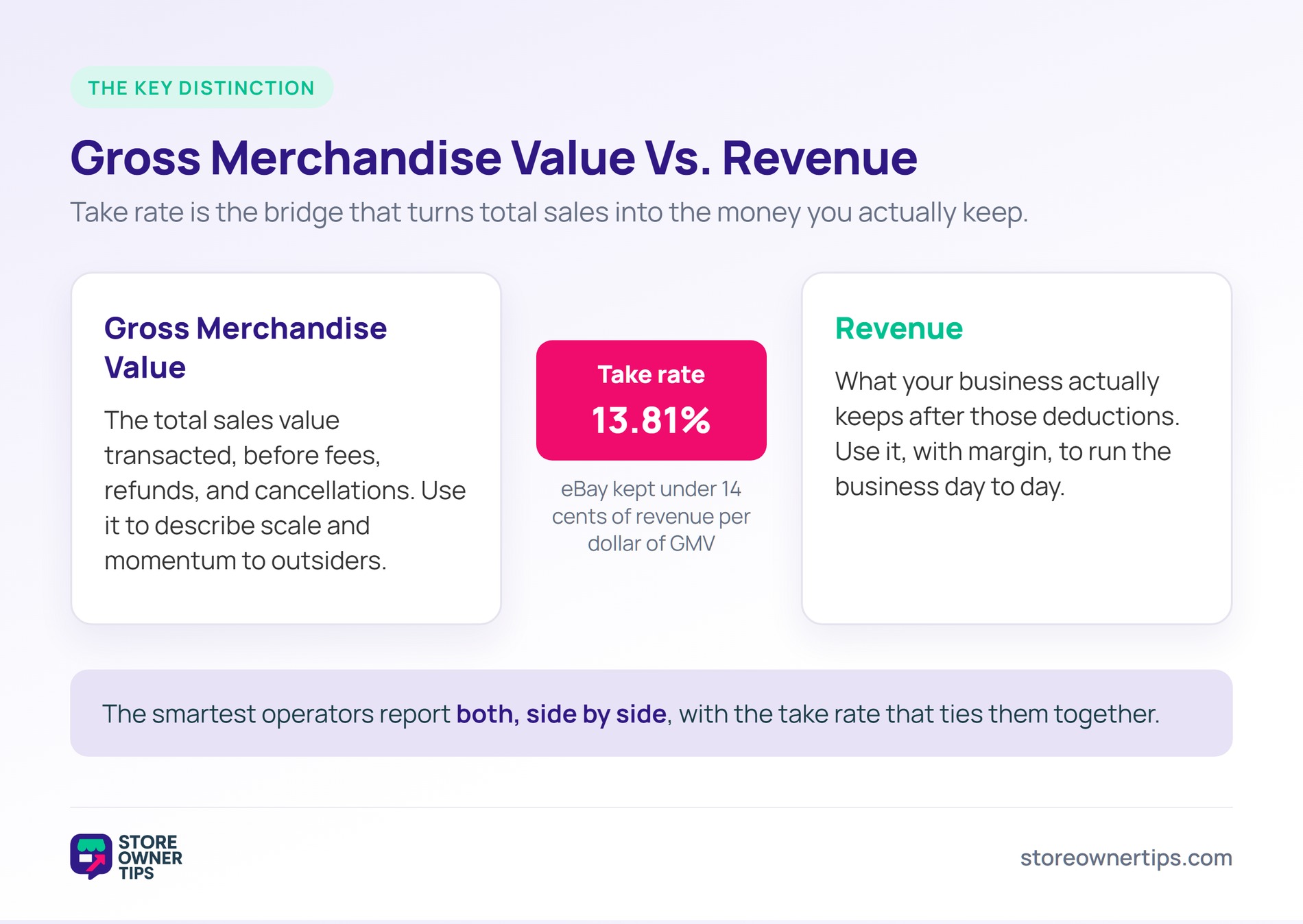
This is the most important distinction to grasp. Gross merchandise value is the total sales value transacted before fees, refunds, and cancellations. Revenue is what your business actually keeps after those deductions. Confusing the two leads to badly inflated expectations.
The link between them is your take rate, or vendor commission. For instance, eBay reported a take rate of 13.81% in a recent year. That means it kept under 14 cents of revenue per dollar of GMV. A high GMV with a low take rate can still mean modest revenue.
So which number should you lead with? Use GMV to describe scale and momentum to outsiders. Use revenue and margin to run the business day to day. The smartest operators report both, side by side, with the take rate that ties them together.
Gross merchandise value is a useful metric, but only with eyes open. On the plus side, it captures scale in one clean number. It is easy to track across periods and easy to explain to outsiders. Rising GMV is a strong, intuitive signal of marketplace momentum.
The downside is that GMV can flatter a struggling business. It masks profitability, since it ignores costs and margins entirely. It can also hide heavy returns when reported as a gross figure. A platform chasing GMV alone may grow volume while bleeding cash.
The fix is simple. Treat GMV as a headline, not the full report. Read it next to revenue, take rate, margin, and retention. Used that way, GMV earns its place on the dashboard.
No, and the difference is large. Gross merchandise value is the total value of all goods sold through your platform. Meanwhile, revenue is the smaller slice you keep after fees and refunds. Your take rate connects the two figures.
It depends on how the platform defines it. Many marketplaces report gross GMV before refunds and cancellations. Others publish a net GMV that strips those out. Always check which version a report uses before comparing numbers.
Gross merchandise value shows the full scale of activity on the platform. Basically, it tends to be a much larger and more impressive number than revenue. Investors use it to gauge growth and market share. Still, smart readers always check the take rate alongside it.
Gross merchandise value is the clearest gauge of how much business flows through a marketplace. It powers growth stories, but it is not money in the bank. Watch the trend over time, not just a single snapshot. Pair it with your take rate to see the revenue that truly drives long-term growth. To go deeper, see this guide on how to build a multi-vendor marketplace.
Copyright © StoreOwnerTips.com. All Rights Reserved.
