Weekly ecommerce tips, deals & news.
A late payment is an invoice that has passed its due date and still has not been paid. The sale already happened. The stock already left your warehouse.
What you are holding is a promise rather than money. So a late payment is a cash-flow event, not a sales event. Your revenue looks fine while your bank balance quietly does not.
A late payment works its way through three stages, and each one costs you something different. Think of an unpaid invoice as a loan you did not agree to make. You supplied the goods and you are funding the gap.
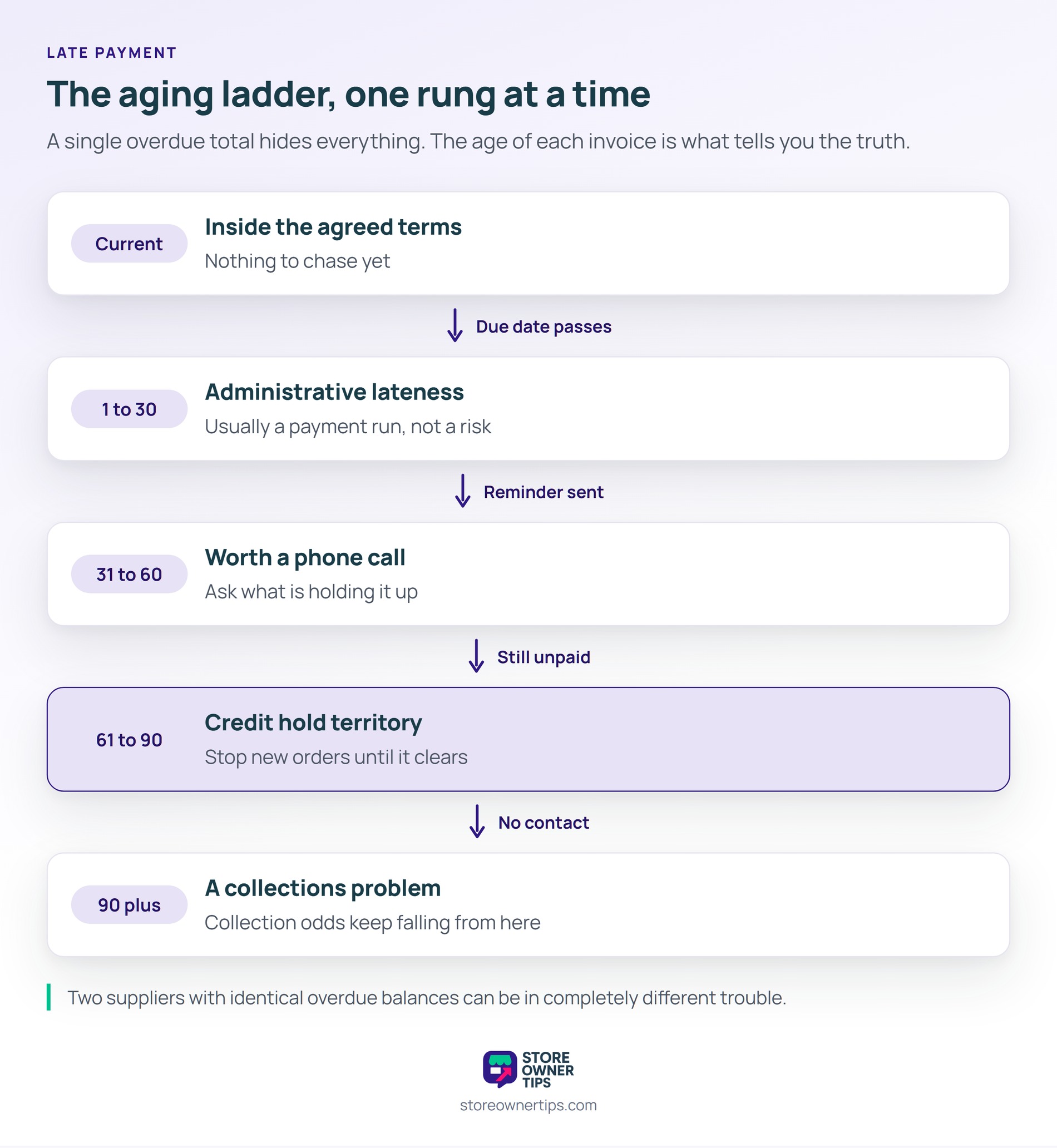
A late payment starts the moment your agreed terms expire. For example, Net 30 means the invoice falls due 30 days after it was issued. So day 31 is late, even if the buyer considers it early.
Meanwhile buyers run their own payment cycle regardless. A supplier invoicing on the 2nd may sit in a run that only pays on the 28th. In practice that mismatch produces most of the lateness you see.
Disputes are the other common cause. A short delivery or a pricing error stops the clock in the buyer’s mind, without anyone telling you. Clear net terms on the invoice remove at least the argument about what was agreed.
So the first question to ask is which kind of lateness you have. A buyer paying on day 45 every single time is running a cycle, not a risk. By contrast, a buyer whose timing keeps slipping is telling you something about their cash.
A late payment tells you very little on its own. What tells you something is how long it has been late. So group your overdue invoices into buckets of 1 to 30 days, 31 to 60, 61 to 90 and beyond.
Those buckets change the conversation. For example, a ledger mostly 1 to 30 days late is an administrative problem. By contrast, a ledger with weight past 90 days is a collections problem.
Collection odds fall as an invoice ages, which is why the oldest bucket deserves the most attention. Meanwhile a single large total hides all of that. Two stores with identical overdue balances can be in completely different trouble.
One more number is worth watching beside the buckets. Track how many days it takes on average to collect, then watch the trend. A total that holds steady while that average climbs means your oldest invoices are getting older.
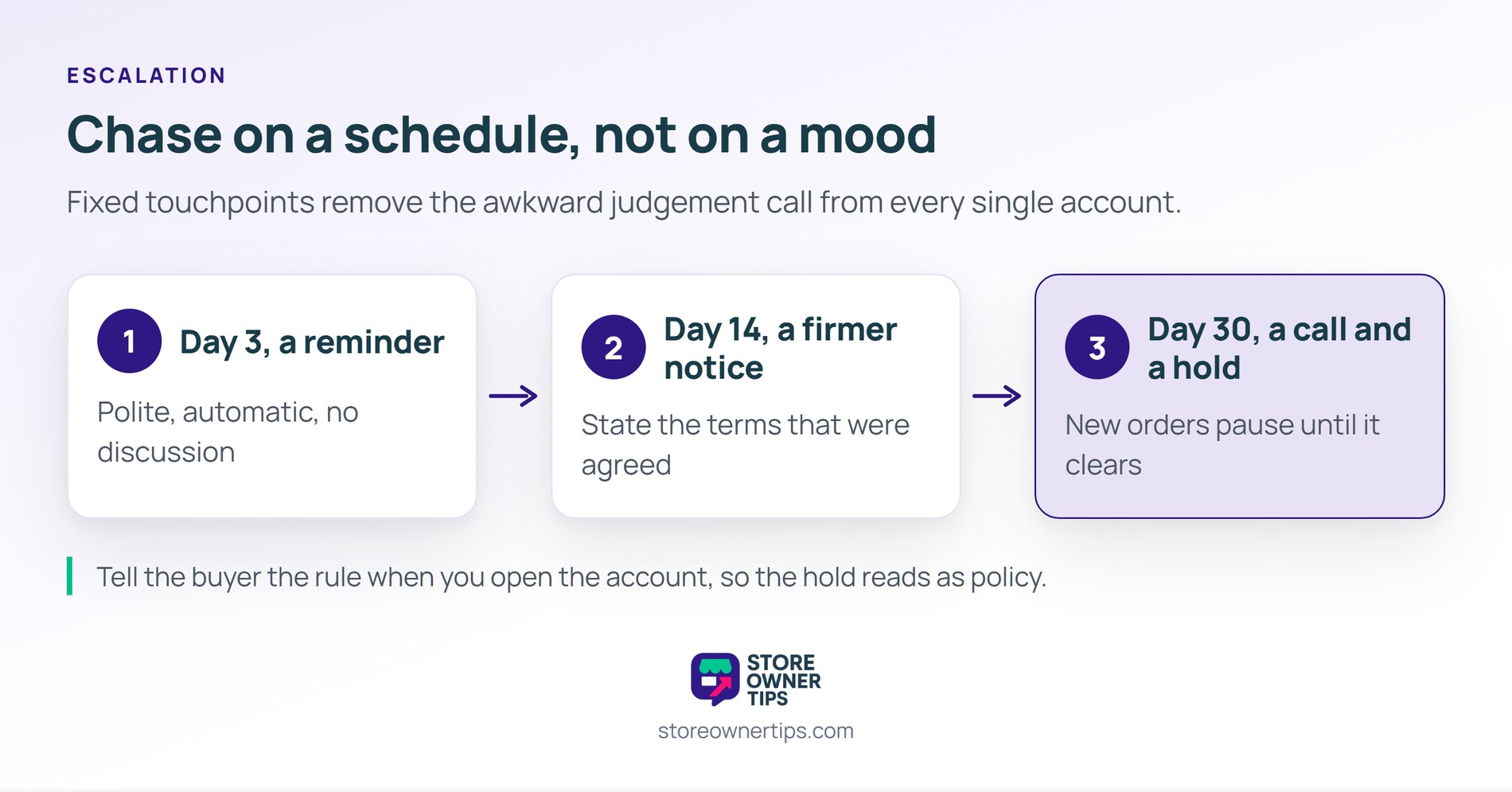
Late payments get chased best by a schedule rather than by mood. So set fixed touchpoints and stick to them for every account. A polite reminder on day 3, a firmer one on day 14, a call on day 30.
Then comes the step most stores delay too long, which is a credit hold. In practice, pausing new orders until the balance clears is the lever that changes behaviour. Also make sure the buyer knows the hold is automatic, not personal.
Still, payment method does a lot of quiet work here too. Offering card or direct debit alongside invoicing shortens the cycle for smaller accounts. Options for wholesale payments and staged plans are worth mapping before you extend terms again.
Late payment is the norm in business-to-business trade rather than the exception. The Atradius Payment Practices Barometer surveys B2B suppliers across markets each year. Its North America edition puts overdue invoices at 43% of credit-based B2B sales in the United States.
The pressure that creates is measurable at the other end. The Federal Reserve’s Small Business Credit Survey drew 7,653 responses from small employer firms. It found 56% of firms naming paying operating expenses as a financial challenge.
For some suppliers it gets existential. In Intrum’s European Payment Report, 38% of businesses said late payments pose a significant or high threat to their survival. That is the gap between a sale and a payment doing real damage.
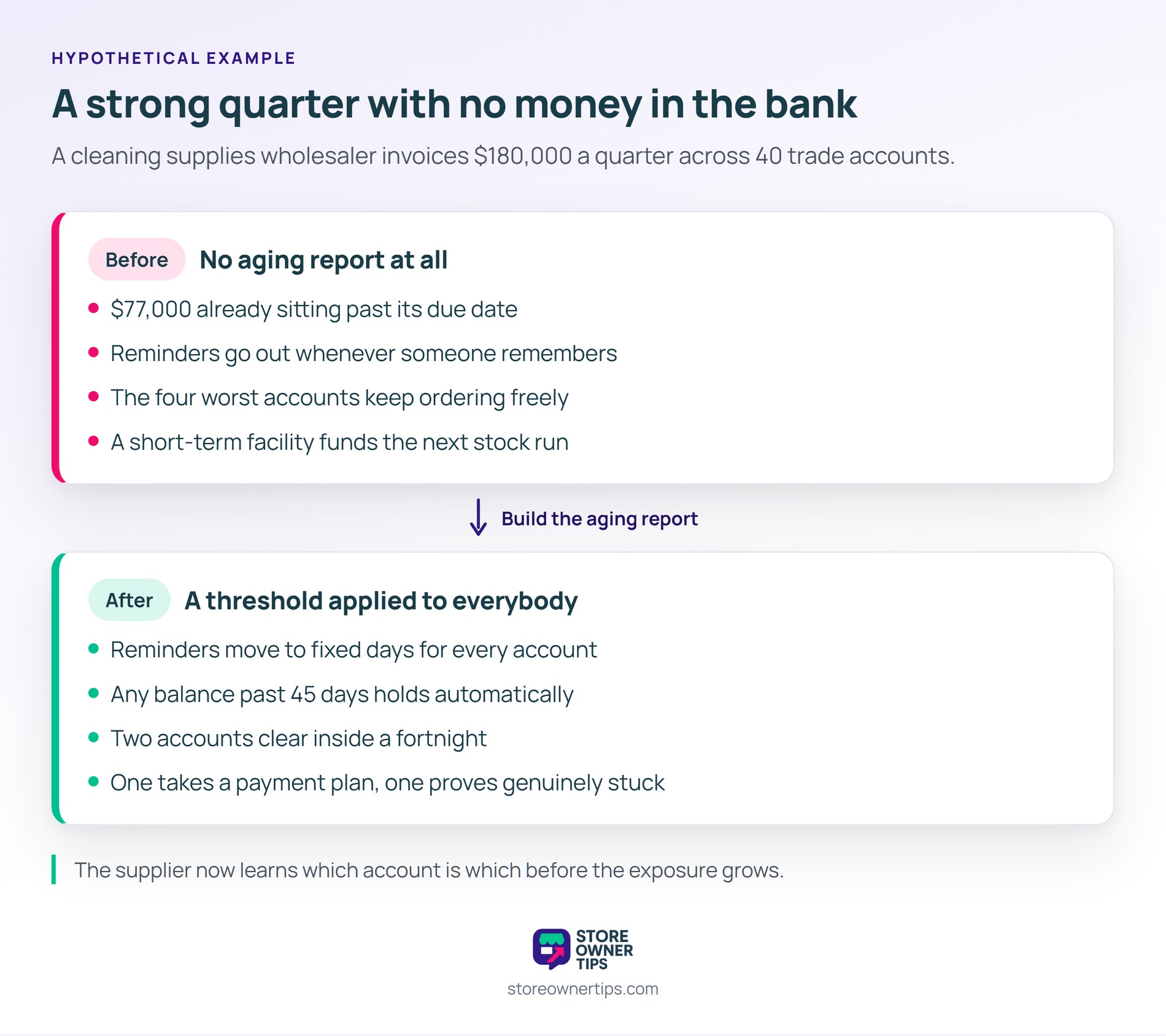
Late payment in practice shows up as a healthy sales report and an unhealthy bank account. Here is a hypothetical example. Picture a supplier selling cleaning products to cafes on Net 30 terms.
In this scenario, the supplier invoices $180,000 a quarter across 40 trade accounts. Terms are Net 30, and reminders go out whenever someone remembers. There is no aging report and no credit hold.
On paper the quarter looks strong. Meanwhile $77,000 of that total is sitting past its due date. Then four accounts turn out to make up most of it.
As a result, the supplier cannot pay its own suppliers on time. So it starts using a short-term facility to cover stock purchases. Meanwhile that interest is a direct cost of somebody else’s slow payment run.
Then the four worst accounts keep ordering, because nothing stops them. Their balances grow while their payments do not. Still, nobody wants to make the call that risks the relationship.
The supplier builds an aging report and finds the weight sits past 60 days. First, reminders move to fixed days for every account. Next, any balance past 45 days puts the account on hold automatically.
Then two of the four accounts clear their balance within a fortnight. One negotiates a payment plan, and one turns out to be genuinely in trouble. As a result the supplier learns which is which before the exposure grows.
Finally, smaller accounts move onto card payment at the point of order. In short, the terms now match the size of the risk rather than the age of the relationship.
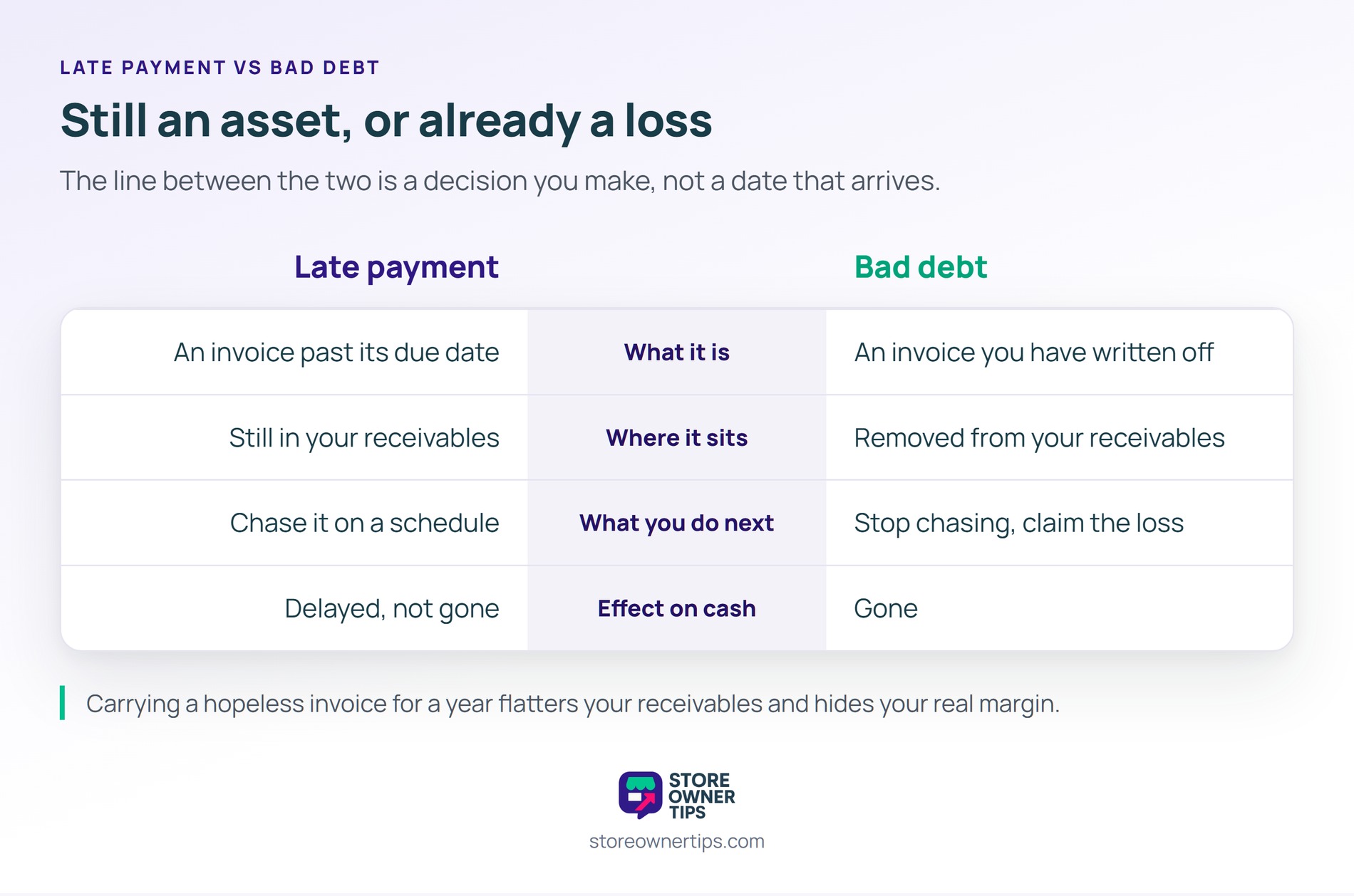
| What you are comparing | Late payment | Bad debt |
|---|---|---|
| What it is | An invoice past its due date | An invoice you have written off |
| Where it sits | Still in your receivables | Removed from your receivables |
| What you do next | Chase it on a schedule | Stop chasing and claim the loss |
| Effect on cash | Delayed, not gone | Gone |
A late payment is still an asset, while bad debt is an admission. The line between them is a decision you make, not a date that arrives.
Accounting rules and tax treatment for a write-off vary by country. So agree the rule with your accountant once, then apply it consistently. An invoice that has sat past 120 days with no contact is the usual candidate.
Most stores leave that decision far too late. Carrying a hopeless invoice for a year flatters your receivables and hides your real margin. By contrast, writing it off early gives you an honest number to plan against.
So pick a threshold in advance and apply it to everybody. A balance past 45 or 60 days is a common trigger for wholesale accounts. Deciding case by case is what makes the conversation feel personal.
Tell the buyer the rule when you open the account, not when you enforce it. Then the hold reads as policy rather than punishment.
First, build an aging report before you judge it. Split overdue invoices into 1 to 30 days, 31 to 60, 61 to 90 and older. A ledger clustered in the first bucket is admin, not danger.
Also track how long collection takes on average, and watch the direction it moves. A rising average is a warning even while the total looks flat.
State a late fee in your terms, because the right to charge one depends on what the buyer agreed. Rules also vary by country, so check what applies where you trade. Having the clause matters more than using it.
In practice most suppliers waive the fee and use it as leverage. A credit hold moves payment dates far more reliably than interest does.
Late payment matters because it separates the money you earned from the money you can spend. A profitable quarter can still leave you unable to buy stock. Plus the fix is a schedule and a threshold, not a difficult conversation every week.
In short, watch the age of what you are owed rather than the size of it.
Copyright © StoreOwnerTips.com. All Rights Reserved.
