Weekly ecommerce tips, deals & news.
A manufacturer part number (MPN) is the unique code a manufacturer assigns to one specific product of their own. It identifies that item across every retailer who stocks it. Unlike a barcode, an MPN is only unique within that manufacturer’s own range. That is why shopping channels ask for the brand name alongside it.
A manufacturer part number works as the maker’s own name for one exact product. They assign it once, print it on the packaging, and use it in their own catalogs. Then every retailer who stocks that item can refer to the same code and mean the same thing.
First, think of buying a replacement oil filter. You do not ask for a filter, you ask for a part number. A dozen filters look identical and only one fits.
So that number is a manufacturer part number. It came from whoever made the filter, and it means the same thing at every parts counter in the country. Meanwhile a rival manufacturer’s equivalent filter carries a completely different number.
So the MPN does two jobs at once. It pins down one exact product, and it implies the brand that made it. Still, the number on its own is not enough, since two manufacturers could coincidentally use the same string.
In practice, an MPN is manufacturer-scoped while a barcode is globally unique. That difference explains why the two identifiers are treated so differently in a product feed.
A GTIN is issued through a global numbering system, so no two products anywhere share one. The formats are fixed too. AdTribes records that a UPC runs to 12 digits, while an EAN runs to 13.
By contrast, an MPN has no such format rules. It can mix letters, numbers and hyphens, and its length is whatever the manufacturer chose. Therefore a channel cannot validate an MPN the way it validates a barcode. Hence the brand requirement.
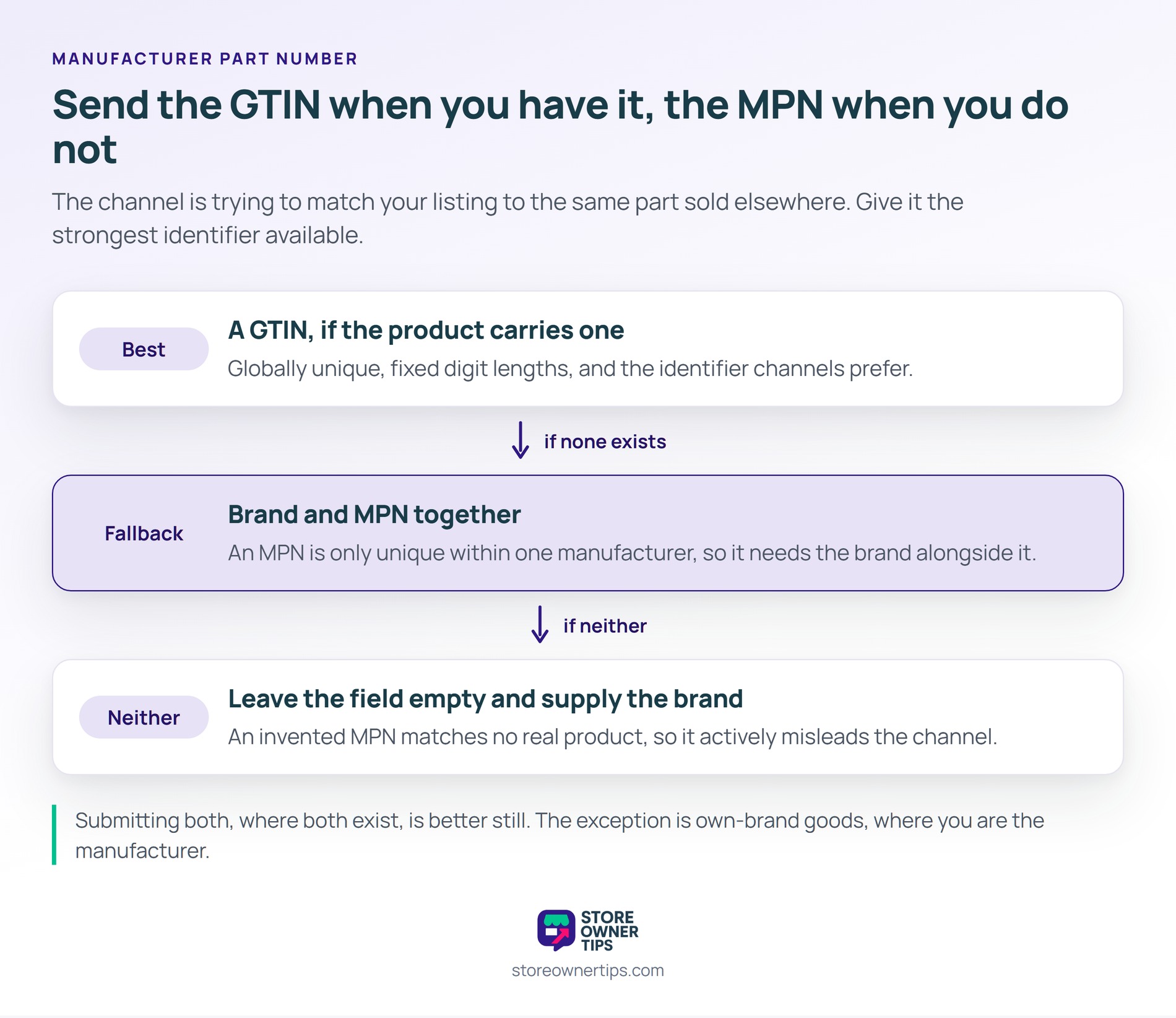
Usually, shopping channels ask for the strongest identifier available, in order of preference. In practice that order decides whether you need an MPN at all.
Notably, that second rule is where MPNs earn their place. Handmade goods, custom furniture and spare parts frequently have no barcode at all. Consequently brand plus MPN becomes the only identification a product data feed can offer.
Notably, most MPN problems come from the wrong value rather than an empty field. Three mistakes account for nearly all of them.
Still, there is one honest exception to the SKU rule. If you manufacture the product yourself, then your own part number genuinely is the MPN. So mapping SKU to MPN is correct for own-brand goods and wrong for anything you resell.
Usefully, the manufacturer part number is nearly always printed somewhere already. You rarely have to ask anyone for it.
Variants deserve one extra check. A manufacturer usually issues a separate part number per size or finish, so one value rarely covers a whole range. Therefore pull each variant’s number rather than assuming the parent applies.
Capturing it once at the point you add a product saves the work later. Otherwise you end up retrofitting 400 values under pressure, after a channel starts rejecting listings.
Identifier formats are strict, and MPNs are the one loose exception. A UPC is fixed at 12 digits and an EAN at 13. Meanwhile an MPN has no defined length at all. Therefore identifier errors are easy to introduce and awkward to spot.
Meanwhile getting one wrong costs time as well as visibility. Google notes a corrected product can take up to 3 business days to be approved and show again. Meanwhile Google Merchant Center is where most stores meet the field. AdTribes, our own feed plugin, reports 80,000+ active installations.

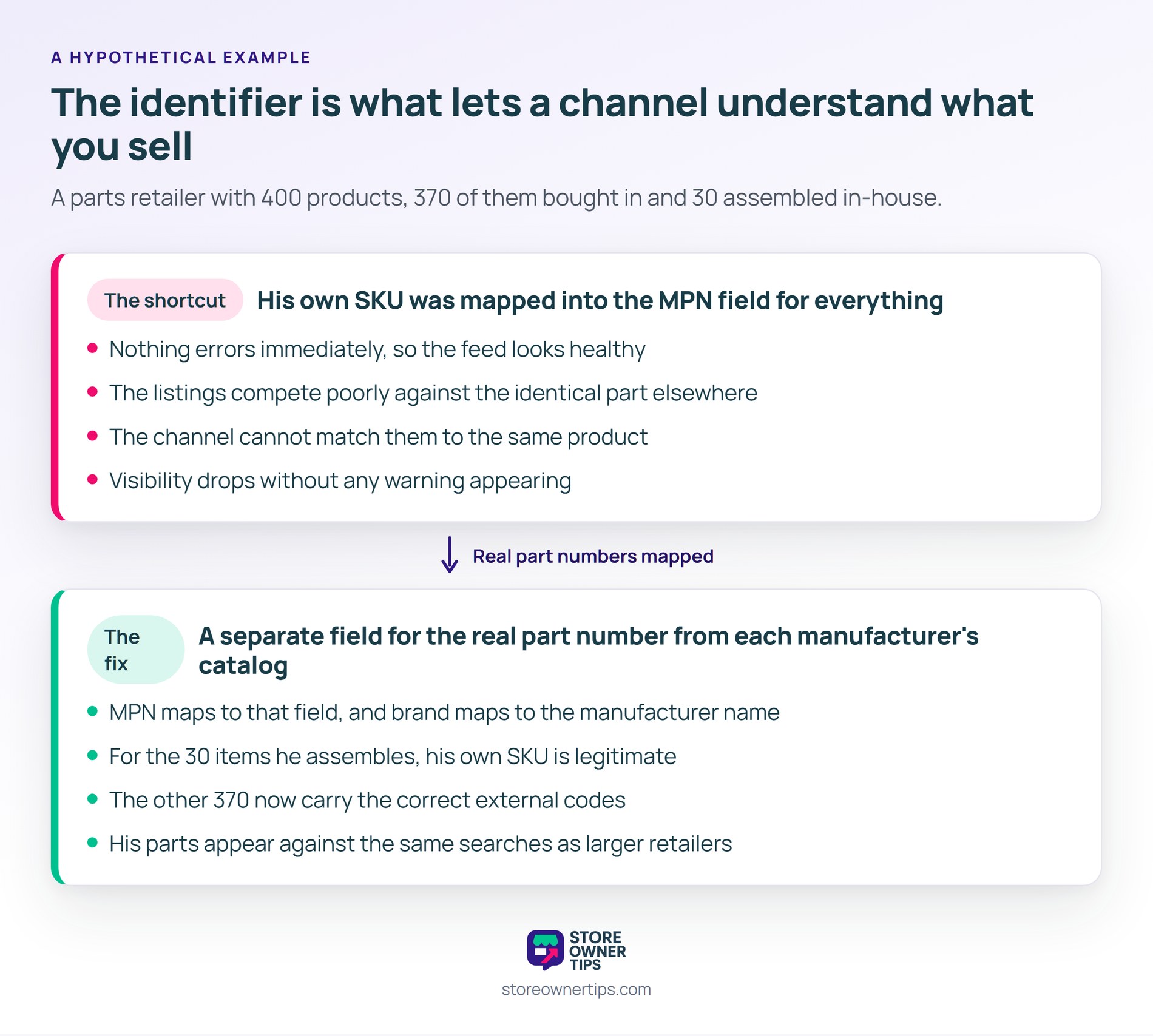
Here’s a hypothetical example. Picture a WooCommerce store selling replacement parts for espresso machines, stocking about 400 items from eight manufacturers.
First, the owner sets up his feed and finds an MPN field waiting to be filled. First he maps it to his own SKU, because that column already exists and it takes one click.
Then his SKUs look like ESP-0142 and ESP-0143, numbered as he added products. Consequently the feed now claims eight different manufacturers all use his numbering scheme.
Meanwhile nothing errors immediately, which is the trap. Still, the listings compete poorly, because the channel cannot match them to the same part sold elsewhere.
So he adds a separate field for the real part number, taken from each manufacturer’s catalog. Then he maps MPN to that field and brand to the manufacturer name.
Then, for the 30 items he assembles himself, he keeps his own SKU as the MPN. That is legitimate, because for those products he is the manufacturer. Meanwhile the other 370 now carry the correct external codes.
Notably, the visible change is match quality rather than volume. His parts start appearing against the same searches as the identical part at larger retailers. In short, the identifier was what let the channel understand what he was selling.
| What you’re comparing | MPN | GTIN |
|---|---|---|
| Who assigns it | The manufacturer | A global numbering body |
| Scope of uniqueness | Within one manufacturer | Worldwide |
| Format rules | None, any characters | Fixed digit lengths |
| Needs a brand alongside | Yes | No |
| Channel preference | Fallback | Preferred |
An MPN and a GTIN both identify a product, but only one is globally unique. Send the GTIN whenever you have it.
Then treat the MPN as the answer for products that never got a barcode. Submitting both, where both exist, is better still.

No, although stores confuse the two constantly. A SKU is the code you invent for your own stock control, so it means nothing outside your business. An MPN comes from the manufacturer and means the same thing to every retailer. The exception is own-brand goods, where you are the manufacturer and the two can match.
Not strictly, since the GTIN is the stronger identifier and channels prefer it. That said, supplying both gives the channel more to match on. Where no GTIN exists, brand and MPN together become the identification instead.
No. Because an invented MPN matches no real product, it actively misleads the channel. If you genuinely cannot find one, leave the field empty and supply the brand. Alternatively, check the packaging or the manufacturer’s own catalog, which is usually where it is printed.
A manufacturer part number matters because it tells a channel your product and somebody else’s are identical. Without it, an item with no barcode is effectively anonymous. Ultimately, getting the MPN right is what lets a small store compete on the same listing as a large one.
Copyright © StoreOwnerTips.com. All Rights Reserved.
