Weekly ecommerce tips, deals & news.
The reciprocity principle is the human pull to return favors. Give someone a small gift or unexpected help, and they often feel a quiet pressure to repay you. Stores tap this with free samples, gifts with purchase, generous return policies, and useful free content.
The pattern is ancient and consistent. Done well, it builds trust and lifts sales. Done badly, it feels like a bribe and quickly backfires. The trick is making the gift feel real, not transactional.
Reciprocity is a cornerstone in the psychology of persuasion, famously outlined in Robert Cialdini’s six principles from his 1984 book Influence. However, the idea predates him by decades. Sociologists like Alvin Gouldner had already named the “norm of reciprocity” as a universal feature of human cultures.
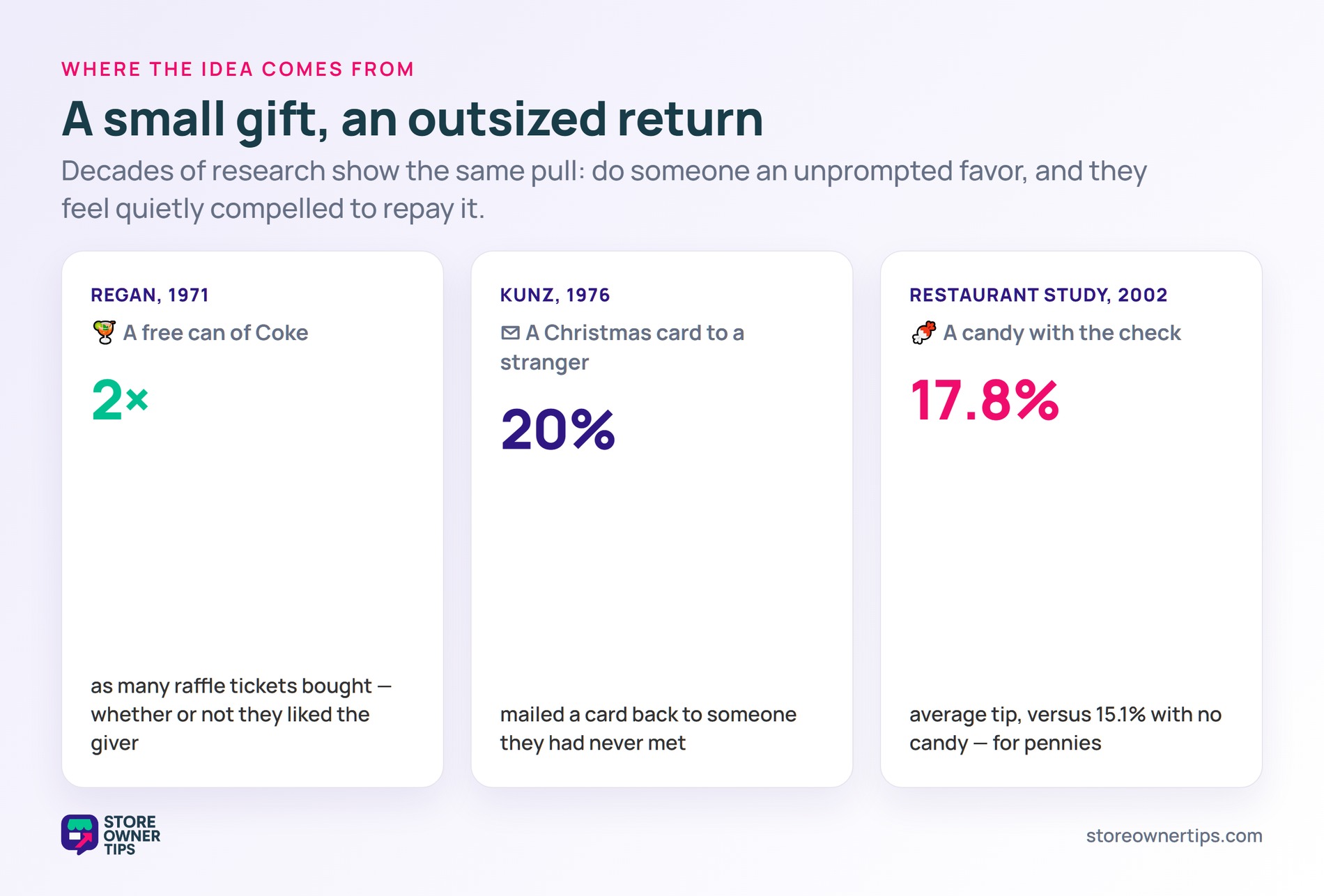
The classic experimental proof came in 1971 from Dennis Regan at Cornell. He had a confederate named “Joe” leave the room and return with a Coke for the participant. Later, Joe asked the participant to buy raffle tickets. Subjects who received the free Coke bought roughly twice as many tickets as those who got nothing.
Five years later, James Kunz mailed Christmas cards to 578 strangers picked from a phone book. Cards flowed back from people who had never met him. The response rate hit 20%, simply because he’d sent a card first.
People feel social debt the moment someone does them a favor. The debt is small, but it sits in the back of the mind until it’s repaid. Behavioral researchers call this the “feeling rule” that keeps social groups running smoothly.
The pressure isn’t logical. Even when shoppers don’t particularly like the giver, they still feel the pull. Regan found this clearly: participants in his Coke study bought more tickets whether or not they liked Joe.
The mechanism cuts both ways. People who refuse to repay feel guilty. People who repay feel relief. That asymmetry is what gives the principle its quiet power.
Surprise is the multiplier. An expected reward, like a discount the customer hunted down, doesn’t trigger the same pull. The brain treats it as earned, not given. Unexpected gifts are the ones that activate reciprocity hardest.
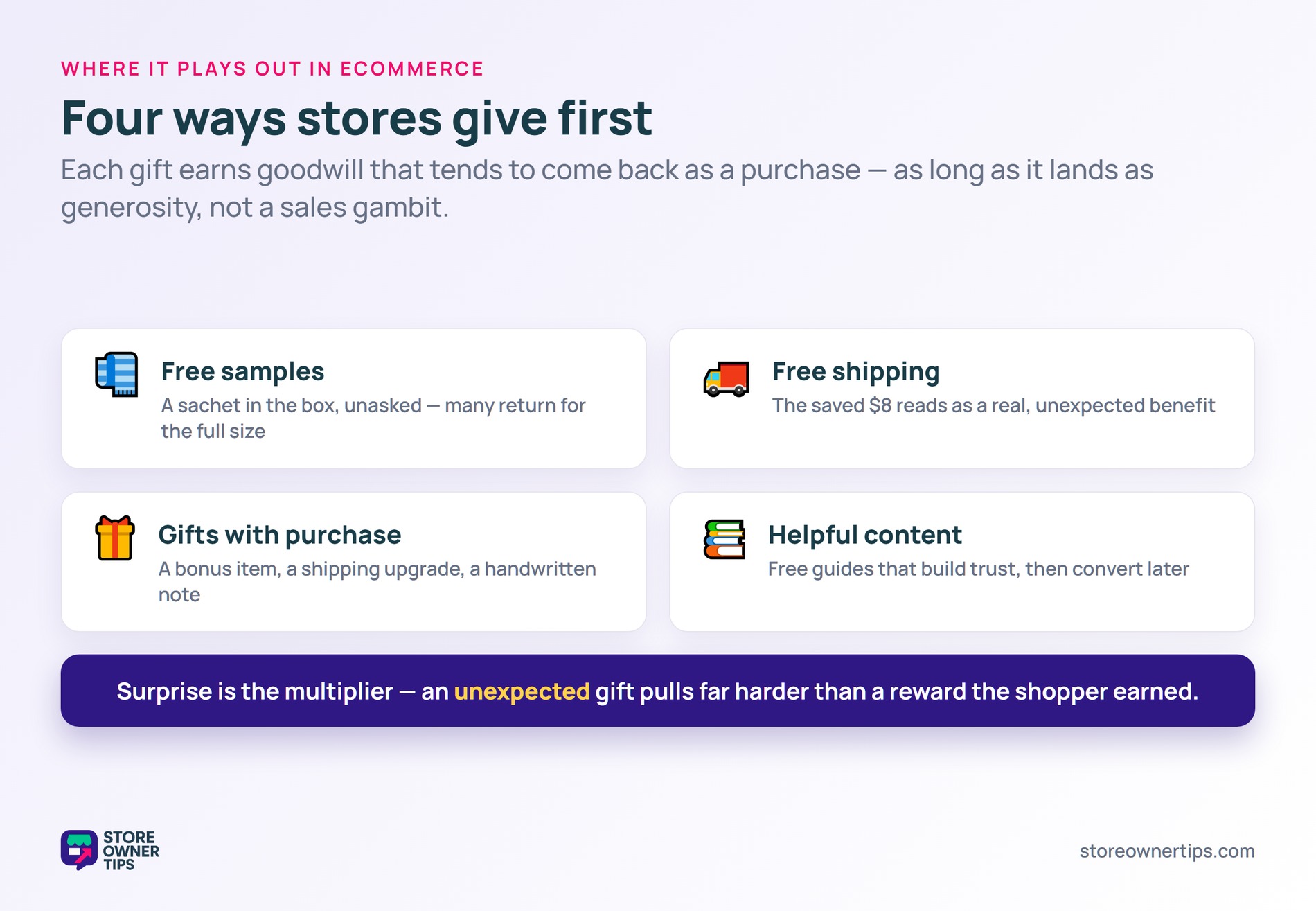
Online stores use reciprocity in a handful of common patterns. First, free samples are the most direct. The principle isn’t new to retail.
A 2002 restaurant study tested this with candy. Servers who gave a small piece with the check earned a 17.84% average tip versus 15.06% without. The candy cost pennies. The lift held across hundreds of meals.
In fact, online stores use the same pattern with samples in the box. Advanced Coupons has a guide on using sample products for reciprocity in sales. Add a sachet of a new flavor to an order without asking. Many customers come back to buy a full size.
Next, free shipping is the most-loved reciprocal gift in ecommerce. Customers see the saved $8 as a real, unexpected benefit. The store earns goodwill that often returns as a second order.
Then, gifts with purchase double down. A free product on the second item, an unexpected upgrade to faster shipping, or a small handwritten note all qualify. Each one nudges the buyer toward a repeat.
Plus, helpful content is the slowest-acting version. Free guides, useful videos, and detailed buying advice cost nothing extra to produce. They build trust over weeks, then convert when the shopper finally needs the product.
Reciprocity isn’t a guarantee. The most common failure is making the “gift” feel like a transaction. A free trial that auto-converts to a paid plan after three days doesn’t feel like a gift. It feels like a trap.
Second failure mode: oversized gifts. When the favor is too large, shoppers feel manipulated
Third is overuse. Stores that send a “free gift” with every promo train customers to expect them. Then the gift stops being a surprise, and the reciprocity pull dies with it.
A fourth failure is timing. A “free” gift that arrives after the purchase often feels like a generic loyalty perk, not reciprocity. Ultimately, the gift should arrive before or alongside the buying decision.
Picture a small-batch tea company called Leafwise, running on WooCommerce. They sell premium loose-leaf blends and want more repeat customers.
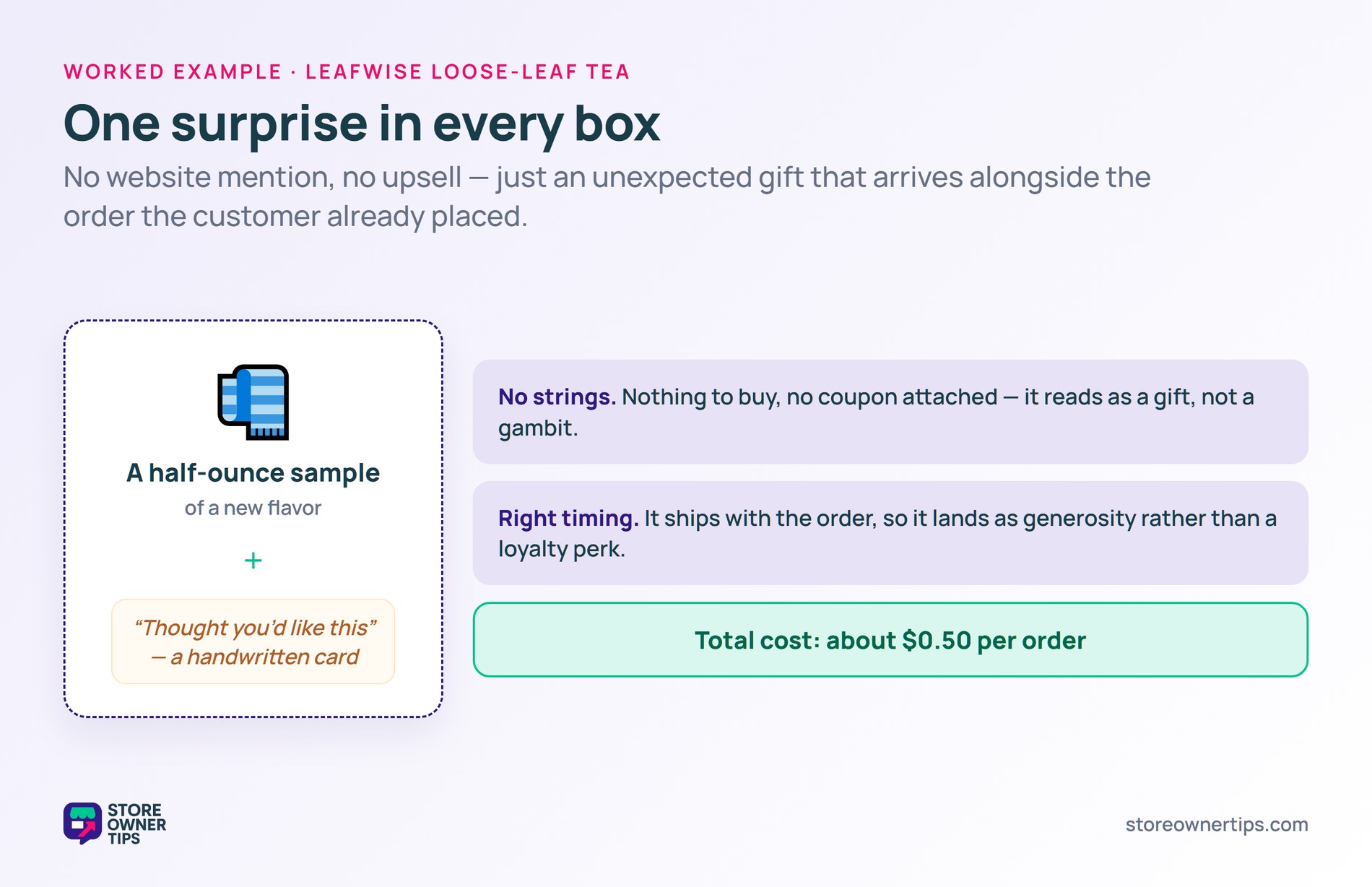
The team decides to slip a half-ounce sample of a new flavor into every order. No mention on the website. No upsell. Just a small handwritten card that says “thought you’d like this.”
Before the change, Leafwise sees a 70% cart abandonment rate, in line with the 70.22% ecommerce average. Repeat purchases within 60 days hover around 12%.
Within two months, two patterns emerge. First, the new-flavor sample shows up in customer reviews and Instagram posts. The brand gets a small wave of organic mentions it never asked for, creating valuable social proof that builds trust with
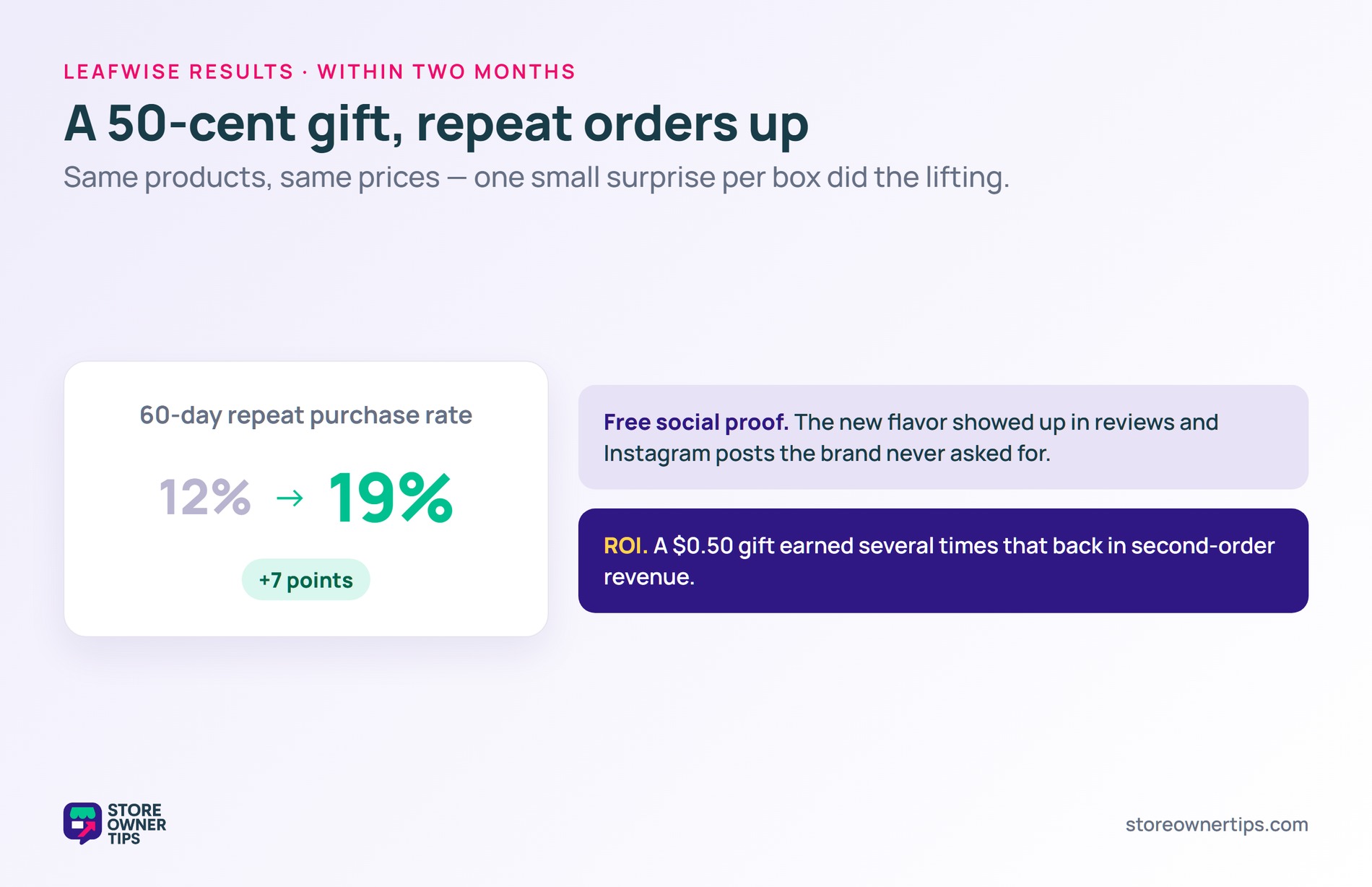
Second, the 60-day repeat purchase rate climbs from 12% to 19%. Most of the lift comes from customers buying the new flavor they sampled. A smaller share comes from people simply choosing Leafwise over a competitor for their next order.
The total cost of the gift is roughly $0.50 per order. As a result, the lift in repeat purchases earns Leafwise multiple times that in second-order revenue. Same products, same prices, one small added gift.
Yes, when the gift is real. Honest free samples, real free shipping, and genuinely helpful content all qualify. The trick is whether the giver would still send the gift if no purchase ever followed.
It crosses the line when the gift is engineered purely to obligate. Auto-renewing free trials and “gift” coupons that require a $200 spend push that boundary. Shoppers spot the manipulation eventually, and trust pays the bill.
A discount is announced. The shopper knows it’s coming and factors it into the buying decision. Meanwhile, reciprocity arrives unexpected. The shopper feels grateful, not strategic.
Both can lift sales, but they work on different parts of the brain. Discounts pull on the wallet. Reciprocity pulls on the heart, which tends to leave a longer trace.
Start small. Pick one unexpected gift you can give every order. For example, it could be a free sample, a handwritten card, or a one-time upgrade to faster shipping.
For free product samples, set up a free-gift coupon that auto-applies on every order. WooCommerce supports this natively or through dedicated plugins. Track repeat purchase rate before and after to see the effect. If the lift is real, keep going.
The reciprocity principle is one of the steadiest persuasion levers in commerce, because it works on something deeper than price. A small, unexpected gift earns goodwill that often returns as repeat business. The cost is usually tiny. In short, the lift is usually real as long as the gift feels real too.
Copyright © StoreOwnerTips.com. All Rights Reserved.
