Weekly ecommerce tips, deals & news.
The Zero Price Effect is a psychological principle where pricing an item at exactly zero creates a massive, irrational spike in consumer demand. Instead of simply seeing a cheaper product, shoppers view a “free” offer as having absolutely zero downside or financial risk. This triggers a powerful emotional response that bypasses normal logical thinking. In e-commerce, offering a completely free item or free shipping is a proven way to boost sales and drive up average order values.
To really use this strategy, you need to understand how human brains react to free things and how your website actually handles them. It’s a mix of deeply rooted human psychology and smart website coding.
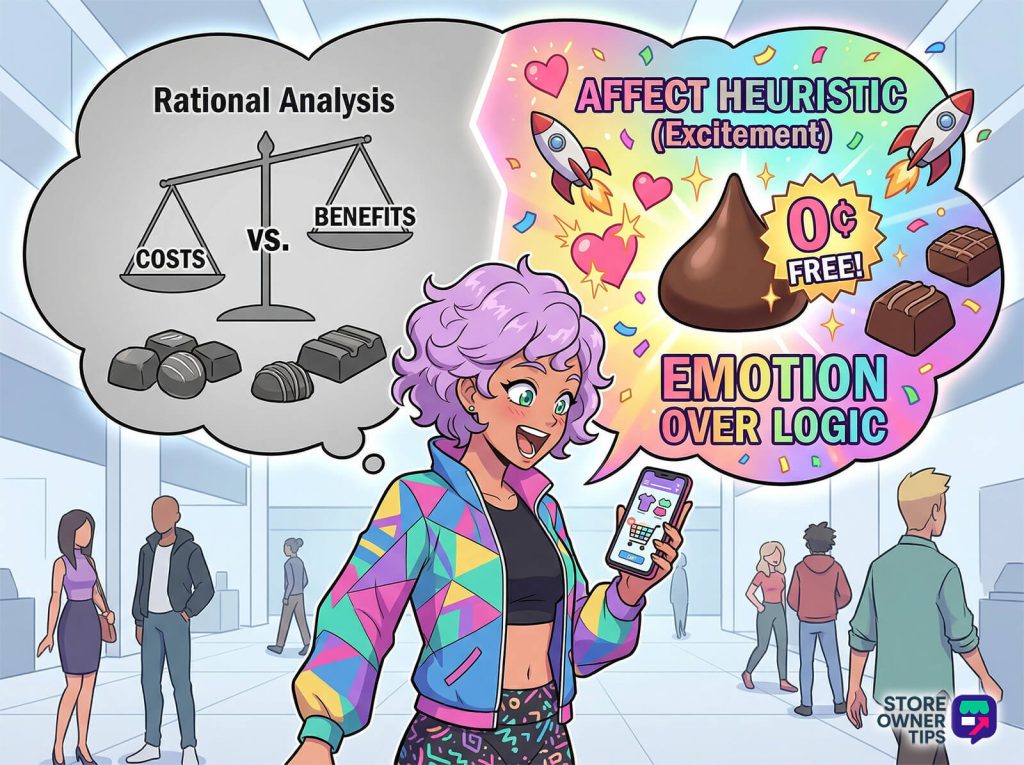
Normally, when someone buys something, they do a rational cost-benefit analysis. They look at the price, think about the effort to buy it, and decide if the product is worth it. But behavioral economics shows us that “zero” is completely different. When a price hits zero, the brain uses an emotional shortcut called the affect heuristic.
Because there’s no financial risk, shoppers don’t feel any fear of loss. Instead of acting like calculating buyers, they get swept up in the excitement. Researchers proved this in a famous 2007 study. They offered people a premium Lindt chocolate for 14 cents or a standard Hershey’s Kiss for 1 cent. Most people (30%) acted rationally and bought the high-quality Lindt, while only 8% bought the Hershey’s.
But then, the researchers dropped the price of both chocolates by exactly one penny. The Lindt was 13 cents, and the Hershey’s was totally free. Even though the price gap was exactly the same, everything flipped. Demand for the free Hershey’s Kiss nearly quadrupled to 31%.
However, there’s a catch. The brain has a secondary response called the scrutiny pathway. If you offer a free item but make the customer jump through hoops to get it—like navigating a slow website, creating a mandatory account, or handing over personal data—they start overthinking. These non-monetary headaches are called incidental costs. If these costs are too high, shoppers assume the free item is a scam or low quality. This triggers the Boomerang Effect, causing your free offer to actually harm your sales.
To make the Zero Price Effect work, your online store has to deliver the free item smoothly. If a customer has to manually type in a clunky coupon code or leave the checkout page, that friction will ruin the emotional high.
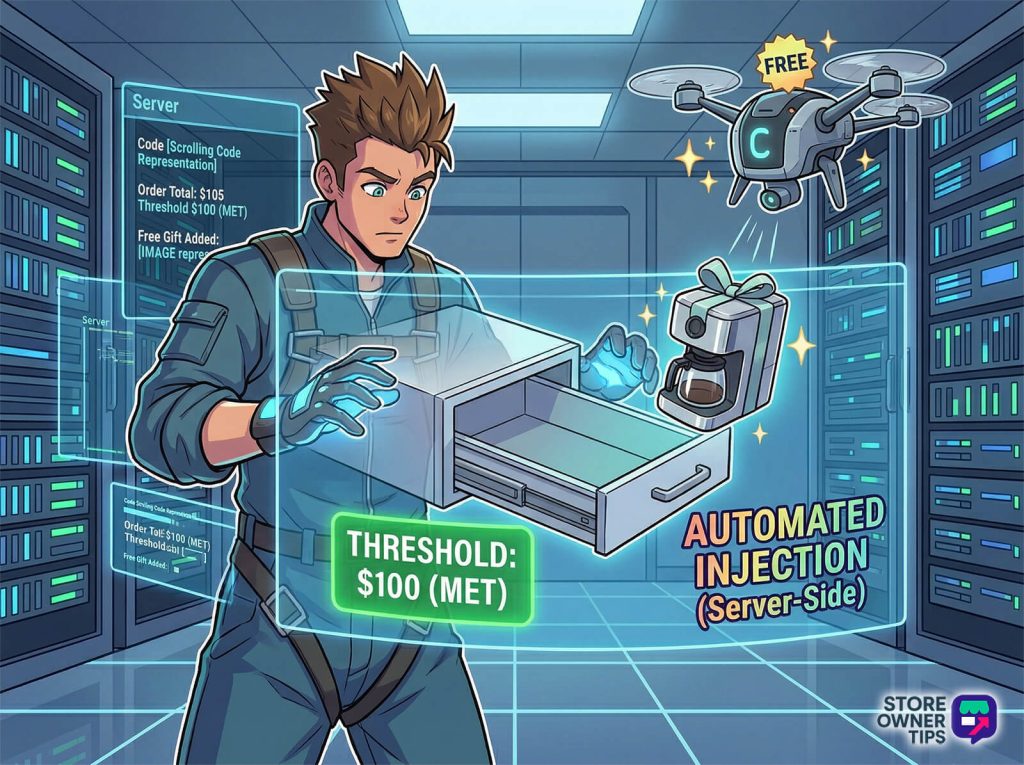
On Shopify, big enterprise stores use the Plus-exclusive Script Editor. This allows developers to write custom server-level scripts. Think of it like a silent robot that watches the shopping cart. If the cart hits a $100 threshold, the script automatically changes the price of a promotional gift to exactly zero before checkout even starts.
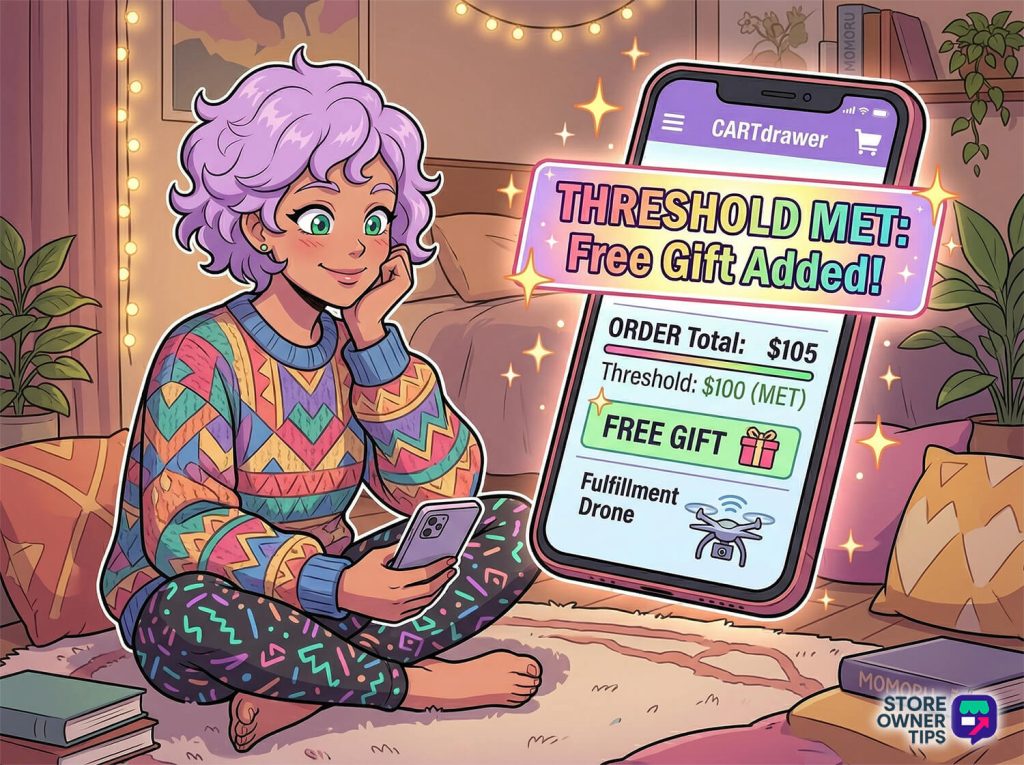
For standard Shopify stores, developers use the AJAX Cart API. They write custom JavaScript that tracks the cart in real-time. When a shopper hits the goal, the code sends a small data package (a JSON payload) behind the scenes. This instantly pops the free item into a slide-out cart drawer with a big “FREE” badge. This immediate visual reward is crucial, especially on mobile phones, where over 60% of shopping happens.
On WooCommerce, you can achieve the same magic using dynamic pricing plugins. Because WooCommerce is open-source, plugins can intercept the cart’s math and inject a secondary product with a 100% price override. You don’t need manual coupons. You can even add a progress bar that says, “Add $15 more to unlock your free gift,” which turns shopping into a fun game.
Let’s look at how a simple zero-price threshold can totally transform a business. Imagine a mid-sized online store selling home goods.
Right now, this store gets 100,000 monthly visits. They have a standard conversion rate of 2.0%, meaning they get 2,000 orders a month. Their Average Order Value (AOV) is $45. They also charge a flat $8 shipping fee on every single order. In this baseline state, the store makes $90,000 in gross monthly revenue. However, their data shows a massive problem: about 48% of shoppers are abandoning their carts right when they see that $8 shipping fee.
To fix this, the store decides to use the Zero Price Effect. They don’t want to lose money, so they add a smart rule to their shopping cart: “Free Shipping on Orders Over $60.” They chose $60 because it’s about 30% higher than their normal $45 order value.
Now, when a shopper puts $45 worth of goods in their cart, a slide-out drawer pops up. It tells them, “You are only $15 away from free shipping!” Driven by the excitement of a free reward, shoppers act irrationally. They would rather spend $15 on a real, physical product than throw away $8 on a hidden shipping fee.
The results are staggering. Because the shipping fee friction is gone, the conversion rate climbs from 2.0% to 2.5%. The store is now getting 2,500 orders a month. Even better, that little progress bar forces shoppers to buy an extra item, pushing the AOV up from $45 to $58.
The store’s new gross monthly revenue jumps to $145,000. By simply moving some numbers around to offer a free reward, the store achieved a massive 61% increase in revenue without paying for a single new website visitor.
The Zero Price Effect is powerful, but it’s not the only way to price your items. Here’s how it compares to other common tactics:
Like any powerful tool, giving things away for free has major benefits and serious risks.
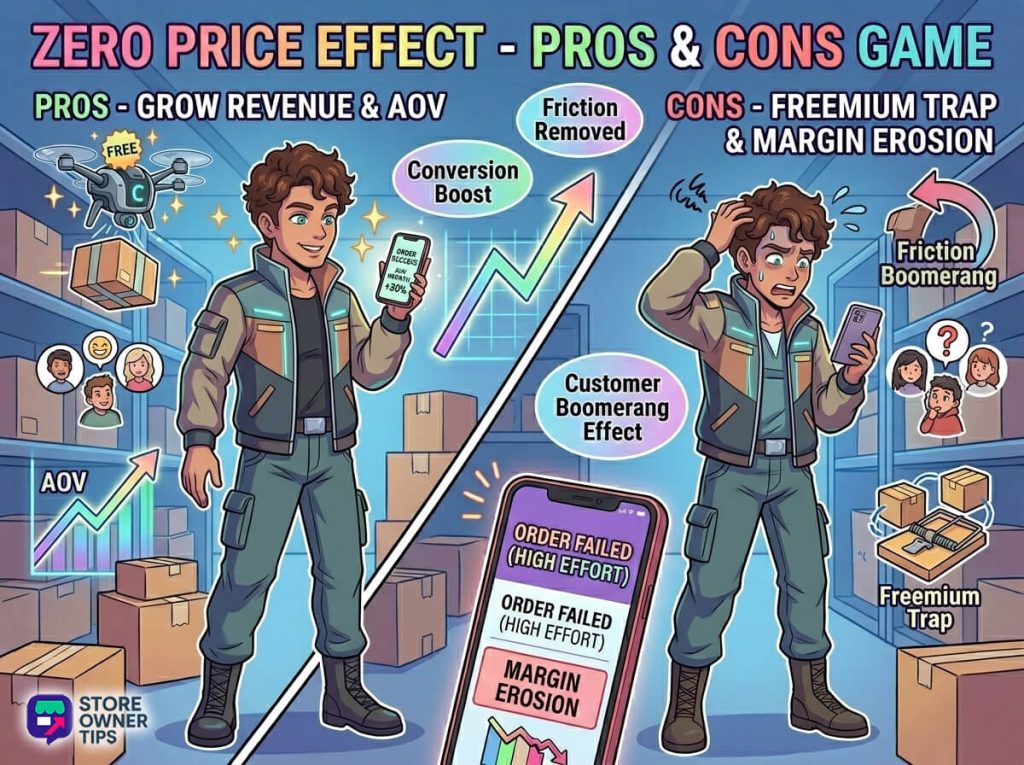
The Pros:
The Cons:
Does offering a free product or service devalue my brand?
It depends on your pricing model. If you sell high-end luxury items (prestige pricing), offering freebies can definitely make your brand look cheap. In B2B sales, a free core product makes buyers suspicious. But for standard consumer goods and software, offering free value doesn’t hurt you. When you frame the free item as an exclusive “gift” alongside a full-priced purchase, it feels like generous social goodwill, not a cheap trick.
Is “Buy One Get One” (BOGO) actually better than offering a 50% discount?
Mathematically, they’re exactly the same. Psychologically, BOGO is much better. Shoppers are willing to spend 40% more when they see the word “free.” A 50% discount makes people feel guilty for spending money. BOGO allows for “mental accounting,” where the first item is a planned purchase, and the second is a guilt-free bonus.
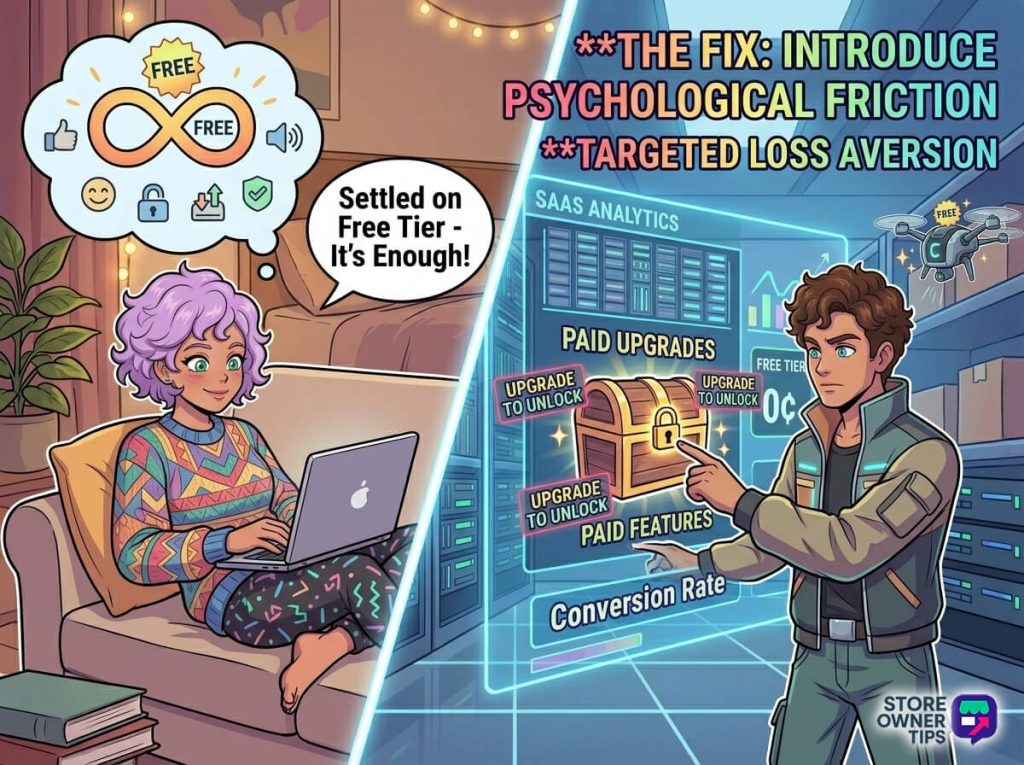
How does the “Freemium Trap” work, and how do I fix it in SaaS?
The freemium trap happens when users love your free software so much they ignore its limits and refuse to upgrade. To fix this, you have to add psychological friction. Stop showing them what the free tier does, and start showing them what they are missing. Put “upgrade to unlock” buttons right next to the best features. Alternatively, charge a tiny $1 fee instead of zero. This filters out the unserious users who won’t even take out their credit cards.
The Zero Price Effect is a fundamental shift in how consumers make choices, proving that “free” is an emotional trigger, not just a price point. By strategically eliminating financial friction through BOGO deals or free shipping thresholds, e-commerce stores can predictably bypass buyer hesitation. When implemented with a smooth, frictionless website experience, it’s one of the most reliable engines for long-term revenue growth and customer acquisition.
Copyright © StoreOwnerTips.com. All Rights Reserved.
