Weekly ecommerce tips, deals & news.
Picture this: two WooCommerce stores sell the exact same organic cotton t-shirt. Store A’s description says “Organic cotton t-shirt. Available in S, M, L, XL. Machine washable.” Store B’s says “Finally, a t-shirt that’s as kind to the planet as it is to your skin. Made from 100% GOTS-certified organic cotton that gets softer with every wash.”
Same product. Wildly different results.
Here’s the truth: your WooCommerce product descriptions are the silent salesperson on every page of your online store. Most store owners either copy-paste manufacturer descriptions (hello, duplicate content) or write feature-heavy paragraphs that nobody actually reads. Both approaches leave money on the table.
The opportunity is real: better great product descriptions mean better SEO rankings and higher conversion rates from the exact same traffic. For this reason, this guide will walk you through a repeatable framework, show you 5 real before/after rewrites you can steal, and give you templates that work for any product type. Let’s make your product copy work harder.
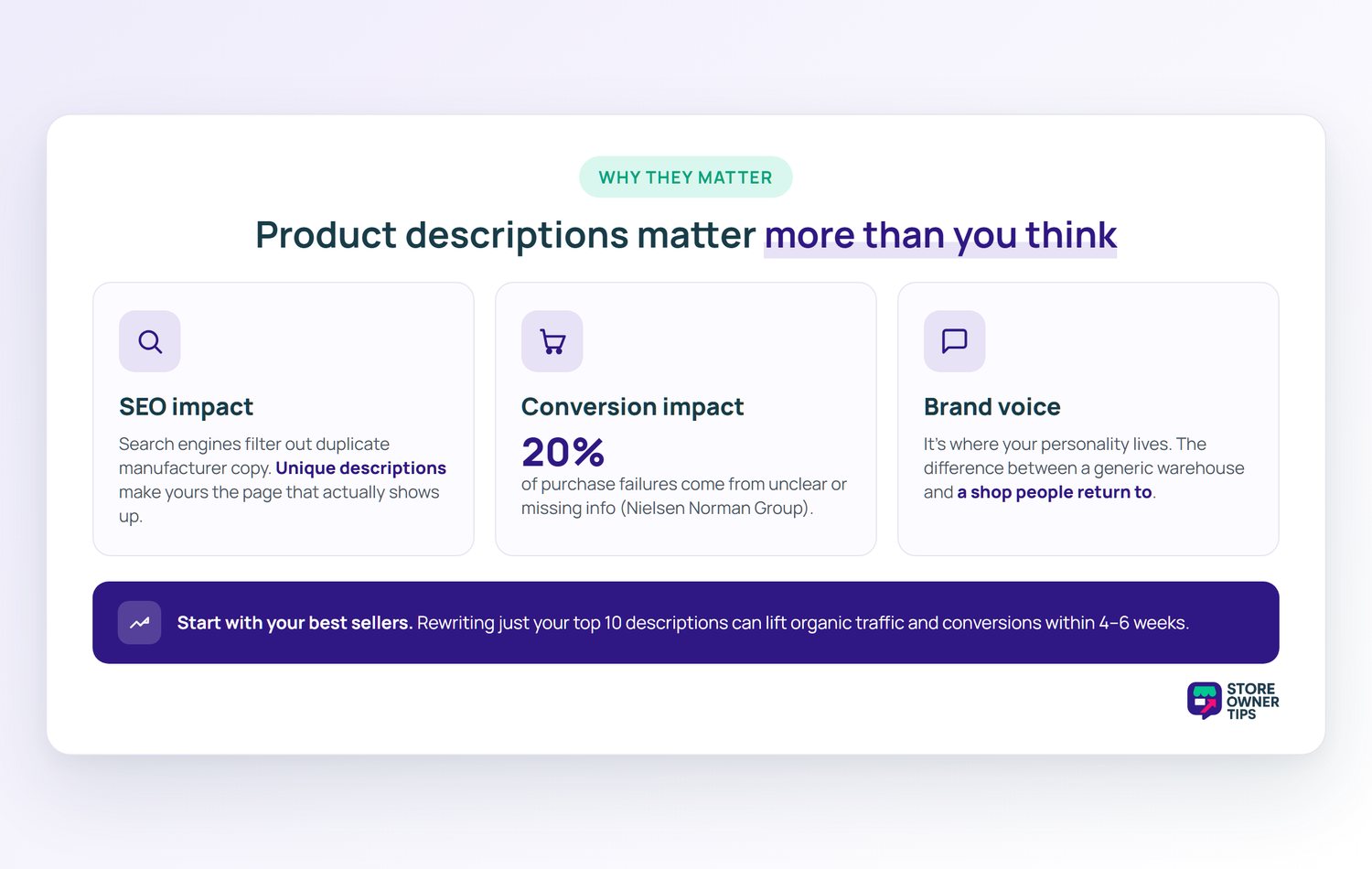
Let’s start with the three reasons you should care about your WooCommerce product descriptions beyond just “filling in the field.”
SEO impact. SEO impact. If you use the exact same manufacturer description as 200 other stores, Google won’t punish or “penalize” your website. However, search engines will usually filter out those duplicates and only show one version in the search results. Writing unique, helpful descriptions is the best way to make sure your product page is the one that actually shows up when shoppers search.
Conversion impact. Descriptions bridge the gap between browsing and buying. Since your customer can’t touch or try on your product, your page has to give them all the answers. Research from the Nielsen Norman Group shows that 20% of purchase failures happen simply because information is unclear or missing. If you forget to include hard details—like exact sizes, shipping costs, or stock levels—shoppers will just leave.
Brand voice. Your product descriptions are where your personality lives. They’re the difference between a store that feels like a generic warehouse and one that feels like a shop you’d actually want to visit again.
🔍️ What We’ve Seen: We’ve watched store owners rewrite just their top 10 WooCommerce product descriptions and see a measurable bump in both organic traffic and conversion rate within 4-6 weeks. You don’t have to rewrite everything at once. Start with your best sellers.
The bottom line: Polishing your product descriptions is a vital first step to boosting sales. Just keep in mind that massive conversion jumps—like a 30% lift according to data from Conversion Rate Experts—usually require looking at the big picture. You have to combine great writing with a smooth checkout process, smart pricing, and clear trust signals.
Here’s the most common mistake we see in WooCommerce product descriptions: leading with features instead of benefits.
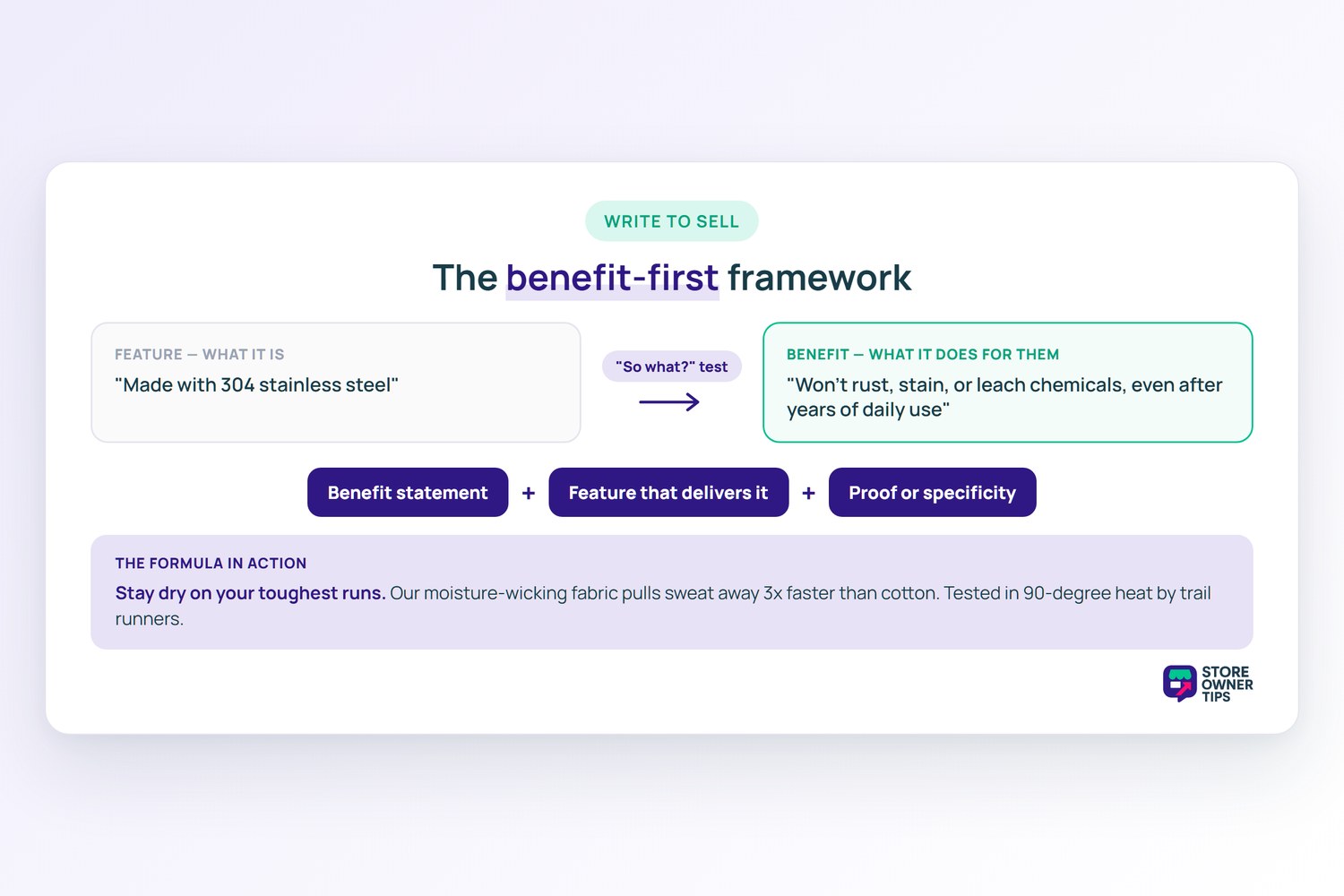
Features describe what a product is. Benefits describe what a product does for the customer. There’s a massive difference.
The quickest way to convert features into benefits is the “So what?” test. For every feature you write down, ask yourself: “So what does that mean for the person buying this?” Keep asking until you land on something that makes someone feel something.
Lead with the benefit, support with the feature. Your opening sentence should always be about the customer’s outcome. Then back it up with the feature that delivers it.
Here’s a formula we love:
🚀 Power Tip: A simple formula that always works: [Benefit statement]. [Feature that delivers it]. [Proof or specificity]. For example: “Stay dry on your toughest runs. Our moisture-wicking fabric pulls sweat away 3x faster than cotton. Tested in 90-degree heat by trail runners.”
✨️ Try this right now: Pick one of your products. Look at the first sentence of the description. If it starts with a spec or a material, rewrite it as a benefit. Just one sentence. That tiny shift changes the entire feel of the page.
Here’s a reality we’ve had to accept: most shoppers scan your product page. They don’t read every word. Eye-tracking studies consistently show that online shoppers skim in an F-shaped pattern, hitting headlines and the first few words of each paragraph.
That means your formatting is just as important as your writing. Here’s how to structure WooCommerce product descriptions for the way people actually shop:
This is something we see a lot of store owners get confused about. In a classic WooCommerce setup, you have two main description fields:
| Field | Where It Shows | Best Used For |
|---|---|---|
| Short Description | Usually sits next to the product image. | This is your elevator pitch: benefits, key features, and the emotional hook (2-4 sentences). |
| Long Description | Usually lives in the “Description” tab below the image. | This is for full details: specs, sizing, and FAQs. |
📝 Note: If you use a modern block theme (where you build pages by dragging and dropping pieces like Lego bricks), you aren’t stuck with this layout! You can place these text blocks anywhere you want on the page.
We tested this across several stores, and the pattern is clear: the short description does the selling, the long description handles the objections. Get both right and you’ve covered the full buyer journey on a single page.
You don’t need to be an SEO expert to write WooCommerce product descriptions that rank. You just need to place your target keywords naturally in a few key spots:
The key word here is naturally. Cramming your target phrase into every other sentence, a.k.a. keyword stuffing, hurts more than it helps. Google’s algorithms are smart enough to understand context. Write for humans first, search engines second.
Long-tail keywords are your secret weapon for product descriptions. Instead of trying to rank for “running shoes,” target “lightweight trail running shoes for wide feet.” These longer phrases have less competition and higher buying intent.
WooCommerce product descriptions feed directly into your on-page SEO. If you’re using a plugin like Yoast SEO or All in One SEO, they’ll give you real-time feedback on keyword placement and readability.
This is the part we get most excited about. Here are 5 product description rewrites that demonstrate the framework in action. Each one shows what most stores write, what’s wrong with it, and how to fix it.
Before:
“Women’s running jacket. Lightweight. Water-resistant. Reflective details. Zip pockets. Available in 4 colors.”
What’s wrong: Pure feature list with zero personality. Reads like a spec sheet. Doesn’t differentiate from a thousand other running jackets.
After:
“Run in any weather without slowing down. This ultralight jacket shrugs off rain and wind while keeping you cool, not clammy. Reflective accents keep you visible on early-morning runs, and two zip pockets hold your phone and keys without bouncing. Available in 4 colors that actually look good after a muddy trail run.”
Why it works: Leads with the benefit (run in any weather), paints a scenario (early-morning runs), and addresses a real pain point (feeling clammy). The same features are there. They’re just wrapped in context.
Before:
“Advanced inventory management plugin for WooCommerce. Features include stock syncing across multiple warehouses, low stock alerts, batch editing, CSV import/export, and REST API support.”
What’s wrong: Jargon-heavy. A store owner reading this still doesn’t know what it’ll actually do for their daily workflow.
After:
“Stop losing sales to ‘out of stock’ surprises. This inventory management plugin keeps your stock levels accurate across every warehouse and sales channel automatically. Get instant alerts before you run low, update hundreds of SKUs in seconds with batch editing, and import your entire catalog with a single CSV. Built for WooCommerce stores that have outgrown spreadsheet inventory.”
Why it works: Opens with the pain point (losing sales), explains the features in terms of what they prevent or enable, and positions the product for a specific audience.
Before:
“Handmade ceramic mug. Holds 12 oz. Dishwasher and microwave safe. Each piece is unique.”
What’s wrong: Generic. Could describe any mug on Etsy. Misses the entire story that makes handmade products worth paying more for.
After:
“Your new favorite morning ritual, shaped by hand. Each mug is wheel-thrown in our Portland studio and glazed with a signature ocean-blue finish that means no two are exactly alike. It holds a generous 12 oz (enough for a proper cup of coffee) and it’s tough enough for the dishwasher and microwave. The kind of mug people ask about.”
Why it works: Adds narrative and specificity (Portland studio, ocean-blue glaze). “The kind of mug people ask about” is a social proof trigger that makes the reader picture themselves owning it.
Before:
“Clear phone case for iPhone 15. TPU material. Shock-absorbing. Slim profile. Wireless charging compatible.”
What’s wrong: This is what every phone case listing says. Zero differentiation.
After:
“Show off your iPhone 15’s design without worrying about the next drop. Our premium TPU case features a UV-resistant coating to delay yellowing and keep things looking fresh. It absorbs impacts from up to 6-foot drops and adds barely any bulk to your pocket. Works perfectly with MagSafe and wireless chargers. Finally, a clear case that actually protects.”
Why it works: Addresses the #1 complaint about clear cases (yellowing), adds specificity (6-foot drops), and closes with a line that directly differentiates.
Before:
“Electric standing desk. Dual motor. Height range: 25.5″ to 51″. 350 lb weight capacity. Memory presets. Cable management tray. 5-year warranty.”
What’s wrong: For a $500+ product, this doesn’t build any trust or address the concerns that make someone hesitate before clicking “buy.”
After:
“Your back has been asking for this. Our dual-motor standing desk transitions from sitting to standing in under 4 seconds—quietly enough for a Zoom call. It handles up to 350 lbs (yes, your triple-monitor setup included), remembers your perfect heights with 4 programmable presets, and comes with a built-in cable management tray so your setup looks as clean as it feels. Backed by a 5-year warranty because a desk this solid should last.”
Why it works: Opens with an emotional hook (your back), addresses real concerns (noise, weight capacity for monitors), and reframes the warranty as a confidence signal rather than a spec.
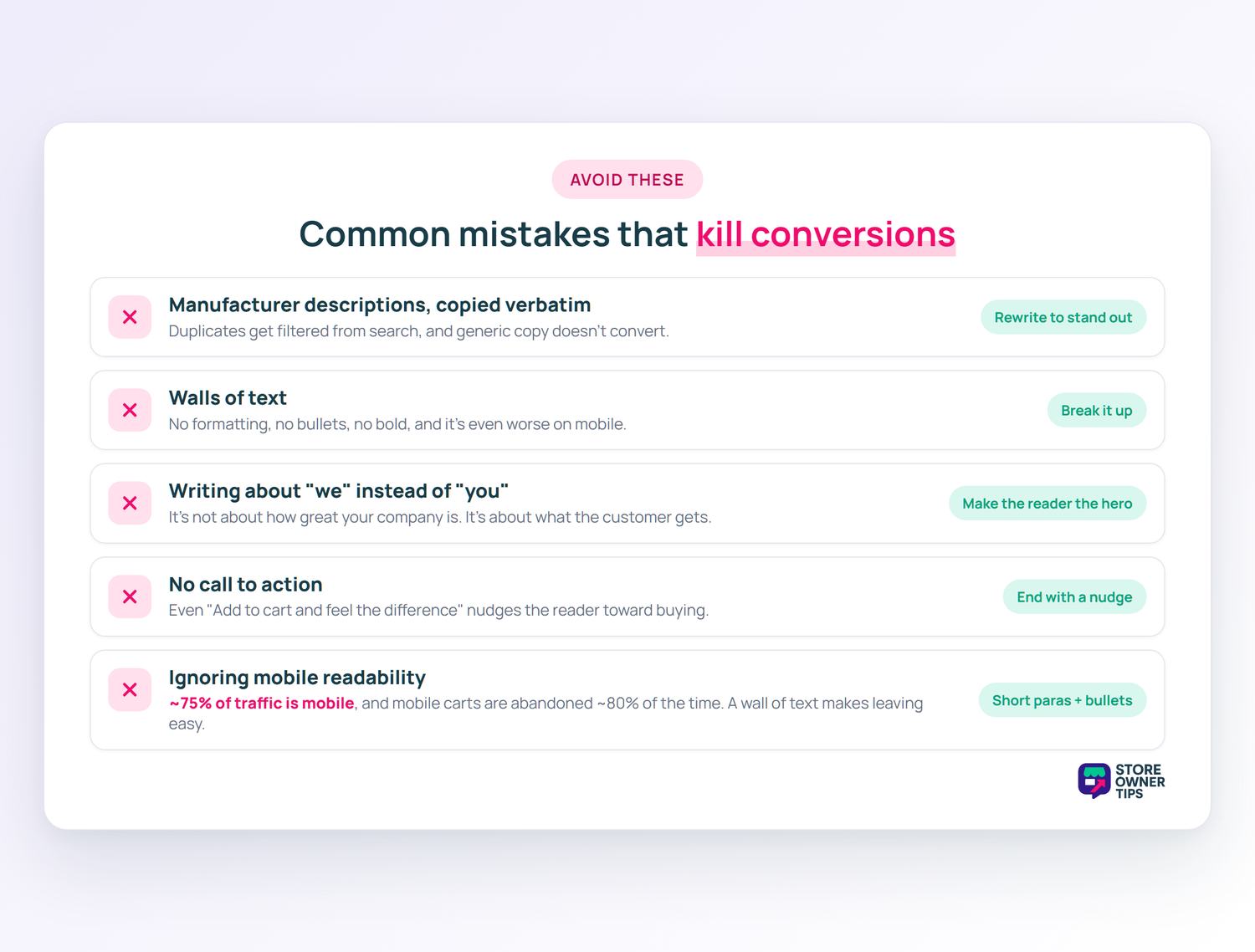
Now that you’ve seen what good looks like, let’s flag the most common mistakes we see in WooCommerce product descriptions:
Here’s the scaling problem every growing WooCommerce store hits: writing unique, high-quality descriptions for 100+ products is brutal. We’ve been there. It can take weeks of dedicated writing time.
That’s where AI tools come in: not to replace your voice, but to scale it.
We’ve tested several AI writing tools for WooCommerce product descriptions, and we always recommend StoreAgent’s AI product description generator. We built this suite of WooCommerce AI tools, meaning it pulls data right from your store to write copy. Just remember: the AI is only as smart as the data you give it. If your store’s tags, sizes, and specs are messy, the AI will write messy descriptions. Clean up your store data first! And if you prefer to draft in Claude or ChatGPT, a WooCommerce MCP server lets the assistant read that product data and save descriptions back to your store.
StoreAgent goes beyond just writing paragraphs. It can also act as a 24/7 customer service chatbot, generate product tags, and summarize customer reviews.
Pricing to keep in mind: StoreAgent has a free “Lite” plan, which is great for testing or updating 25 products a month. If you need to write descriptions for hundreds of items at scale, you’ll need to upgrade to a paid plan (which starts at $19/month for 500 tasks).
Here’s the workflow we recommend:
✍️ When to write manually: Hero products, limited editions, and anything where the story is the product. AI handles the catalog; you handle the stars.
For more on how AI tools are transforming WooCommerce store management, check out our roundup of AI tools for WooCommerce.
Here are three fill-in-the-blank templates you can copy and use right now.
[Primary benefit statement: what the customer gets].
[Feature that delivers the benefit]. [Proof, specificity, or social proof].
Key features:
[Call to action or urgency line].
Tired of [common problem your audience faces]?
[Product name] fixes that. [How it solves the problem in one sentence].
Unlike [common alternative], [your product differentiator]. [Proof or specificity].
What you get:
[Evocative opening line that paints a picture].
[Origin story: where/how it’s made, one sentence]. [What makes it unique].
[Practical details: size, materials, care instructions woven into narrative].
[Closing line that makes the reader picture themselves owning it].
Before you publish any product description, run it through this quick audit:
Learning how to write product descriptions that actually convert isn’t about becoming a copywriter overnight. It’s about following a simple framework: lead with benefits, format for scanners, optimize for SEO, and use AI to scale.
Product descriptions are just one piece of the product page puzzle. For the full optimization playbook (images, reviews, layout, and more) see our product page optimization guide.
Here’s your challenge for this week: pick your top 5 best-selling products and rewrite their descriptions using the Benefit-First Framework. Just five. You’ll be surprised how much of a difference it makes.
Your WooCommerce product descriptions are working for you 24/7. Make sure they’re saying the right things.
Aim for 150-300 words for most products. Simple, low-cost items can get away with shorter descriptions (100-150 words), while complex or high-ticket products benefit from longer, more detailed copy (300-500 words). The key is not word count but completeness: answer every question a buyer might have before clicking Add to Cart. Use the short description field (50-80 words) for your benefit-driven hook and the long description for details, specs, and supporting information.
AI tools like StoreAgent are excellent for generating first drafts at scale, especially if you have hundreds of products to describe. However, AI-generated descriptions still need human editing to match your brand voice, verify accuracy, and add the specific product knowledge that makes descriptions genuinely helpful. The best workflow is using AI for the initial draft and structure, then polishing with your brand personality and real product expertise.
Include your target keyword naturally in the product title, first paragraph of the description, and at least one subheading. Use the short description for a benefit-driven summary that includes the keyword. Add alt text to product images. Write unique descriptions for every product. Don’t just copy manufacturer text. Remember, search engines tend to filter out identical pages, so having unique copy helps you show up in results. An SEO plugin like AIOSEO or Yoast SEO helps you optimize meta titles and descriptions for each product page.
The short description appears prominently near the price and Add to Cart button. It’s the first description text most shoppers read. Use it for your strongest benefit-driven hook (50-80 words). The long description appears in a tab below the product image and is where you provide detailed information, specs, use cases, and supporting copy. Both are important: the short description sells, while the long description informs and reassures buyers who need more detail before committing.

Copyright © StoreOwnerTips.com. All Rights Reserved.
