Weekly ecommerce tips, deals & news.
The cold start problem is the stall a new marketplace hits when it lacks both sellers and buyers. With too few sellers, buyers don’t come, and with too few buyers, sellers don’t list. Each side waits for the other to show up first. Until one side grows on its own, the marketplace feels empty to everyone who visits.
The cold start problem works like a new restaurant with an empty dining room. Diners walk past because nobody is inside, and nobody is inside because diners keep walking past. A multi-vendor marketplace faces the same loop, except it needs two crowds instead of one.
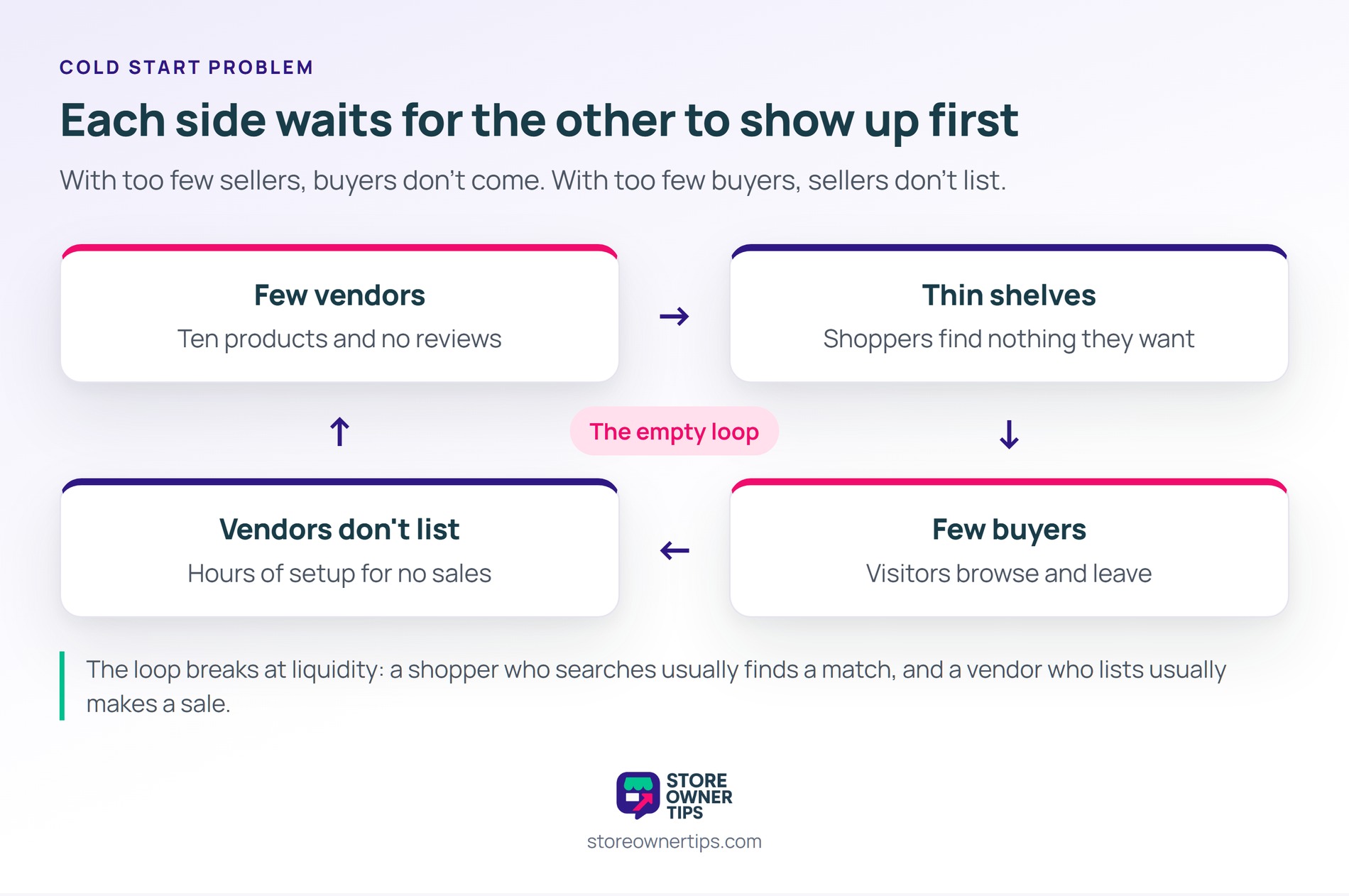
The cold start problem comes from how each side judges your marketplace. A shopper wonders whether they’ll find what they want. A vendor wonders whether anyone will buy. With ten products and no reviews, both answers look like no.
Vendors also weigh their time. Setting up a storefront, writing listings, and learning your rules takes hours. However, a vendor will only spend those hours if the marketplace already has shoppers. That’s why a launch ad campaign alone rarely works, since the traffic lands on thin shelves and leaves.
The cold start problem ends when a marketplace reaches liquidity. Liquidity means a shopper who searches usually finds a match, and a vendor who lists usually makes a sale. Think of it like a party that becomes fun once enough guests arrive.
Liquidity is easier to reach in a small space. A marketplace for one craft, one city, or one hobby needs far fewer vendors to feel full. As a result, many founders launch narrow, then widen once the first category runs on its own.
A WooCommerce marketplace hits the cold start problem the day it goes live. The plugin handles vendor accounts, orders, and payouts, but it can’t create sellers or shoppers. Plus, most store owners launch with a small budget, so they can’t buy their way out with heavy ads.
The upside is control. You can approve every early vendor by hand and set terms one seller at a time. That personal touch is hard for big platforms to match. It also suits the slow, manual work a cold start needs.
The cold start problem drains money and goodwill at the same time. Ads sent to a thin catalog convert poorly, so your customer acquisition cost climbs. Shoppers who leave disappointed rarely come back to check again.
Vendors pay a price too. A seller who lists and makes no sales soon becomes an inactive vendor, with stale stock and slow replies. Those dead shops then make the marketplace look even emptier to the next visitor.
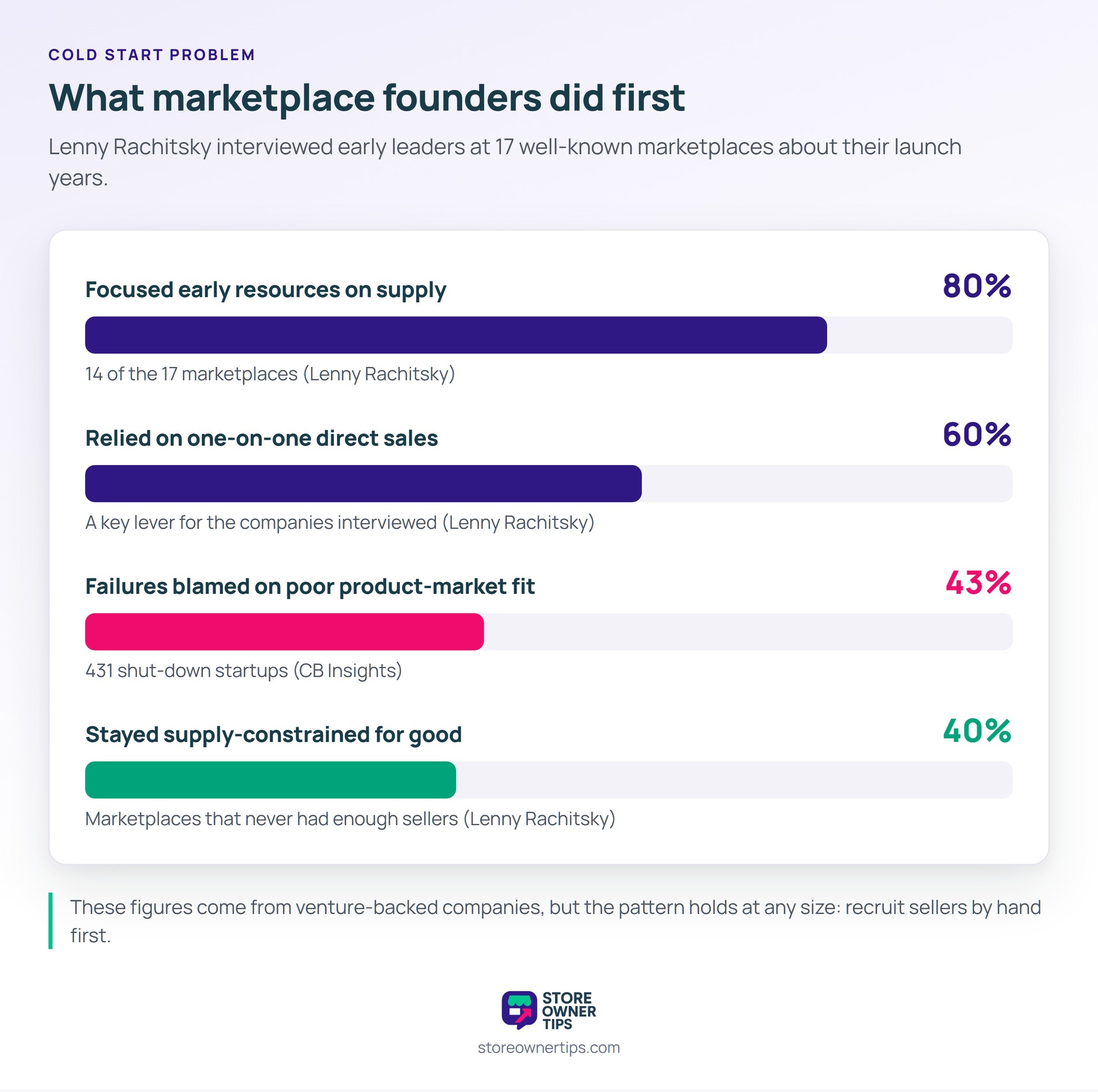
The cold start problem shows up clearly in interviews with marketplace founders. Product writer Lenny Rachitsky interviewed early leaders at 17 well-known marketplaces about their launch years.
Those figures come from venture-backed companies, not small WooCommerce stores. Still, the pattern holds at any size: recruit sellers by hand first.
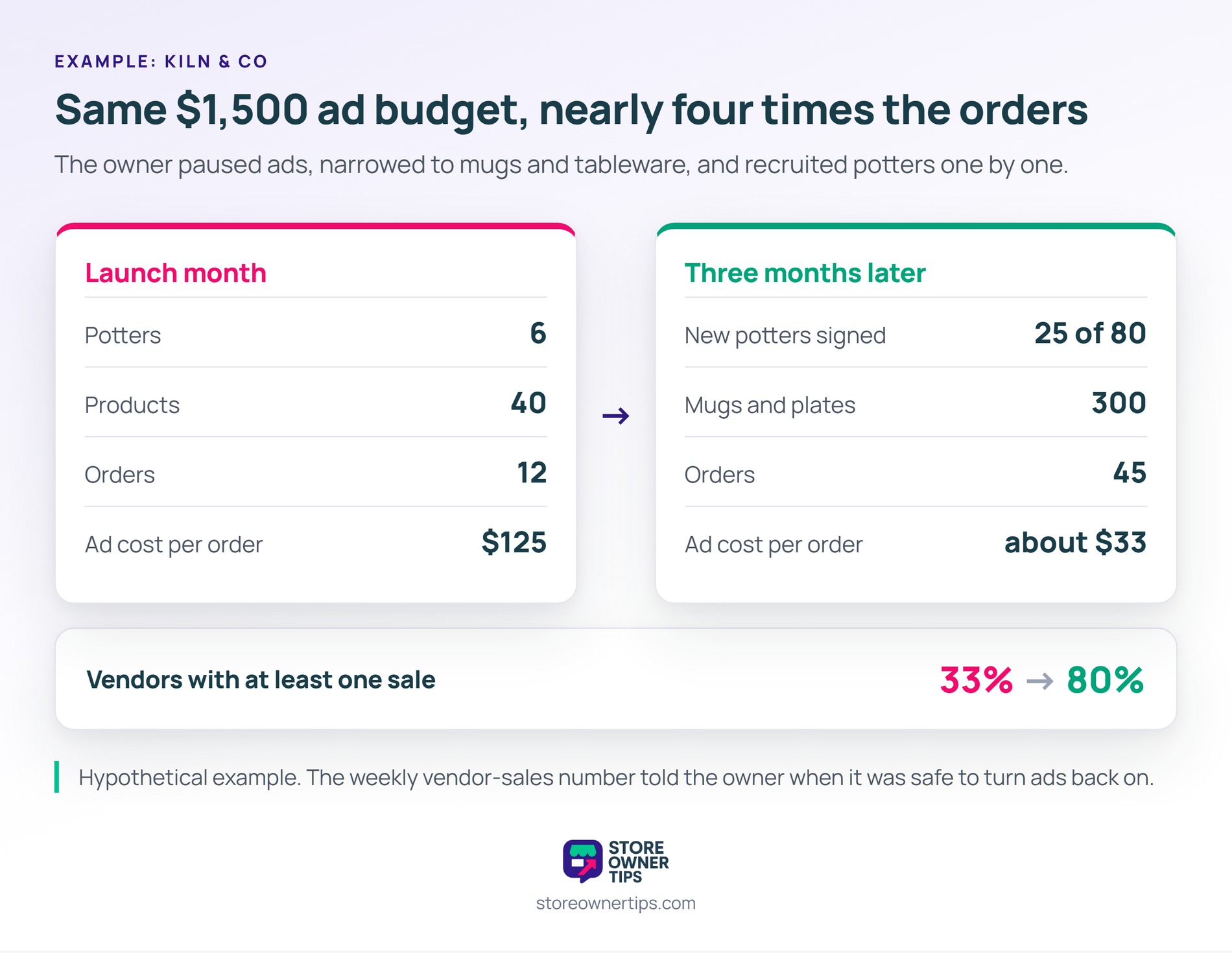
Here’s a hypothetical example of the cold start problem on a new marketplace. Imagine a handmade ceramics marketplace called Kiln & Co. It runs on WooCommerce with a multi-vendor plugin.
The owner launches with a polished homepage and $1,500 in social ads. However, only six potters have signed up, with 40 products between them. The ads bring 3,000 visitors in the first month.
Visitors browse two pages and leave. Only 12 orders come in, so each order costs $125 in ads. Meanwhile, four of the six potters make one sale or none, and two stop updating their shops.
New potters check the site, see thin shelves, and decide it isn’t worth the effort. The marketplace is stuck in a loop where every month looks emptier than the last.
First, the owner pauses ads and narrows the focus to mugs and tableware only. Next, she messages 80 potters directly and signs 25 of them. She offers founding vendors a lower commission for their first six months.
Three months later, the site lists 300 mugs and plates. The same $1,500 ad budget now brings 45 orders, cutting the cost per order to about $33. Vendors start sharing their shop links, which brings free traffic and more potters.
The owner also tracks one simple number each week: the share of vendors with at least one sale. It climbs from 33% to 80%. That tells her sellers now get real value, so she can safely turn ads back on.
You solve the cold start problem by filling one side of the marketplace on purpose, usually the sellers. These steps work well on a WooCommerce marketplace:
Once vendors start bringing their own customers, shift effort toward buyers. Then track the share of searches that find a match.
You’ll know the cold start problem is fading when a few signs line up. New vendors apply without being asked. Most active vendors make regular sales. On top of that, repeat shoppers start arriving from search and word of mouth rather than paid ads.
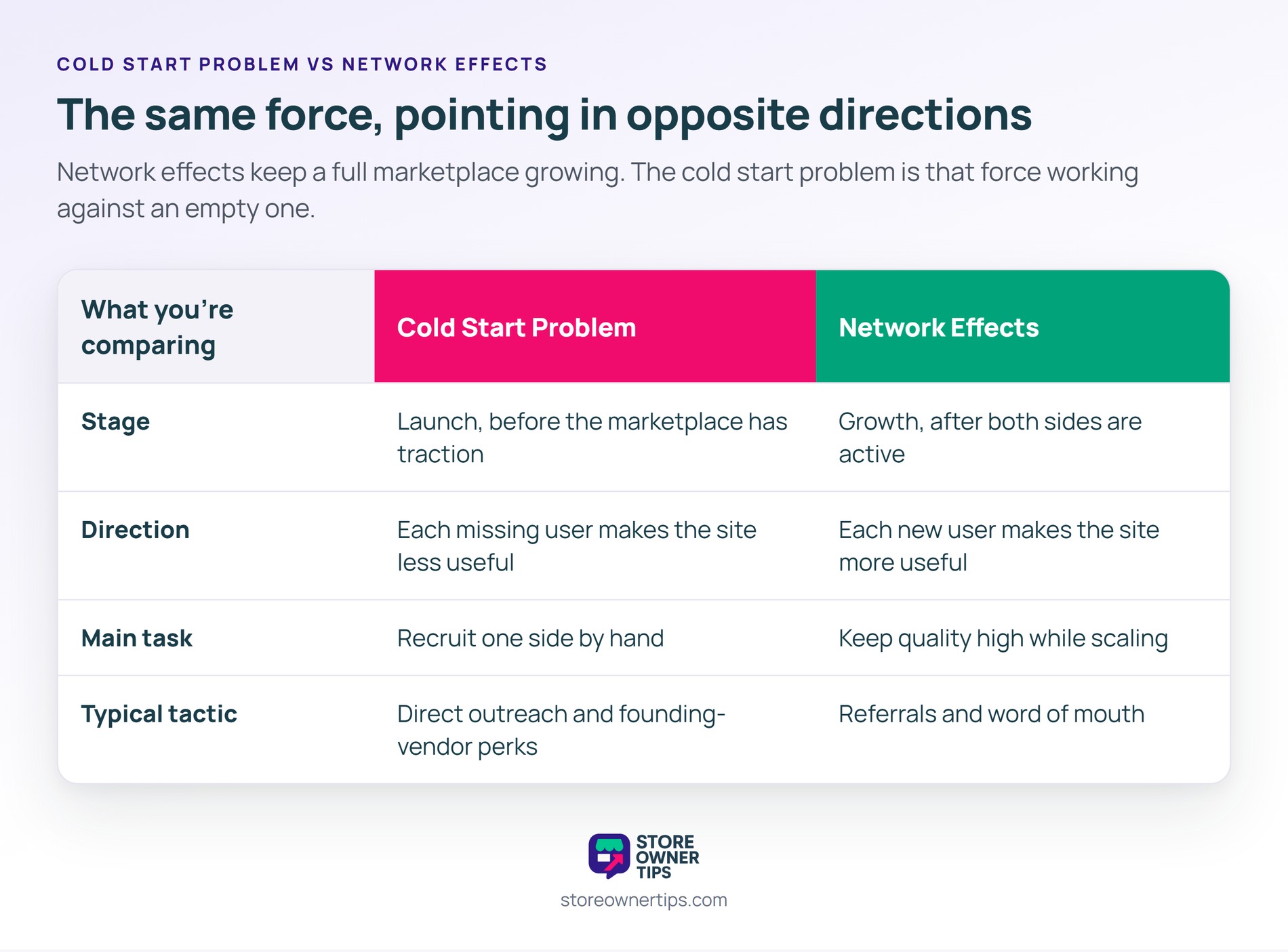
| What you’re comparing | Cold Start Problem | Network Effects |
|---|---|---|
| Stage | Launch, before the marketplace has traction | Growth, after both sides are active |
| Direction | Each missing user makes the site less useful | Each new user makes the site more useful |
| Main task | Recruit one side by hand | Keep quality high while scaling |
| Typical tactic | Direct outreach and founding-vendor perks | Referrals and word of mouth |
The cold start problem and network effects are two sides of the same force. Network effects are why a full marketplace keeps growing. Venture firm NFX credits them with about 70% of the value created in tech. The cold start problem is that same force working against you while the marketplace is still empty.
Get vendors first in most cases. Shoppers need products to browse, and good vendors often bring their own customers with them. Focus on buyers first only if sellers are easy to find but shoppers are scarce.
There’s no fixed number. You need enough vendors that a typical shopper finds several good options in your main category. In a tight niche, that might be 20 to 30 sellers rather than hundreds.
Yes, and it’s a common way to fill early gaps. Your own products keep categories from looking empty while you recruit vendors. Just make sure your listings don’t crowd out vendors once they join.
The cold start problem matters because it decides whether a marketplace ever grows on its own. Owners who plan for it recruit sellers by hand, launch narrow, and reward early vendors. Owners who ignore it spend their budget sending shoppers to empty shelves.
Copyright © StoreOwnerTips.com. All Rights Reserved.
