A stocking stuffer is a small, low-priced gift that fits inside a Christmas stocking. For an online store, it’s also a merchandising category: cheap, light items grouped so shoppers can add them fast. Stores use stocking stuffers to fill gift lists and nudge carts past a free-shipping minimum.
A stocking stuffer works as a low-cost gift that rides along with a bigger order. Shoppers buy one main present, then add a few small extras to finish the stocking. For the store, that habit turns tiny items into a reliable seasonal category. The category earns its keep by raising average order value, not by selling on its own.
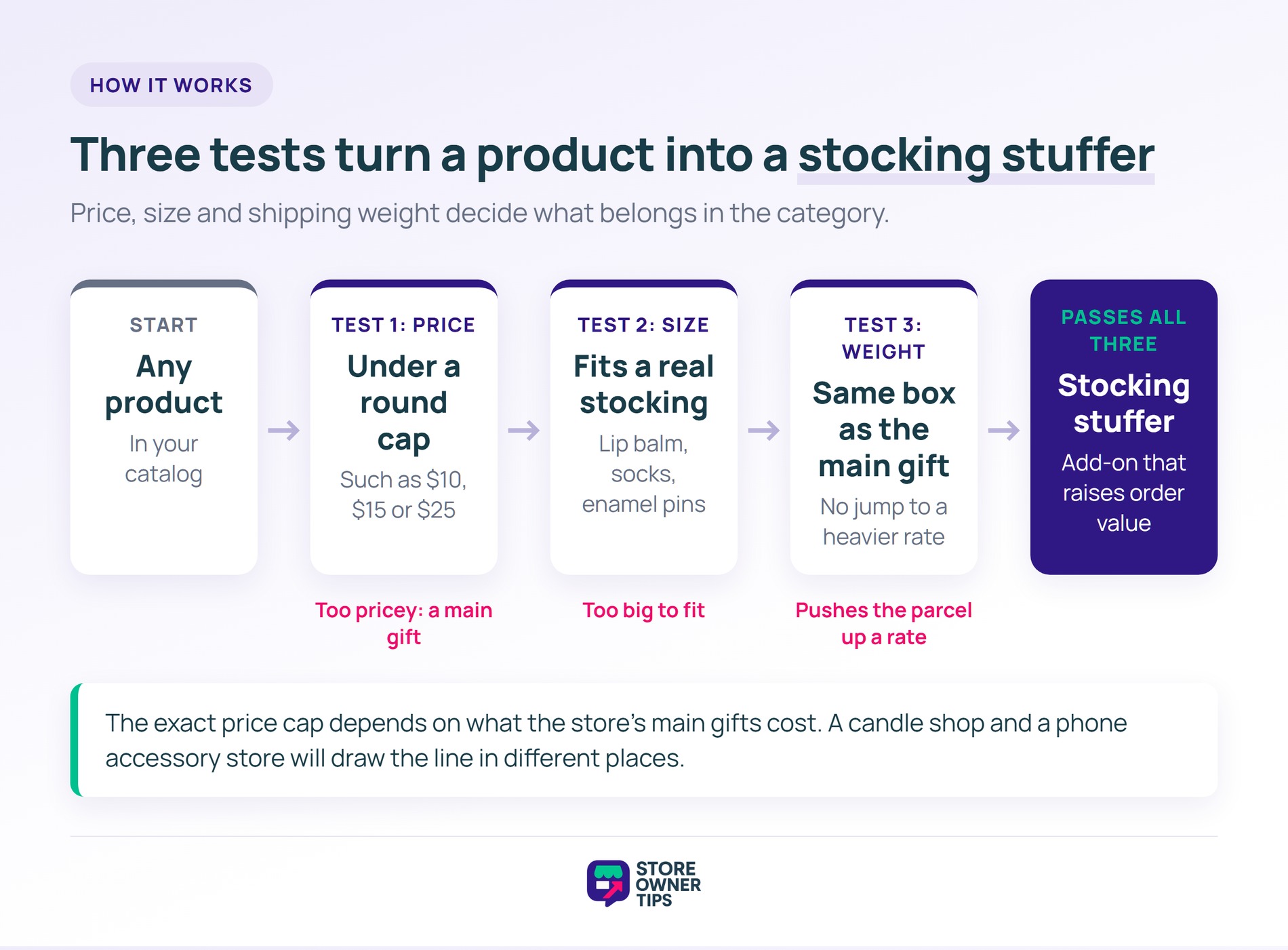
A stocking stuffer qualifies when it passes three tests: price, size and shipping weight. Most stores set a round price cap for the category, such as $10, $15 or $25. The exact cap depends on what the store’s main gifts cost. A candle shop and a phone accessory store will draw the line in different places.
Size matters because the item has to fit inside a real stocking. Think lip balm, socks, enamel pins, tea samplers, card games or a pocket tool. Shipping weight matters just as much for an online store. A good stuffer slips into the same box as the main gift without pushing the parcel into a heavier rate.
Picture the category like the candy rack beside a supermarket checkout. Every item is cheap, small and easy to grab. Nothing on that rack needs a long product page to explain it.
In WooCommerce, a stocking stuffer section usually starts as a product category, such as “Stocking Stuffers” or “Gifts Under $20.” Store owners assign qualifying products to it and link it from the menu, homepage and holiday banners. Many stores also tag items by price band so shoppers can filter fast.
From there, stores move stuffers closer to the buying moment. WooCommerce’s cross-sells field shows chosen products on the cart page, which suits small add-ons well. A free shipping method can carry a minimum order amount, so shoppers see a gap to close. Stuffers priced just under that gap give them an easy way to close it.
Some stores pre-pack stuffers into a small “stocking kit” of three items at one price. Shipping classes help here too, since a light class keeps rates accurate when stuffers travel with heavier gifts. These Christmas promotion ideas show how gift sets fit a wider holiday plan. Product feeds and ads can promote the category too, as these holiday marketing tips explain.
Stocking stuffers sell because they feel low-risk. A $12 item rarely needs comparison shopping, reviews or a long think. Gift givers also buy them in multiples, because one stocking holds several small things. A single cheap product can end up in the same order three times.
Free shipping adds a second pull. When a cart sits a few dollars short of the minimum, a small gift feels smarter than paying for postage. The shopper gets a present for roughly what shipping would have cost. Stores that set their free shipping threshold with stuffers in mind make that choice easy.
Stocking stuffer sales draw from a large holiday budget. The National Retail Federation’s holiday survey found consumers planned to spend $890.49 per person for the season. Of that total, $627.93 was set aside for gifts for family and friends. Small gifts compete for a slice of that money.
Shipping costs shape how shoppers fill carts. NRF research found 51% of online shoppers add items to their carts to meet a shipping minimum. The same research found 47% back out of a purchase when they don’t qualify for free shipping. A stocking stuffer category is built to catch that first group.
Surprise costs kill orders, too. Baymard Institute found 40% of shoppers who abandoned a checkout left because extra costs, like shipping, were too high. Meanwhile, NRF’s October holiday survey lists free shipping or shipping promotions (37%) as a factor in where people shop.
A stocking stuffer in practice is a cheap add-on that turns a stalled cart into a free-shipping order. Here’s a hypothetical example. Imagine Fennel & Flint Mercantile, a small online shop selling kitchen goods, spices and handmade home items. Its main holiday gifts are cast-iron pans and spice sets priced between $45 and $90.
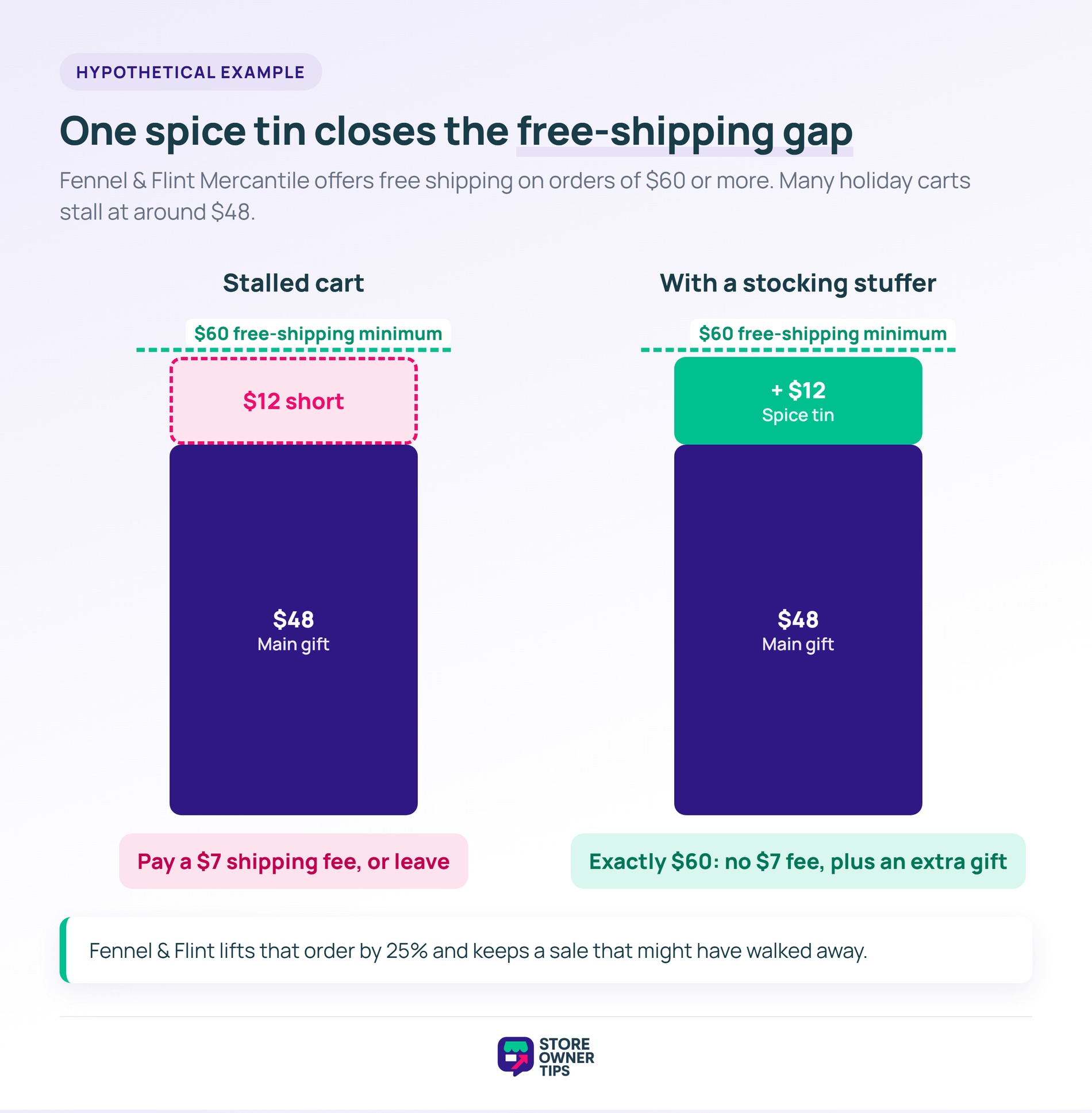
Fennel & Flint Mercantile offers free shipping on orders of $60 or more. The owner notices that many holiday carts stall at around $48. Those shoppers either pay a $7 shipping fee or leave. So she builds a “Stocking Stuffers Under $15” category with 18 small items.
The list includes spice tins, wooden spoons, beeswax wraps and tea towels. Each item weighs under 8 ounces and fits a padded mailer. She lists her four best sellers as cart cross-sells on every main gift. She also creates a $25 “Cook’s Stocking Kit” with three items in one bag.
A $48 cart plus one $12 spice tin reaches the $60 minimum exactly. The shopper skips the $7 fee and gets an extra gift for the stocking. Fennel & Flint lifts that order by 25% and keeps a sale that might have walked away. Across December, the shop’s average order value climbs as more carts carry two or three stuffers.
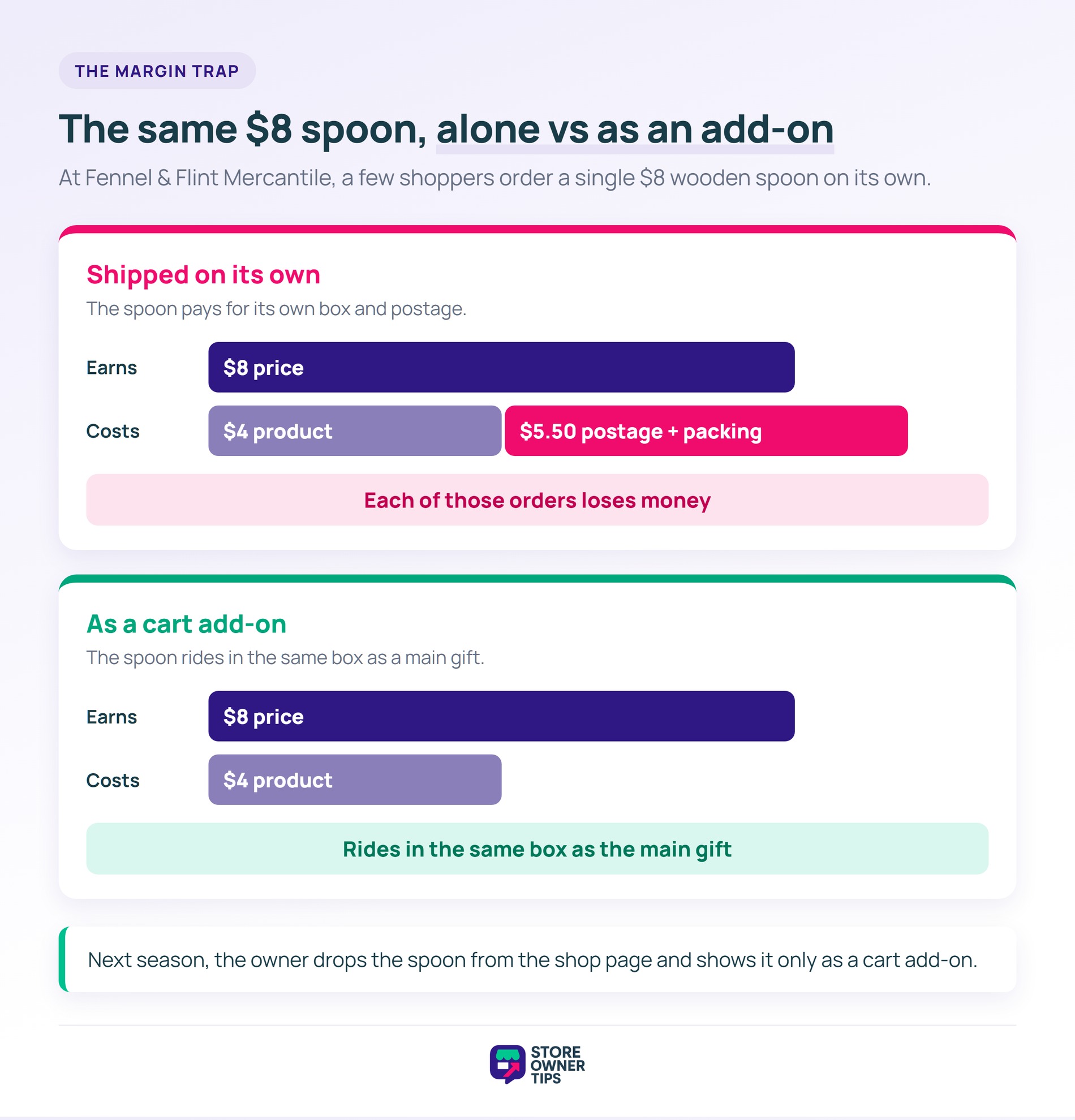
The owner also spots a trap. A few shoppers order a single $8 wooden spoon on its own. After a $4 product cost and $5.50 for postage and packing, each of those orders loses money. Next season, she drops the spoon from the shop page and shows it only as a cart add-on.
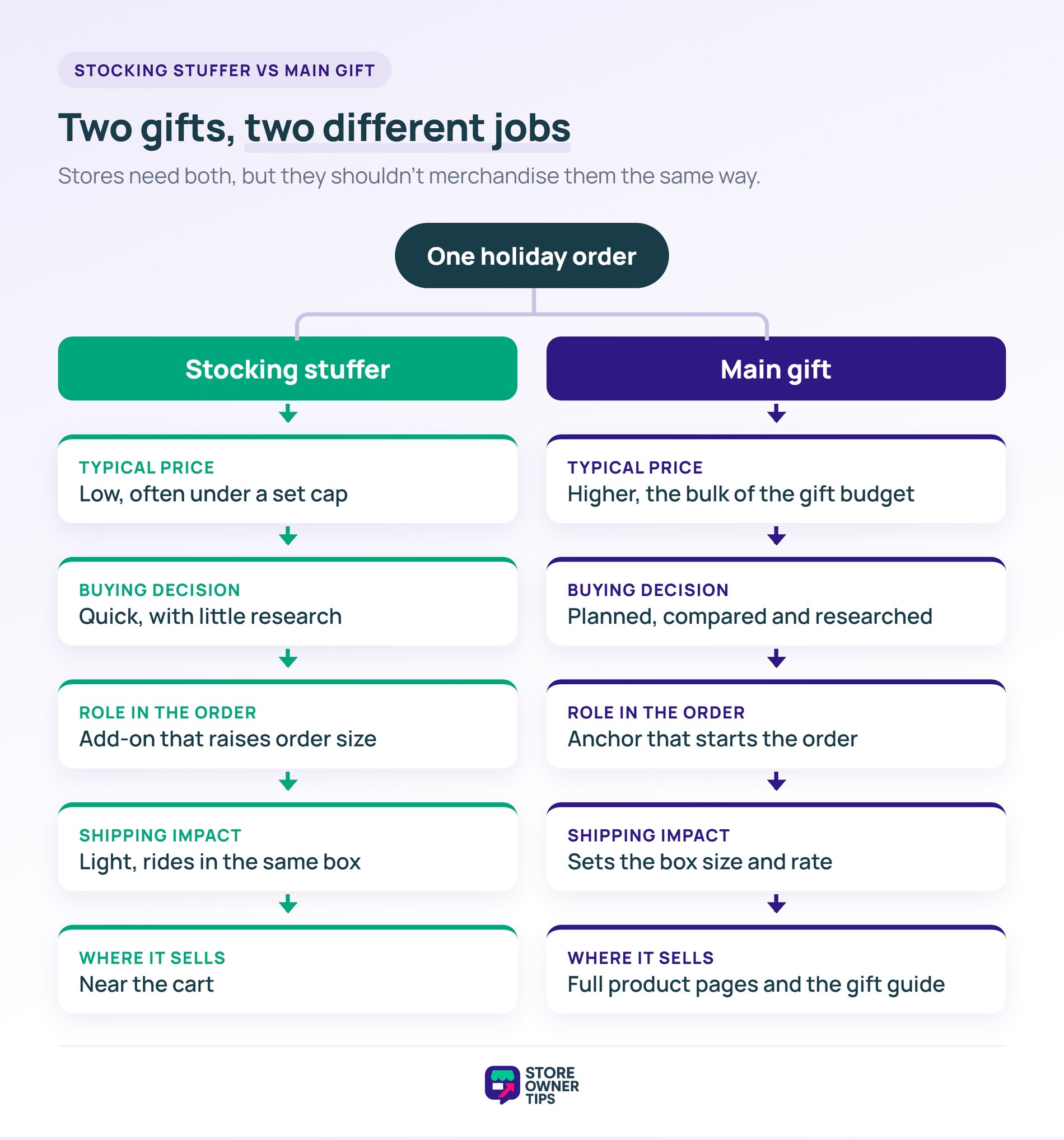
| What you’re comparing | Stocking Stuffer | Main Gift |
|---|---|---|
| Typical price | Low, often under a set cap | Higher, the bulk of the gift budget |
| Buying decision | Quick, with little research | Planned, compared and researched |
| Role in the order | Add-on that raises order size | Anchor that starts the order |
| Shipping impact | Light, rides in the same box | Sets the box size and rate |
A stocking stuffer is a small, cheap extra, while a main gift is the centrepiece present a shopper plans around. Stores need both, but they shouldn’t merchandise them the same way. Main gifts deserve full product pages and a spot in your gift guide. Stocking stuffers belong near the cart, where they ride along with a main gift.
Stocking stuffers raise order values and simplify gift shopping, but they carry thin margins and a short season.
A stocking stuffer usually costs well below a main gift, and most stores pick a round price cap. Common caps are $10, $15, $20 or $25. Choose yours based on your main gift prices and your free-shipping gap. If carts often fall $10 short of the minimum, stuffers between $8 and $15 close it neatly.
Stocking stuffers rarely should ship free on their own, because postage can wipe out the margin. A free-shipping minimum lets stuffers count toward a bigger order instead. A light shipping class keeps rates fair when shoppers do order one alone. Small gifts are often last-minute buys, so remind shoppers of your holiday shipping cutoff too.
Stocking stuffers work best in three places: a dedicated category, the cart page and holiday campaigns. The category serves shoppers who arrive looking for small gifts. The cart page catches shoppers who are a few dollars short of free shipping. Email and banners during a Christmas sale in WooCommerce remind past buyers that stockings still need filling.
A stocking stuffer matters because it turns cheap, small products into a seasonal growth lever. Handled well, the category lifts order values and helps more carts reach free shipping. Handled carelessly, it ships low-margin items at a loss. The difference comes down to price bands, shipping weight and placing stuffers where they ride with bigger orders.
Copyright © StoreOwnerTips.com. All Rights Reserved.
