A holiday shipping cutoff is the last day a store can take an order and still deliver before a holiday. Each shipping speed gets its own cutoff, because ground, expedited, and overnight services take different amounts of time. Orders placed after the cutoff can still be sold, but they need a fallback like an e-gift card or pickup.
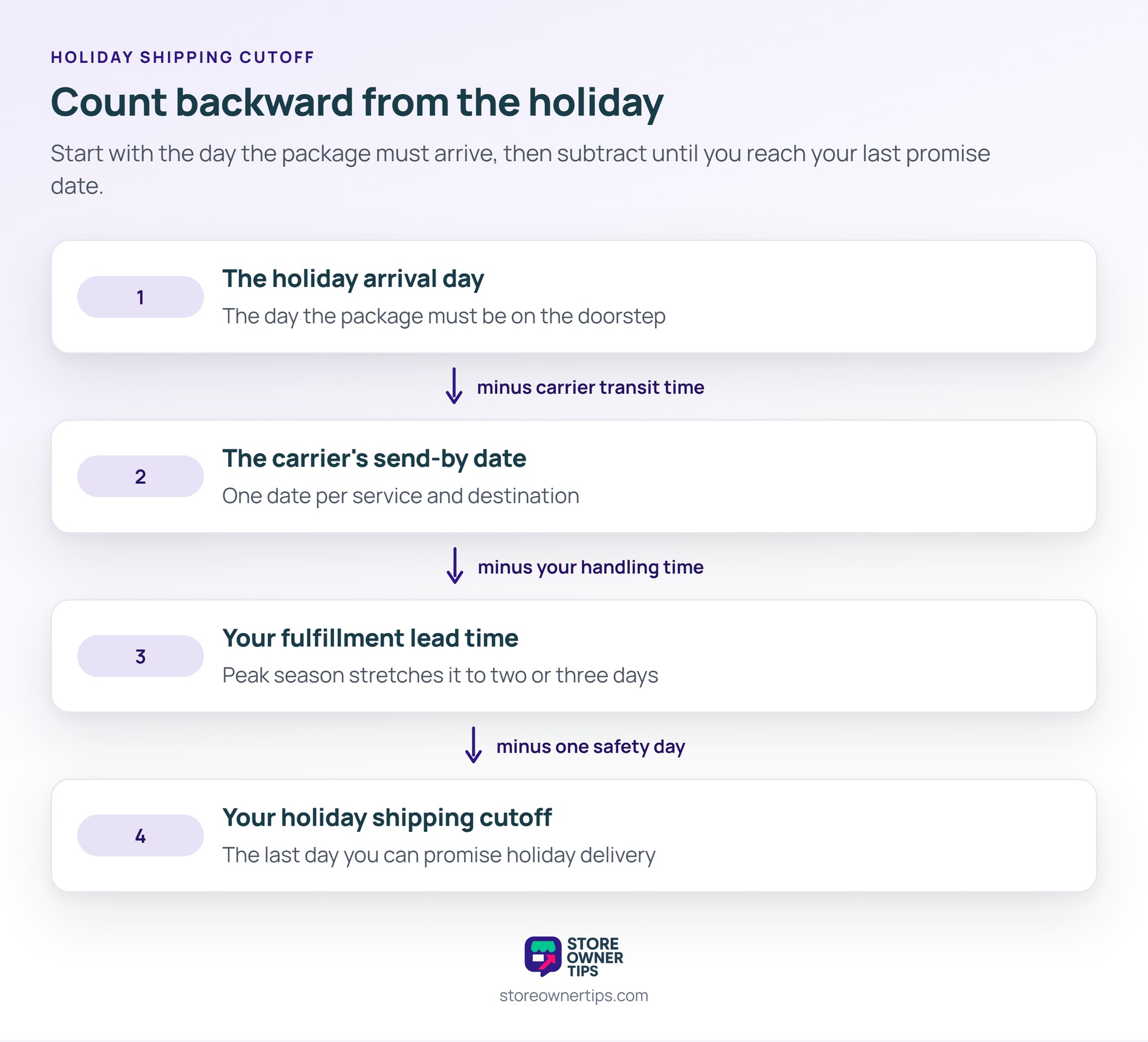
A holiday shipping cutoff works by counting backward from the holiday. You start with the day the package must arrive and subtract the carrier’s transit time. Then you subtract your own handling time. The date that’s left is the last day you can promise holiday delivery.
Every holiday shipping cutoff starts with the carriers. Each year, USPS publishes recommended send-by dates for expected delivery by December 25. UPS and FedEx release similar calendars for their ground and air services. These calendars share a few traits:
Think of a send-by date like the last train of the night. If your parcel isn’t on the platform when it leaves, waiting at the station won’t help. Even after a parcel reaches the local hub, last-mile delivery can add a day in peak season. The dates change every year. Check each carrier’s page every season rather than reusing old numbers.
A store’s holiday shipping cutoff is the carrier’s send-by date minus your lead time for getting orders out the door. If order fulfillment takes two business days, your cutoff lands two business days before the carrier’s date.
Peak season stretches that buffer. Order volume jumps after the late-November sales. A warehouse that ships same-day in October may need two or three days in December. Stores using third-party logistics providers should ask for the warehouse’s own holiday deadline. It often falls earlier than the carrier’s date.
Most stores add one more safety day on top. Carrier networks get crowded in December, and one missed pickup can push an order past the holiday.
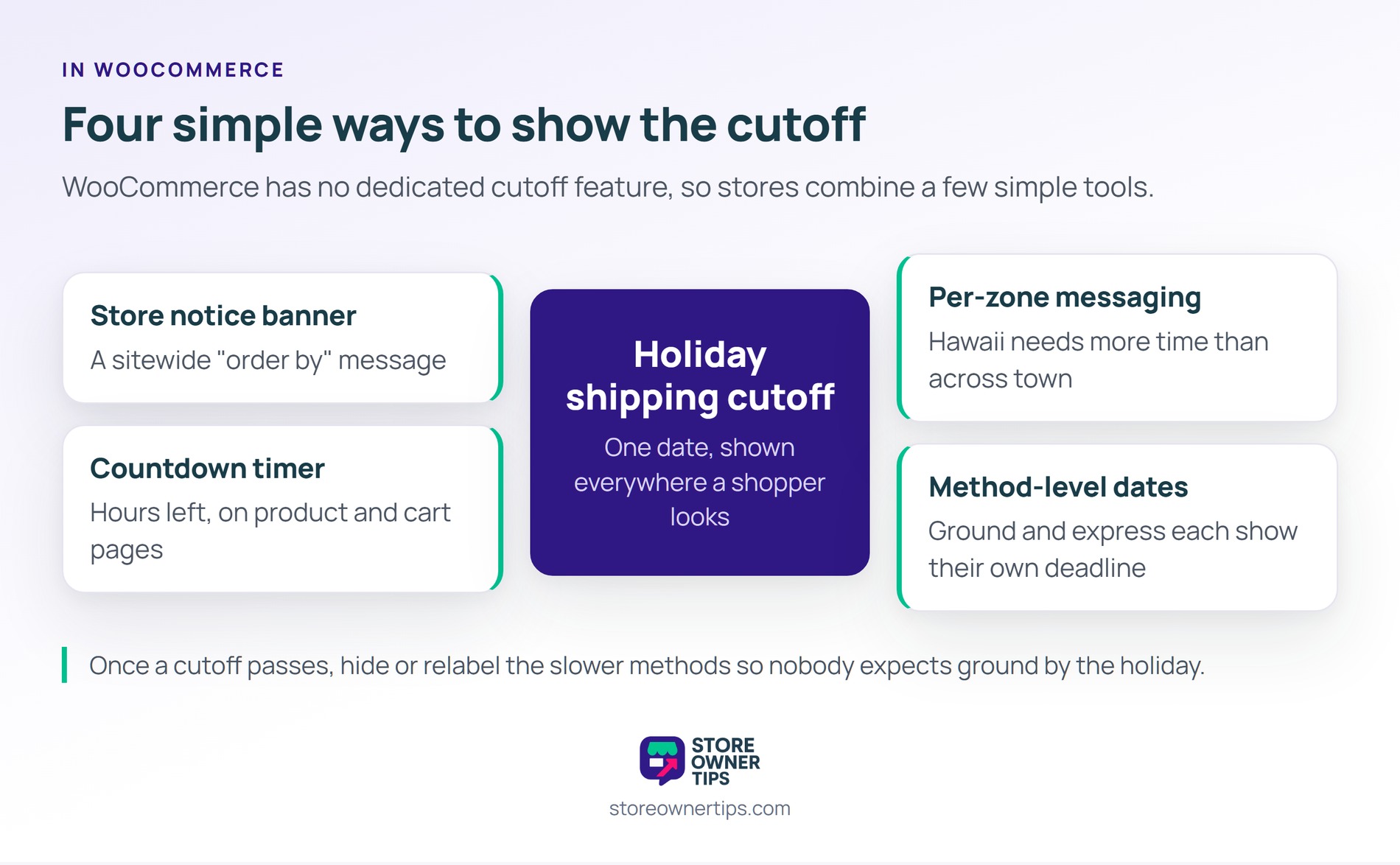
WooCommerce doesn’t include a dedicated holiday shipping cutoff feature. Stores usually combine a few simple tools:
Once a cutoff passes, many stores hide or relabel the slower methods. That stops shoppers from picking ground shipping and expecting it by the holiday. Stores showing real-time shipping rates should check that carrier estimates at checkout match the banner.
Holiday shipping cutoffs push late shoppers toward other ways of getting their gifts. Adobe’s holiday shopping data shows curbside pickup peaking the day before Christmas Eve, driving 39.0% of online orders. In an earlier season, Adobe saw the same pattern. Pickup reached 36.8% of online orders across December 22 and 23. Adobe tied both peaks to anxious shoppers making sure their gifts arrived on time.
Gift cards are the other big release valve. The National Retail Federation reports that 47% of holiday shoppers would like to receive gift cards. That makes a digital gift card one of the safest products to sell once parcels can’t arrive in time.
A holiday shipping cutoff in practice is a set of dated deadlines, one per shipping method and zone. Here’s a hypothetical example. Imagine a small candle brand called Wickline Candles that ships across the U.S. from one warehouse.
Wickline Candles needs two business days to pour, pack, and label each order during peak season. The owner checks the carrier calendars and builds three cutoffs:
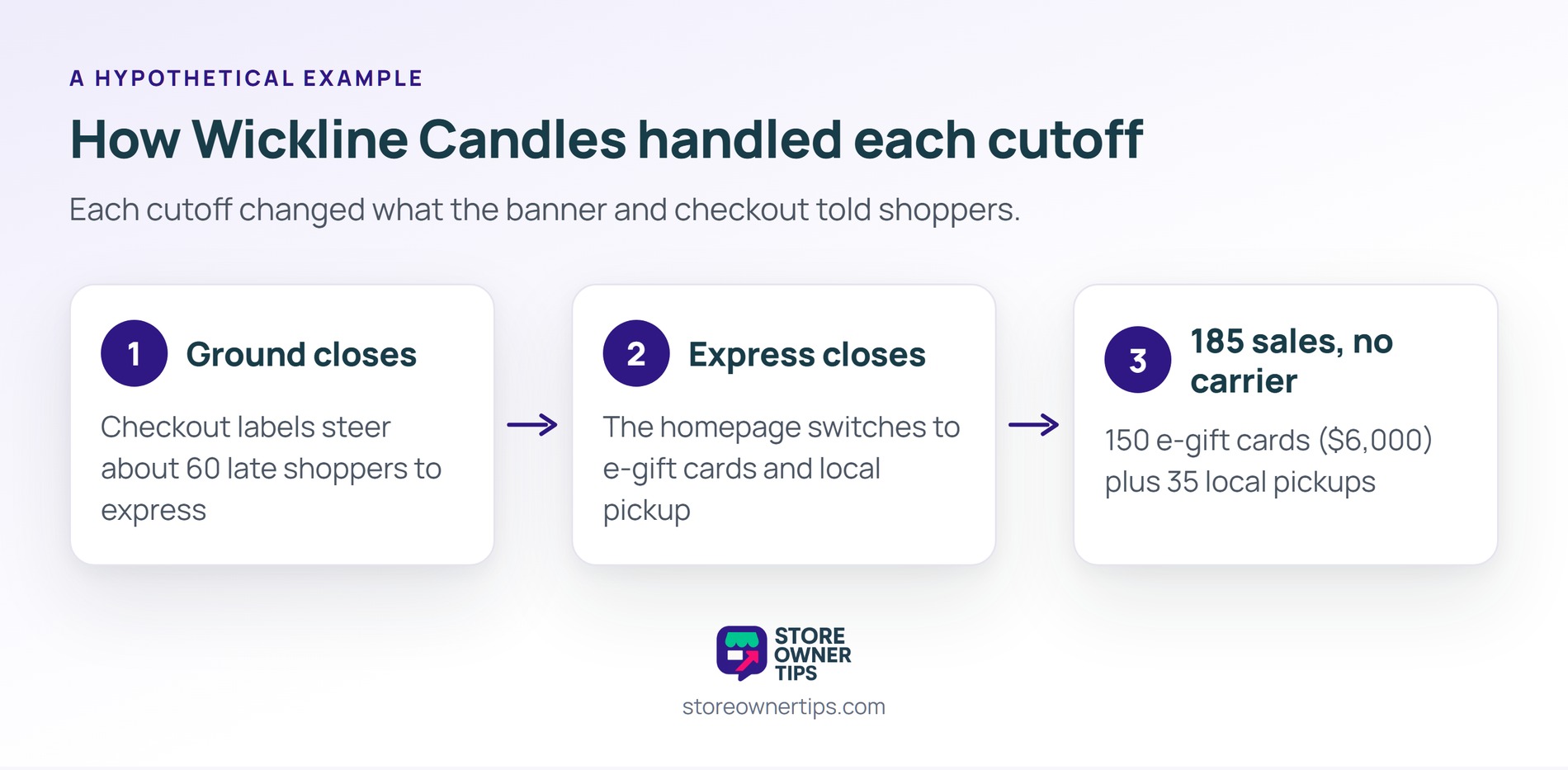
Next, the owner adds a store notice banner and a countdown timer on the cart page. The banner changes each time a cutoff passes. Once ground closes, it reads: “Ground shipping has closed. Express still arrives before Christmas.” The owner lowers the free shipping threshold on express for the final days.
In the final week before the express cutoff, Wickline gets 400 orders. About 60 shoppers try to choose ground shipping after the ground cutoff. The checkout labels steer most of them to express, and only a handful complain.
Without those labels, each of those 60 orders could have become a late shipment. That usually means a wave of WISMO tickets and some angry reviews.
After the express cutoff, the store switches its homepage to e-gift cards and local pickup. Over the last four days, it sells 150 e-gift cards at an average of $40. That adds $6,000 in revenue. Another 35 local customers order online and collect in person. None of those 185 sales needed a carrier.
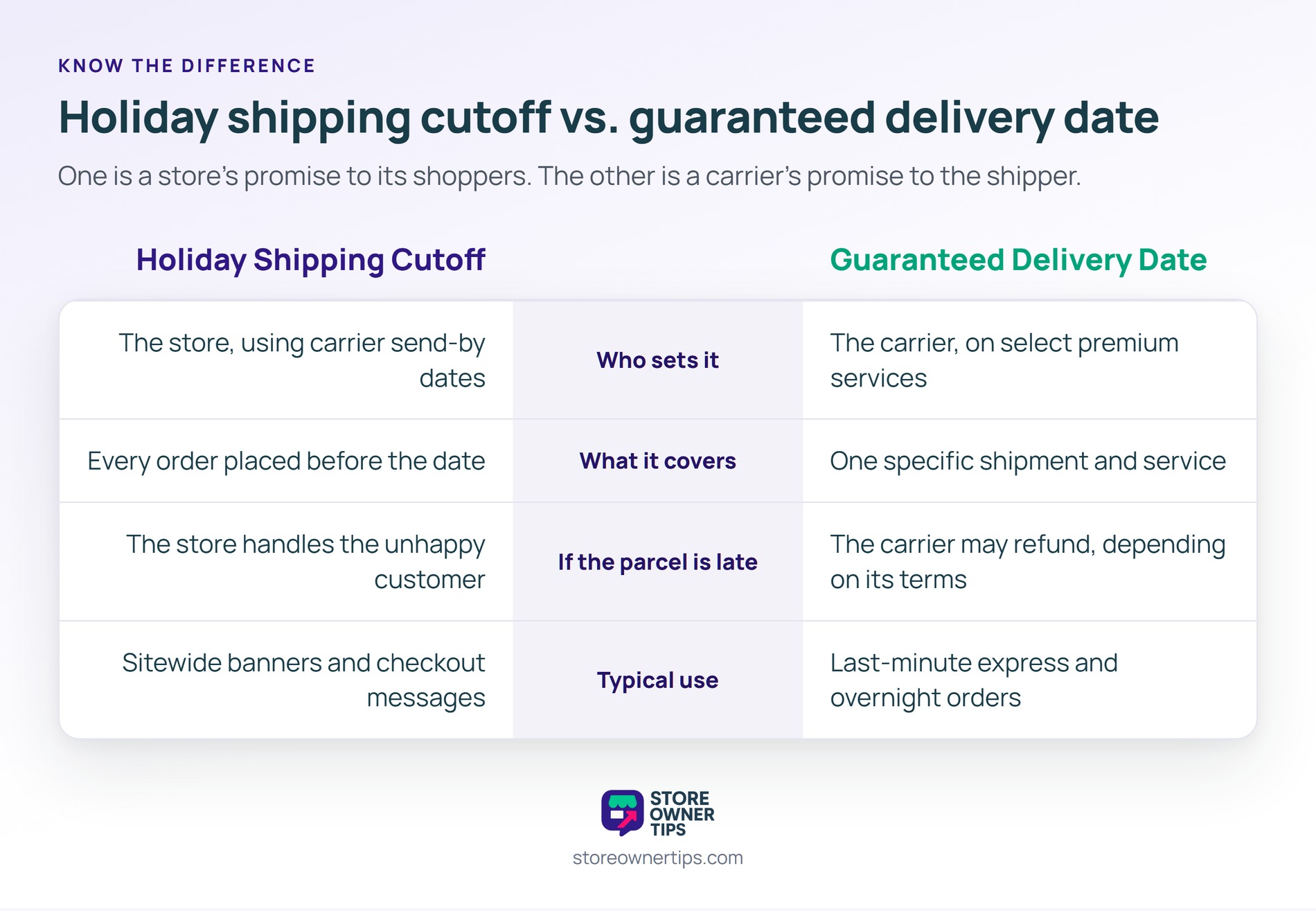
| What you’re comparing | Holiday Shipping Cutoff | Guaranteed Delivery Date |
|---|---|---|
| Who sets it | The store, using carrier send-by dates | The carrier, on select premium services |
| What it covers | Every order placed before the date | One specific shipment and service |
| If the parcel is late | The store handles the unhappy customer | The carrier may refund, depending on its terms |
| Typical use | Sitewide banners and checkout messages | Last-minute express and overnight orders |
A holiday shipping cutoff is a store’s promise to its shoppers. A guaranteed delivery date is a carrier’s promise to the shipper. Most stores need the cutoff first, because it sets expectations for every order. Guaranteed services are a useful upgrade for last-minute buyers. Still, check each carrier’s current terms, since guarantees vary by service and season.
After the holiday shipping cutoff, a store can still sell anything that doesn’t depend on a parcel arriving in time. The strongest fallbacks are:
Promote each fallback in the same banner that announced the cutoff. That way, the moment shipping closes, shoppers see what they can still buy. A plain gift card rescues shoppers who are working through a holiday wishlist at the last minute.
If an order placed before the holiday shipping cutoff arrives late, the store usually handles the fix. That’s true even when the carrier caused the delay. Many stores offer a partial refund, a discount code, or a gift card as an apology. A buffer day in your own cutoff is the best protection, because carrier send-by dates are only recommendations.
Yes, your holiday shipping cutoff should almost always be earlier than the carrier’s date. The carrier’s send-by date is when the parcel must be in the carrier’s hands, not when the customer orders. Subtract your processing time, then add a safety day for peak-season delays. Stores that ship same-day can cut it closer. A buffer helps them too.
Yes, and international and military holiday shipping cutoffs usually fall much earlier than domestic ones. USPS publishes separate send-by dates for each international region and for APO, FPO, and DPO military addresses. Ground service to military addresses can close weeks earlier than domestic ground. Set these destinations up as separate shipping zones, with each one showing its own date.
A holiday shipping cutoff matters because it turns the busiest weeks of the year into a promise you can keep. Clear cutoffs reduce late-delivery complaints, protect your reviews, and keep repeat customers coming back. Paired with smart fallbacks, they let the selling season run right up to the holiday itself.
Copyright © StoreOwnerTips.com. All Rights Reserved.
