Weekly ecommerce tips, deals & news.
A wholesale customer is a business buyer who purchases your products in large volumes at heavily discounted prices. They usually buy these goods to resell to everyday consumers, or they use your products as parts to make their own items.
These buyers are part of the business-to-business (B2B) market, meaning they have completely different reasons for shopping than standard retail buyers. While retail shoppers often make quick, emotional purchases, wholesale customers need logical, easy-to-repeat buying options.
When a wholesale customer visits your site, they need specific bulk pricing and custom ordering systems. By providing these tools, you turn your online store into a valuable partner, helping both of your businesses make a profit.
Understanding how a wholesale customer acts compared to a regular retail buyer is important because it completely changes how you build and run your store. Remember, a wholesale customer is a long-term business partner, not just a quick visitor.
Because of this, you might need to use dual-mode settings on your website to serve both groups. While retail shoppers want to see nice pictures and read engaging marketing text, wholesale buyers usually want to skip the marketing and go straight to a simple bulk order form.
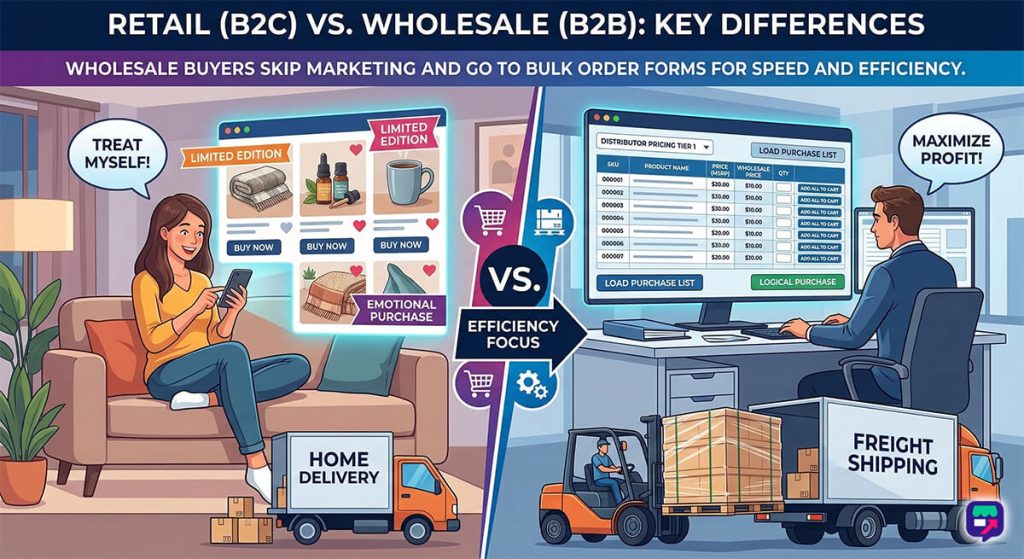
The following table breaks down the main differences between these two types of buyers:
| Feature | Wholesale Customer (B2B) | Retail Customer (B2C) |
| Why They Buy | To make a profit, stock their own store, or run their business. | For personal use, to solve a problem, or because they like the item. |
| Order Size & Frequency | Buys many items at once, but orders less often. Usually has to meet a Minimum Order Quantity (MOQ). | Buys only a few items at a time, but orders much more frequently. |
| Profit Per Item | Lower profit per item (10% to 20%), but makes up for it by buying in huge amounts. | Higher profit per item (40% to 60% or more) to cover expensive ads and marketing. |
| Pricing & Catalog | Hidden or custom pricing based on bulk discounts. Buyers usually need a special account to see prices. | Everyone sees the same prices and the entire product catalog at all times. |
| How They Pay | Often uses credit terms (paying 30 or 60 days later) or gets invoiced after the items ship. | Pays immediately at checkout using a credit card or digital wallet. |
| Shipping | Shipped in bulk on large wooden pallets using heavy freight trucks. | Shipped in small, standard boxes directly to their home. |
| Marketing Strategy | Focuses on building long-term business relationships and one-on-one account management. | Uses digital ads, social media, and loyalty points to reach a massive audience. |
| What They Want | Wants bulk amounts of a few proven, reliable items that guarantee a profit. | Wants a huge variety of colors, sizes, and trendy styles to choose from. |
Regular online stores treat every shopper the same. However, a wholesale store needs a special system to manage different types of business buyers.
Here is how you can manage these unique accounts:
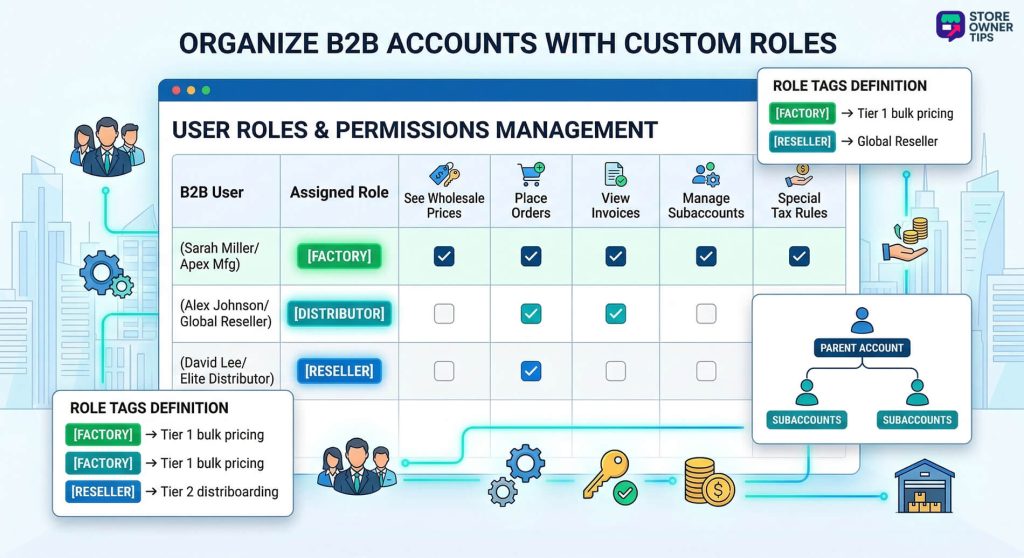
Signing up a wholesale customer takes more work than a standard retail user. While a retail shopper just needs an email and a password, a wholesale buyer must prove their business is legitimate.
You will need a custom registration form to collect their specific details, such as their legal business name, tax ID, and official documents like a state resale certificate.
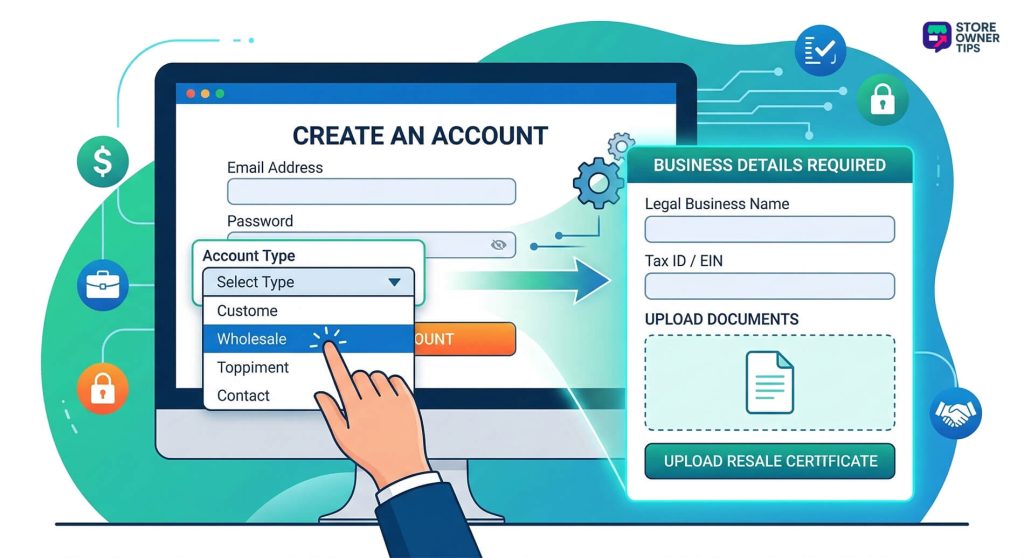
To keep things clean, use “smart forms” that automatically change based on what the user selects. If someone chooses a retail account, the form stays short. If they pick a wholesale account, the form expands to require those extra business details and file uploads. You should also add spam prevention, like CAPTCHA, so bots do not fill up your system with fake applications.
After a wholesale customer applies, their account goes into a manual review queue. You must check their business details and tax forms before officially approving them. Once approved, your store will redirect them straight to their private wholesale dashboard.
Pricing products for wholesale customers requires a different approach than standard retail. Set prices simply do not work for bulk buyers. Instead, you need to use dynamic pricing—rules that automatically change the cost to encourage massive orders.
The most common method is a tiered volume discount, where the price drops as the buyer adds more items to their cart. The table below explains the most common dynamic pricing rules for B2B stores:
| Pricing Rule | How It Works |
| Tiered Volume Pricing | The more they buy, the cheaper it gets (e.g., buying 1-49 items charges full price, but 100+ items triggers a 50% discount). |
| Category Discounts | A flat percentage off an entire group of products, available exclusively to wholesale buyers. |
| Cart Conditions | Discounts only apply if the total order hits a specific weight or dollar amount. |
| Buy X, Get Y | A strategy that encourages buyers to purchase slower-moving inventory to unlock deals on your most popular goods. |
| Payment Incentives | Gives the buyer a discount if they use a preferred payment method (like a direct bank transfer) to help you avoid expensive credit card fees. |
| Attribute Pricing | Changes the price based on specific product details, like size, color, or material. |
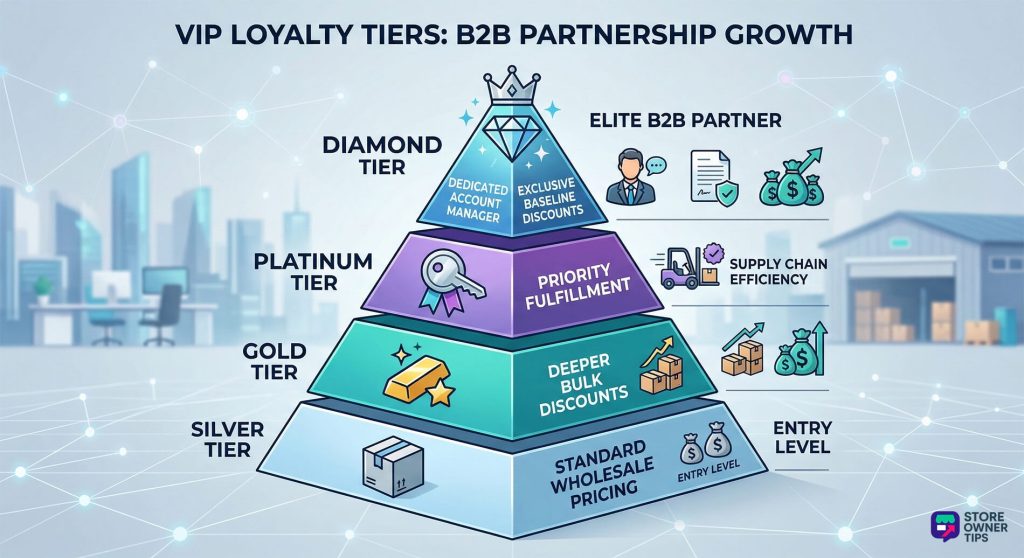
Sometimes, a loyal customer needs a completely custom price. For example, a long-term partner might have a negotiated contract for an extra 5% discount. You can easily assign these special rules directly to their specific user account.
Buyers may also need to ask for custom quotes. Instead of forcing them through a standard checkout, your store can let them submit their cart as a formal quote request. You can negotiate the terms, reach an agreement, and send back a custom offer complete with an automatic expiration date.
Taking payments from wholesale customers is very different from regular checkouts. Because they spend huge amounts of money, they need flexible options to protect their cash flow. The most important feature you can offer is net terms.
Net terms mean the buyer gets the products now but pays the invoice 30, 60, or 90 days later. This lets them sell the goods to their own shoppers first, and then use that new cash to pay you back.
To manage the risk of unpaid bills, your store should connect to automated invoicing software. This system creates and tracks invoices over time. You can even keep their corporate credit card on file to charge it exactly when the payment is due.
Some store platforms use special services that handle credit checks and collect the money for you, acting like a “buy now, pay later” feature for businesses. You can also offer early payment discounts, like taking 2% off the total invoice if they pay within the first ten days.
Finally, many stores use digital wallets for their best buyers. A wholesale customer can pre-load money into their account using a direct bank transfer, which saves you from paying high credit card processing fees on massive orders.
Managing taxes for wholesale customers can be complicated. Usually, these buyers don’t pay sales tax because they plan to resell the products to others.
It is your responsibility to prove they are tax-exempt. You must collect and save a valid resale certificate from them when they sign up.
Here are the most important tax rules and forms you need to know:
| Tax Rule / Form | What It Means for Your Business |
| Business Deductions (IRC 162) | Helps you subtract the high cost of shipping and packaging bulk orders from your taxable income. |
| Inventory Rules (IRC 263A) | Tells you how to record the costs of buying and moving your stock in your official accounting. |
| Recordkeeping (IRC 6001) | Requires you to keep digital copies of your customers’ tax certificates in case the government audits your business. |
| COGS Reporting (Form 1125-A) | The specific form used to report exactly how much you spent on the products you sold during the year. |
After you verify a customer’s certificate, your website should stop charging them tax automatically. You can do this by turning on a “tax-exempt” setting for their specific user account. For international buyers, your platform can check their VAT (Value Added Tax) number against official databases to ensure they are legitimate.
Be careful with drop-shipping. If a wholesale buyer asks you to ship an item directly to a regular consumer instead of their warehouse, standard taxes might apply again. Your system must check the shipping address against their tax ID to make sure the right rules are followed. Doing this incorrectly can lead to expensive fines for your business.
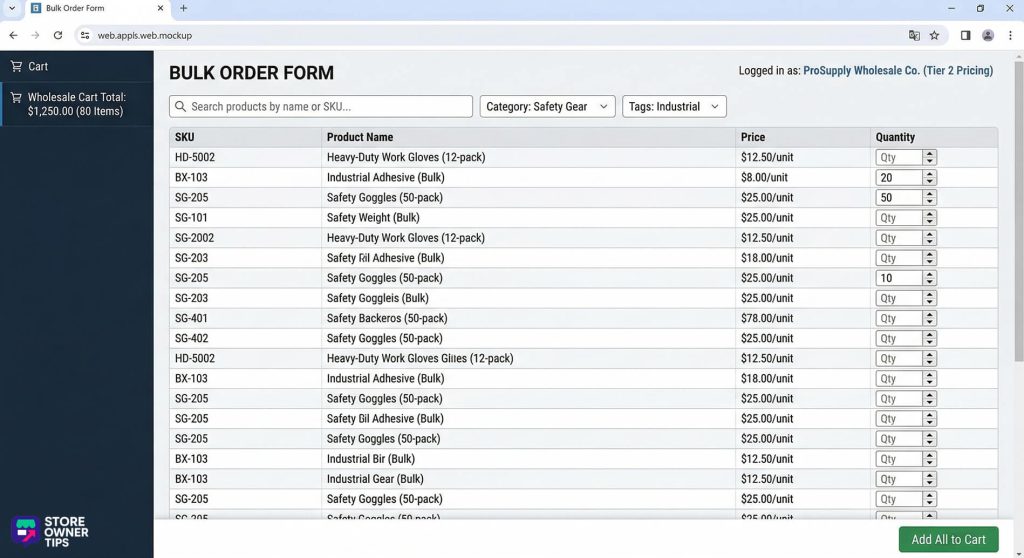
Wholesale customers don’t browse your store for fun. Usually, they arrive knowing exactly what they need and have a list of specific part numbers ready to go. Showing them big marketing pictures only slows them down.
To help them buy faster, you should use bulk order forms. These pages display your entire catalog in a searchable table format, allowing buyers to filter by tags and enter quantities for dozens of items at once.
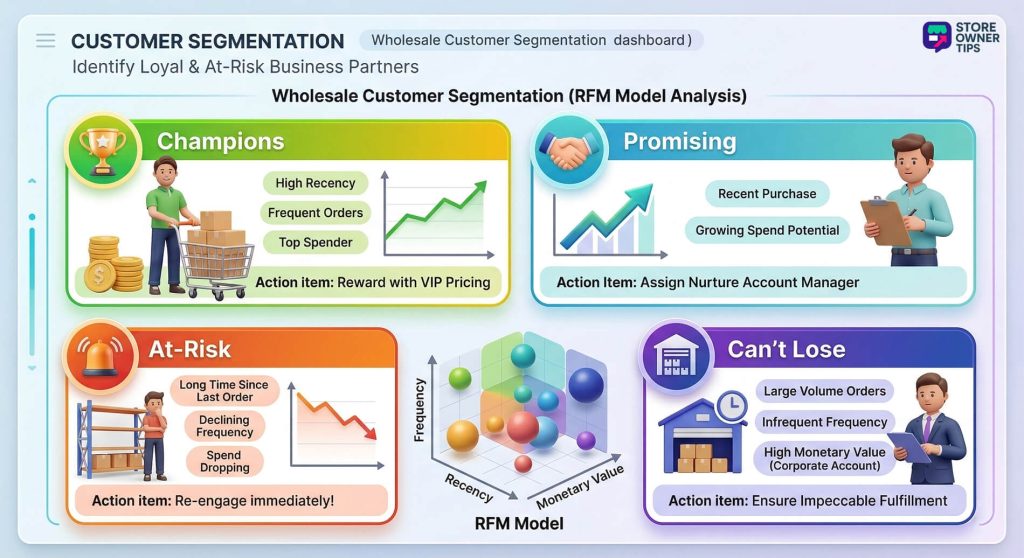
Every time a wholesale customer buys, they leave behind massive amounts of data. Studying this information helps you predict future sales and stop important buyers from leaving your store. One of the most popular ways to do this is using the RFM model.
RFM stands for Recency (how long ago they bought), Frequency (how often they buy), and Monetary Value (how much total money they spend). By tracking these three things, you can group your buyers into categories and decide how to treat them:
| Customer Group | Who They Are | What You Should Do |
| Champions | Your absolute best customers. They buy often, recently, and spend the most. | Reward them with VIP pricing and early access to new products. |
| Promising | New buyers who spend well but haven’t ordered many times yet. | Have a sales rep reach out to build a long-term relationship. |
| At-Risk | Formerly great customers who haven’t placed an order in a long time. | Contact them immediately to see if something is wrong before they leave for a competitor. |
| Can’t Lose | Huge companies that make massive orders, but only once or twice a year. | Make sure their orders are perfect every time and keep in touch between sales. |
Some larger stores use AI and machine learning to group their buyers automatically. These smart systems can find hidden spending patterns and tell the difference between different types of businesses, like a restaurant versus a retail shop.
These platforms also use data to suggest products. For example, if the system sees a buyer ordering large amounts of industrial detergent, it will automatically suggest the specific paper products they are likely to need next. This makes it easier for the customer to buy everything they need in one place.
The lifecycle of a wholesale order doesn’t end when the customer clicks “pay.” Instead, that data needs to flow instantly into your other business systems to keep your records accurate.
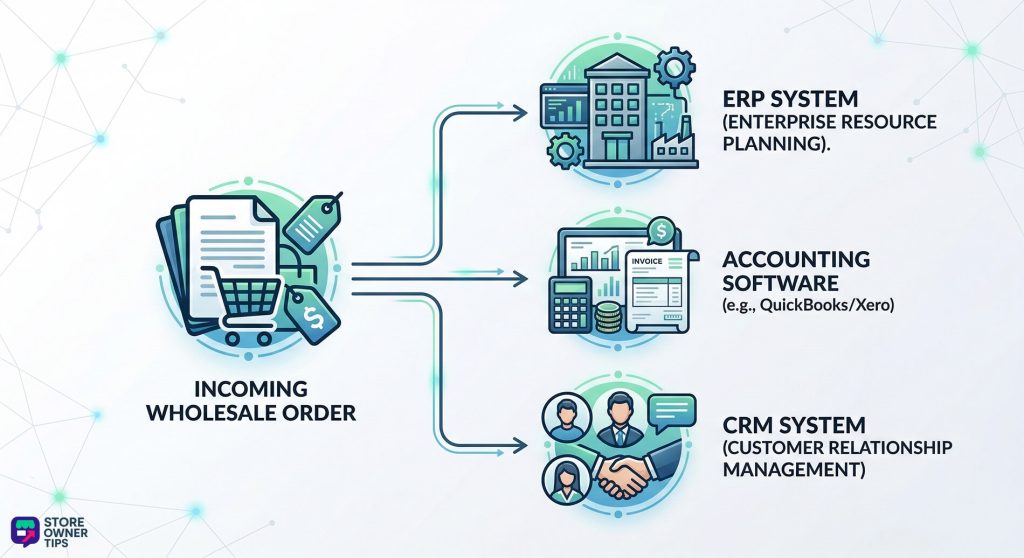
Many store owners use “automation recipes” (like Zapier or Make) to handle these tasks without human intervention. For example, you can set a rule that says: “If a wholesale order is over $5,000, send a notification to the account manager and create a draft invoice in the accounting software.” This keeps your business organized, professional, and ready to scale.
Marketing to wholesale customers is different because you aren’t just selling a product; you are proving that you are a reliable business partner. Your goal is to show procurement managers (the people in charge of buying for a company) that your supply chain is efficient and your prices are fair.
Here are the best ways to reach and keep these high-value buyers:
By focusing on building a relationship rather than just making a quick sale, you turn a one-time lead into a permanent business partner.
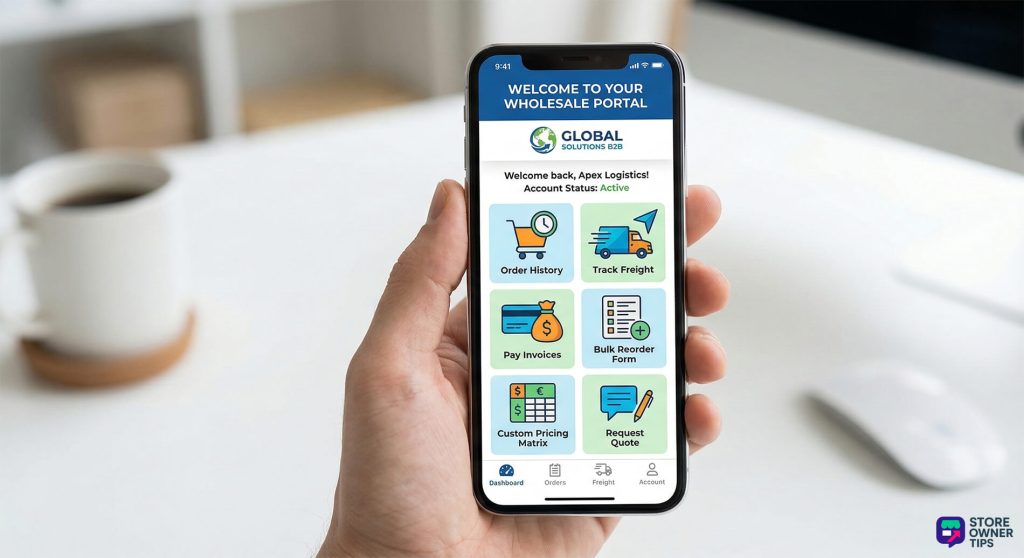
The way wholesale customers shop is changing fast. They no longer want to wait for a sales representative to help them. Instead, modern buyers want self-service tools that let them handle everything on their own.
Corporate buyers expect to log in at any time to see their custom price lists. They want to be able to check old invoices, repeat complex past orders, and track large freight shipments entirely on their own.
Many big athletic and lifestyle brands are currently moving back toward wholesale partnerships. This is because the cost of digital ads for selling directly to individual people online has become too expensive. These big brands are happy to accept a lower profit per item in exchange for the guaranteed volume and steady cash flow that a wholesale customer provides.
Finally, modern buyers care deeply about the planet. They often demand to see the “carbon footprint” of their bulk shipments to understand their environmental impact. They also expect personalized dashboards and milestone discounts—special rewards that unlock automatically as they reach certain spending goals over time.
Ultimately, a wholesale customer is more than just a buyer; they are a strategic partner. By purchasing in bulk, they provide the steady volume and predictable cash flow that retail shoppers cannot. While they expect deeper discounts, the long-term value they bring to your business far outweighs the lower profit per item.
Serving these professional buyers requires a shift from emotional marketing to practical efficiency. To keep a wholesale customer happy, you must provide a friction-free experience that includes custom pricing, bulk order forms, and flexible payment terms. When you treat these buyers as professional partners, you create a stable foundation for your store to grow.
Related concepts to explore next:
Ready to get started? Try setting up a dedicated wholesale registration form on your site to start vetting and onboarding professional buyers for your store.
Copyright © StoreOwnerTips.com. All Rights Reserved.
