Weekly ecommerce tips, deals & news.
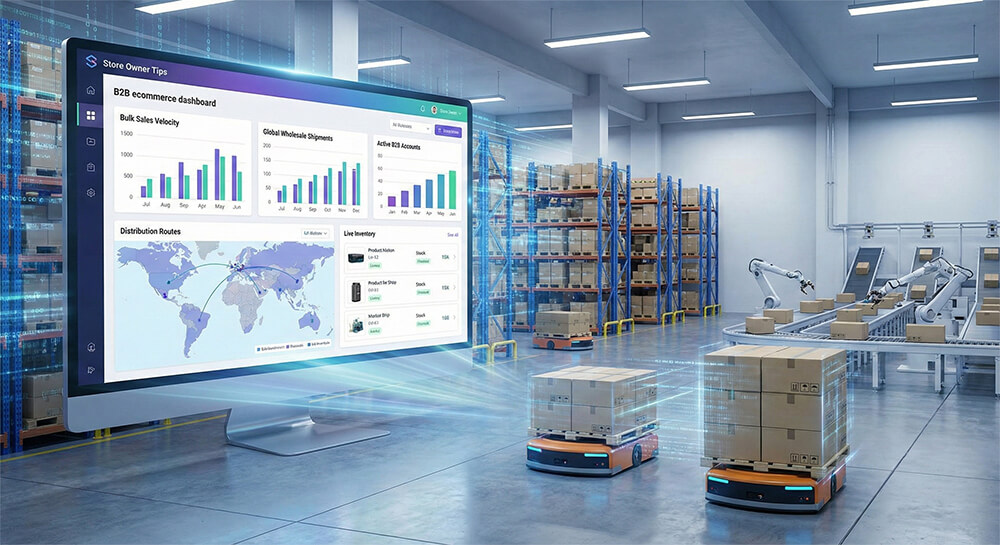
Online wholesale is the digital version of traditional business-to-business (B2B) commerce. It involves selling large amounts of goods to retailers, distributors, and organizations over the internet. This modern approach replaces slow, manual methods—like phone orders and paper invoices—with specialized digital systems.
Today’s commercial buyers expect the ease of personal online shopping, but with specialized B2B features like minimum order quantities and tax exemptions. By moving to a digital platform, businesses can centralize their catalogs, predict demand, and free up their sales teams to focus on building relationships rather than just taking orders. Getting there starts with knowing how to manage wholesale sales rep accounts so each rep has the right pricing access and order attribution from day one.
With the global B2B eCommerce market projected to hit $25 trillion by 2025, mastering online wholesale is now an absolute necessity.
Traditional wholesale is a slow, highly manual process. It relies on printed catalogs, trade shows, and field sales teams. To place an order, a buyer has to call a representative for a quote, wait for them to check a spreadsheet for the right pricing tier, and finally receive a paper or PDF invoice.
Online wholesale automates this entire cycle. Buyers can log into a digital storefront 24/7 to see their specific negotiated prices, check live inventory, and place bulk orders entirely on their own.
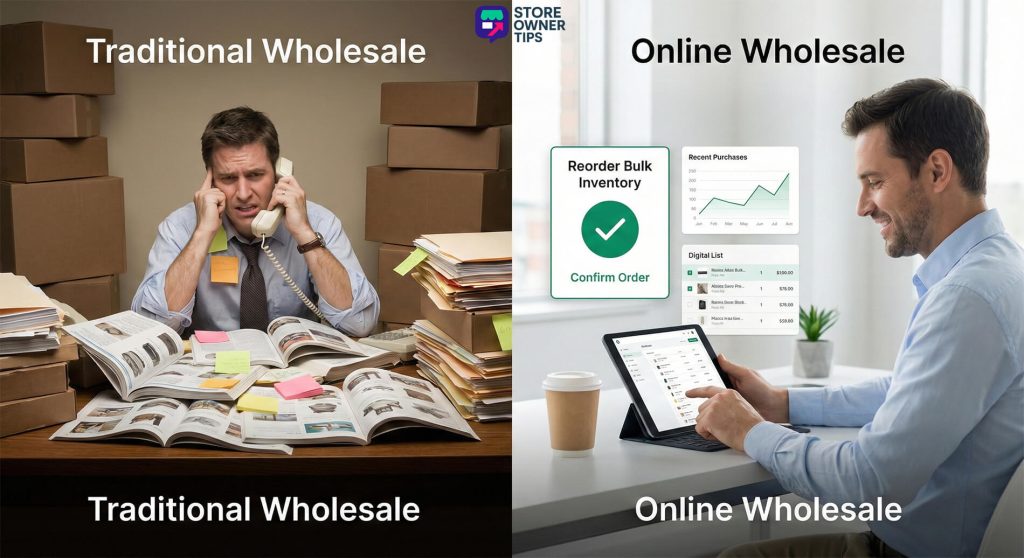
| Business Area | Traditional Wholesale | Online Wholesale |
| Order Processing | Manual (phone, email, fax, or in-person). | Automated through self-service websites. |
| Pricing Management | Checked manually using offline spreadsheets. | Shows personalized prices automatically upon login. |
| Catalogs | Printed books or static PDF lists. | Digital search with live inventory updates. |
| Sales Team’s Job | Stuck taking manual orders and writing quotes. | Free to focus on building valuable relationships. |
| Data & Tracking | Hard to track buying trends across scattered files. | Easy to see real-time analytics and purchase history. |
For a long time, brands thought selling directly to consumers (DTC) was best because cutting out the middleman let them keep the full retail markup. While it is true you make more profit on a single item with DTC, online wholesale is often much more profitable overall.
Here is why bulk B2B sales often come out on top:
If you run both a wholesale and a DTC business, you must be careful. If you push your direct retail sales too hard, you might anger your wholesale partners by competing with them. This is called “channel conflict.” If they stop buying your products in bulk, that massive loss will easily wipe out any gains you made in retail.
| Business Metric | Direct-to-Consumer (DTC) | Online Wholesale (B2B) |
| Profit per Item | Very high. The brand keeps the full retail markup. | Lower. Items are heavily discounted for bulk buyers. |
| Order Size & Value | Very low. Shoppers usually buy just one or two items. | Very high. Businesses buy massive amounts at once. |
| Cost to Get Customers | Extremely high. Relies on constantly paying for digital ads. | Lower. Built on long-term relationships and high lifetime value. |
| Income Predictability | Unstable. Changes constantly based on trends and ad success. | Highly stable. Driven by regular, repeating bulk orders. |
| Shipping & Logistics | Complicated. Requires sending out many small packages to individuals. | Simpler. Requires managing fewer, but much larger, shipments on pallets. |
B2B platforms need special features to give corporate buyers a smooth experience. The technology used for wholesale is very different from a standard retail site.
In regular retail, everyone sees the same price. In online wholesale, prices change based on your relationship with the buyer. When a customer logs into their account, the system instantly recognizes them and automatically applies their specific discount rules.
Here are the main ways B2B systems handle these custom prices:
Unlike retail shoppers who love to browse pictures and discover new items, wholesale buyers usually already know exactly what they need. Their main goal is speed and efficiency.
Because of this, B2B websites must remove visual clutter and offer dedicated bulk order forms. Instead of clicking through dozens of individual product pages, buyers can use a single, fast page to:
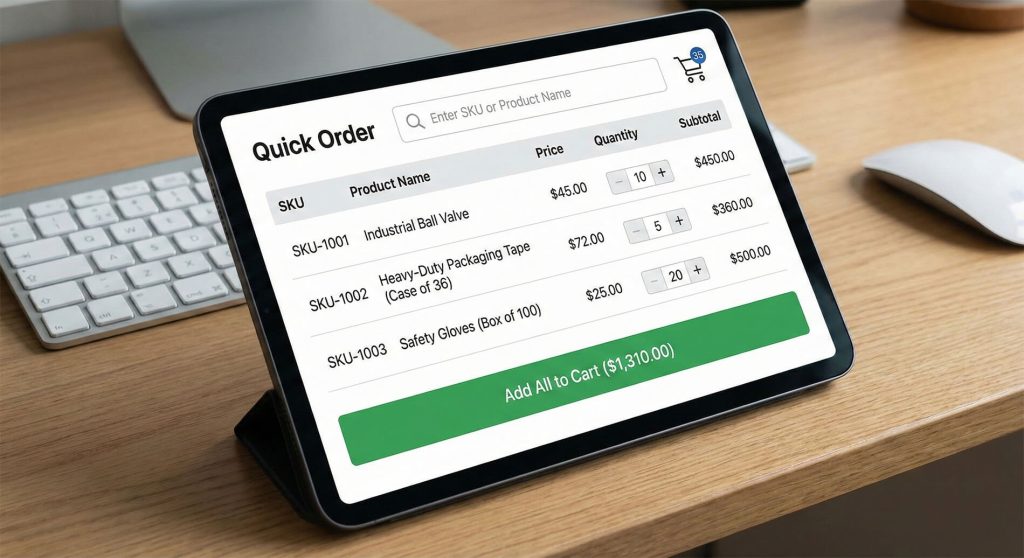
Another great tool is the saved purchase list. Buyers can save their exact cart as a template. The next time they need to restock, they can easily duplicate that past order or instantly load the whole list directly into checkout.
Regular retail stores let anyone create an account and buy instantly. Online wholesale is different—it requires strict vetting. You simply cannot show your special discounted pricing to the general public or your competitors!
To protect your business, B2B platforms use custom registration forms to collect specific details like:
Once a buyer submits this form, a store admin reviews their documents and approves the account to ensure only legitimate businesses get access.
A strong wholesale website controls exactly what each user is allowed to see. This keeps regular retail shoppers away from bulk-only items and stops B2B buyers from being distracted by retail promotions.
The most common strategy is hiding prices until a user logs in. By hiding prices and “add to cart” buttons from logged-out visitors, your store acts as a digital lookbook. This protects your sensitive pricing data and forces interested businesses to actually register for an account!

Running a large online wholesale business takes special technology. Standard retail websites just don’t have the right tools, so businesses usually choose one of two paths:
Depending on your software, you have two main ways to present your store:
To run smoothly, your digital storefront needs to connect with your behind-the-scenes systems to keep data perfectly accurate. The two most important are:

Many store owners use sales funnels and psychology to boost their bulk order sizes and make the buying process as smooth as possible.
Moving your wholesale business online brings complex new tax and legal responsibilities. Unlike standard retail, B2B sales involve strict tax rules that change based on the buyer’s location and account type.
In the future, experts expect online wholesale to rely heavily on Artificial Intelligence (AI) and Augmented Reality (AR) to make bulk buying almost effortless:

Yes! Meeting face-to-face will always be valuable for business. However, trade shows will become events for building relationships rather than just taking manual orders. Buyers will simply use your digital wholesale portal later to officially place the bulk orders you discussed in person.
Ultimately, online wholesale drives modern B2B growth by turning slow, manual tasks into a fast, automated experience. A self-service platform meets buyer expectations, frees up your sales team to win bigger accounts, and gives you the exact data you need to scale safely. Mastering this digital model—along with custom pricing and tax rules—is the best way to secure long-term, recurring revenue.
Related concepts to explore next: To better manage a professional B2B storefront, check out these connected terms:
Ready to get started? Try setting up a dedicated wholesale area on your website to see how automated B2B features can streamline your workflow and boost your bulk sales!
Copyright © StoreOwnerTips.com. All Rights Reserved.
