Weekly ecommerce tips, deals & news.
Zero-click commerce is a digital shopping setup where a customer buys a product directly through an AI chatbot, a voice assistant, or a social media feed without ever visiting your actual website. Instead of clicking through a maze of category pages and long checkout forms, the entire purchase happens instantly at the exact moment the buyer asks a question. It completely removes traditional shopping friction, turning a simple voice command into a finished order.
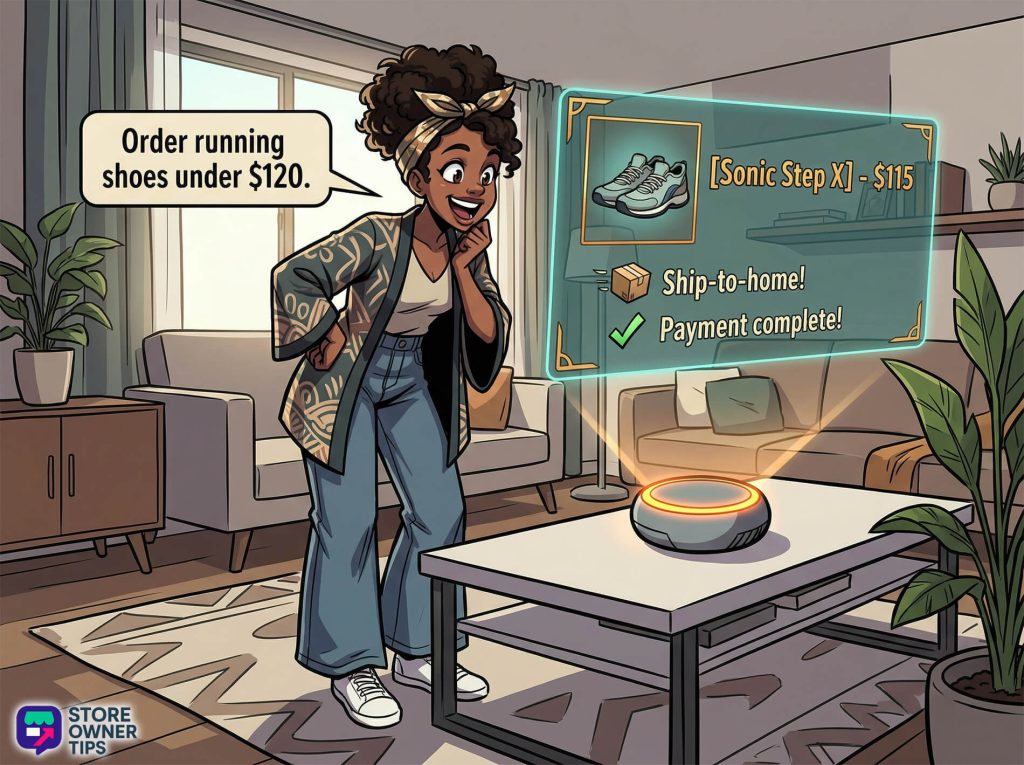
To really get how this works, think of the digital economy as one giant conversation managed by smart AI helpers. In the past, if someone wanted running shoes under $120, they had to search Google, click a few links, scroll through your website, pick a size, and type in their credit card.
Today, a shopper just asks their smart speaker to order the shoes. The AI assistant skips the comparison sites, ignores your homepage, checks your stock in the background, and pays using saved details. The purchase happens at the very first point of contact.
Underneath the surface of platforms like Shopify or WooCommerce, this is powered by headless commerce.
Here is a simple analogy: Think of your store like a restaurant. Your back-end (inventory and prices) is the kitchen. Your front-end (website design) is the dining room. Headless commerce simply means your kitchen can serve food directly to a drive-thru window (an AI assistant) without making the customer sit down in your dining room.
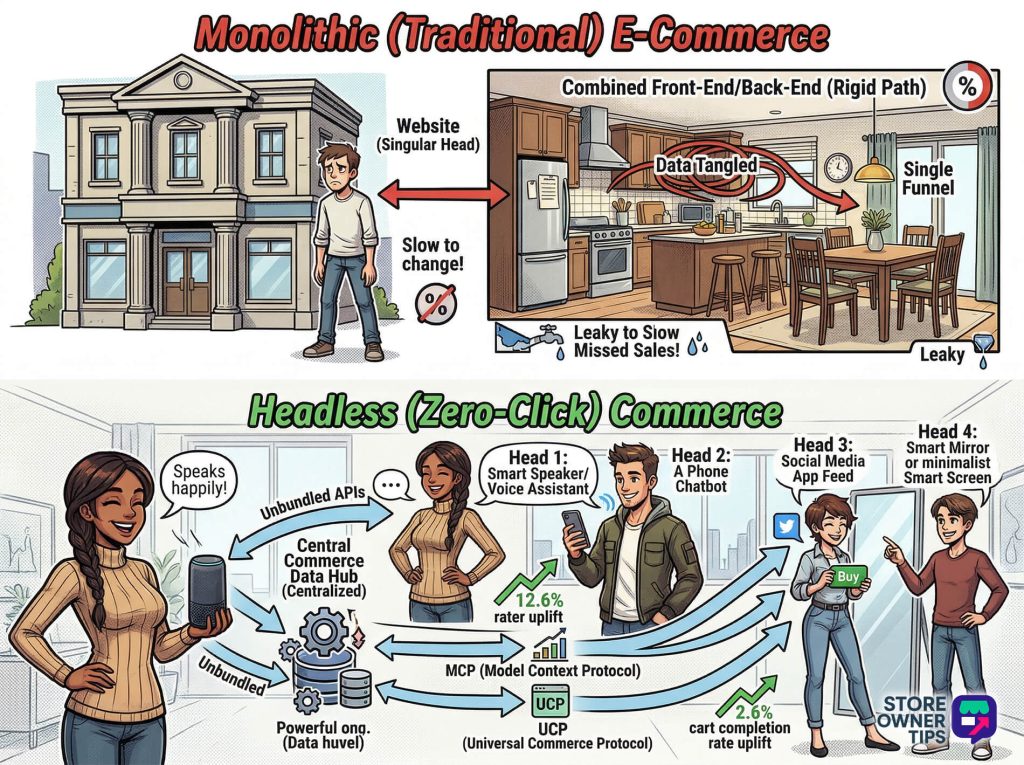
To make this drive-thru work smoothly, AI relies on two main tools:
Why is this so effective? It all comes down to your customer’s “mental battery,” also known as cognitive load.
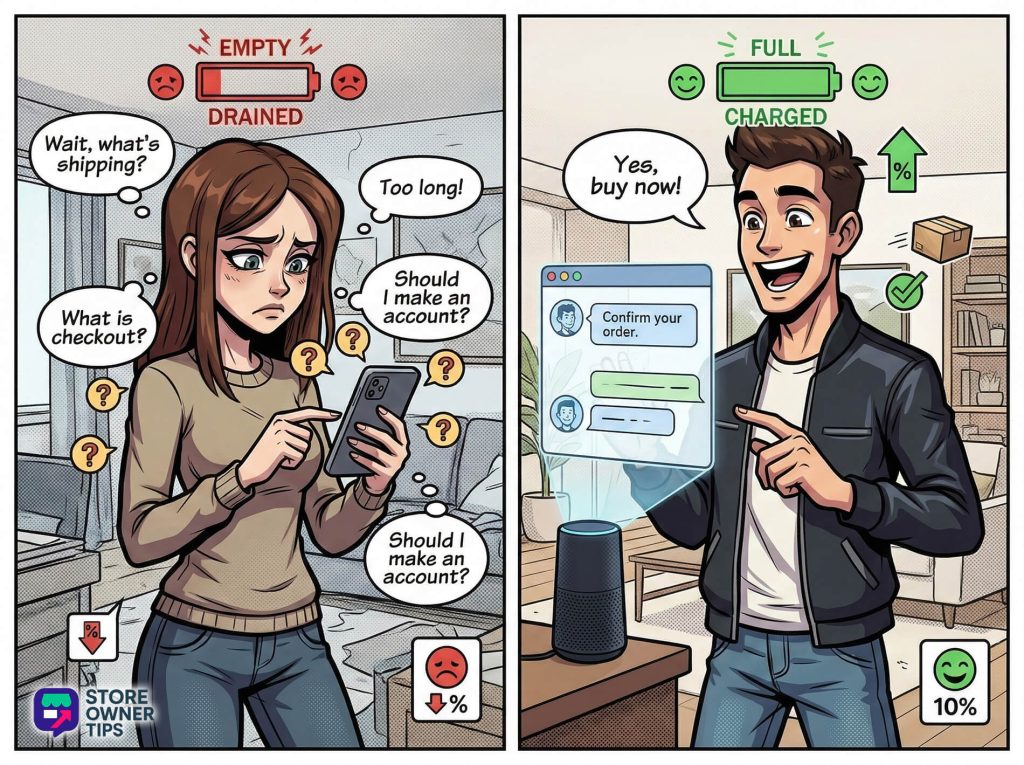
Humans have a limited amount of mental energy. Traditional checkouts often have over twenty form fields. This drains their battery quickly. When people get mentally tired, especially on small mobile phone screens, they simply give up and leave.
Psychologists divide human thinking into two systems. System 1 is fast, emotional, and automatic. On the other hand, System 2 is slow, careful, and overthinks things. Traditional shopping forces buyers into System 2. It gives them too much time to stare at the total price and change their minds. Zero-click shopping keeps them in System 1. By making the purchase as easy as speaking a sentence, you capture their impulse right when they feel it.
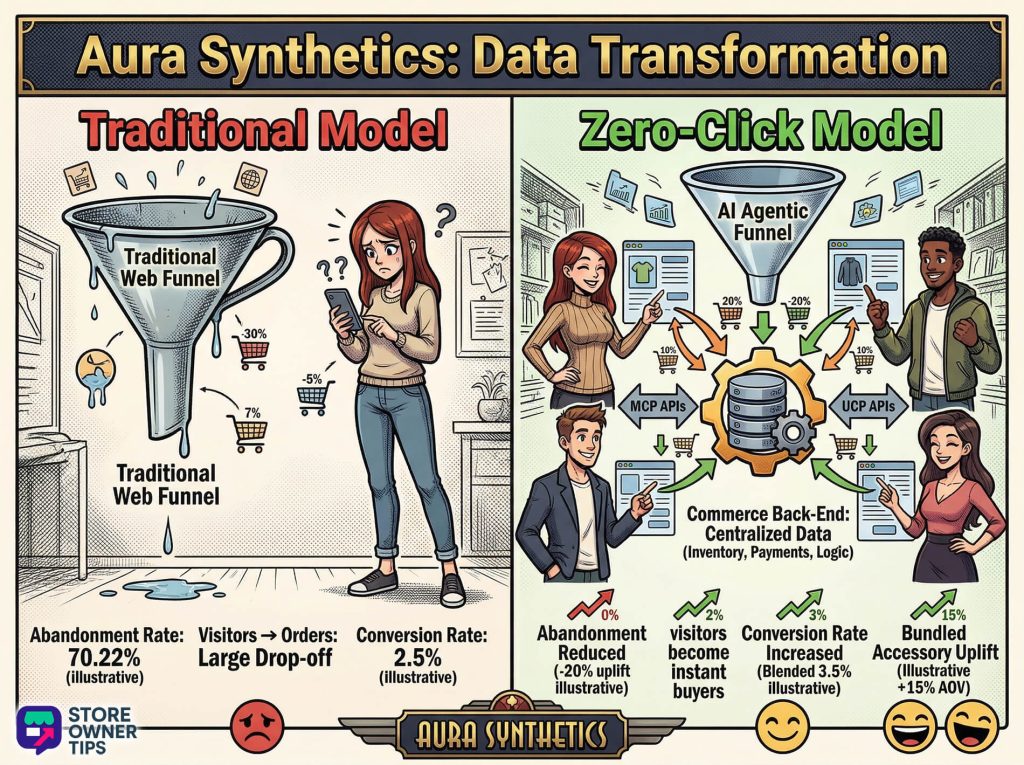
Let’s look at exactly how this changes the math for a hypothetical store. Imagine a mid-sized consumer goods brand called “Aura Synthetics.”
Right now, Aura Synthetics gets 100,000 visitors to their website every month. Following standard industry averages, their store converts at about 2.5%. This means they get 2,500 successful orders a month. With an average order value of $100, they make $250,000 in monthly revenue.
However, things are leaking badly behind the scenes. Based on global averages, they suffer a 70.22%–77.15% cart abandonment rate. That means they lose around 5,880 carts every single month. When they survey their lost shoppers, 21% say the checkout was too complicated. Meanwhile, 24% say they hated being forced to make an account.
Aura Synthetics decides to fix this by upgrading to a headless architecture and plugging into AI answer engines. Now, when a shopper asks an AI chat app for “the best synthetic travel gear,” the AI can pull Aura’s products directly into the chat and offer a “Buy Now” button right there.
Because the buyer doesn’t have to navigate a website, make an account, or type their shipping address, the friction is gone. For the shoppers buying through AI, Aura Synthetics sees an immediate 20% bump in successful checkouts.
Even better, the AI automatically suggests a matching travel bag at the exact moment the buyer is paying. This smart bundling bumps their average order value up by 15%. Aura Synthetics is now making significantly more money from the exact same amount of interest, simply because they stopped forcing people to use a clunky website.
To see exactly why the rise of zero-click is such a massive shift for store owners, let’s compare the old way of doing things with the new way.
| Feature | Traditional E-Commerce | One-Click Commerce | Zero-Click Commerce |
| Where it happens | Your actual website | Your actual website | AI chats, voice assistants, social feeds |
| How products are found | Customer manually clicks and filters | Customer manually clicks and filters | AI finds and recommends the best option |
| Checkout process | Customer types in all their details | Customer clicks a saved “Buy” button | AI handles the payment in the background |
| Mental effort | Very high | Medium | Near zero |
The biggest difference is who is doing the work. In traditional shopping, the human makes every single little choice. In zero-click shopping, the human just sets their budget and preferences, and the machine does the rest.
Going completely frictionless sounds amazing, but it brings some serious risks alongside the rewards. Here is what you need to weigh before jumping in.
The Pros:
The Cons:
To get an AI to recommend you, you have to stop worrying about traditional keyword stuffing and focus on AEO (Artificial Engine Optimization). AI agents need structured, verifiable data. You must provide clean data feeds that show your exact stock and pricing. Also, make sure your brand is talked about on trusted public forums like Reddit, because AI models scrape those sites to figure out what real people like.
This invisible shopping journey is called the “dark funnel,” and it makes traditional click-tracking useless. Instead of counting pageviews, you need to rely on zero-party data. This means adding mandatory post-purchase surveys asking, “How did you hear about us?” You also need to judge your success purely by tracking your overall revenue growth and how much it costs to acquire a customer, rather than counting clicks.
It is a major investment. While a basic store template might cost $500 to set up, building a custom headless store that speaks perfectly to AI agents usually costs between $40,000 and $120,000. On top of that, you will likely need to keep developers on retainer, which can cost anywhere from $3,000 to $12,000 a month. However, simpler plugins for smaller stores are slowly starting to hit the market.
Zero-click shopping isn’t just a passing trend; it’s the new reality of how your store will grow over the next decade. If you don’t make it totally effortless for AI assistants to find and sell your items, your brand will simply disappear from the conversation. Get your store’s background data ready now, and you’ll easily scoop up the instant sales your competitors are losing to their clunky, outdated websites.
Copyright © StoreOwnerTips.com. All Rights Reserved.
