Weekly ecommerce tips, deals & news.
A yearly subscription discount is a pricing strategy where a store offers a lower overall price to customers who pay for a full twelve months of service or products upfront. Instead of charging a customer every single month, you give them a financial reward for committing to a full year in one go. This strategy secures guaranteed long-term revenue for the business while giving the shopper a better deal.
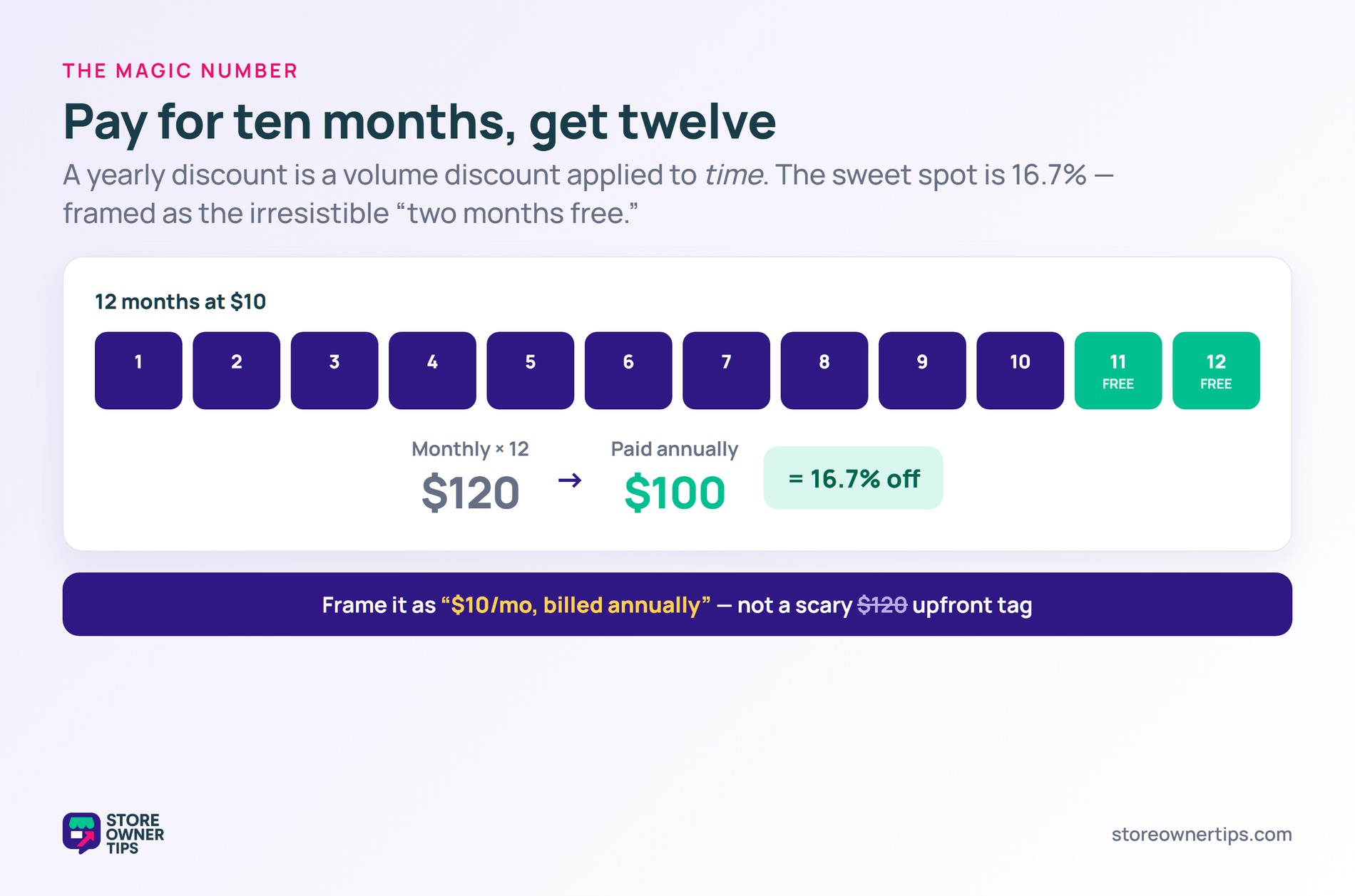
To truly grasp how a yearly subscription discount works, we have to look past the price tag. At its core, this isn’t just a simple coupon. It’s a volume discount applied to the dimension of time. By getting your buyer to pay for twelve months in a single checkout, you secure cash immediately.
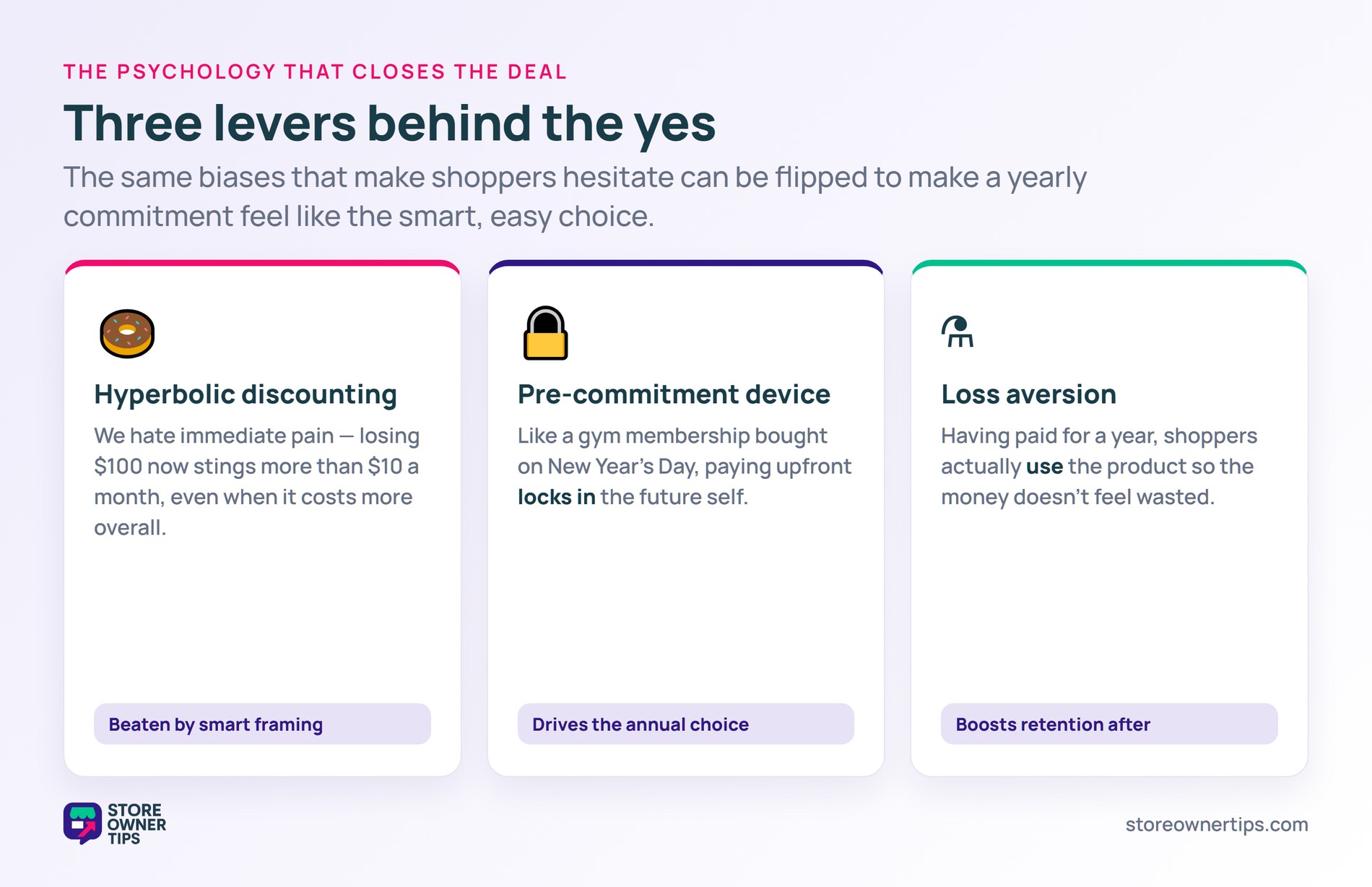
But why do customers hesitate, and how do we convince them? It all comes down to a psychological glitch called hyperbolic discounting.
Hyperbolic discounting means human beings naturally prefer instant gratification and hate immediate pain. Think of it like a diet: eating a donut today is instantly rewarding, while losing ten pounds next year feels too far away to matter. In e-commerce pricing, the pain of losing $100 today feels much worse than losing just $10 a month, even if the $10 option costs more by the end of the year!
To fix this, smart store owners use clever visual framing. Instead of slapping a scary $120 price tag on the page, they display it as “$10 per month, billed annually.” This anchors the customer’s brain to the smaller, friendlier number.
Once the customer buys the yearly plan, another psychological trick kicks in: the pre-commitment device. Think of this like paying for a full year of a gym membership on New Year’s Day. The customer knows they might get lazy in March, so they lock their future self into the commitment right now. Because they paid upfront, they also experience loss aversion—they’re highly motivated to actually use your product so they don’t feel like they wasted their money.
Properly executing a yearly subscription discount is incredibly complex behind the scenes. It requires heavy database lifting to make sure everything triggers on the right date. Here is how the big platforms handle it:
Let’s imagine a hypothetical mid-market brand called Aura Botanicals. They sell premium, scientifically backed daily health supplements directly to consumers.
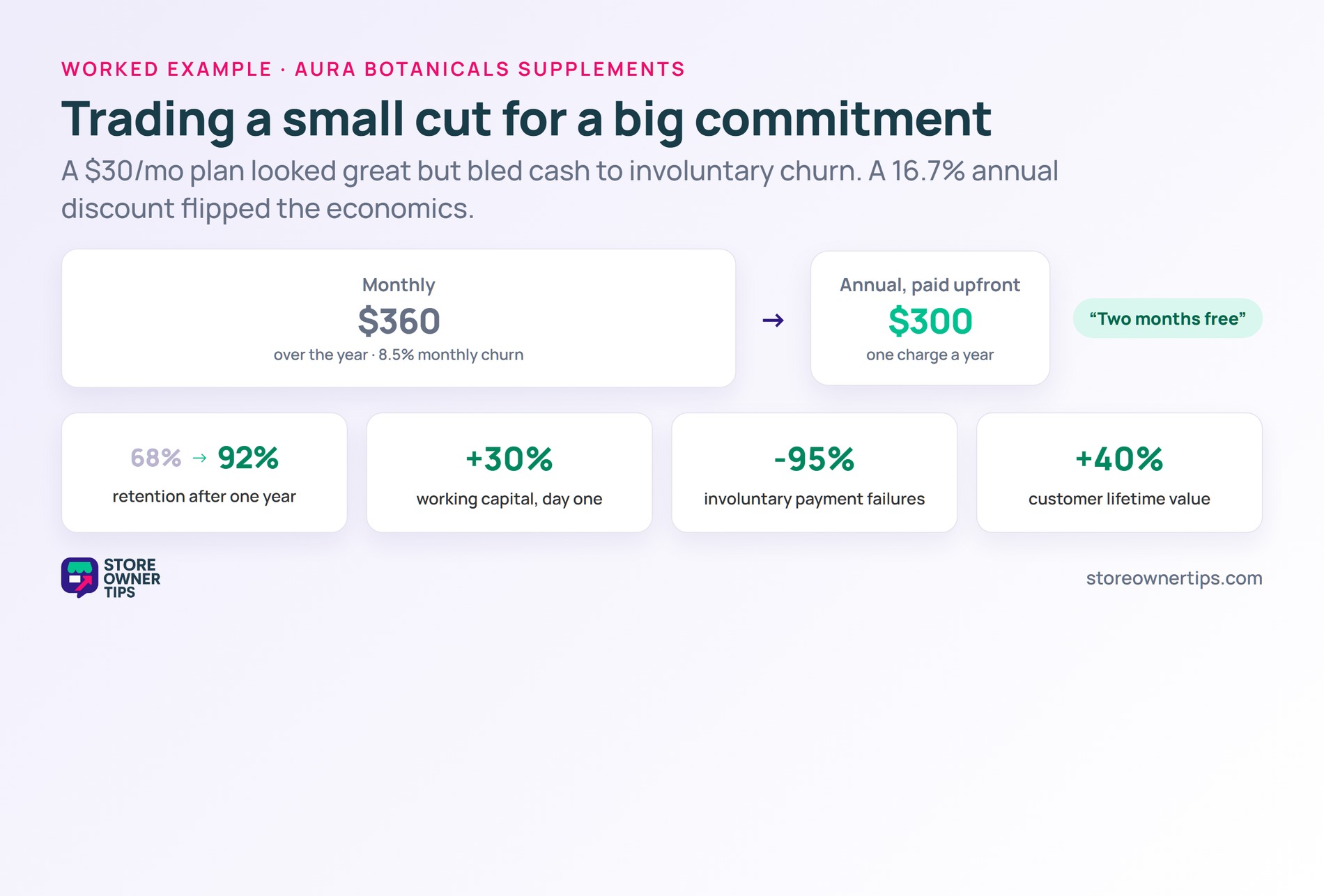
Initially, Aura Botanicals offered their core vitamin routine as a standard $30 month-to-month subscription. At first, things looked great. The low price meant lots of people signed up. However, the business was silently bleeding cash. They suffered from a massive 8.5% monthly churn rate.
Worse, most of this churn wasn’t even from angry customers. It was involuntary churn. Because Aura had to ping thousands of credit cards twelve separate times a year, payments constantly failed. Cards expired, banks flagged the recurring charges as fraud, and accounts ran low on funds. Because they were losing so many people every month, it took the business an agonizing six months just to break even on the marketing money they spent to acquire a single customer.
Desperate to fix their cash flow, the executive team introduced a yearly subscription discount. They didn’t want to destroy their brand’s premium vibe, so they used the exact industry standard benchmark: a 16.7% discount. This allowed them to market the incredibly catchy phrase: “Get two months free!”
Instead of paying $360 over the course of the year, the customer paid a flat $300 upfront. While it’s true that fewer people signed up for the expensive $300 yearly plan compared to the $30 monthly plan, the math worked out beautifully.
Aura Botanicals instantly received twelve months of cash on day one. This gave the business 30% more working capital immediately, which they aggressively pumped right back into Facebook ads and fresh inventory. When they looked at the data a year later, the results were staggering. The yearly buyers had an incredible 92% retention rate, completely crushing the 68% retention rate of their monthly buyers. Because the system only ran credit cards once a year, involuntary payment failures completely vanished, dropping by 95%. Ultimately, these yearly buyers generated over 40% more Customer Lifetime Value (LTV) for the brand.
When planning your store’s pricing, your biggest rival to the annual discount is the standard, static monthly plan.
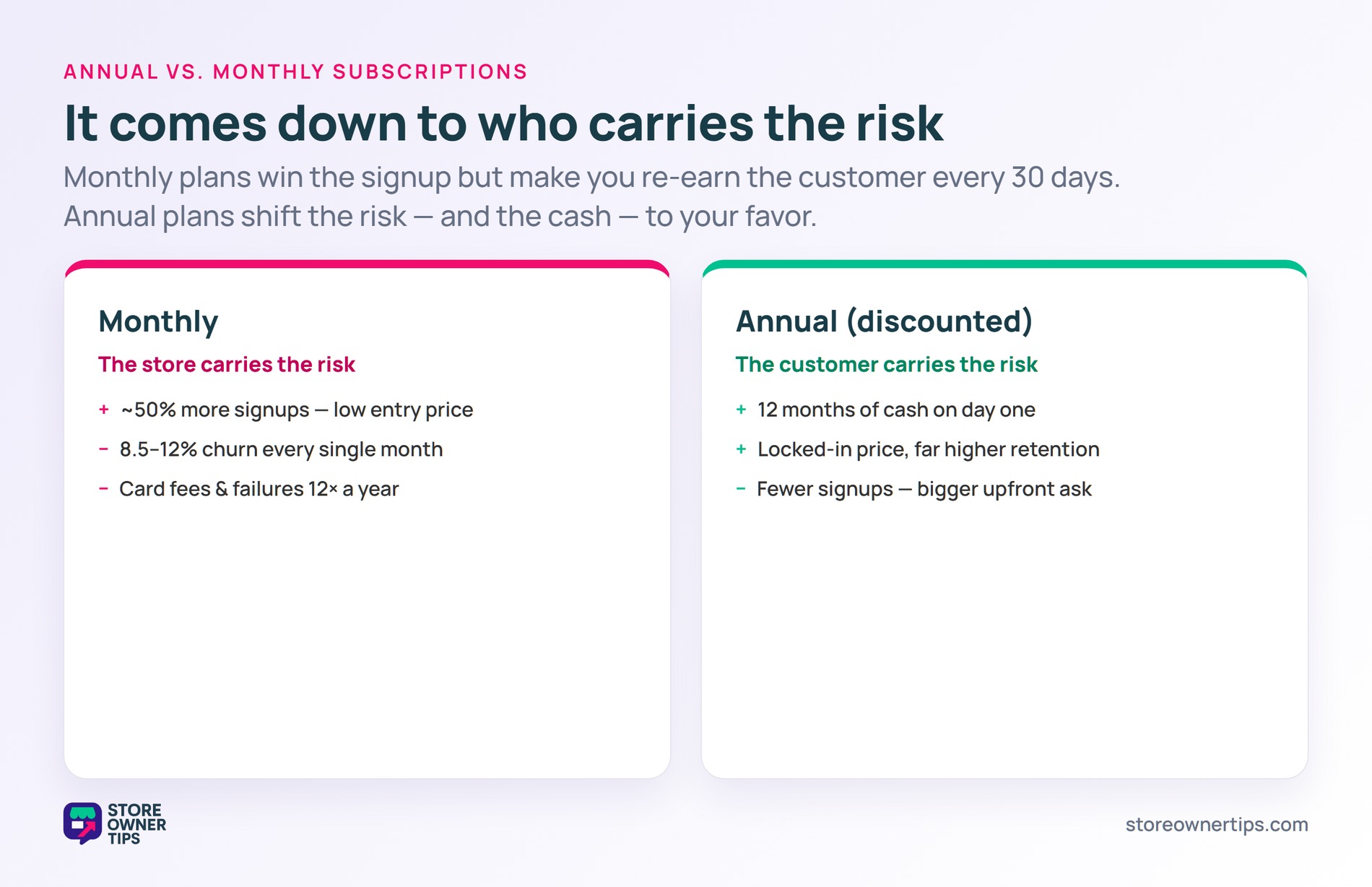
The major difference here is about who carries the risk. With a monthly plan, the store carries all the risk. The customer can cancel on a whim, meaning the store has to re-earn their business every thirty days. When utilizing a yearly subscription discount, the customer carries the risk. They hand over a big chunk of cash upfront, trusting your brand to deliver value for the next 365 days.
Monthly plans are amazing for getting people in the door. Because the cost is so low, you can expect to see top-of-funnel conversions spike by about 50% compared to pitching an expensive yearly plan. However, you pay a steep price for those easy signups. Monthly plans bleed customers, featuring brutal churn rates between 8.5% and 12% every single month. You also lose a ton of profit margin paying flat-rate credit card processing fees twelve times a year instead of just once.
It’s also worth noting the Dynamic Usage-Based Model. This is where you only charge a customer for what they use (like paying per gigabyte of data). While customers like it because it feels fair, it’s a nightmare for cash flow. In fact, roughly 42% of monthly buyers cancel because they hate unpredictable budgets. Annual plans solve this totally by locking in a guaranteed, unmoving price.
Offering a yearly subscription discount completely changes how your business handles money. Here are the core pros and cons.
You should absolutely start with monthly subscriptions. When your business is brand new, nobody trusts you yet. Asking a total stranger for a massive upfront yearly payment causes severe friction. Start with cheap monthly plans to build trust, collect feedback, and find your product-market fit. Once they love your product, use the yearly discount as an upsell later!
The statistically optimal discount rate is exactly 16.7%. This works so well because it translates perfectly to giving the customer “two months free” when they pay for ten months upfront. Dropping the discount below 10% isn’t exciting enough to make people open their wallets. Pushing it over 30% makes your brand look cheap and desperate.
No, they don’t. While standard PayPal can handle incredibly basic monthly charges, it completely falls apart when you try to do complex things like mid-year discount changes or mixing different subscription lengths in one cart. You need to upgrade to modern, API-driven platforms like Stripe or Shopify Payments to handle this architecture properly.
A yearly subscription discount is far more than just a marketing gimmick; it’s a profound structural upgrade to your store’s financial health. By intelligently trading a small fraction of your profit margin for an upfront, twelve-month commitment, you can instantly stabilize your cash flow, eradicate payment failures, and build an army of highly profitable, long-term brand loyalists.
Copyright © StoreOwnerTips.com. All Rights Reserved.
