Weekly ecommerce tips, deals & news.
The endowment effect is a behavioral economics principle: people value things more once they feel they own them. The classic experiment showed mug owners demanded roughly twice the price to sell that buyers were willing to pay. In e-commerce, the endowment effect powers free trials, wishlists, and “try before you buy” returns. Even a brief sense of ownership shifts how shoppers judge value. It’s one of the most reliable conversion levers in commerce.
The endowment effect explains a behavior that drives a lot of e-commerce revenue. People get attached to things they think they already have. It applies to physical products, digital goods, and even abstract things like loyalty points. It’s also one of the most reliable predictors of conversion lift in commerce.
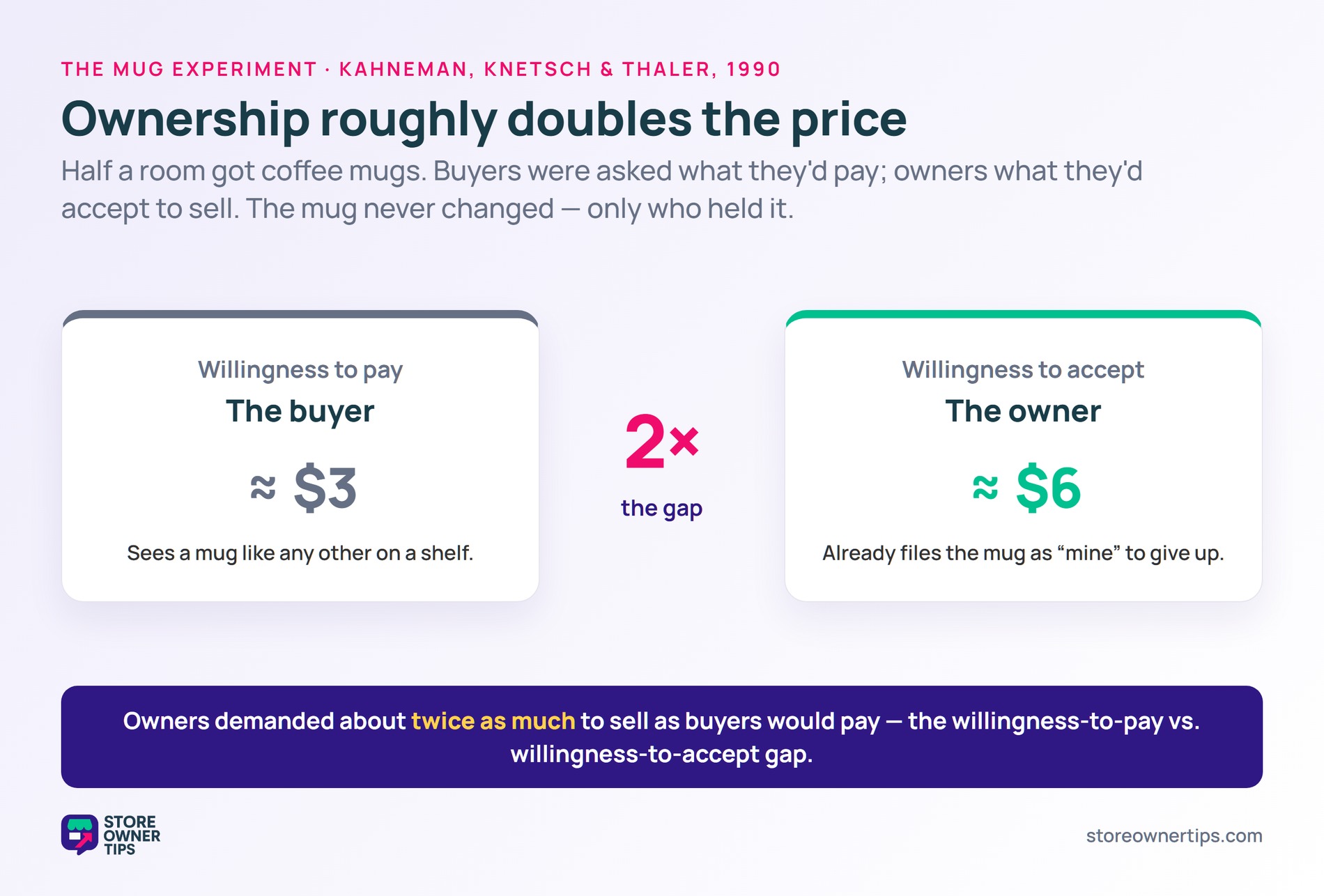
The trigger isn’t real ownership. It’s the feeling of ownership.
Economists Daniel Kahneman, Jack Knetsch, and Richard Thaler tested the effect in a 1990 experiment, later explaining their findings in the Journal of Economic Perspectives. In the test, half the students in a room got coffee mugs; the other half didn’t. The students who got mugs were asked the lowest price they’d accept to sell. The students without mugs were asked the highest price they’d pay to buy.
The results were striking. Mug owners demanded about twice the money that buyers were willing to pay. The mug itself hadn’t changed. Only the ownership had.
That gap is now called the willingness-to-pay vs willingness-to-accept gap. Or just WTP and WTA. The endowment effect is the formal name for the gap.
The endowment effect rides on a deeper principle: loss aversion. People feel the pain of losing something about 2.5 times more than the joy of gaining something equal. Once a shopper feels they own a product, giving it up triggers that pain response.
Loss aversion is the engine. The endowment effect is one of the gears it spins. The two together explain everything from real estate stubbornness to free-trial conversion. Once the brain files something as “mine,” giving it up registers as loss, not refusal.
A useful analogy: a free haircut sample turns a stranger’s chair into “your chair.” Even though you didn’t pay, the brain has filed it as yours. Walking away feels like leaving something behind.
The effect isn’t a universal constant. Research with the Hadza people in northern Tanzania found two groups. Market-oriented Hadza retained their items at 75%. Less market-oriented Hadza split closer to 50-50.
The takeaway: the effect strengthens with more exposure to markets and trade. Western e-commerce shoppers are about as exposed as anyone gets. Stores can count on it firing reliably.
The endowment effect shows up across the funnel:
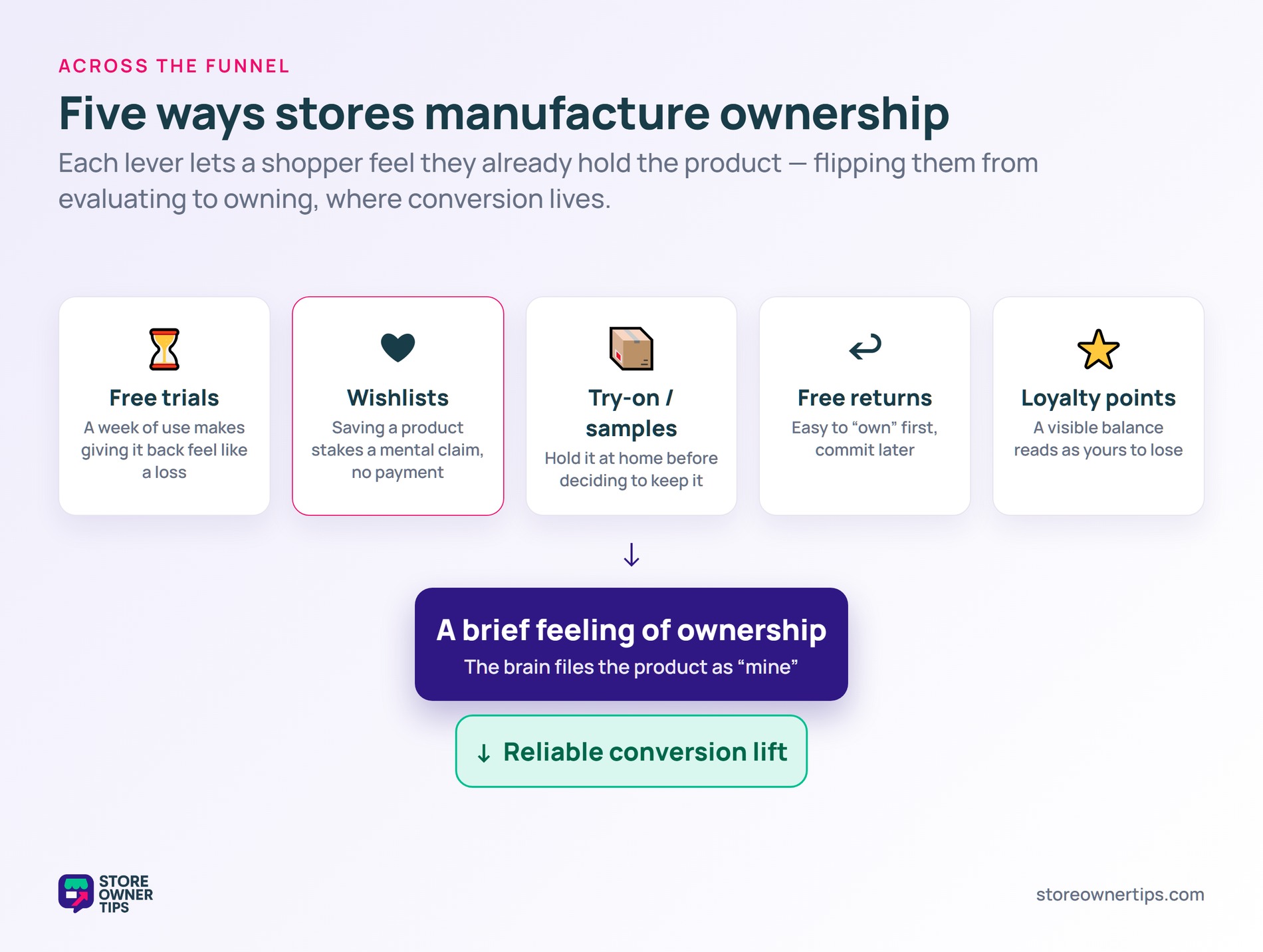
The common thread: shift the shopper from evaluating to owning, even briefly. Once that switch flips, the conversion is mostly downhill.
Most stores already have at least one of these levers in place. The mistake is treating them as features, not psychology levers. A wishlist isn’t just a save-for-later feature. It’s a low-cost trigger for the most reliable conversion lift in commerce.
Walk through a fully hypothetical store applying the endowment effect to its catalogue page and email flow. The mechanics below borrow from real research and benchmarks.
Imagine a mid-size online retailer selling premium leather wallets on WooCommerce. Call it Hide and Hook. The store gets 30,000 monthly sessions and converts at 2.1%. Average order value sits at $85.
The team notices a pattern in their session data. Lots of visitors view a product, scroll the photos, then leave without buying or saving. Repeat visit rate is low. There’s no mechanism to capture intent.
The team suspects shoppers are bouncing because there’s no way to “hold” a product. Most categories like leather goods need consideration time.
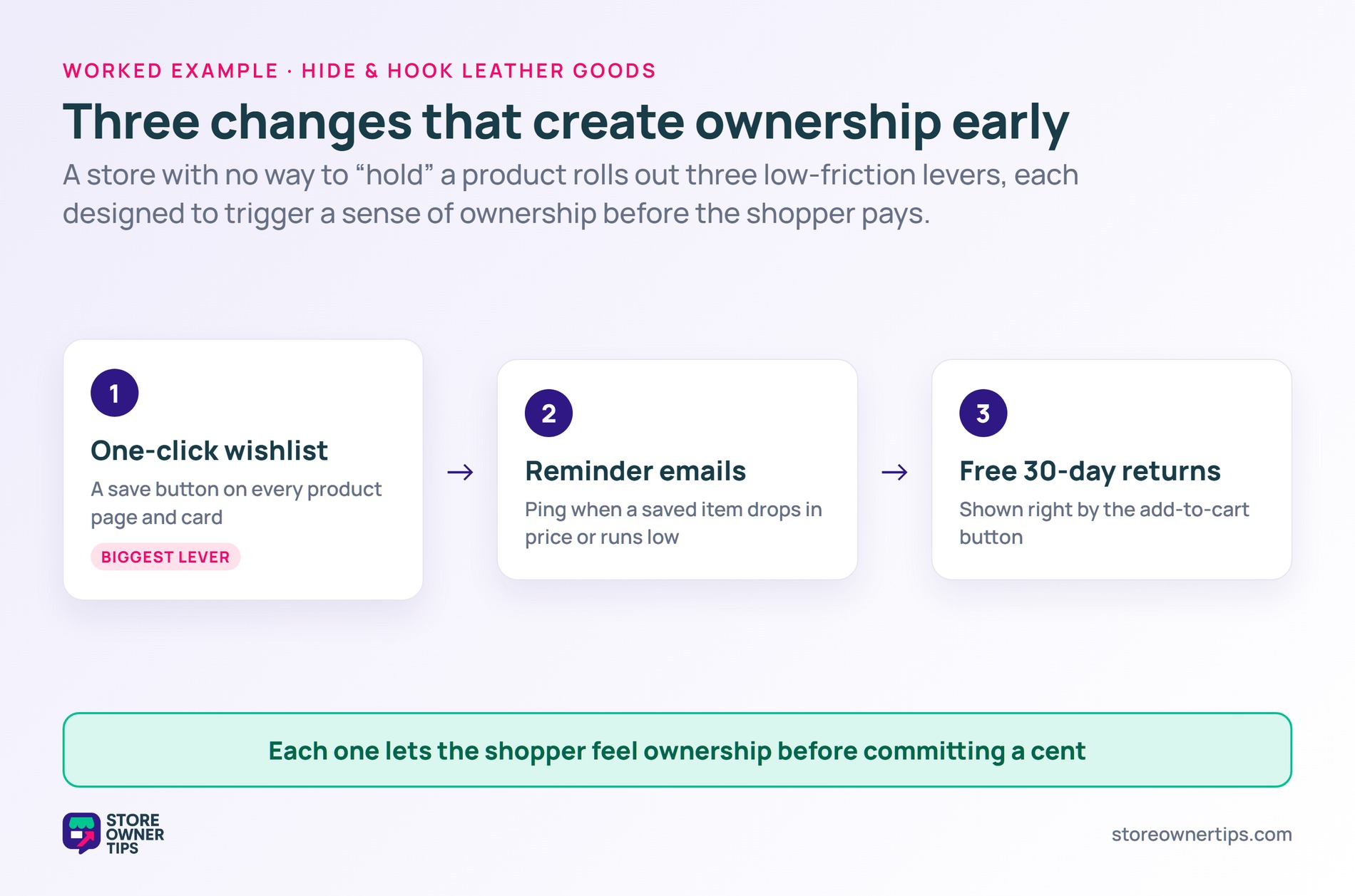
The team rolls out three changes, each designed to create a brief sense of ownership before purchase:
The wishlist button is the biggest lever. Saving a product kicks the endowment effect into gear, even though the shopper hasn’t paid a cent.
Six months in, the picture shifts:
Monthly orders climb from 630 to 780. Revenue moves from $53,550
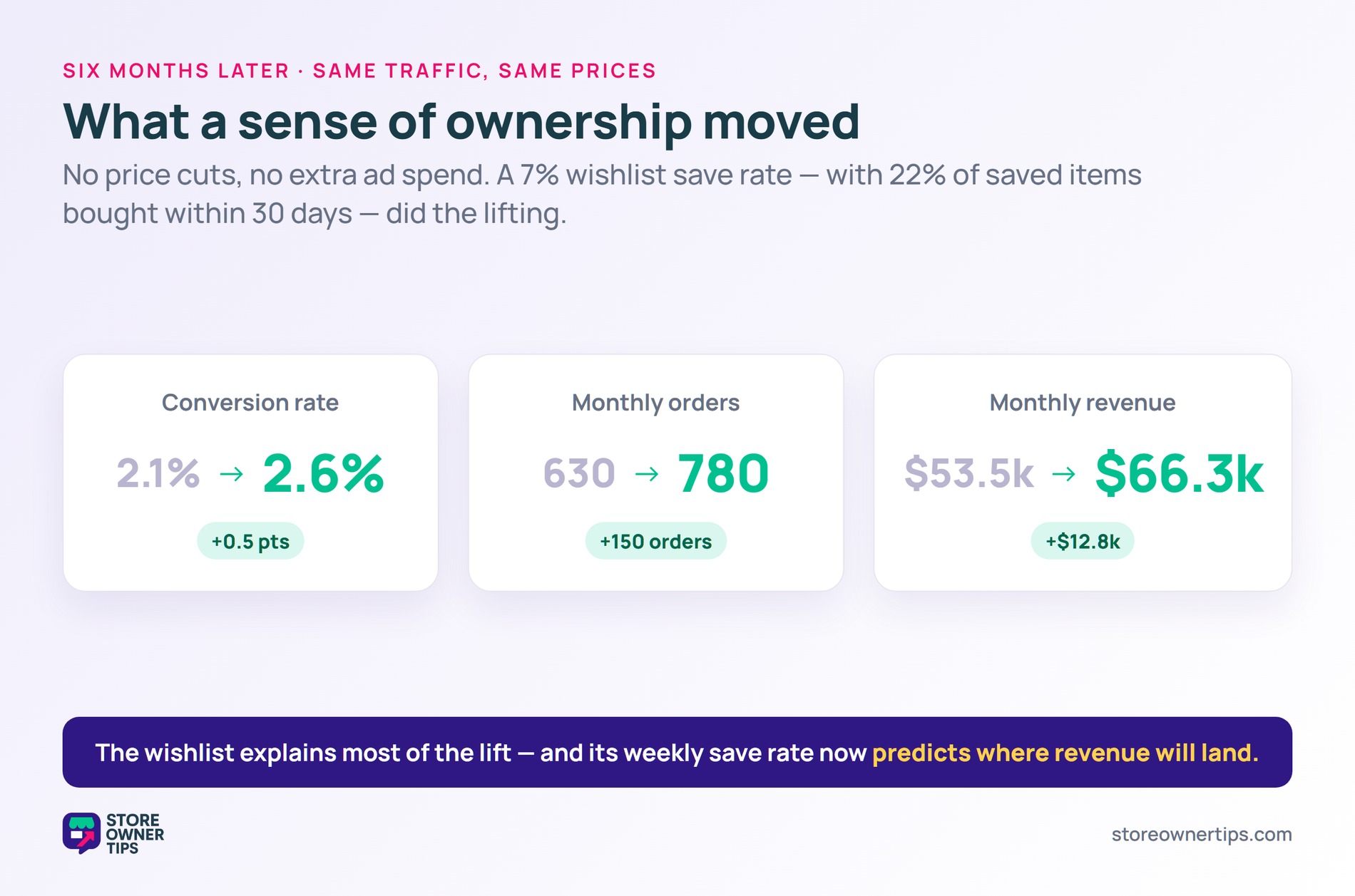
The wishlist alone explains most of the lift. The free-returns badge contributed roughly a third of the gain. Both work because they let the shopper feel ownership before committing.
Most importantly, the wishlist now serves as a leading indicator for revenue. The team can watch wishlist save rate weekly and predict where revenue will land. That’s a leap forward from waiting on conversion data alone.
Loss aversion is the broader principle. The endowment effect is one specific case of it. Loss aversion says losses hurt more than equivalent gains. The endowment effect says ownership creates the loss frame in the first place.
Think of loss aversion as the rule and the endowment effect as one of its applications. The rule says losses hurt more than gains. The effect identifies one specific way ownership creates that loss frame.
Both rely on the same brain wiring. Stores often trigger both at once. A wishlist invokes the endowment effect, and a “your saved item is about to sell out” email invokes loss aversion.
Yes, often more strongly than on physical goods. Digital products like apps, courses, and subscriptions create ownership faster because the user starts engaging immediately. There’s no shipping wait or unboxing delay.
Free trials are the best example. A SaaS tool used for a week is one a person feels invested in, even if no money has changed hands. Cancelling means giving back something they’ve already been using.
Start with the lowest-friction ownership move: a wishlist or save for later button. Both require no payment, build no friction, and trigger the effect instantly.
Next, look at returns and trial policies. A liberal returns policy lets a customer feel they own the product before fully committing.
For higher-ticket items, consider a free sample or virtual try-on. The goal is to put the product in the customer’s hands, real or digital, before asking for payment.
Don’t try all three at once. Pick the one that fits your category and traffic profile. For most stores, a wishlist is the cheapest first move.
The endowment effect is one of the cleanest psychology levers available in e-commerce. Free trials, wishlists, and liberal returns aren’t just helpful features. They are mechanisms that flip the shopper from evaluating to owning, which is exactly where conversion lives. Stores that build at least one ownership trigger into their experience consistently outperform stores that don’t.
Copyright © StoreOwnerTips.com. All Rights Reserved.
