Weekly ecommerce tips, deals & news.
Customer Acquisition Cost (CAC) is the total amount you spend to win one new customer. You add up your marketing and sales costs, then divide by the number of new customers those efforts brought in. It tells you whether your growth is profitable or quietly draining cash. A low CAC means you win customers cheaply, while a high one eats into your margins.
CAC sounds technical, but the math is grade-school simple. Think of it like the cost per fish on a fishing trip. You add up everything you spent on bait, fuel, and gear, then divide by the number of fish you caught. The result tells you if the trip was worth it.
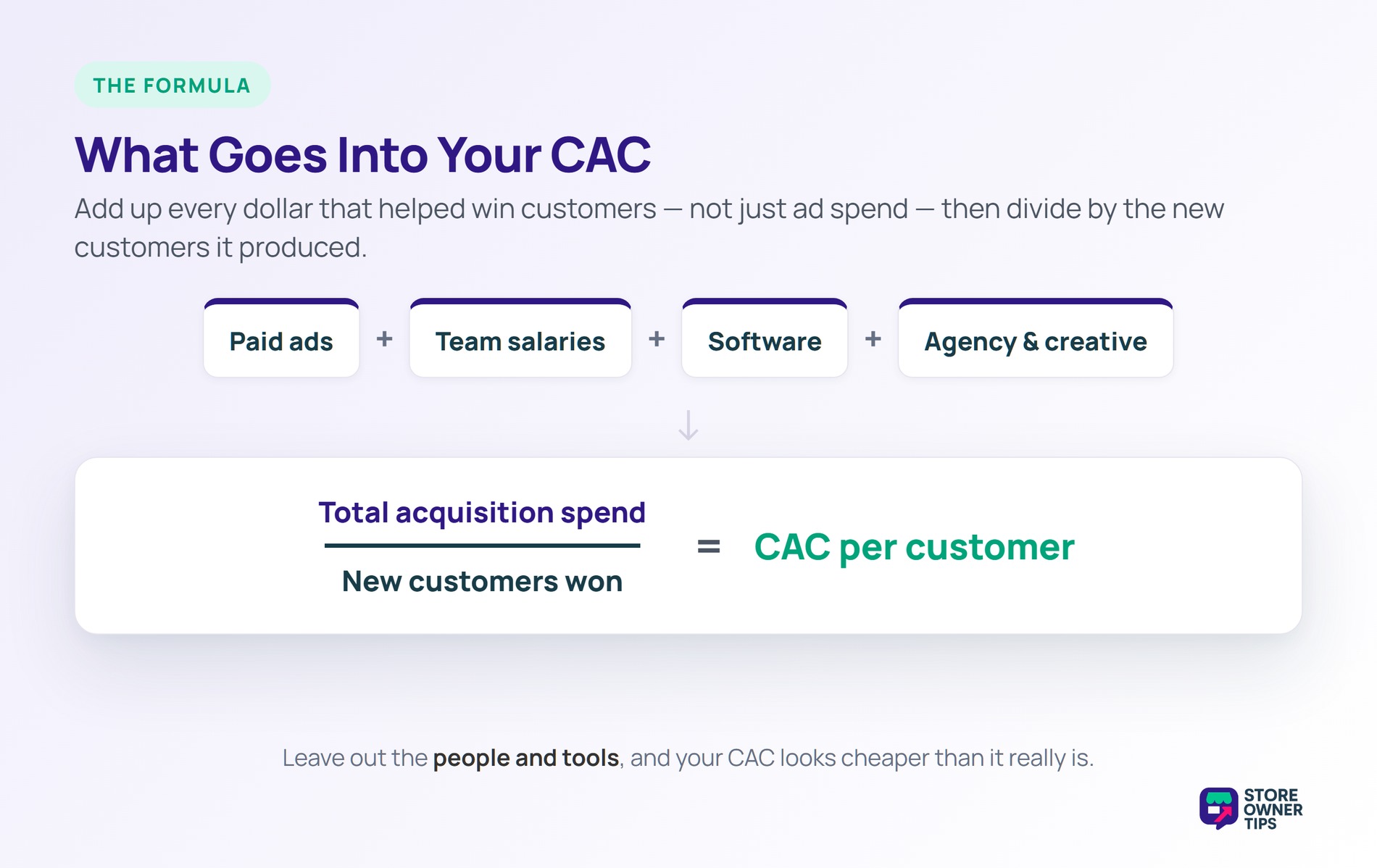
Your CAC includes far more than just ad spend. You add up paid ads, salaries for your marketing and sales team, software, agency fees, and creative costs. Then you divide that total by the new customers from the same period. Leaving out the hidden costs makes your CAC look better than it really is.
Many store owners forget the people costs and count only ad spend. That mistake makes growth look cheaper than it actually is. A useful habit is to pick one time period, then capture every dollar that helped win customers in it. The cleaner your inputs, the more you can trust the number that comes out.
Not all CAC is measured the same way, and the difference matters. Blended CAC divides your total spend by every new customer, including those who found you for free. Paid CAC counts only the customers who came directly from paid ads.
Blended CAC always looks rosier, because free traffic drags the average down. Paid CAC is harsher, but it shows the true cost of buying growth. Smart owners watch both, so a spike in paid CAC never hides behind cheap organic wins.
CAC is the gut-check for whether your growth is actually healthy. If a customer costs more to win than they ever spend, you lose money on every sale. That hurts even more because acquiring a new customer is anywhere from five to 25 times more expensive than keeping one. On top of that, much of the traffic you pay for never buys, since cart abandonment averages 70.22% across e-commerce.
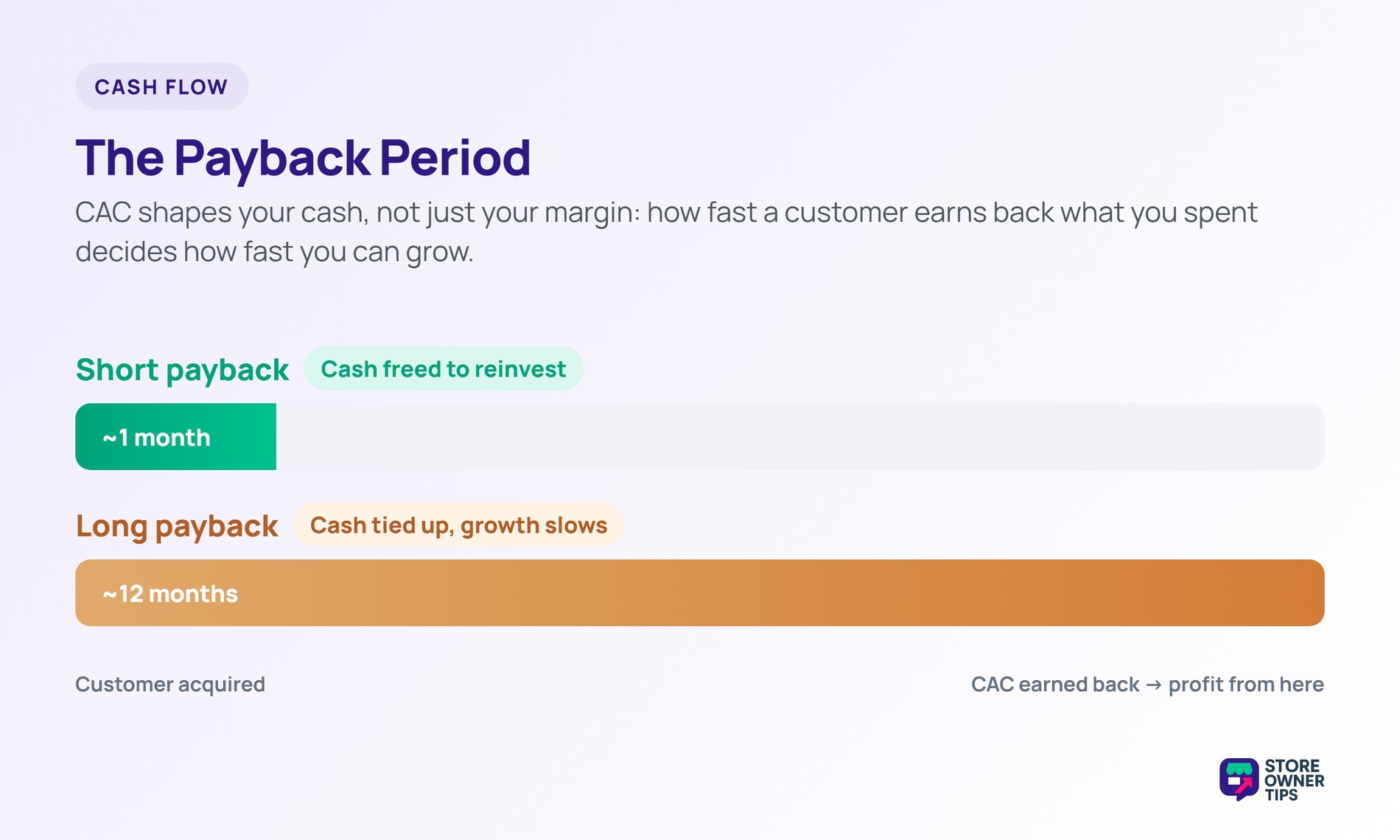
CAC shapes your cash flow, not just your profit margin. The payback period measures how long a customer takes to earn back what you spent to acquire them. A short payback frees up cash you can reinvest in the next round of growth.
A long payback ties up money and slows everything down, even when the sale eventually profits. A customer who repays their CAC in one month fuels faster growth than one who takes a year. So timing matters just as much as the raw number.
CAC rarely sits still, and lately it only moves one way. Ad auction prices climb, privacy changes make targeting harder, and more brands fight for the same eyeballs. On WooCommerce or Shopify, that means the same budget buys fewer customers than it did a year ago. As a result, the smartest fix is rarely spending more, it is converting more of the traffic you already pay for.
There is a silver lining hiding in that pressure. Because acquisition keeps getting pricier, even small efficiency gains pay off in a big way. Reviving past buyers or fixing a leaky checkout can cut your effective CAC sharply. In a rising-cost world, the careful operator quietly pulls ahead.
A few common mistakes quietly distort CAC for growing stores. Counting only part of your costs is the biggest one. Measuring CAC over too short a window is another, since one strong week can skew the whole average.
Judging CAC without lifetime value beside it is the costliest mistake of all. A $30 CAC can be terrible, and a $100 CAC can be a steal. The number only earns its meaning once you pair it with what each customer is truly worth.
Imagine a mid-sized coffee roasting brand called Hearth and Bean. They run their store on WooCommerce and want to know if their growth is sustainable. The CAC formula gives them a clear answer.
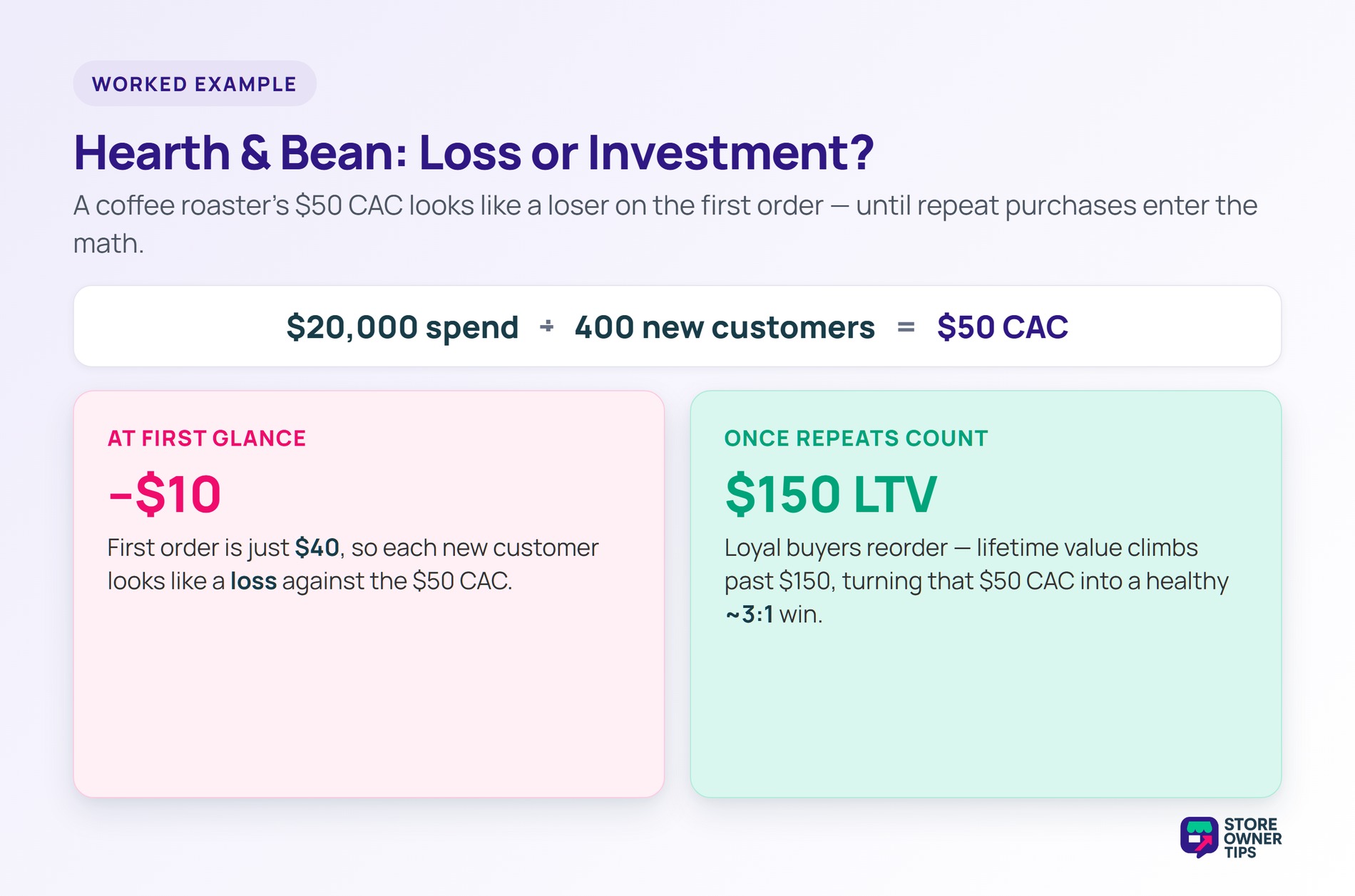
Last quarter, Hearth and Bean spent $12,000 on ads, $6,000 on marketing salaries, and $2,000 on software. That is $20,000 in total acquisition costs. Those efforts brought in 400 new customers. So their CAC works out to $50 per customer, or $20,000 divided by 400.
Each new shopper spends about $40 on a first order, which is their average order value. At first glance, that means Hearth and Bean loses $10 on every new customer. On its own, that looks like a slow-motion disaster. But the picture changes once repeat purchases enter the math.
Their best customers come back again and again. In fact, loyal repeat buyers often drive 44% of total revenue despite being a small slice of the base. When Hearth and Bean nudges first-timers into a second and third order, lifetime value climbs past $150. Suddenly that $50 CAC looks like a bargain, landing near the healthy 3:1 ratio stores aim for.
This is exactly why fixating on a single CAC number misses the point. Acquisition is only the first chapter of the customer relationship. The stores that win treat that $50 as an investment, not a loss.
Hearth and Bean does not just accept that $50 CAC and hope. They send targeted email campaigns to first-time buyers, each with a clear reason to return. They also smooth out their checkout so paid traffic actually converts into orders.
Within a quarter, more first-timers place a second and third order. Their lifetime value climbs, and the gap over CAC widens nicely. The same ad budget now produces far more profit per customer. That is the real win, easing CAC pressure without spending an extra dollar on ads.
It is easy to mix up CAC with customer lifetime value (CLV), but they measure opposite ends of the same relationship. CAC is what you pay to get a customer in the door. CLV is the total profit that customer brings over their entire time with you. One is a cost, and the other is the payoff.
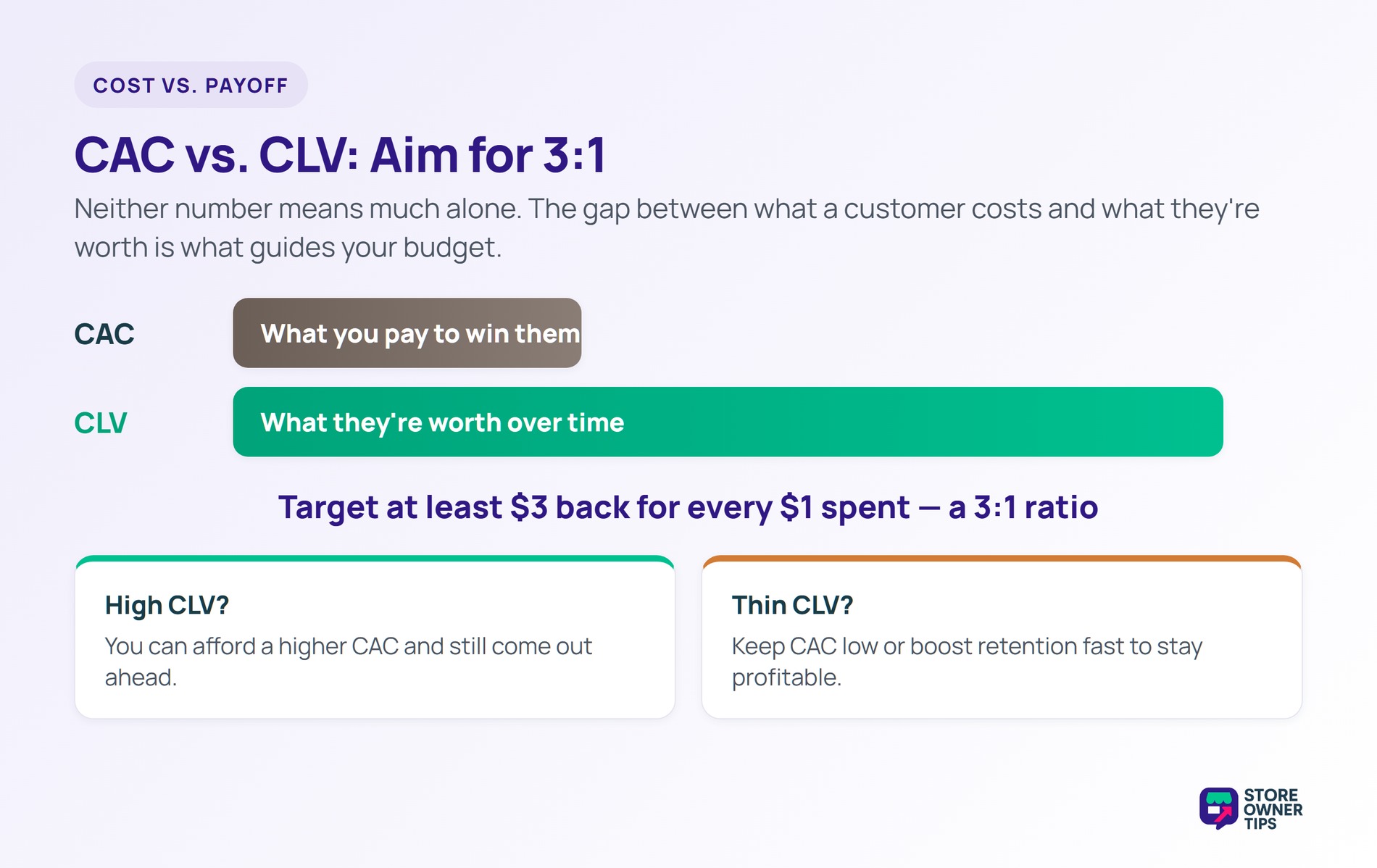
Neither number means much on its own. A $50 CAC is excellent if CLV is $200, yet alarming if CLV is only $40. The goal is a comfortable gap between them, which is why most stores target that 3:1 ratio. Track the two together, and you will know how much you can afford to spend on growth.
Here is the practical takeaway for store owners. If your CLV is high, you can afford a higher CAC and still come out ahead. If your CLV is thin, you must keep CAC low or boost retention fast. This one comparison guides nearly every marketing budget decision you make.
Add up all your sales and marketing costs for a set period. Then divide that total by the number of new customers from the same window. For the truest number, include ad spend, salaries, software, and agency fees. Skipping those hidden costs gives you a CAC that looks better than reality.
There is no universal good number, because it depends entirely on your lifetime value. Most healthy stores aim for a CLV-to-CAC ratio of around 3:1. In plain terms, you want at least three dollars back for every dollar spent acquiring. Anything below 1:1 means you lose money on each new customer you buy.
Focus on keeping customers, not just finding brand-new ones. A strong loyalty program turns one-time buyers into repeat revenue you do not pay for twice. Reducing cart abandonment with a smoother frictionless checkout also stretches every ad dollar further. Together, these tactics squeeze more value from the traffic you already bought.
Customer acquisition cost is the clearest signal of whether your growth pays for itself. On its own, the number means little, but next to lifetime value it shows how far each marketing dollar goes. Keep CAC in check, lean on retention, and you build a store that grows without bleeding cash. Watch it closely every month, and every dollar you spend starts working harder for you.
Copyright © StoreOwnerTips.com. All Rights Reserved.
