Weekly ecommerce tips, deals & news.
The manufacturer’s suggested retail price, or MSRP, is the price a supplier recommends a retailer charge the public. It is a suggestion, not an instruction, and the shop is free to ignore it. Suppliers publish one to anchor what a product is worth and to keep pricing consistent across every stockist.
So MSRP is a reference point, and the whole trade price sits underneath it.
Most people meet MSRP as the crossed-out number on a price tag. From the retailer’s side it is a comparison device. However, from the supplier’s side it is something more deliberate.
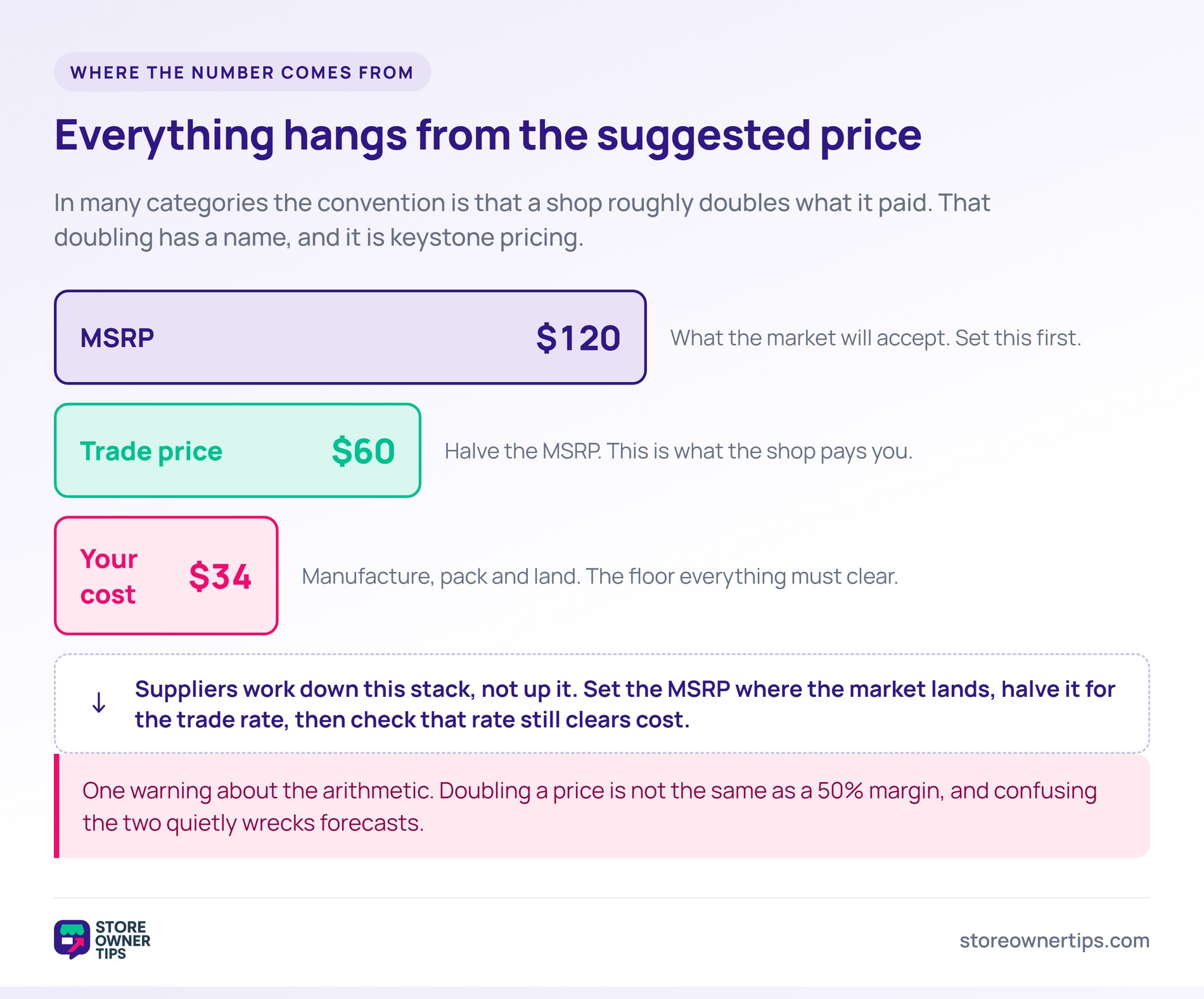
It is the number your entire pricing structure hangs from.
Suppliers do not pick MSRP out of the air. First, they work out what the product costs to make and land. Next, they decide what margin a retailer needs to bother stocking it.
Those two figures produce the shelf price almost automatically. In many categories the convention is that a shop roughly doubles what it paid. That doubling has a name, and it is keystone pricing.
So a supplier often works backwards. Set the MSRP where the market will accept it, then halve it for the trade rate. Then check that rate still clears cost. If it does not, the product is priced wrong.
That final check is really a gross margin question in disguise.
One warning about the arithmetic. Doubling a price is not the same as a 50% margin, and confusing the two quietly wrecks forecasts. The distinction is covered by markup vs margin.
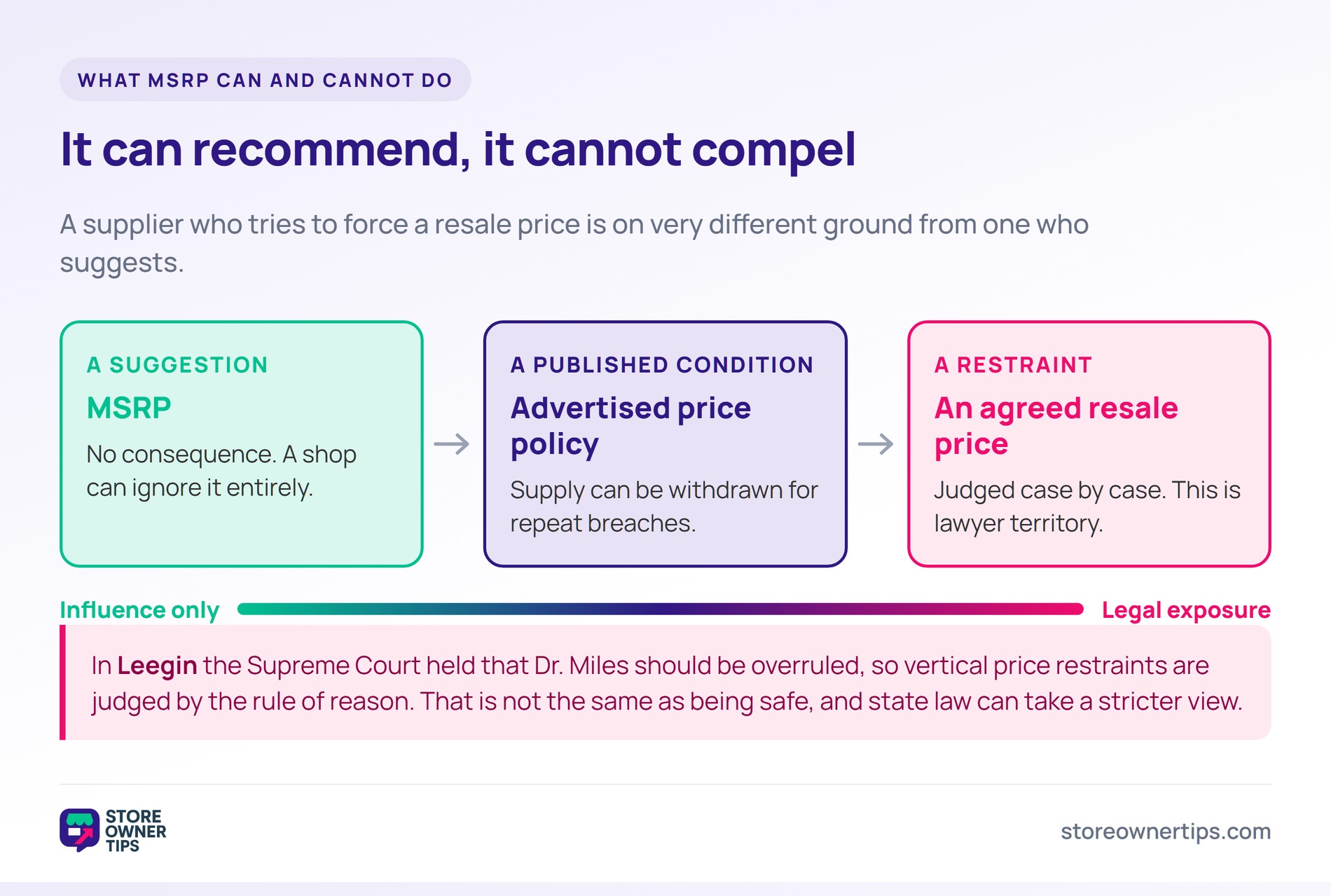
MSRP can recommend. It cannot compel, and this is the part store owners most often get wrong. A supplier who tries to force a resale price is on very different legal ground.
In the United States the Supreme Court addressed this directly. In Leegin the Court held that Dr. Miles should be overruled and that vertical price restraints are judged by the rule of reason. So such agreements are no longer automatically illegal.
That is not the same as being safe. Rule of reason means a court weighs the effects case by case. Meanwhile, state law can take a stricter view, so this is a question for a lawyer rather than a glossary.
The practical takeaway is simpler. Publish MSRP as guidance and let it work through consistency. If you need something with teeth, that is a separate policy, not a suggested price.
Because a shared reference price stops your stockists fighting each other. When three shops all sell near MSRP, none of them is losing to the others on price alone. So they compete on service instead. Suppliers running exclusive wholesale pricing lean on this even harder.
It also matters because buyers are price-led. Forrester found that at least a third of B2B buyers in North America and Europe are primarily influenced by price. A retailer weighing your line is running exactly that calculation.
The scale involved makes consistency worth the effort. U.S. merchant wholesalers moved $11.38 trillion in a recent survey year. In practice, most of that volume passes through exactly this kind of supplier-to-retailer relationship.
There is a shopper-facing reason as well. MSRP gives a discount something to be measured against. Even so, that only works while the number is credible.
The number itself is chosen carefully. A suggested $99 reads very differently from $100, which is why psychological pricing shapes most MSRPs. So the last digit is rarely an accident.
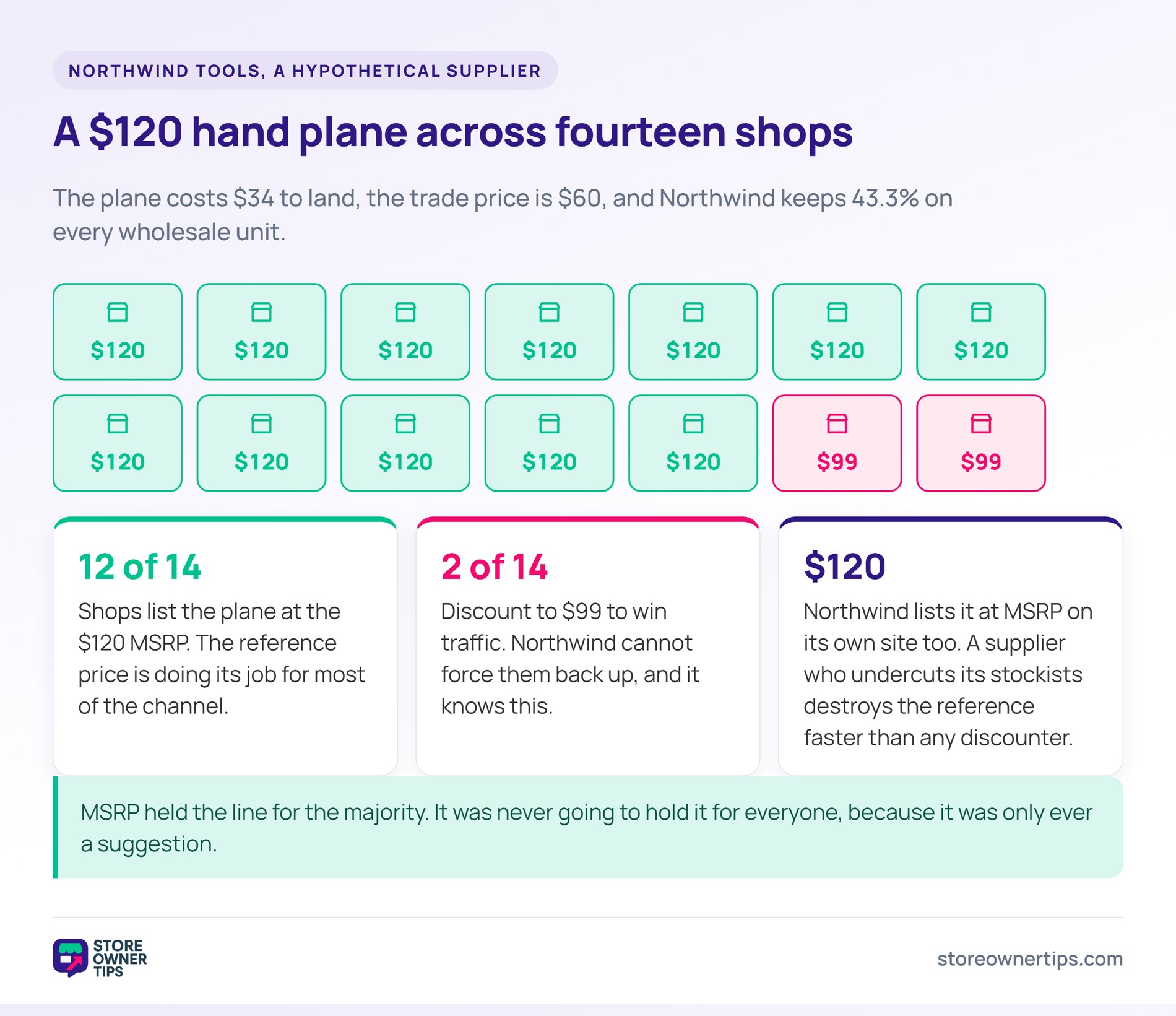
Imagine a supplier called Northwind Tools launching a hand plane. It sells through its own site and through fourteen independent hardware shops. Now it has to decide what the plane is worth.
First, the plane costs $34 to manufacture, pack and land. Comparable planes sell between $110 and $130. So Northwind sets an MSRP of $120.
Then halving that gives a trade price of $60. Against a $34 cost, Northwind keeps a 43.3% margin on every wholesale unit. Meanwhile, the shop keeps $60 on a $120 sale.
Both sides clear their floor, so the structure holds. Crucially, Northwind checked the trade rate against cost before publishing the MSRP. Doing it the other way round is how suppliers end up trapped.
In practice, twelve of the fourteen shops list the plane at $120. Two discount it to $99 to win traffic. Northwind cannot force them back up, and it knows this.
The other twelve start complaining within a month. From their side, they are doing the demonstrations and losing the sale. So the MSRP is doing its job for most of the channel and failing at the edges.
Northwind also lists the plane at $120 on its own site. That matters more than it sounds. A supplier who undercuts its own stockists destroys the reference price faster than any discounter can.
In short, MSRP held the line for the majority. It was never going to hold it for everyone, because it was only ever a suggestion.
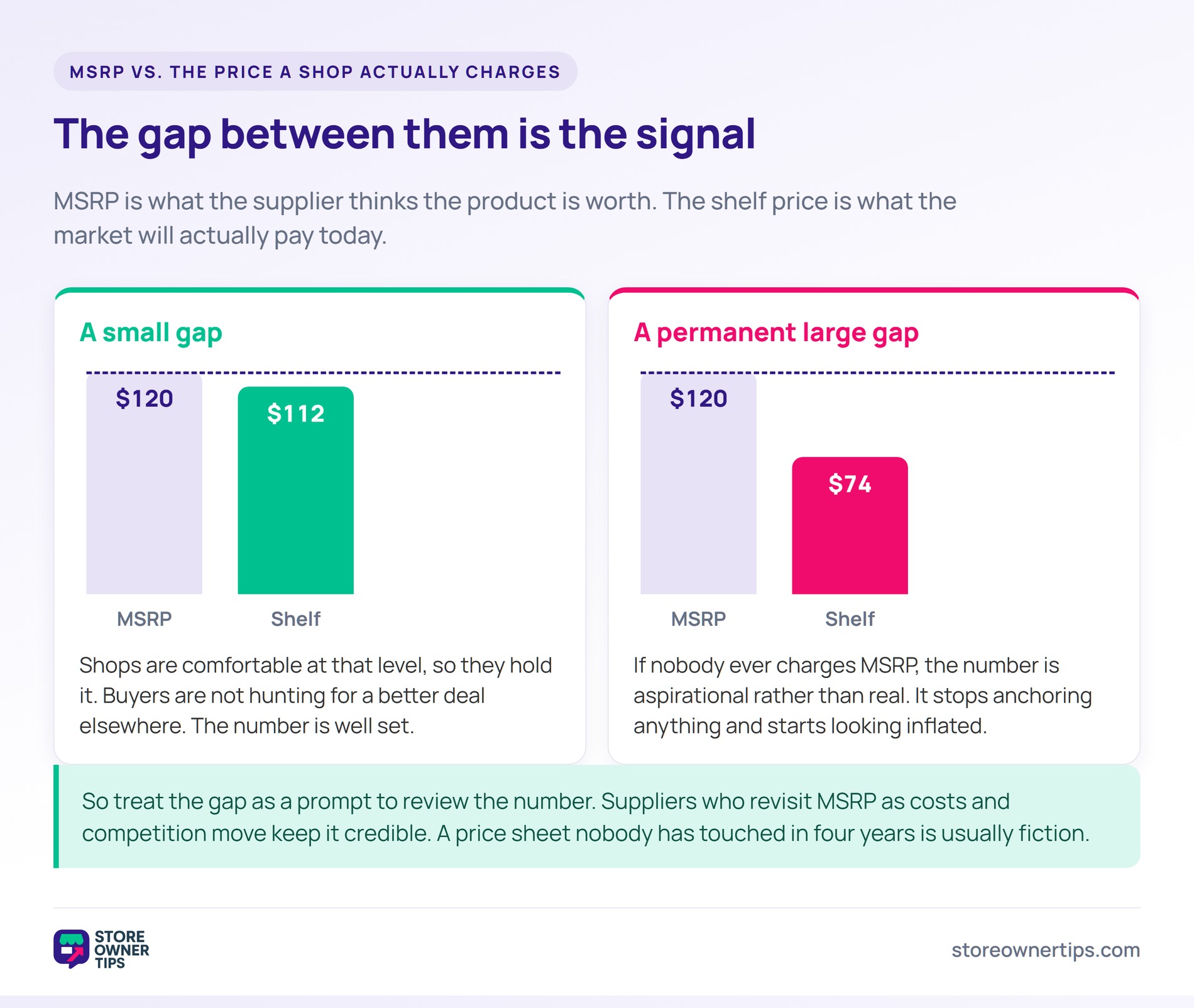
These drift apart constantly, and that gap tells you something useful. MSRP is what the supplier thinks the product is worth. The shelf price is what the market will actually pay today.
A small gap usually means the MSRP is well set. Shops are comfortable at that level, so they hold it. Meanwhile, buyers are not hunting for a better deal elsewhere.
A permanent large gap means the opposite. If nobody ever charges MSRP, the number is aspirational rather than real. Then it stops anchoring anything and starts looking like an inflated reference.
So treat the gap as a signal to review the number. Suppliers who revisit MSRP as costs and competition move keep it credible. By contrast, a price sheet nobody has touched in four years is usually fiction.
Not through the suggested price itself, because a suggestion is exactly that. Instead, retailers set their own prices and price to their own market. So MSRP works by agreement, not by control.
Suppliers who want more influence usually adopt a separate advertised-price policy instead. That is a different instrument with different rules. Given the legal complexity, take advice before writing one.
Start from the retailer’s side, not yours. Work out the margin a shop needs to justify shelf space, then work back to a trade price. Finally, check that trade price still clears your own cost.
The common shortcut is to double the trade price. That gets you close in many categories, but not all of them. For example, food and hardware often run tighter than fashion or giftware.
Only if you actually sell at it. A supplier who lists MSRP and then permanently discounts below it is undercutting its own stockists. That damages the channel faster than an outside discounter can.
Selling at MSRP yourself is the strongest signal you can send. It tells retailers you are a supplier, not a competitor. Meanwhile, your wholesale pricing stays the reason they buy from you.
MSRP is the reference price everything else is measured from, including your own trade rate. Its power comes from being credible rather than from being enforceable.
So set it where the market really lands, sell at it yourself, and review it as costs move. For the arithmetic behind the trade rate, see this guide to calculating a wholesale price.
Copyright © StoreOwnerTips.com. All Rights Reserved.
