Weekly ecommerce tips, deals & news.
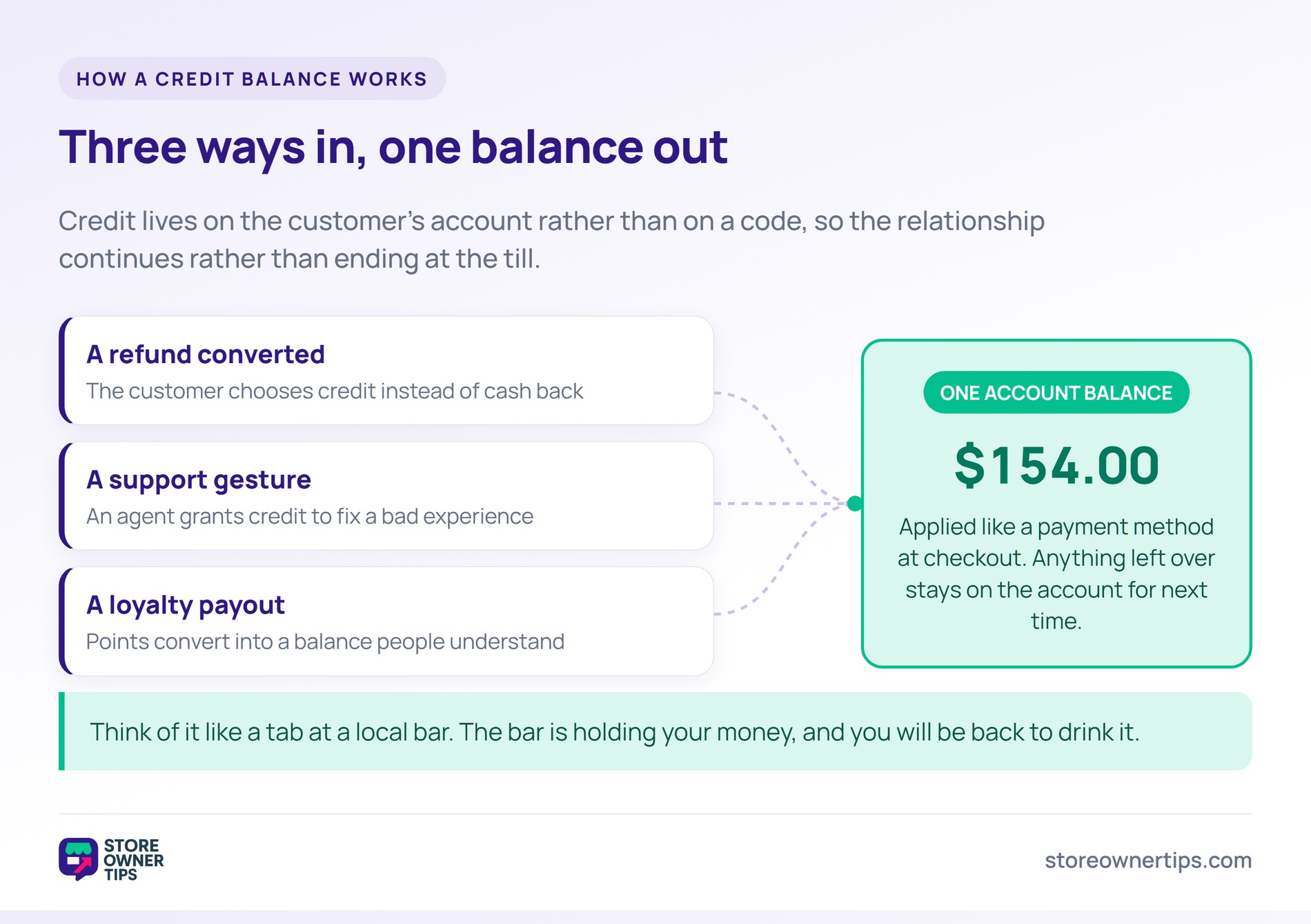
Store credit is a balance you attach to a customer’s account that they can spend with you later. Stores issue it instead of a cash refund, as a goodwill gesture, or as a reward. The money never leaves your business, so the customer comes back to use it.
So it turns a refund from a loss into a deferred sale.
Good returns management is one of the largest costs in retail, and most stores treat it as pure loss. However, a return is also a customer standing in front of you with money in hand. Store credit is the tool that keeps that money.
It is less a discount mechanic than a retention one.
A credit balance lives on the customer’s account rather than on a code. When they check out, the balance can be applied like a payment method. Anything left over stays on the account for next time.
Think of it like a tab at a local bar. The bar is holding your money, and you will be back to drink it. So the relationship continues rather than ending at the till.
Stores issue it from several places. A refund can be converted to credit, or a support agent can grant it. A loyalty scheme can also pay out in it. In practice, one balance handles all three.
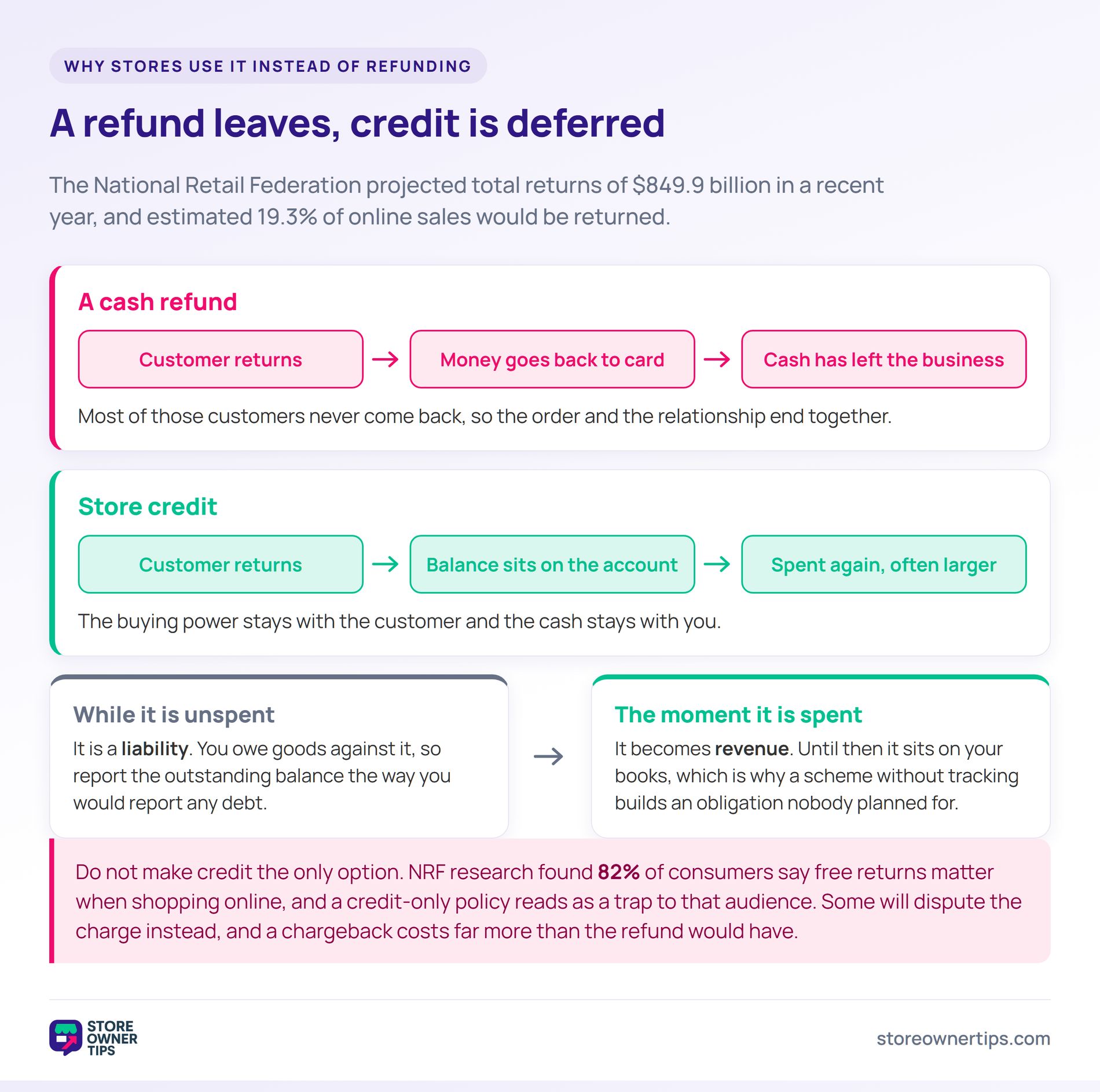
One accounting point matters. Issued credit is a liability, because you owe goods against it. Meanwhile, it only becomes revenue at the moment it is spent.
The returns bill is the reason. The National Retail Federation projected total returns of $849.9 billion for the retail industry in a recent year. Every one of those refunds is cash walking out.
Online stores feel it hardest. The same research estimated that 19.3% of online sales would be returned. So an e-commerce store is refunding roughly one order in five.
Converting even a slice of that to credit changes the arithmetic. The customer keeps their buying power, and you keep the cash. As a result, your refund rate still rises but the revenue impact softens.
There is a behavioral effect as well. Shoppers spending credit often add something on top rather than spending exactly the balance. So the returned order frequently becomes a larger second order.
The biggest mistake is making credit the only option. Shoppers care a great deal about how returns are handled. The same NRF research found 82% of consumers say free returns matter when shopping online.
A credit-only policy reads as a trap to that audience. Some will accept it grudgingly, and some will dispute the charge instead. Meanwhile, a chargeback costs far more than the refund would have.
Expiry is the second trap. Aggressive expiry dates make credit feel worthless and generate complaints. Consumer rules on expiry also vary by jurisdiction, so check before setting one.
Finally, do not forget the liability sitting on your books. A store that issues freely without tracking builds an obligation it has not planned for. So report outstanding credit the way you would report any debt.
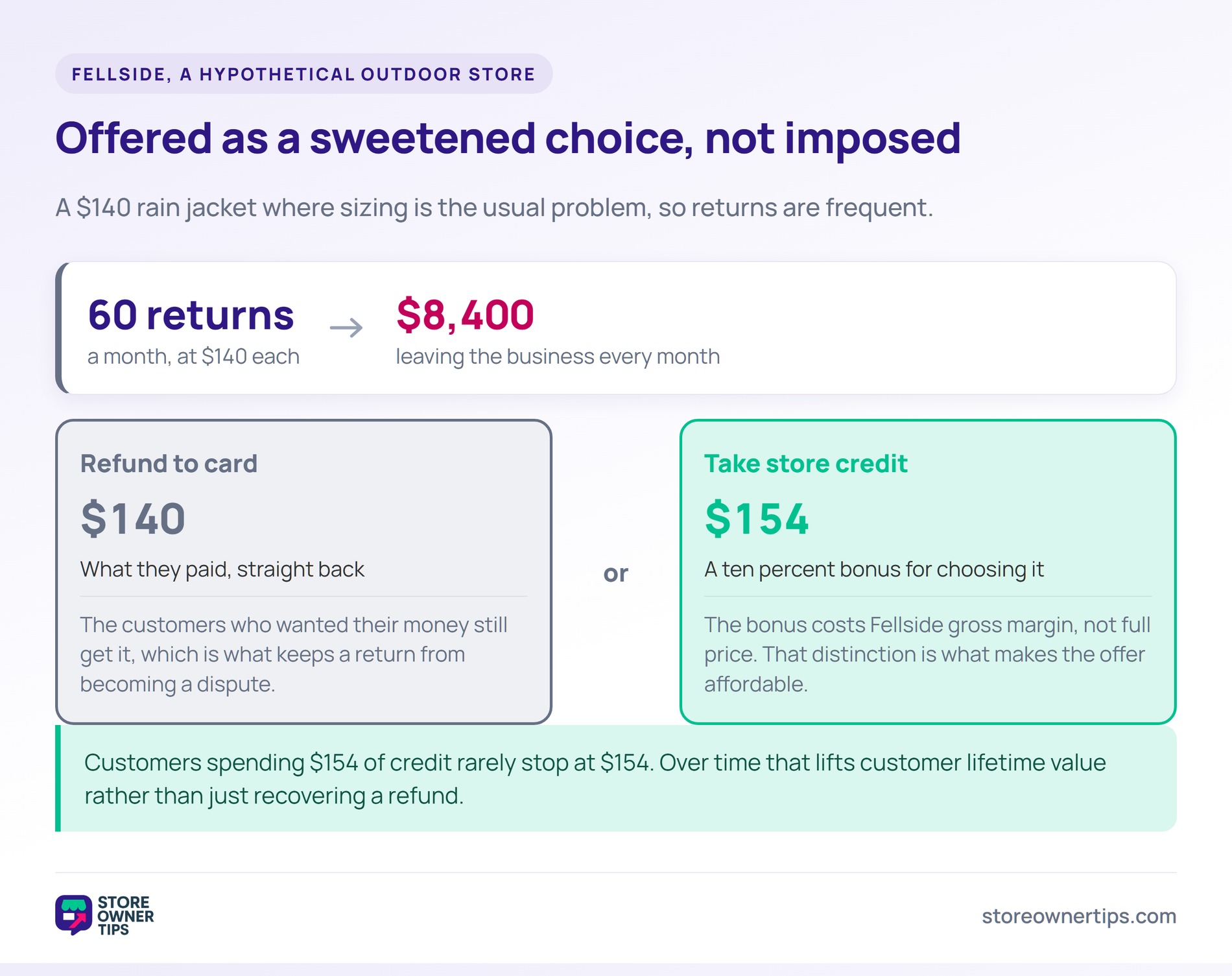
Imagine an outdoor clothing store called Fellside selling a $140 rain jacket. Sizing is the usual problem, so returns are frequent. Previously every return was refunded to card without a question.
Fellside processes about 60 jacket returns a month. At $140 each, that is $8,400 leaving the business monthly. All of it goes back to cards and most of those customers never return.
The owner adds store credit as an option rather than a replacement. At the returns step the customer picks a card refund or credit. Crucially, the credit option carries a ten percent bonus.
So a $140 return becomes either $140 back to card or $154 in credit. The bonus costs Fellside gross margin, not full price. That distinction is what makes the offer affordable.
A share of customers take the credit, mostly the ones who liked the jacket but needed another size. Those returns become exchanges in everything but name. Meanwhile, the cash never leaves.
The customers who wanted their money still get it. That matters, because forcing the choice would have converted some of them into disputes. So the option preserves goodwill instead of spending it.
Fellside also starts tracking outstanding credit as a liability. It reports the balance monthly alongside stock and payables. In practice, that stops the scheme quietly building an obligation nobody planned for.
The second-order effect is the interesting one. Customers spending $154 of credit rarely stop at $154. Over time, that lifts customer lifetime value rather than just recovering a refund.
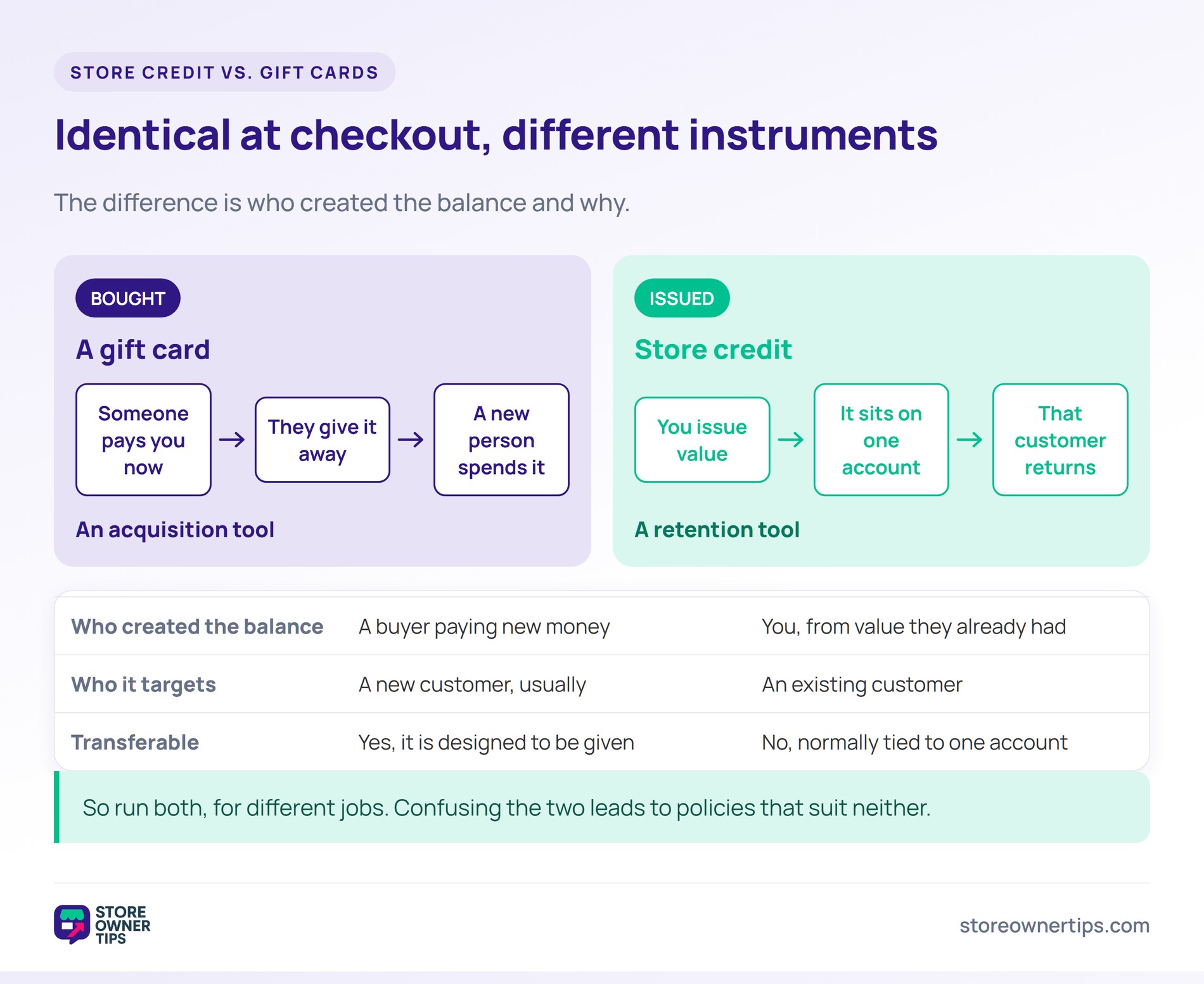
These two look identical at checkout and they are genuinely different instruments. The difference is who created the balance and why.
A gift card is bought. Someone pays you money now so that another person can spend it later. So a gift card is a sale, and it usually brings a new customer with it.
Store credit is issued. Nobody paid new money for it, because it represents value the customer already had. Meanwhile, it is aimed at an existing customer rather than a new one.
They also behave differently in practice. Gift cards are usually transferable and designed to be given away. By contrast, store credit is normally tied to one account and not transferable.
So run both, for different jobs. Gift cards are an acquisition tool, while store credit is a retention tool. Confusing the two leads to policies that suit neither.
Offer it, but rarely require it. Where a customer has a legal right to a refund, credit is not a substitute. So the safe pattern is to present both and make credit the more attractive one.
A bonus is the usual way to do that. Adding ten percent for choosing credit converts a good share of returns voluntarily. Meanwhile, nobody feels their money was withheld.
Be careful here, because expiry rules are regulated in many places. Even where it is permitted, short expiry generates complaints and rarely saves much. So a long window is usually the better trade.
If you do set one, communicate it clearly at the moment of issue. A balance that vanishes silently produces exactly the support ticket you were trying to avoid. In practice, a reminder email works better than an expiry date.
It pairs naturally with one, because credit is a clean way to pay out rewards. Points convert to a balance the customer already understands. So there is no second currency to explain.
That also makes the reward feel concrete. A loyalty program paying in vague points is easy to ignore. Meanwhile, a visible dollar balance tends to get spent.
Store credit turns refunds from money leaving the business into money waiting to be spent again. It works best offered as a sweetened choice rather than imposed as a policy.
Track the outstanding balance as the liability it is, and keep it distinct from gift cards. For a fuller comparison, see this guide to store credit versus gift cards.
Copyright © StoreOwnerTips.com. All Rights Reserved.
