Weekly ecommerce tips, deals & news.
Spam complaint rate is the share of your delivered emails that recipients report as spam. Somebody presses the report button rather than the unsubscribe link. That single action is the strongest negative signal in email.
Mailbox providers watch this number more closely than any other. So it is the metric that decides whether your email reaches inboxes at all. Open rates are a symptom, and this is a cause.
The spam complaint rate works as a running vote on whether your mail is wanted. Think of every send as an election with a very low tolerance for no votes. Three objections in a thousand is enough to lose.
The vote is counted per receiving provider, not across your whole list. So you can be fine at one provider and in trouble at another.
The spam complaint rate divides complaints by messages delivered, not by messages sent. Bounced mail never reached anybody, so it is excluded. Still, that distinction matters when a bad list inflates both numbers.
Complaints reach you through a feedback loop, which is a reporting channel providers offer senders. For example, Gmail exposes the figure in its own postmaster reporting. Meanwhile some providers report a rate without ever telling you which address complained.
Meanwhile your email platform surfaces the same data under abuse reporting. Still, the figure you should watch is the one the provider calculates. That is the number being used to judge you.
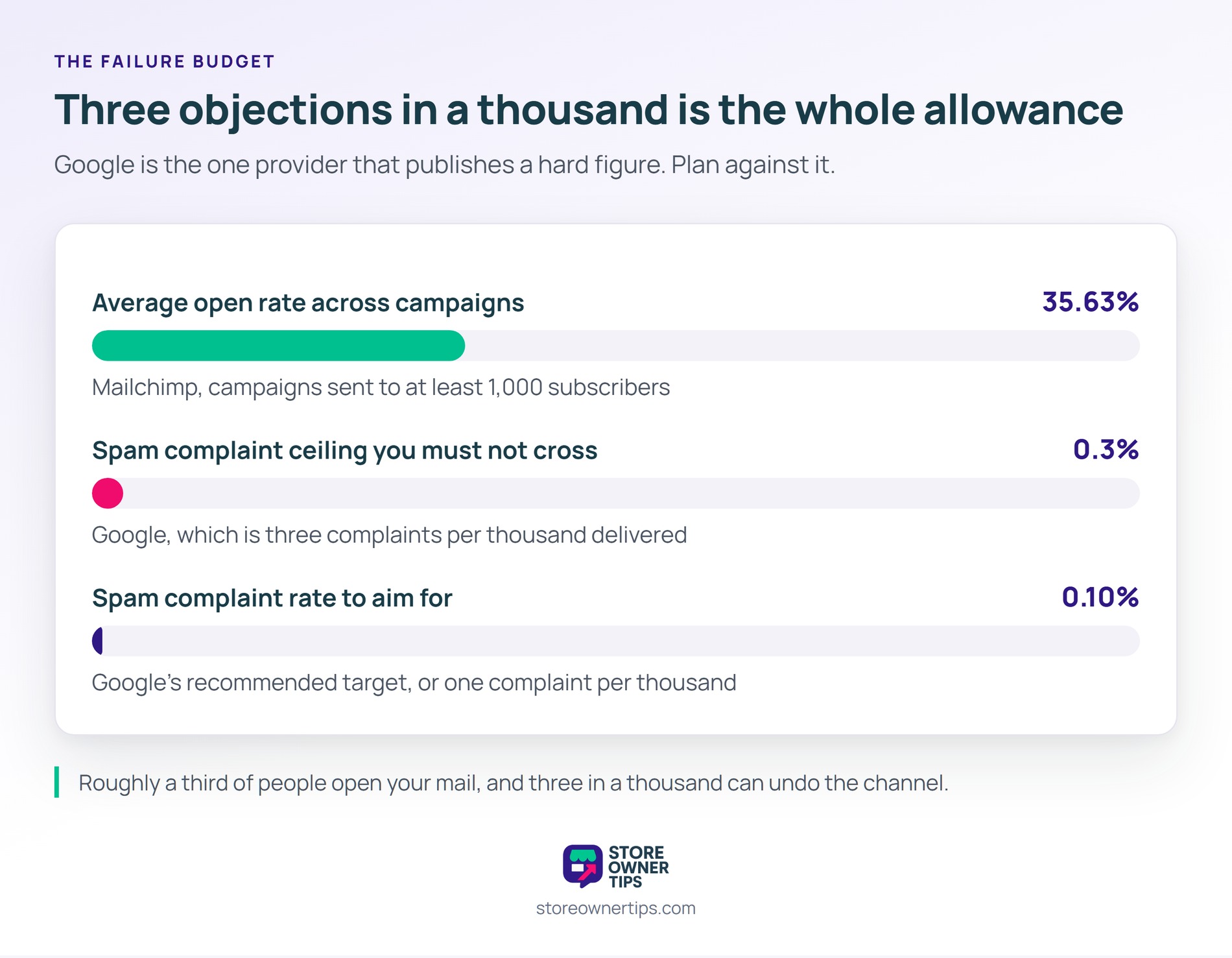
One provider states a hard figure and the rest stay deliberately vague. Google asks bulk senders to keep spam rates below 0.3%, and recommends aiming under 0.10%. So those two numbers are the closest thing to an industry standard.
Work the arithmetic and the tightness becomes obvious. For example, a 0.10% target means one complaint per thousand delivered emails. By contrast, the 0.3% ceiling means you have three.
Meanwhile other providers publish requirements without committing to a number. Yahoo’s own sender guidance explicitly declines to specify a volume threshold, and names no complaint figure either. So Google’s published rate is the one to plan against.
So treat the number as a ceiling rather than a target to approach. Sitting at 0.28% is not compliance, it is a warning.
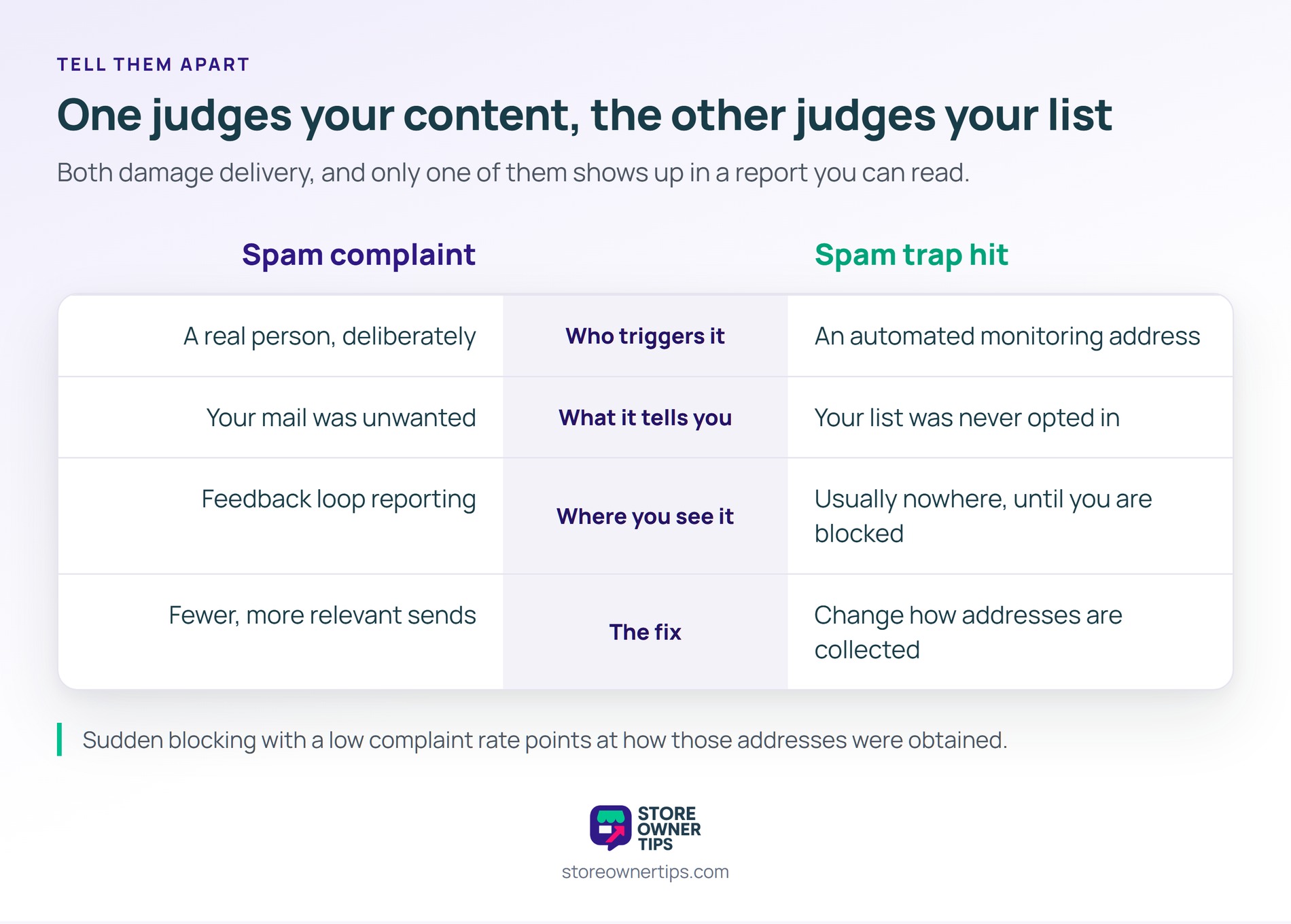
Complaints come from a mismatch between what someone expected and what arrived. First is the unrecognised sender, where the from-name means nothing to the reader. A brand name they signed up to beats a person they have never heard of.
Next is frequency. A weekly subscriber suddenly receiving daily mail reports it rather than reasoning about it. Meanwhile a long gap has the same effect, because a list mailed once a year feels like a stranger.
Then there is the hidden unsubscribe link. Somebody who cannot find the exit uses the spam button as one. That is the single most avoidable complaint you will ever receive.
Finally, bought and scraped lists produce complaints immediately. Nobody on them agreed to hear from you. A guide to re-engagement campaigns covers the polite way to re-permission a list you are unsure about.
The complaint threshold is unusually strict compared with every other email benchmark. Still, engagement figures give you the contrast. Mailchimp, measuring campaigns sent to at least 1,000 subscribers, reports an average open rate of 35.63%.
So roughly a third of people open your mail, and three in a thousand can undo the channel. As a result, that asymmetry is why this metric deserves attention. Nothing else in email marketing has a failure budget that small.
What is at stake is worth stating plainly too. Litmus puts email’s return at $36 for every dollar spent. A complaint rate you ignore puts that entire return at risk.
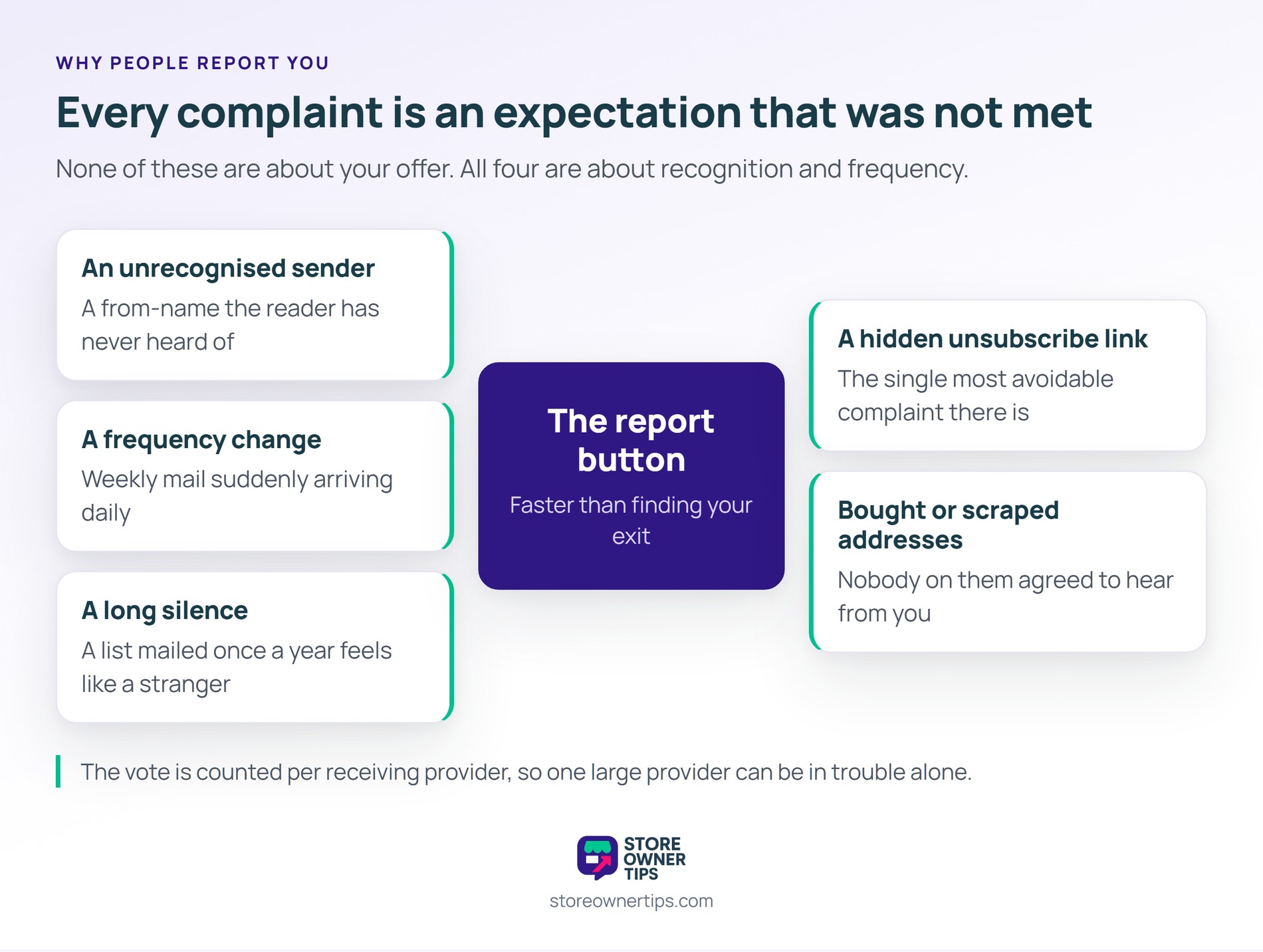
A rising complaint rate in practice looks like a campaign that simply stopped working. Here is a hypothetical example. Imagine a homeware store with 40,000 subscribers and a monthly newsletter.
In this scenario, the store decides to promote a clearance sale hard. Then monthly sending becomes three emails a week for a fortnight. The unsubscribe link sits in small grey text at the very bottom.
Nobody is watching complaint reporting, because nobody has looked at it before. The team judges each send on opens and revenue alone. In this scenario, the first two emails perform well.
By the fifth send the complaint rate has climbed past 0.3%. That is fewer than 120 people out of 40,000, which feels like nothing. Meanwhile it is enough to move the store into a different category of sender.
So the sixth and seventh emails land in far fewer inboxes. Then order confirmations start arriving late, because they share the same sending domain. As a result sender reputation damage spreads well beyond the campaign that caused it.
Meanwhile the team reads the collapse as sale fatigue. Still, the cause was three emails a week and a hard-to-find exit.
So the store makes leaving easy before it does anything else. First, the unsubscribe link moves up and gets normal-sized text. Next, a one-click list-unsubscribe header is enabled so mail clients can offer their own exit.
Then frequency drops back and segmentation takes over the heavy sending. Only people who opened something in the last 90 days receive the sale sequence. Meanwhile the complaint rate is added to the same report as opens and revenue.
Even so, recovery takes a few weeks of consistent, wanted sending. In short, the store treats the complaint rate as a limit to plan around. It is no longer a number discovered afterwards.
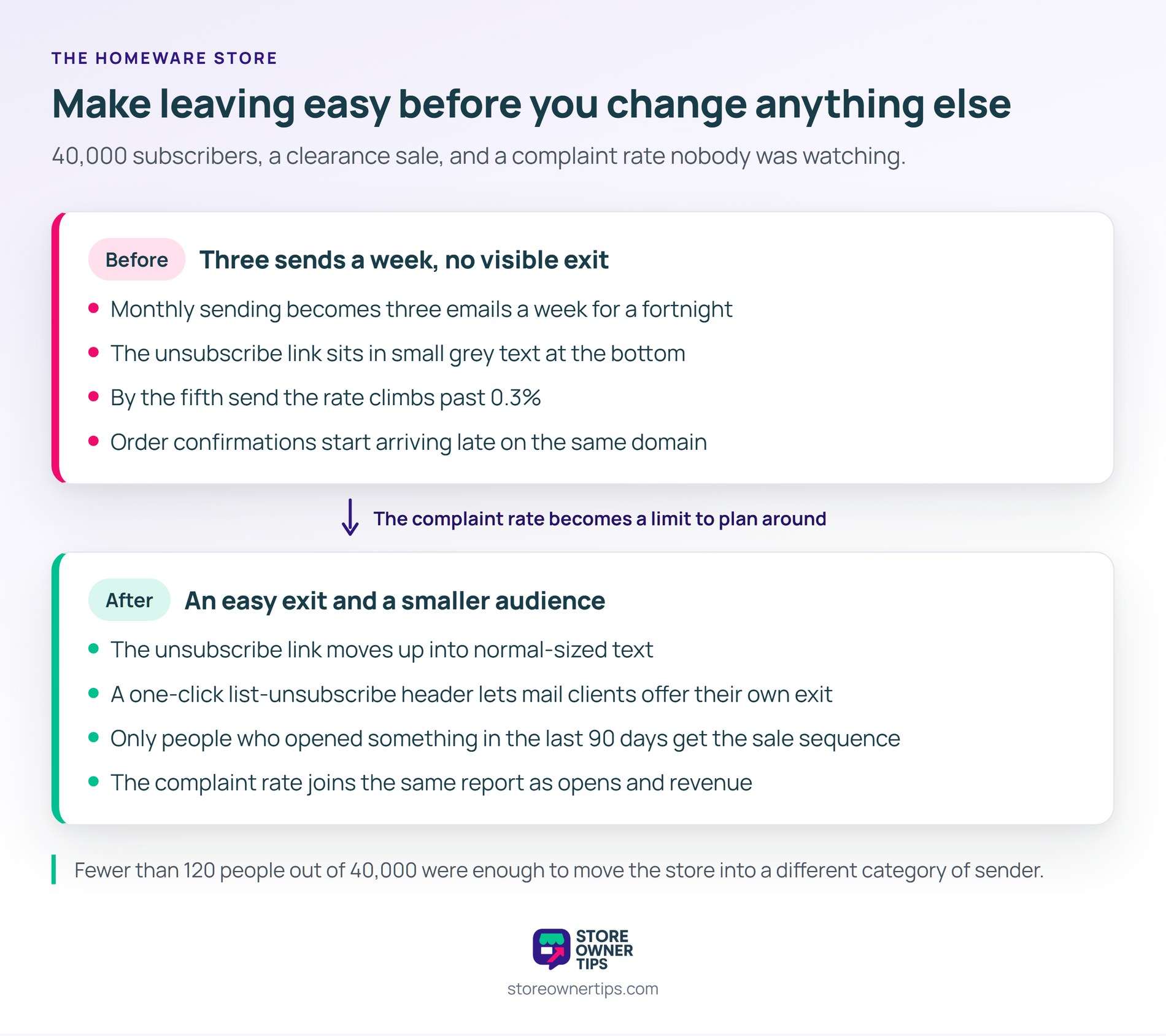
| What you are comparing | Spam complaint | Spam trap hit |
|---|---|---|
| Who triggers it | A real person, deliberately | An automated monitoring address |
| What it tells you | Your mail was unwanted | Your list was never opted in |
| Where you see it | Feedback loop reporting | Usually nowhere, until you are blocked |
| The fix | Fewer, more relevant sends | Change how addresses are collected |
A complaint is a human verdict on your content, while a trap hit is a verdict on your list building. Both damage delivery, and only one of them shows up in a report you can read.
So the pairing tells you where to look. A high complaint rate on a list you built yourself points at frequency and relevance. By contrast, sudden blocking with a low complaint rate points at how those addresses were obtained.
Under 0.10% is the figure to aim for, with 0.3% as the ceiling you must not cross. Google publishes both, and they are the clearest guidance available. Anything trending upward matters more than the absolute number.
Check it per receiving provider rather than as one blended average. A problem at one large provider can hide inside a healthy overall figure.
Mostly because they no longer recognise the sender or cannot find the exit. A signup from eighteen months ago is not a memory anybody keeps. So the report button becomes the fastest way to stop the mail.
Frequency changes cause the rest. Going from monthly to several times a week reads as a different relationship entirely.
Rarely, and you should not count on it. Some providers pass the complaining address back through a feedback loop, and others report only a rate. Gmail gives you the percentage without naming anybody.
Where an address is returned, suppress it immediately and permanently. Mailing somebody who has already reported you is the worst possible next move.
The spam complaint rate matters because it is the one email number a third party enforces against you. Every other metric is feedback, and this one is a limit. Plus the damage spreads to receipts and shipping notices that share your domain.
In short, make leaving easy so that nobody has to report you to make it stop.
Copyright © StoreOwnerTips.com. All Rights Reserved.
