Weekly ecommerce tips, deals & news.
Every November, WooCommerce store owners hit the same crunch. Traffic and orders climb, and there’s less time to fix anything that breaks. A Black Friday checklist turns that rush into a plan you can work through week by week.
Plus, the shoppers will be there. According to Adobe, US consumers spent $11.8 billion online on Black Friday 2025, up 9.1% year over year. At Cyber Monday’s peak, between 8 pm and 10 pm, they spent $16 million every minute.
Below, I’ll walk you through the key 2026 dates, a 12-week runway, and a five-part checklist. It covers your site, stock, offers, storefront, and marketing.
Jump to:
Black Friday falls on the Friday after US Thanksgiving, and it opens the holiday shopping season. In 2026, it lands on November 27, followed by Cyber Monday on November 30.
In fact, many shoppers plan their holiday budgets around this weekend. So it’s worth planning beyond a single day of deals.

Also, plenty of stores now spread their sales over a week or more. That eases traffic spikes and reaches shoppers who buy early or late. Here’s a simple way to plan your sale calendar:
| EVENT | 2026 DATES | STRATEGY |
|---|---|---|
| Early Black Friday | November 20 to 25 | Start offering small discounts or teaser deals. |
| Thanksgiving Day | November 26 | A big browsing day. In 2025, 61.6% of its online sales came through phones. Open your sale here for a head start. |
| Black Friday | November 27 | Your main sale day. Consider a flash sale with bigger discounts. |
| Small Business Saturday | November 28 | Keep the sale going, and remind shoppers what’s still on offer. |
| Cyber Monday | November 30 | Highlight online-only deals. |
| Cyber Week | November 26 to 30 | The five-day peak that Adobe measures. Plan it as one campaign, not five. |
You can also plan around later shopping events:
🔥 Hot Tip 1: Start preparing early. Ideally, follow the 12-week runway below, or start at least a month before your sale. Early planning gives you time to manage stock, shape your offers, and test your site before the rush.
🔥 Hot Tip 2: Pick the sale days that matter most to your store. Black Friday and Cyber Monday now span several days, but you don’t need to run all of them. After all, a strong offer on fewer days often beats a thin one spread across the week.

Black Friday is still one of the biggest opportunities of the year for online stores. Here’s what Adobe Analytics recorded across the 2025 holiday season:
The season also showed where shoppers are coming from:
In short, Black Friday is a chance to reach new customers, move more stock, and set up repeat sales. Loyalty programs and paid memberships can turn one weekend’s buyers into repeat orders.
Many Black Friday checklists hand you a pile of tasks with no order. As a result, it’s hard to know what to do first. Knowing you need a coupon plan doesn’t help if you build it the week of the sale.
So before the Black Friday checklist itself, here’s the sequence. Twelve weeks gives you time to fix what’s broken, build your offers, test them, and still reach the sale rested.
Overall, each phase has one job. Finish it before you move on, because later work depends on earlier work.
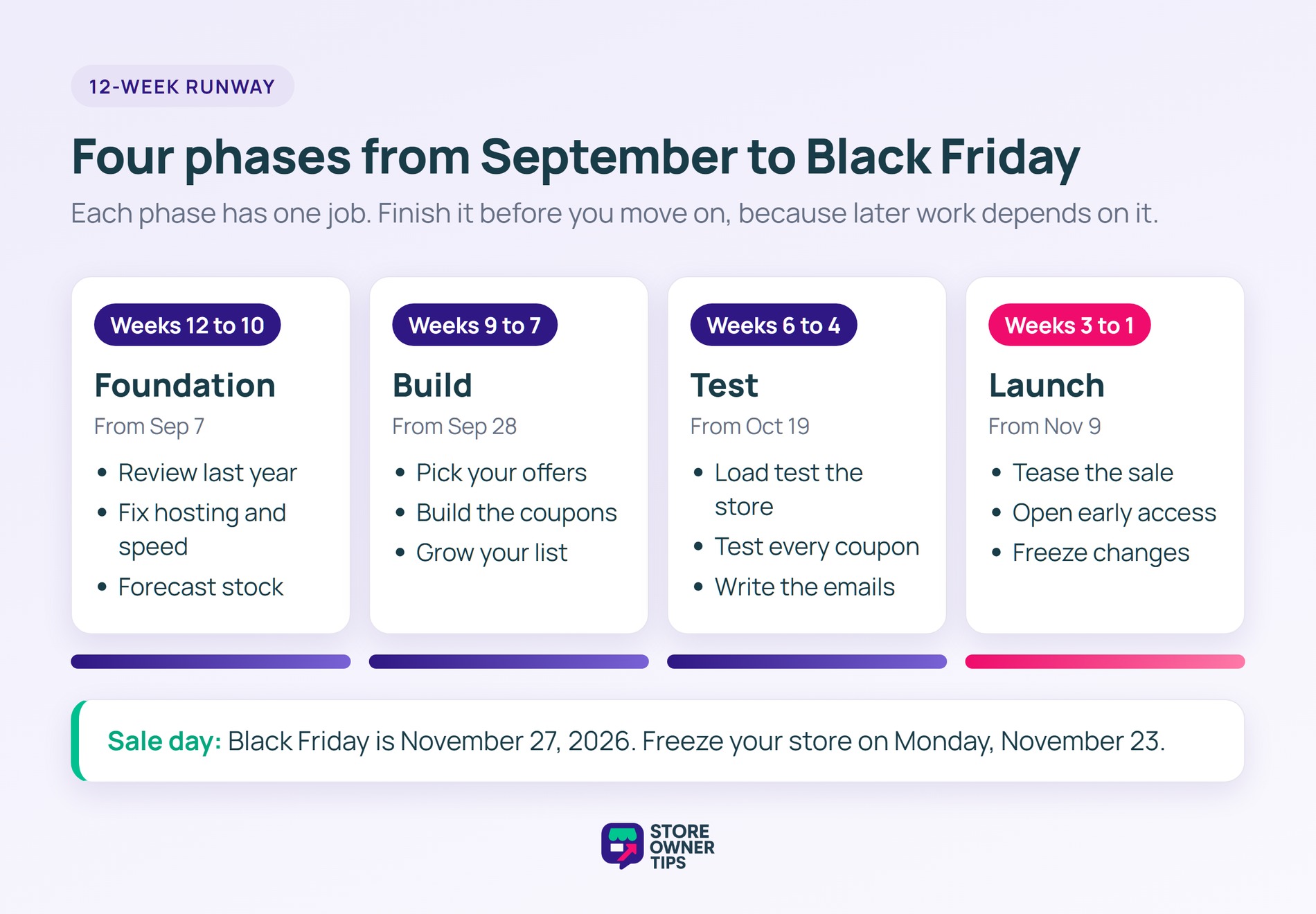
Black Friday 2026 lands on November 27, so the runway opens the week of September 7. The dates below run Monday to Sunday.
| WEEK | DATES | WHAT TO DO |
|---|---|---|
| 12 | Sep 7 to 13 | Pull last year’s sales, traffic and support data. Write down what broke and what sold out. |
| 11 | Sep 14 to 20 | Run speed tests on desktop and mobile. Ask your host about a temporary resource boost for November. |
| 10 | Sep 21 to 27 | Forecast stock product by product. Order anything with a long supplier lead time now. |
| 9 | Sep 28 to Oct 4 | Choose the products you will discount and set the depth. Check the margin before you commit. |
| 8 | Oct 5 to 11 | Build the coupons and cart conditions. Schedule the start and end times now, not later. |
| 7 | Oct 12 to 18 | Grow the list. Add wishlist and back-in-stock capture to your top products. |
| 6 | Oct 19 to 25 | Update your product feeds so ad channels carry the sale data before the auction heats up. |
| 5 | Oct 26 to Nov 1 | Load test the store. Place a real test order through every coupon and every payment method. |
| 4 | Nov 2 to 8 | Write and schedule the full email sequence. Design the banners, badges and social creative. |
| 3 | Nov 9 to 15 | Brief your support team. Update the FAQ, the shipping cutoffs and the returns policy for the season. |
| 2 | Nov 16 to 22 | Tease the sale. Send the deals-are-coming email to wishlist holders and subscribers first. |
| 1 | Nov 23 to 29 | Freeze changes on Monday. Open early access, launch on Friday, then watch stock and site speed hourly. |
🔥 Hot Tip 3: Freeze your store on the Monday of sale week. In other words, no new plugins, no theme edits, and no checkout tweaks. In our experience, a well-meant last-minute change can cause as much trouble as the traffic itself. If a fix can’t wait, take a backup first and test it on a staging copy.
Reading this after week 12 has passed? In that case, don’t start at the top. Start at the current week, then carry forward only the earlier tasks that block the ones ahead. Stock forecasting and coupon setup are the two that hold everything else up.
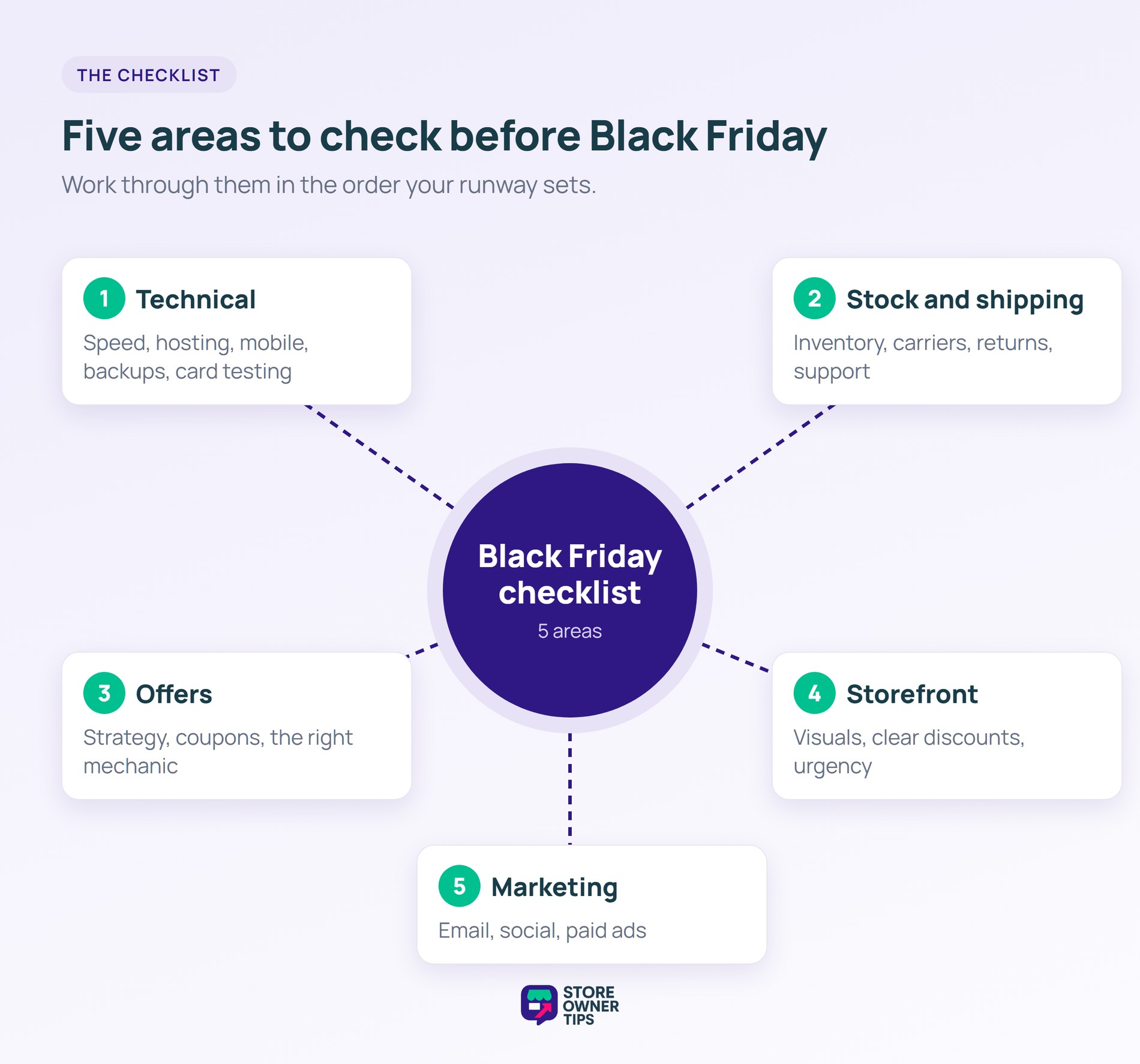
Here’s the Black Friday checklist itself, split into five areas of your store. Then work through them in the order your runway sets.
A slow or crashing store costs sales right when traffic peaks. These five checks cover the technical side of your Black Friday checklist.
Shoppers expect pages to load fast, and a few seconds of delay can make them leave.
Test your site at different times of day, on both desktop and mobile. For example, a page that feels fast on a laptop can lag on a phone. Google PageSpeed Insights shows what’s slowing each page down.
Then fix the common culprits. Compress your images, lazy load images below the fold, and remove plugins you don’t use. In addition, a lightweight theme and fewer heavy scripts help.
Caching also saves your server from rebuilding every page for every visitor. We recommend WP Rocket, a popular caching plugin for WordPress.

Your hosting plan sets how many visitors your store can serve at once. If it’s too small for November traffic, pages slow down or fail to load.
Ask your hosting provider about a temporary resource boost for the sale period. With managed WooCommerce hosting like Levamo, PHP workers and memory scale automatically during spikes, so you do not need to ask for a boost. Check their uptime record too, aiming for 99.9% or better. Cloud hosting can also scale resources up or down with demand.
A content delivery network (CDN), such as BunnyCDN, spreads the load further. It serves your images and files from servers close to each shopper.
Most holiday shoppers buy on their phones. Adobe found that 56.4% of online transactions in the 2025 holiday season happened on a smartphone. On Cyber Monday, in particular, phones drove 57.5% of online sales.
So test your store on a few real phones, not just a resized browser window. Make buttons easy to tap, and keep checkout short and simple.

Also, keep navigation short and fonts readable. Check that your product images resize without losing quality. Offering Apple Pay or Google Pay also saves shoppers from typing card details on a small screen.
Still, even well-prepared stores have bad days. A recent backup means you can recover quickly if something goes wrong.
Set automatic daily backups for the sale period, and store copies away from your server. Then test a restore, so you know it works before you need it.
Duplicator is one option. It schedules backups, stores them in the cloud, and restores your site if something breaks. In other words, think of it as insurance for your store.

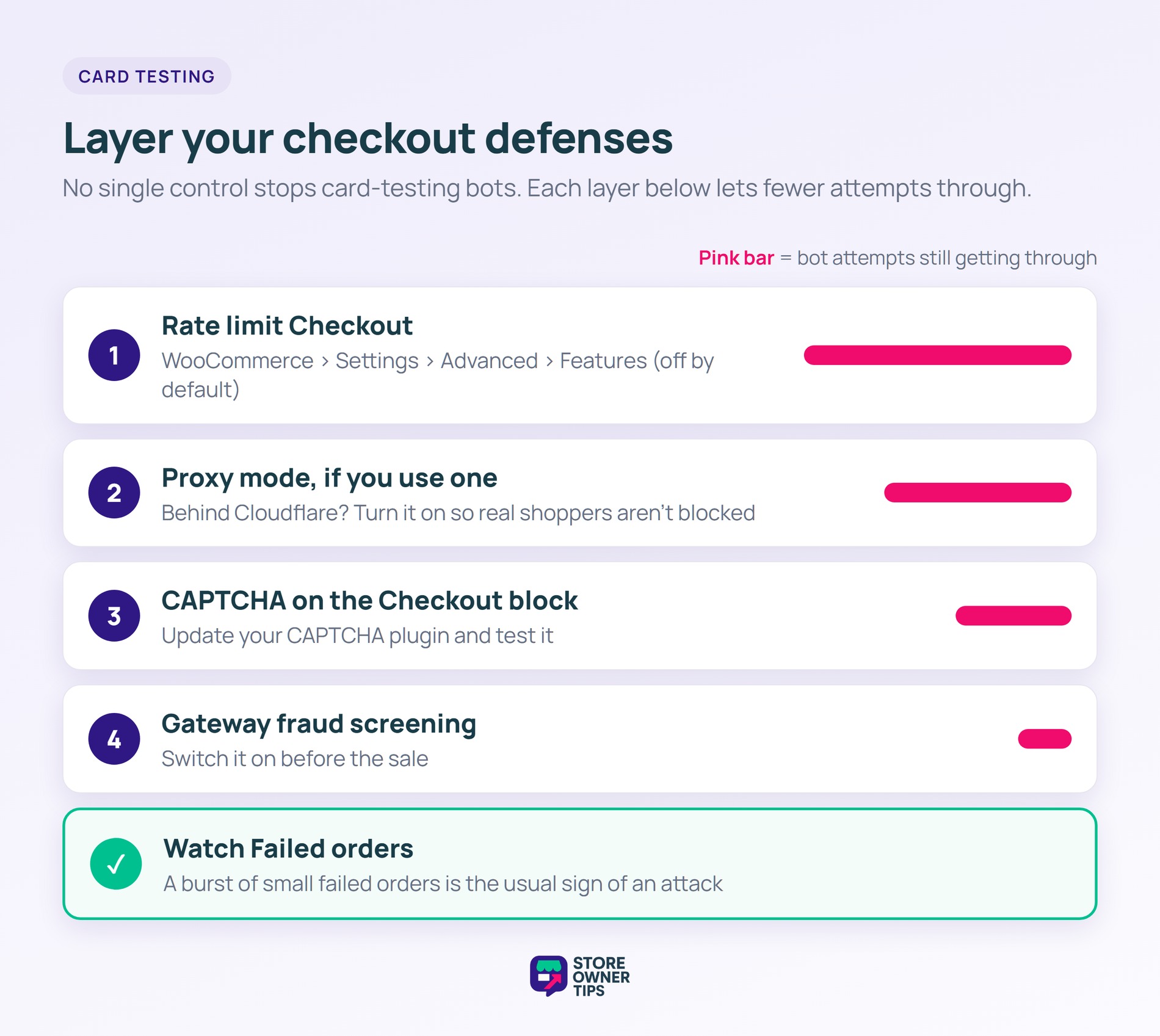
Card testing is when bots use stolen card numbers to place lots of small orders. They’re checking which cards still work. A busy sale week gives that traffic more room to hide, so set up protection before November.
During the sale, filter your Orders screen by Failed status now and then. A sudden run of small failed orders is the usual sign of an attack.
Running out of stock or missing a shipping cutoff during your busiest weekend costs sales and goodwill. So add stock, shipping, returns, and support to your Black Friday checklist before the rush.
Start with last year’s numbers. Which products sold out quickly, and which ones sat on the shelf? Then order more of the first group, and avoid overstocking the second.
WooCommerce can email you when an item drops below a set level. Turn on low stock notifications under WooCommerce > Settings > Products > Inventory. A tool like Stock Manager also lets you review and edit stock for all products on one screen.
If you sell on multiple sales channels, a tool like Zapier can help keep stock in sync between them.
It also helps to group products by demand: bestsellers, seasonal items, and slow movers. For example, if phone cases always outsell chargers, order more cases and line up a backup supplier.
Finally, place a test order to confirm stock updates correctly. After all, selling an item you don’t have is a quick way to lose a shopper’s trust.
Contact your carriers early to confirm pickup times, delivery estimates, and holiday cutoffs. Those dates set your last guaranteed delivery date before Christmas. Also, if you ship internationally, check customs timelines.
Compare rates between carriers like UPS, FedEx, DHL, and local couriers to balance speed and cost. Extensions such as WooCommerce Shipping or ShipStation can print labels from your dashboard. That saves time when order volume climbs.
Returns rise after the holidays, and a confusing process frustrates buyers. So review your return policy before the sale starts.
Break it into simple steps: how to request a return, how long shoppers have, and how refunds work. In addition, prepaid return labels make the process smoother.
Then mention your return policy on product pages and in order emails. From our experience, a clear and fair process can turn a disappointed buyer into a repeat customer.
Support requests climb with order volume, and most of them repeat. Write saved replies now for the questions you’ll get most:
Then make the answers easy to find without contacting you. Shoppers can check order status under My Account > Orders, so link to it in your confirmation email. Also post your holiday support hours and shipping cutoffs on your FAQ page.
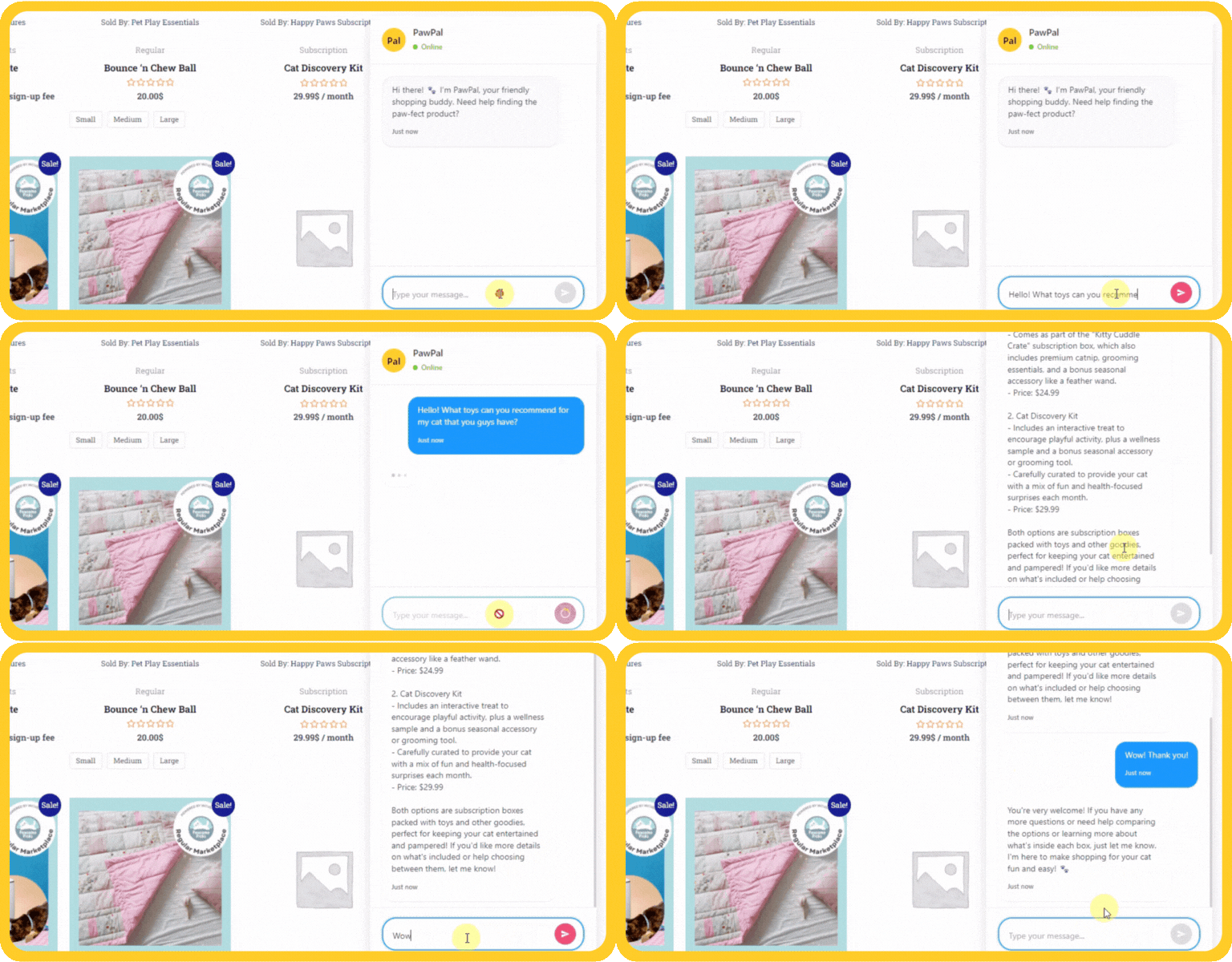
If order-status questions still pile up, an AI chatbot can take the repeat ones. StoreAgent is an AI chatbot and agent for WooCommerce. It has a free Lite plan, plus paid plans sized by how busy your store is.
Check your plan’s reply limit against your expected Black Friday traffic, since Lite credits don’t renew. StoreAgent also explains how to reduce support costs with AI.
Shoppers are hunting for deals, so clear, well-planned offers do much of the work. In this part of your Black Friday checklist, start with the strategy, then build the coupons that run it.
Decide which products to discount and by how much. Bestsellers and high-margin items are usually the safest choices, so check past sales first.
Shoppers also arrive with a number in their head, often set by what big retailers offered last year. These were the peak discounts Adobe recorded across the 2025 holiday season:
| CATEGORY | PEAK 2025 DISCOUNT |
|---|---|
| Electronics | 30.9% |
| Toys | 29.6% |
| Apparel | 25.1% |
| Televisions | 24.3% |
| Computers | 23.4% |
| Sporting goods | 20.3% |
| Appliances | 20.2% |
| Furniture | 18.8% |
Treat these as what shoppers expect, not as your target. That’s because a smaller store rarely wins a race to the deepest percentage. From what we’ve seen, bundles, free gifts, and tiered thresholds protect your margin better than another five points off.
Advanced Coupons can run bundle deals and tiered discounts that encourage bigger orders. For example, a “Buy two, get 15% off” deal or a BOGO deal can lift cart size. It can also move slower stock.

Build your coupons early, so you have time to test them. When you create each one, decide whether it’s a percentage, a fixed amount, or free shipping.
Also, keep your coupon codes short and easy to type. Then schedule them to start and end on their own. For example, a “FLASH” code can run for just a few hours.
Also decide which coupons can combine. WooCommerce’s “Individual use only” setting, under Usage restriction, stops a code from stacking with others. That prevents combinations that cut deeper than you planned.
Test every coupon with a real order before the sale. Once they’re live, track usage to see which codes perform best. A smooth coupon setup keeps checkout stress-free for shoppers.
In fact, Black Friday plans often fail in the build, not the idea. You might settle on a tiered discount in October, then find in November that your coupon screen can’t do tiers.
So pick the offer first, then confirm the mechanic exists before you promise it. Here’s how common Black Friday offers map to features in Advanced Coupons. Some, like auto-apply and auto-added free products, need Advanced Coupons Premium.
| THE OFFER | THE MECHANIC THAT RUNS IT | WHY IT MATTERS ON THE DAY |
|---|---|---|
| A flash sale that opens and closes on its own | Day and time coupon schedules | Nobody has to be awake at midnight to switch it on. |
| A sitewide discount with no code to type | Auto-apply with cart conditions | Shoppers don’t have to find or type a code. |
| Buy one, get one free | BOGO coupons | Moves slow stock without discounting your bestsellers. |
| Spend more, save more tiers | Cart conditions on the subtotal | Lifts average order value instead of cutting it. |
| A free gift over a threshold | Add a free product to the cart | Feels generous and costs you less than a percentage off. |
| Refunds you would rather keep in the store | Store credit | January returns come back as January orders. |
| A last-second add-on at checkout | One-click order bump | Extra revenue from traffic you already paid for. |
| A code that dies at midnight | Coupon expiration dates | Real deadlines create urgency that shoppers trust. |
Need offer ideas rather than mechanics? Advanced Coupons has creative Black Friday campaign ideas and Black Friday coupon code ideas. For the full menu, browse its rundown of 39 coupon types.
If you also sell to trade buyers, Wholesale Suite covers preparing for Black Friday as a wholesaler. It also has a B2B Black Friday toolkit. And if you run paid ads, check Google Shopping promotions before sale week.
Advanced Coupons extends the coupon screen WooCommerce already gives you. The free version covers BOGO deals for specific products, cart conditions, URL coupons, and start and end dates. Premium adds the rest of the features below.
Whichever features you use, test each coupon with a real order before sale week.

Your storefront should make your deals easy to spot. A quick refresh, the fourth part of your Black Friday checklist, helps shoppers find the offers and act on them.
Add Black Friday colors, banners, and graphics that fit your brand. Keep the layout simple, though, so shoppers notice the deals rather than the decorations.
However, you don’t need a designer for this. A tool like Canva has templates for sale banners and social graphics.

Similarly, clear product photos matter. From what we’ve seen, shots from several angles help shoppers buy with confidence. Lifestyle photos that show the product in use help even more.
Compress your images before you upload them, since large files slow your pages down. Faster pages also give shoppers fewer reasons for cart abandonment.
Don’t forget the login page, where returning customers land first. Custom Login for WooCommerce lets you put a Black Friday offer beside the login form.
Show prices before and after the discount, so shoppers see exactly what they save. WooCommerce does this for sale prices by default, with the regular price struck through.
Highlight your top deals on your homepage and category pages, so shoppers don’t have to search. Mark sale items the same way everywhere, with one style of badge or banner.
Tools like OptinMonster can add header bars, exit-intent popups, and countdown timers to your store. Then check it all on a phone. Discounts and timers should be just as clear on a small screen.
Limited-time offers and flash sales give shoppers a reason to act now. Schedule them in advance, so they start and end on their own.
For example, countdown timers show exactly how long a deal has left. You can use OptinMonster to add them to popups and header bars.

Similarly, low-stock messages like “only a few left” add urgency. Keep them accurate, though, because false scarcity costs shoppers’ trust.
Pair these signals with highlighted deals on product pages and category listings. Urgency works best when it reflects a real deadline or real stock levels.
However, your deals only work if shoppers see them. So the last part of your Black Friday checklist covers email, social, and ads.
Segment your list so each group gets a relevant offer. For example, send past buyers product recommendations, and give loyal customers early access.
Wishlist shoppers are an often-overlooked segment. That’s because a shopper who saved a product has told you what they want. So the products with the highest save counts are often the safest ones to discount. Email that group first, then send a price-drop alert when the sale opens.
Schedule your campaigns ahead of time in a platform like Mailchimp. And use WP Mail SMTP so your store’s own emails, like order confirmations, reliably reach inboxes.
Also, write subject lines and preview text that hint at the offer. Then add a reminder email as each deal nears its end.
Before you send, test every email: links, images, and coupon codes. Afterward, track opens, clicks, and orders to see what worked.

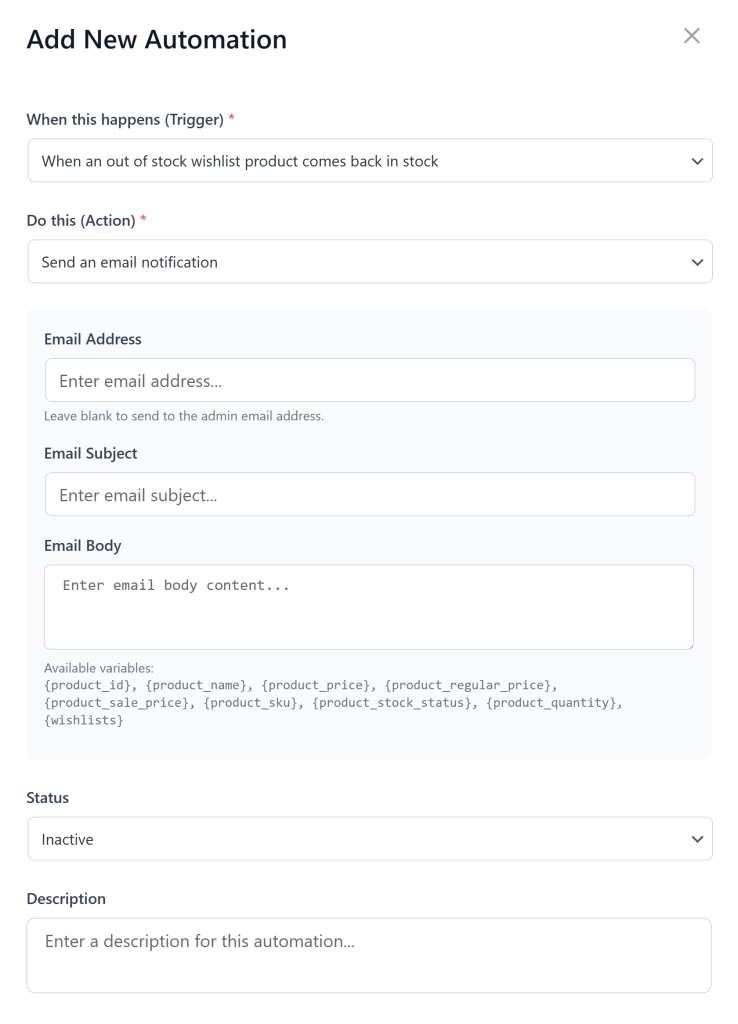
SaveTo Wishlist is a WooCommerce wishlist plugin with a free Lite version and three paid plans. Lite handles saving and sharing. SaveTo Wishlist Pro, included from the Growth plan up, adds the alerts and data your Black Friday emails can use.
One timing detail matters. The price-drop alert fires when you save the sale price, not when a scheduled sale starts. So apply sale prices on wishlisted products when the sale opens, or change them again at launch.
Update your profile images and banners with Black Friday visuals. Then plan themed posts for Facebook, Instagram, TikTok, and other platforms.
Schedule posts in advance, so your message stays consistent everywhere. In addition, mix images, short videos, and carousels to show your deals in different ways.
Give every post a clear call to action, like “Shop the sale” or “Use code BF20”. During the sale, reply to comments and messages quickly, since shoppers often ask about deals there first.
Afterward, check which posts got the most engagement. Those results are a head start on next year’s plan.

Paid ads reach shoppers who haven’t found your store yet. Platforms like Facebook, Instagram, and TikTok let you target people by interests, behavior, or past visits.
Whatever you spend, an ad is only as good as the data behind it. Sale prices, stock status, and shipping all travel through your product feed. So fix the feed before you raise the budget. AdTribes has a walkthrough on running a Black Friday sale in WooCommerce that covers it.
Also, keep ad messages short, and lead with the offer. Test a few variations on a small budget first, then move spend to the best performers.
Finally, retarget shoppers who clicked but didn’t buy. A reminder of the deal can bring them back before the sale ends.
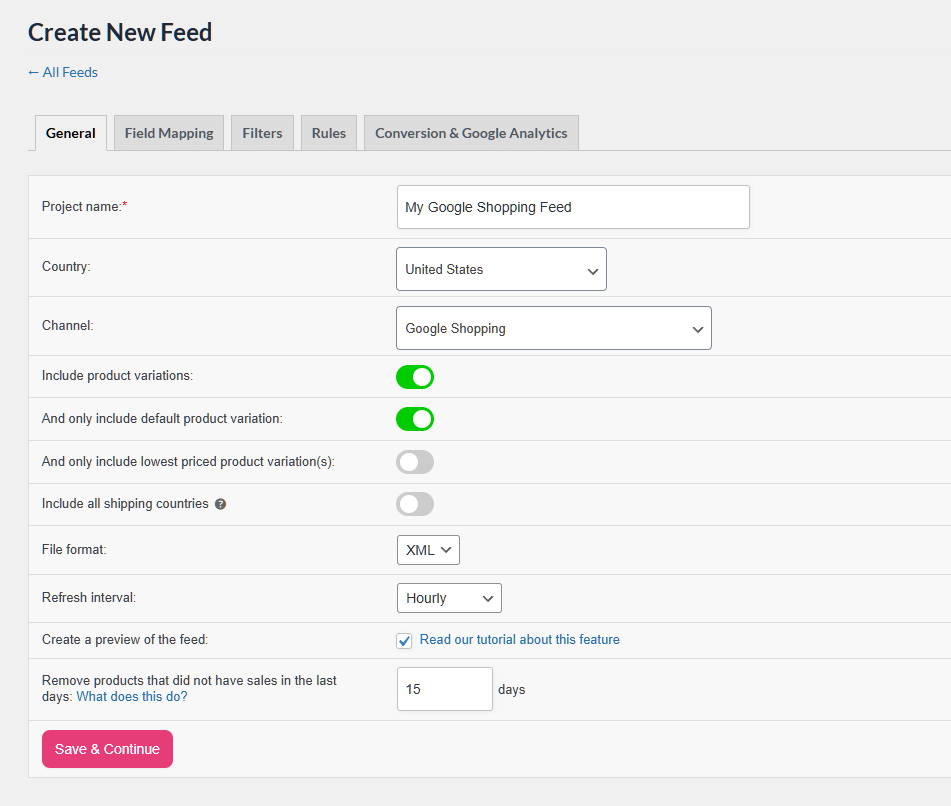
AdTribes builds product feeds from your WooCommerce catalog for Google Shopping, Meta, TikTok, and other channels. Its free plugin, Product Feed PRO, covers the basics of a Black Friday feed. The paid Product Feed Elite plans add custom refresh schedules and extra tools.
If you also use wishlist price-drop alerts, you’ll apply some sale prices on launch day. Keep the feed on an hourly refresh, then check Merchant Center that morning.
Black Friday is busy, but a Black Friday checklist keeps your store on track. Work through the runway, and most problems get fixed before shoppers ever see them.
Need offers to plug into this plan? Our Black Friday sale ideas guide has 11, plus the margin math. And when the weekend’s over, here’s what to do after Black Friday.
To recap, here’s your Black Friday checklist:
Use it to get ready for November 27, and check out our other Store Owner Tips for more ecommerce advice.
Focus on popular or high-margin products, then confirm the coupon mechanic exists before you promise the offer. Scheduled coupons, auto-apply discounts, BOGO deals, and spend-more-save-more tiers can all run without you touching the store. Then promote them on your site, in email, and in your product feeds.
Review last year’s sales data about ten weeks out, and order long lead-time products by late September. Turn on low stock notifications, and confirm holiday cutoffs with your carriers. Then publish a clear return policy before the sale opens.
Speed up your site on desktop and mobile, and ask your host about a temporary resource boost. Keep tested backups, and turn on checkout rate limiting to slow card-testing bots. Load test about four to five weeks out, then freeze changes on the Monday of sale week.
US shoppers spent $257.8 billion online across the 2025 holiday season, up 6.8%, according to Adobe. Cyber Week alone brought in $44.2 billion. And 25 separate days topped $4 billion in online sales, so the opportunity now runs for weeks.
Black Friday 2026 falls on Friday, November 27. Small Business Saturday is November 28, and Cyber Monday is November 30. Cyber Week runs from Thanksgiving on November 26 through Cyber Monday. Green Monday follows on December 14.
Twelve weeks is a comfortable runway, which means starting the week of September 7, 2026. That gives you three weeks each for data and fixes, building offers, testing, and launch. With less time, prioritize stock forecasting and coupon setup first.
Adobe recorded peak 2025 holiday discounts of 30.9% on electronics, 29.6% on toys, 25.1% on apparel, and 18.8% on furniture. Treat those as what shoppers expect, not a number you have to beat. Bundles, free gifts, and spend-more-save-more tiers usually protect your margin better.
It’s worth it. Adobe found traffic to retail sites from generative AI tools grew 693.4% across the 2025 season. So make sure your product pages state price, stock, shipping cutoffs, and returns in plain text. That’s what an AI assistant reads.

Copyright © StoreOwnerTips.com. All Rights Reserved.
