Weekly ecommerce tips, deals & news.
Bad debt is money a customer owes you that you have decided you will never collect. The invoice stops being an asset. It becomes an expense you write off your books.
So bad debt is a decision rather than an event. Nothing arrives to tell you an invoice has died. You choose the moment, and most stores choose it far too late.
Bad debt works by moving a number from one side of your books to the other. Think of an unpaid invoice as fruit in a bowl. It stays there looking like an asset long after it stopped being edible.
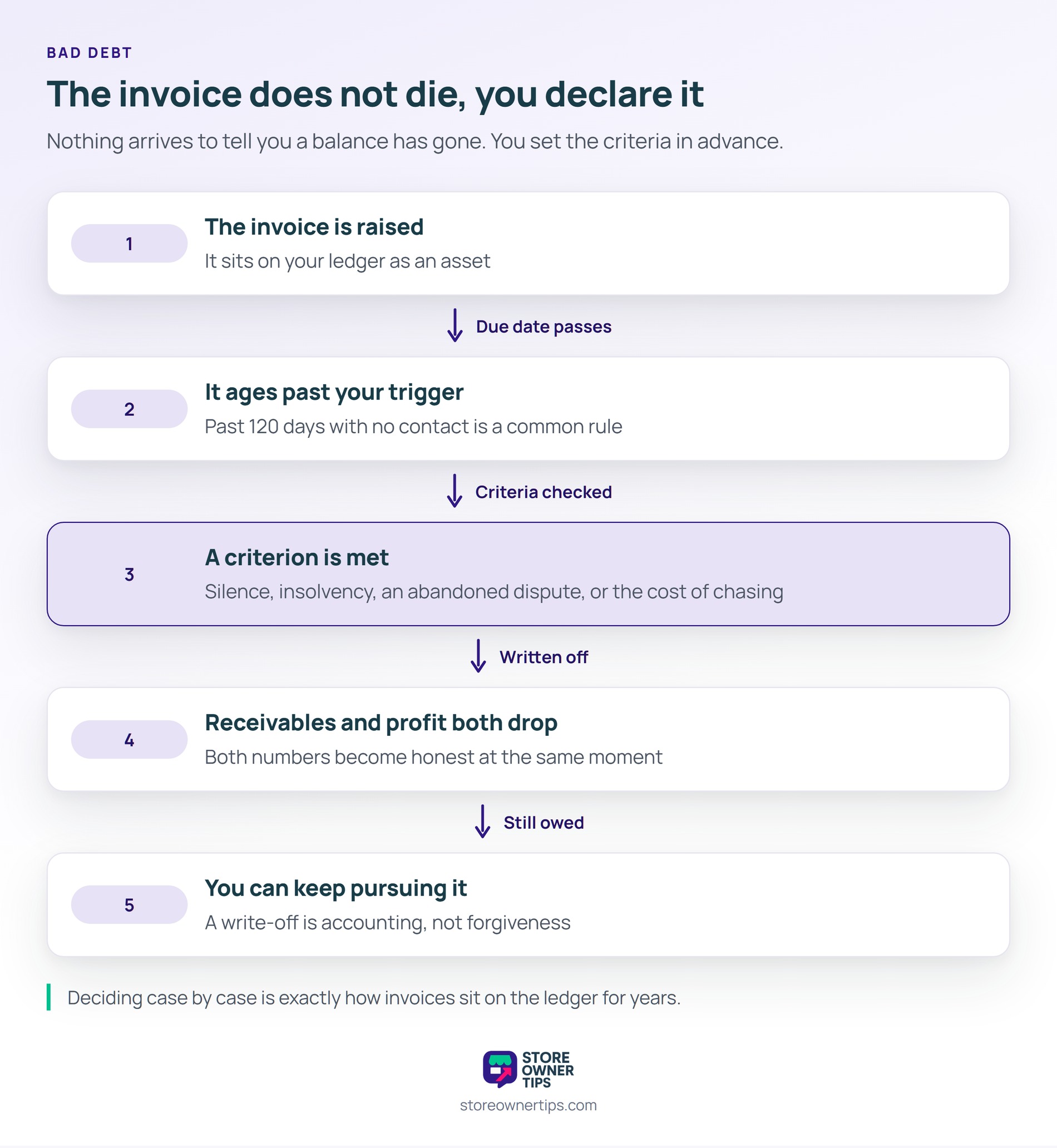
So somebody has to throw it out for the bowl to mean anything. That act is the write-off.
Bad debt starts with criteria you agree in advance, not with a feeling. First, an invoice where the buyer has stopped responding entirely is a candidate. In practice, silence across several months is the clearest signal.
Next comes insolvency, which is the unambiguous case. When a buyer enters a formal process, your invoice joins a queue you rarely reach the front of. Meanwhile a disputed invoice the buyer abandoned is the messier version.
Then there is the economic test, which store owners underuse. If chasing a balance costs more in time than the balance itself, it is already bad debt. In practice, that test alone clears a lot of small ancient invoices.
So write the rule down once and apply it to everybody. For example, an invoice past 120 days with no contact is a common trigger. Doing this per case is exactly how late payment quietly turns into a permanent hole.
A write-off removes the invoice from what you are owed and records the loss as an expense. Your receivables drop, and so does your reported profit. Both numbers become honest at the same moment.
That honesty is the entire point. A ledger stuffed with uncollectable invoices tells you that you can afford stock you cannot actually pay for. Meanwhile your gross margin looks better than the business is really achieving.
Meanwhile larger sellers do this in two stages rather than one. A provision sets aside an expected share of losses across the whole ledger before anyone knows which invoice fails. Then individual write-offs draw against that provision as they happen.
Tax treatment varies by country and by accounting basis, so this is a conversation to have once with your accountant. Agree the rule, then stop revisiting it.
Writing a debt off does not extinguish it, and that surprises people. The buyer still owes the money, and you may still recover some. What changes is that you have stopped counting on it.
So a collections agency is the usual next step for balances worth pursuing. They typically work on a share of what they recover, so the cost scales with success. Meanwhile legal action makes sense only well above a value you should decide in advance.
Still, recovery is partial at best, and planning on a full return is a mistake. Even so, an unexpected payment against a written-off invoice is a pleasant accounting entry rather than an awkward one.
By contrast, the more valuable work happens earlier. Screening an applicant properly, and setting a sensible credit limit, prevents far more than collections recovers. Practical steps for setting up a WooCommerce trade account cover the checks worth making first.
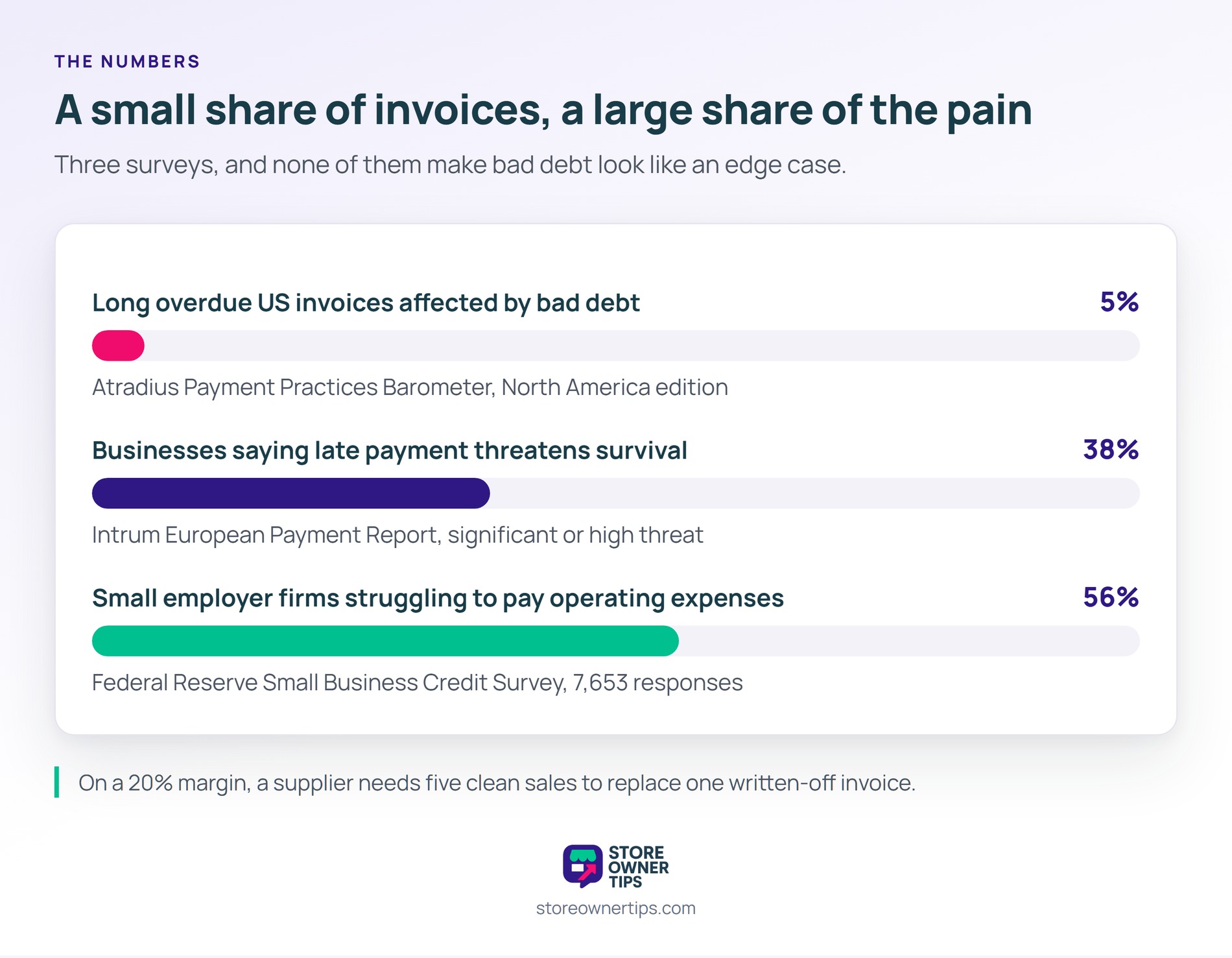
Bad debt is a small share of invoices and a large share of the pain. The Atradius Payment Practices Barometer surveys business-to-business suppliers each year. Its North America edition reports bad debts affecting 5% of long overdue invoices in the United States.
Five percent sounds survivable until you apply it to your own margin. For example, a supplier on a 20% margin needs five clean sales to replace one. So a handful of failures can consume the profit on a whole quarter.
Meanwhile the wider pressure is measurable too. The Federal Reserve’s Small Business Credit Survey drew 7,653 responses from small employer firms. Among them, 56% of firms named paying operating expenses as a challenge.
For some suppliers it becomes existential. In Intrum’s European Payment Report, 38% of businesses said late payments pose a significant or high threat to their survival.
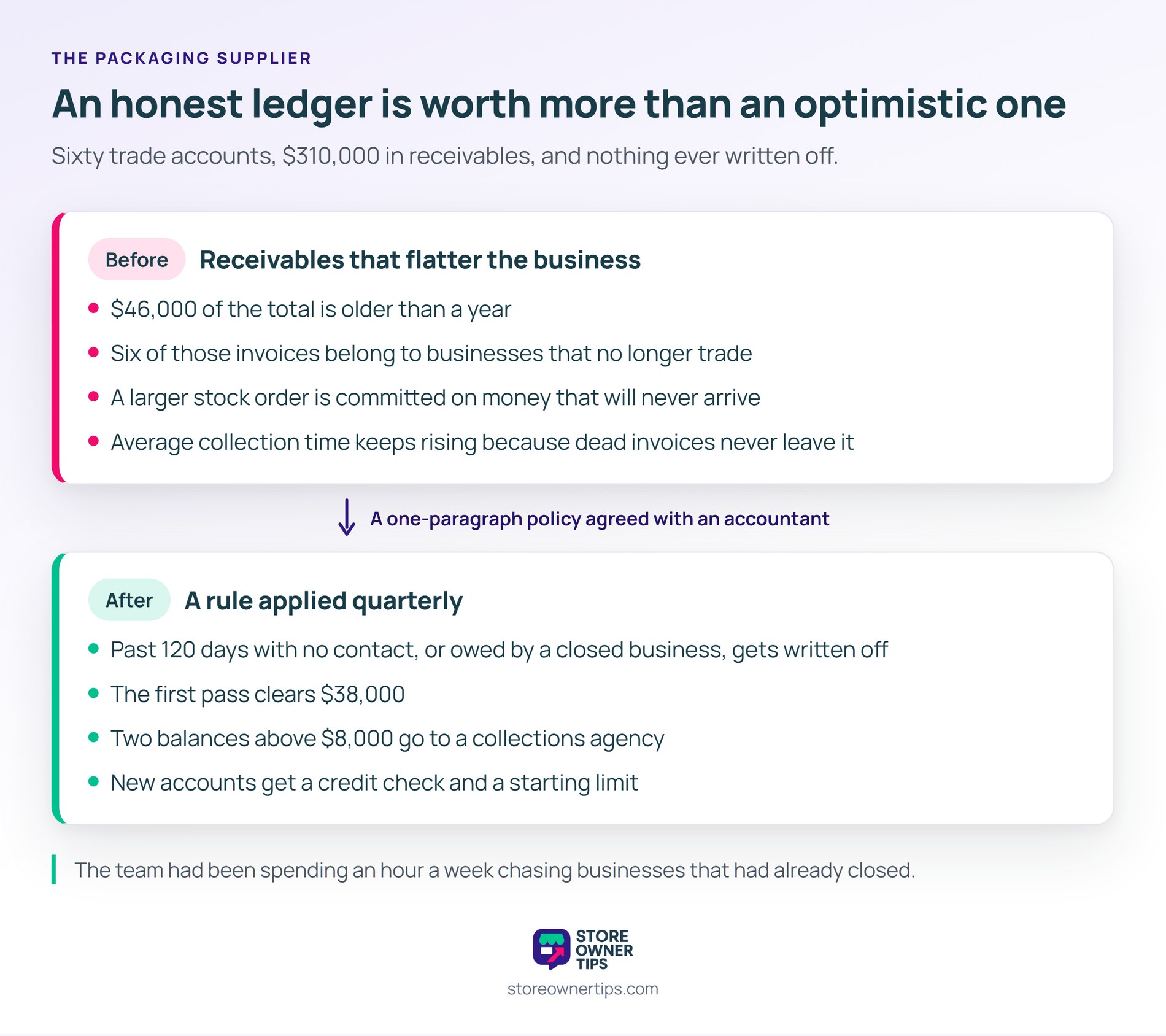
Bad debt in practice hides as an unusually healthy receivables figure. Here is a hypothetical example. Picture a supplier of packaging materials with 60 trade accounts.
In this scenario, the supplier carries $310,000 in receivables and feels comfortable. Nothing has ever been written off, because writing things off feels like admitting defeat. Invoices simply stay on the ledger.
Then, among that total, $46,000 turns out to be older than a year. Six of those invoices belong to businesses that no longer trade. In this scenario, two more are disputes nobody has touched in eight months.
As a result, the inflated receivables figure drives a bad decision. The supplier commits to a larger stock order on the strength of money it will never see. Then the shortfall shows up as a cash squeeze three months later.
Meanwhile reporting makes it worse rather than clearer. Average collection time keeps rising because dead invoices never leave the calculation. As a result nobody can tell whether the genuinely active accounts are paying well or badly.
Meanwhile the team still spends an hour a week chasing the closed businesses. Still, nobody has authority to stop, because there is no rule to point at.
So the supplier writes a one-paragraph policy with its accountant. Anything past 120 days with no contact, or owed by a closed business, gets written off quarterly. That clears $38,000 in the first pass.
Next, two balances above $8,000 go to a collections agency instead. One recovers about half, and the other recovers nothing at all. Even so, both are already out of the receivables figure.
Finally, new accounts get a credit check and a starting limit. In short, the ledger shrinks and the reporting starts telling the truth. Stock decisions stop being made on money that does not exist.
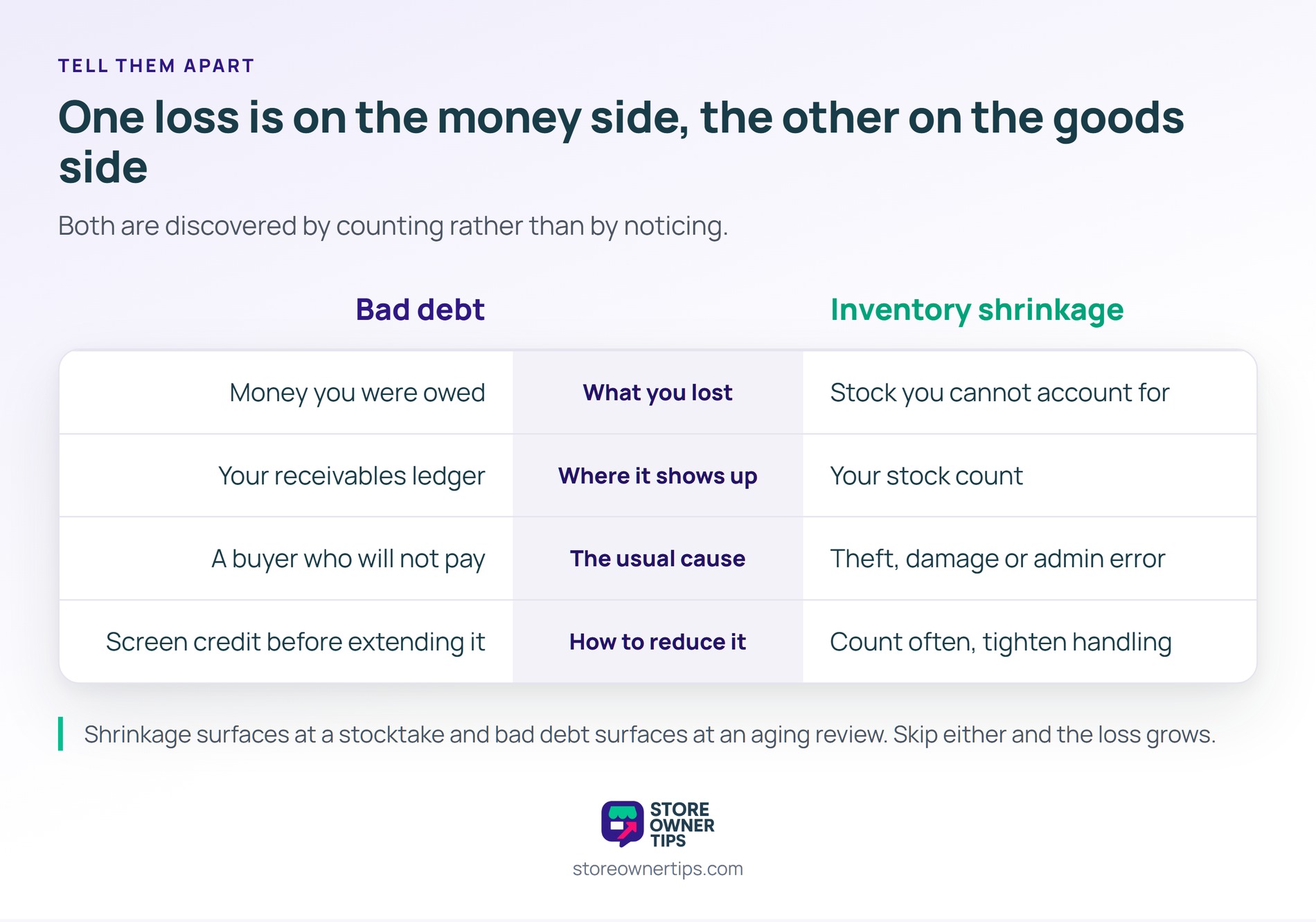
| What you are comparing | Bad debt | Inventory shrinkage |
|---|---|---|
| What you lost | Money you were owed | Stock you cannot account for |
| Where it shows up | Your receivables ledger | Your stock count |
| The usual cause | A buyer who will not pay | Theft, damage or admin error |
| How to reduce it | Screen credit before extending it | Count often, tighten handling |
Bad debt and shrinkage are the two losses that never appear as a sale going wrong. One is on the money side of the business and the other is on the goods side.
They share a nasty property, which is that both are discovered by counting rather than by noticing. Inventory shrinkage surfaces at a stocktake, and bad debt surfaces at an aging review. Skip either exercise and the loss simply keeps growing.
Set a rule rather than judging each case. Past 120 days with no contact, or owed by a business that has closed, covers most situations. Add an economic test for small balances that cost more to chase than they are worth.
Then run the exercise on a schedule, quarterly for most sellers. Agree the treatment with your accountant once so the timing is not a fresh debate each time.
No, and this is the most common misunderstanding. A write-off is an accounting decision about what you count as an asset. The buyer still owes the money.
You can hand it to a collections agency or pursue it legally afterwards. Any recovery is then recorded as income rather than reducing your receivables.
Do the work at account opening, because that is where the exposure is created. A credit check, trade references and a modest starting limit filter most of the risk. Raise the limit as an account proves itself.
Then enforce a credit hold consistently once a balance ages. Concentration matters too, so watch how much of your ledger sits with one buyer.
Bad debt matters because an invoice you refuse to write off keeps making decisions for you. It inflates what you think you can afford and distorts every collection metric you own. Plus the fix is a written rule rather than a difficult conversation.
In short, an honest ledger is worth more than an optimistic one.
Copyright © StoreOwnerTips.com. All Rights Reserved.
