Weekly ecommerce tips, deals & news.
A cash flow gap is the stretch of time between paying for your stock and getting paid by your customers. During that window, your money is tied up in products and unpaid invoices. Wholesale stores feel it most, because trade buyers often pay 30, 60 or 90 days after delivery.
A cash flow gap works like a relay race. Your money has to run three legs before it comes home.
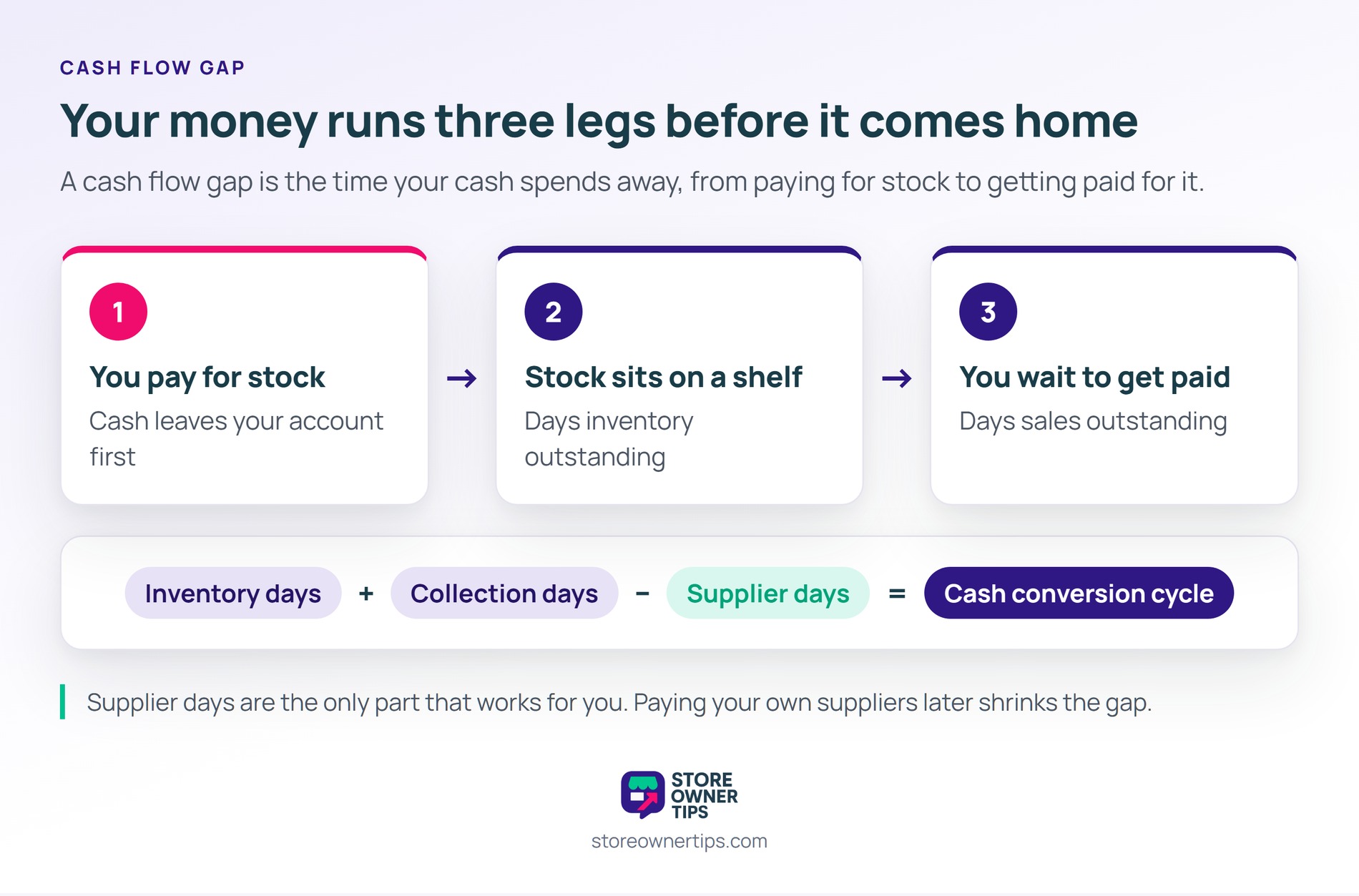
First, you pay for stock. Next, that stock sits on a shelf until it sells. Finally, you wait for the customer to pay the invoice.
Accountants measure a cash flow gap with the cash conversion cycle. It adds two waiting periods and subtracts one helper:
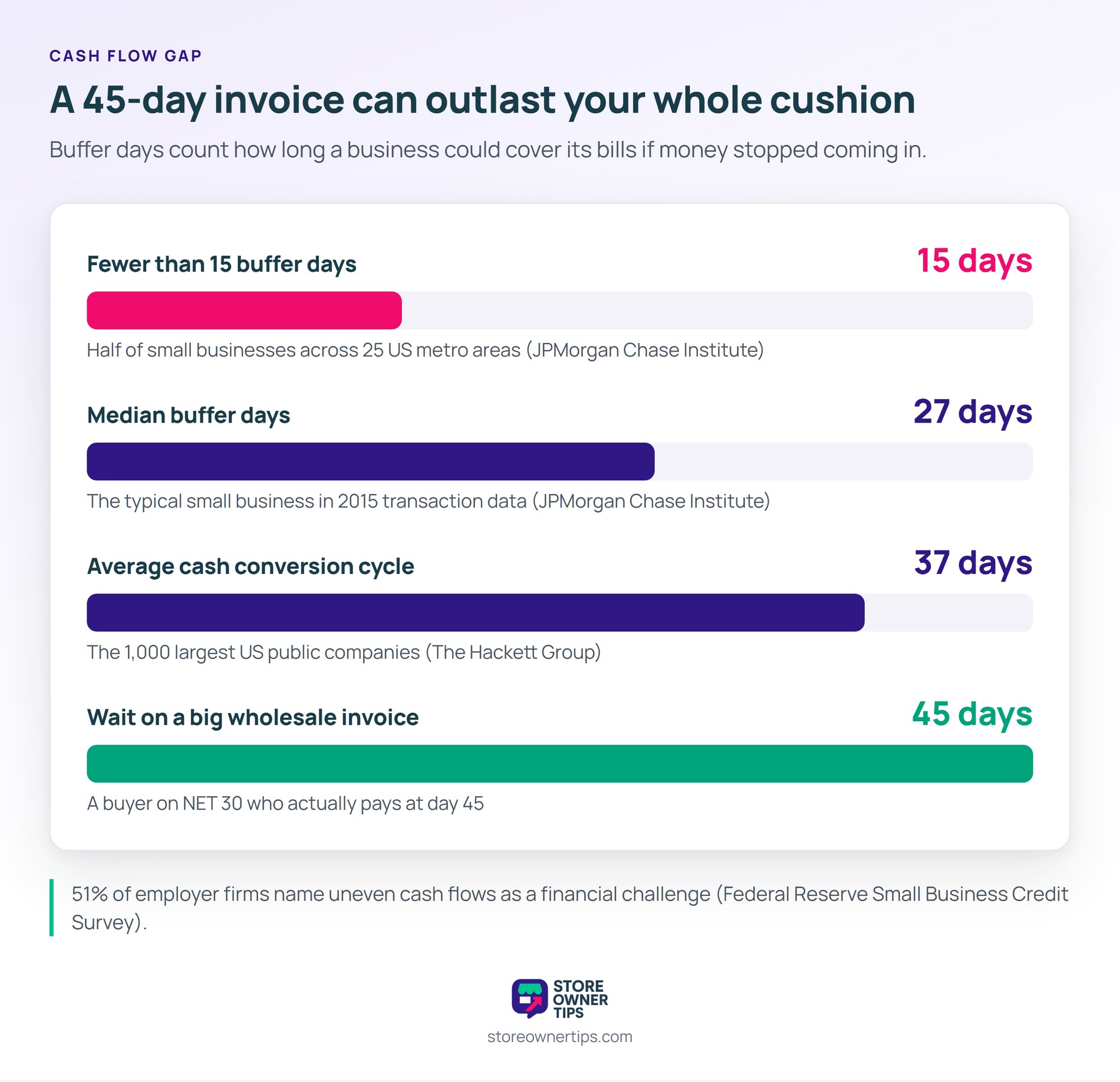
So the formula is inventory days plus collection days, minus supplier days. A result of 60 means your cash is gone for about two months on every sale. Even the biggest companies live with this. Across the 1,000 largest US public companies, the cycle averaged 37 days in The Hackett Group’s working capital research.
A cash flow gap hits wholesale sellers harder than retail stores. A retail shopper pays by card at checkout, so the money lands in days. A trade buyer usually expects net terms, which means paying 30 or more days after the invoice.
Wholesale orders are also bigger. One café chain might order a month of stock at once. That’s great for revenue, but you fund the whole order before you see a cent.
Then there’s the paperwork. Many B2B sellers still email invoices by hand and chase payments one by one. As a result, a few slow payers can quietly add weeks to the gap.
A growing cash flow gap usually shows up in your bank account before your reports. Watch for these early signals:
Paying suppliers late is the riskiest of these. It can cost you early-payment discounts and strain a relationship you depend on.
WooCommerce has no built-in payment terms, so stores add them with a plugin. Wholesale Suite’s Wholesale Payments plugin adds NET 30, 60 and 90 terms, plus custom plans. Here’s what it lets you set up:
Think of it as swapping a shoebox of paper invoices for an automatic bill collector. Buyers still get their terms. However, you stop relying on memory to chase every payment.
Cash flow gaps are one of the most common money problems for small businesses. In the Federal Reserve’s Small Business Credit Survey, 51% of employer firms named uneven cash flows as a financial challenge.
Most small businesses also have a thin safety net. The JPMorgan Chase Institute found the median small business held 27 cash buffer days in its 2015 transaction data. Buffer days count how long a business could cover its bills if money stopped coming in.
Later research from the same institute looked at 25 US metro areas. There, 50 percent of small businesses had fewer than 15 cash buffer days. So a 45-day wait on a big invoice can outlast many stores’ entire cushion.
A cash flow gap is easiest to see in a single store’s numbers. Here’s a hypothetical example. Imagine a small coffee roaster that sells beans to cafés through a WooCommerce wholesale store.
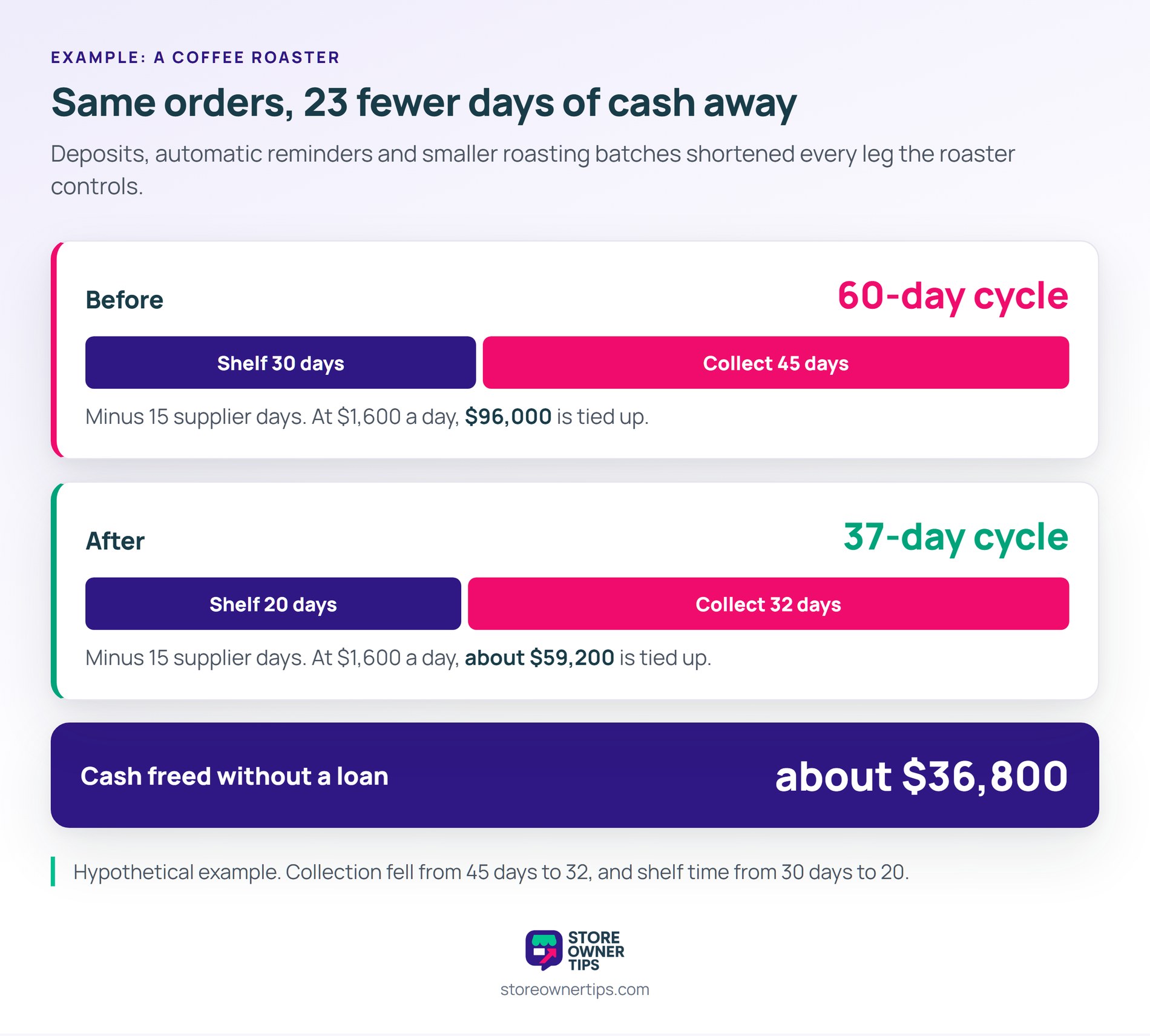
The roaster pays its green bean importer within 15 days. Roasted stock sits for about 30 days before it ships. Cafés are on NET 30, but in practice they pay after 45 days on average.
That gives a cash conversion cycle of 30 plus 45, minus 15. The answer is 60 days. The roaster spends about $800 a day on beans, roasting and packaging. Over 60 days, roughly $48,000 is locked up at any moment.
Then a regional café chain signs on, and orders double. That sounds like a win. However, daily costs jump to $1,600, so the cash tied up climbs to about $96,000.
The roaster is more profitable than ever on paper. Still, it can’t pay the importer on time without dipping into a credit card. This is the classic growth trap of a cash flow gap.
The owner makes three changes. New large orders need a 50% deposit, with the balance on NET 30. Invoices now go out automatically, with reminders before and after the due date.
Average collection time drops from 45 days to 32. The owner also roasts in smaller batches, cutting shelf time from 30 days to 20. The new cycle is 20 plus 32, minus 15, which equals 37 days.
At $1,600 a day, the cash tied up falls from $96,000 to about $59,200. That frees roughly $36,800 without a loan. Plus, the deposits cover half the bean cost on big orders before roasting starts.
You shrink a cash flow gap by collecting sooner, holding less stock, or paying suppliers later. Most stores get the biggest win from the collection side. These steps work well together:
Track the cycle every month. If collection days creep up, act early, before a late payment turns into a cash crunch.
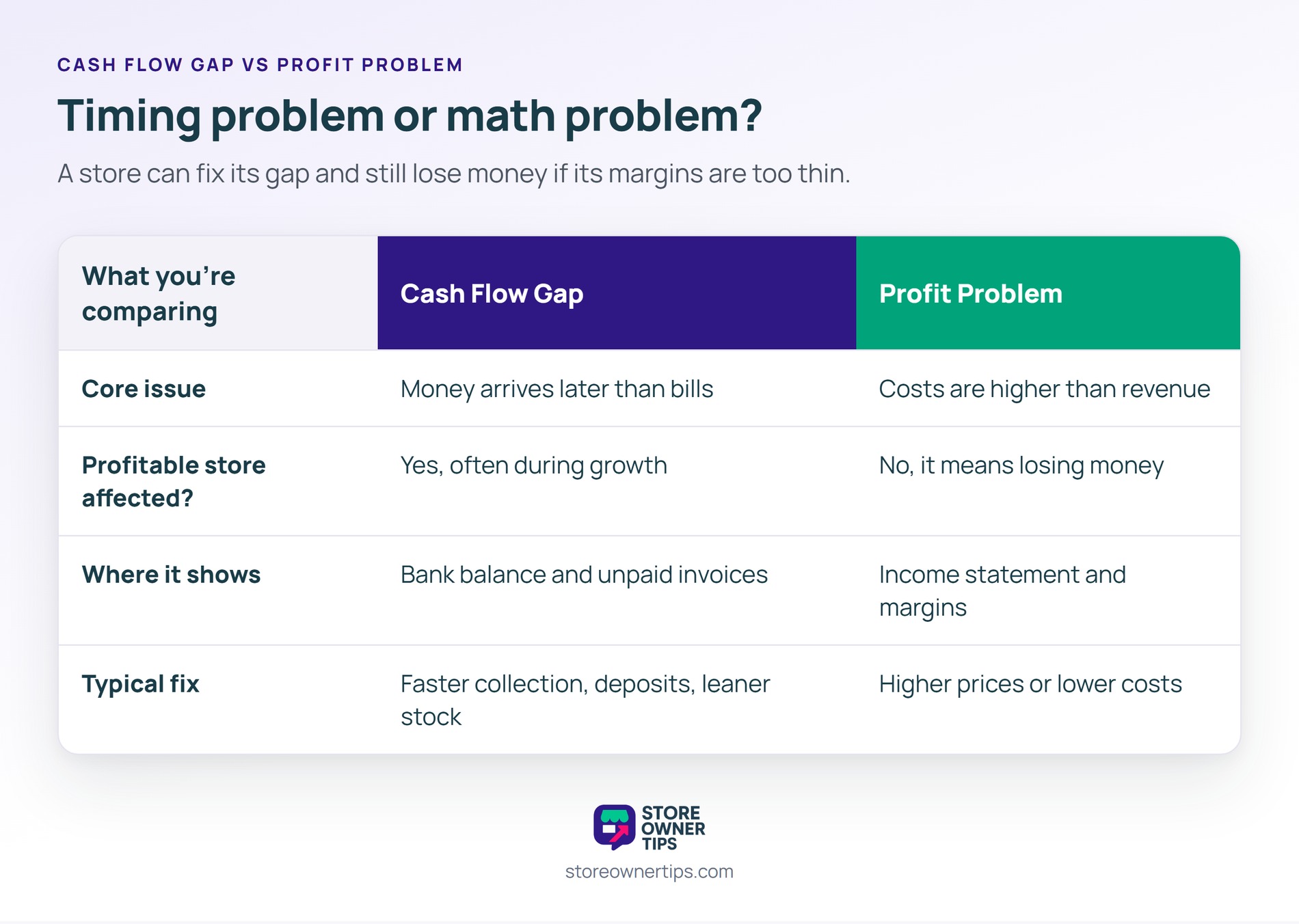
| What you’re comparing | Cash Flow Gap | Profit Problem |
|---|---|---|
| Core issue | Money arrives later than bills | Costs are higher than revenue |
| Profitable store affected? | Yes, often during growth | No, it means losing money |
| Where it shows | Bank balance and unpaid invoices | Income statement and margins |
| Typical fix | Faster collection, deposits, leaner stock | Higher prices or lower costs |
A cash flow gap is about timing, while a profit problem is about the math of each sale. A store can fix its gap and still lose money if its margins are too thin. So check your contribution margin first, then work on speeding up the cash.
You calculate a cash flow gap with the cash conversion cycle. Add the days stock sits unsold to the days customers take to pay. Then subtract the days you take to pay suppliers. The result is how many days your cash is tied up.
Yes, a profitable business can run out of cash. Profit counts a sale when you make it, but the money may arrive weeks later. Fast-growing wholesale stores are especially exposed, because bigger orders need more cash upfront.
Net 30 terms can win bigger trade accounts, but they widen your cash flow gap. Offer them to approved buyers with a solid payment record. Many stores also ask for a deposit on large orders to soften the wait.
A cash flow gap matters because cash, not profit, pays your suppliers and staff. Stores that measure and shrink the gap can grow wholesale sales without borrowing to fund every new order.
Copyright © StoreOwnerTips.com. All Rights Reserved.
