Weekly ecommerce tips, deals & news.
A chatbot is software that holds a conversation with a shopper in plain language. In practice, it answers questions about products, orders, shipping, and returns without a person typing the reply. Some follow fixed scripts, while newer ones use AI to interpret whatever the shopper actually asks. So for a store, it is a way to answer common questions instantly.
In short, it handles the repetitive questions so your team can handle the rest.
Chatbots stopped being a novelty some time ago. Pew Research Center reports that about half of U.S. adults now use AI chatbots. So your shoppers already know how to talk to one.
That familiarity cuts both ways. Meanwhile, they also know exactly how a bad one feels.
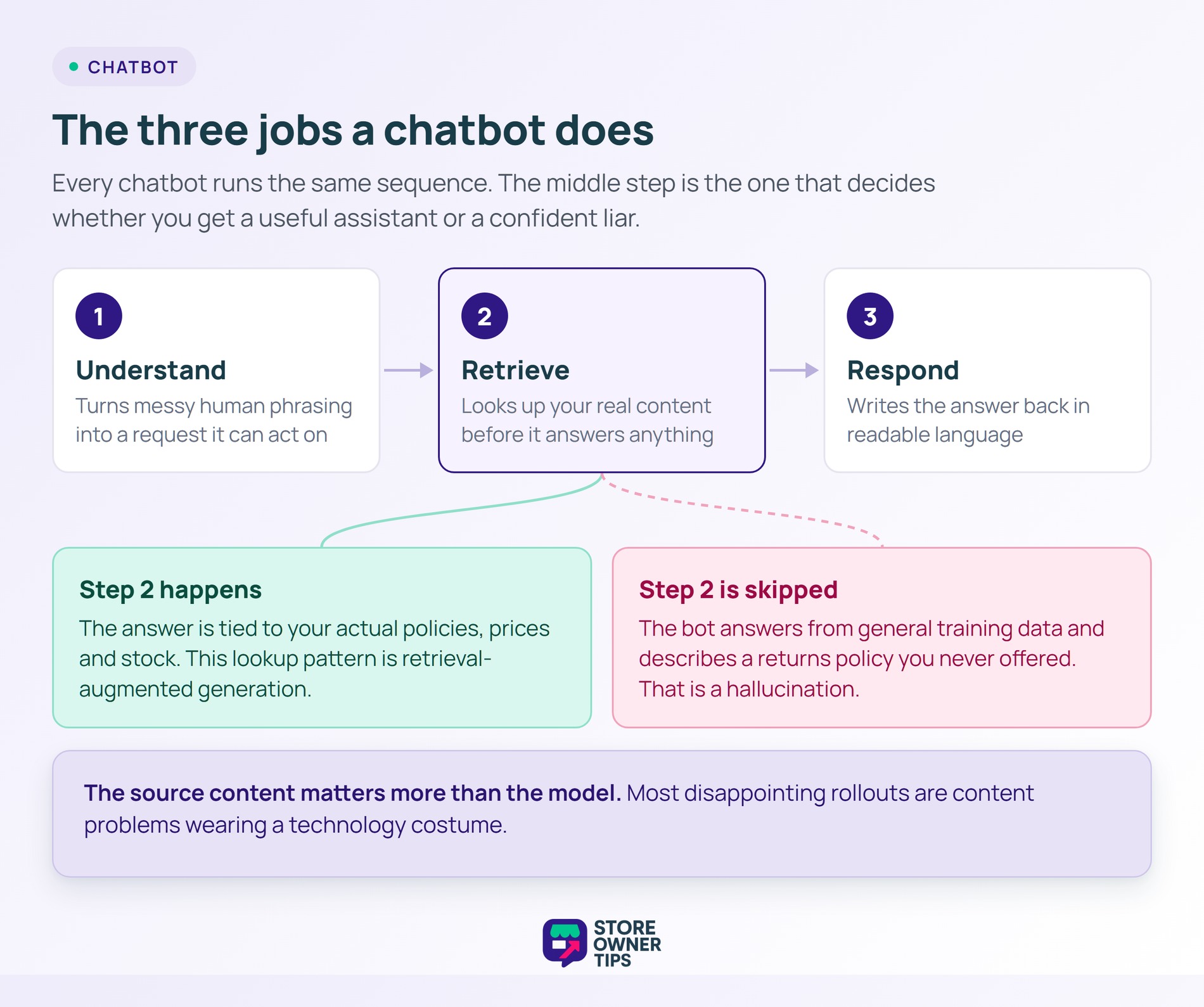
Every chatbot does three jobs in sequence. First, it works out what the shopper meant. Next, it finds an answer somewhere. Finally, it writes that answer back in readable language.
Step one is the hard part. Turning messy human phrasing into a machine-readable request is called natural language processing. Think of it like a receptionist who understands both mumbling and formal requests.
Step two is where stores succeed or fail. A modern bot looks up your real content before answering. That lookup pattern is called retrieval-augmented generation, and it is what keeps answers tied to your actual policies.
Without that lookup, the bot answers from general training data. Then it will happily describe a returns policy you have never offered. That failure has a name, and it is AI hallucination.
So the source content matters more than the model. A well-maintained knowledge base plus live product data beats a clever bot with nothing to read. In practice, most disappointing rollouts are content problems wearing a technology costume.
A rule-based bot is a decision tree with a chat window. It offers buttons, matches keywords, and follows branches you defined. However, ask it something off-script and it stalls.
These bots are predictable, cheap, and genuinely useful for narrow jobs. Order tracking is a good example, because the flow never varies. By contrast, they collapse the moment a shopper phrases things unexpectedly.
An AI bot runs on a large language model instead. It can handle rephrasing, typos, and questions nobody scripted. That flexibility is the upgrade, and it is also the risk.
Flexibility means the bot can say something you never approved. So guardrails matter: restrict it to your content, and make it say when it does not know. In short, a bot that admits ignorance is worth more than one that guesses well.
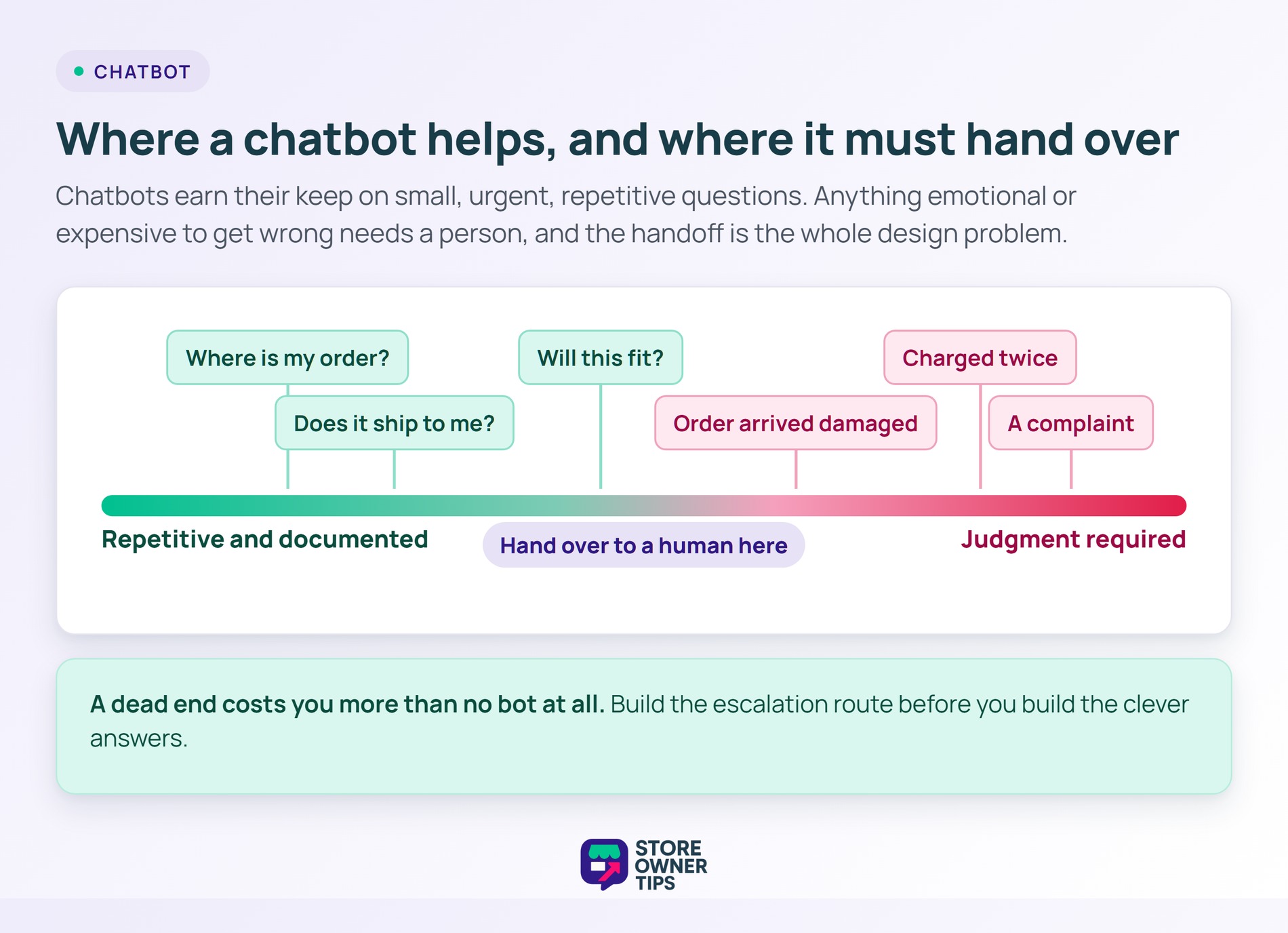
Chatbots earn their keep on small, urgent, repetitive questions. Will this fit? When does it ship? Can I return it?
Those questions arrive at the exact moment a shopper hesitates. Baymard Institute puts the average documented cart abandonment rate at 70.22%. An unanswered question is one of the cheapest ways to join that number.
By contrast, they fail on anything emotional, unusual, or expensive to get wrong. A damaged order, a billing dispute, or a complaint needs a person. Trying to automate those is how stores lose customers permanently.
Trust is the other constraint worth respecting. Pew found half of U.S. adults feel more concerned than excited about AI, with just 10% more excited than concerned. So a bot that pretends to be human starts on the back foot.
Usability research points the same way. Nielsen Norman Group tested eight site chatbots with real users. Often, people could not tell what the bot was for. Say plainly what it can do, and say plainly that it is a bot.
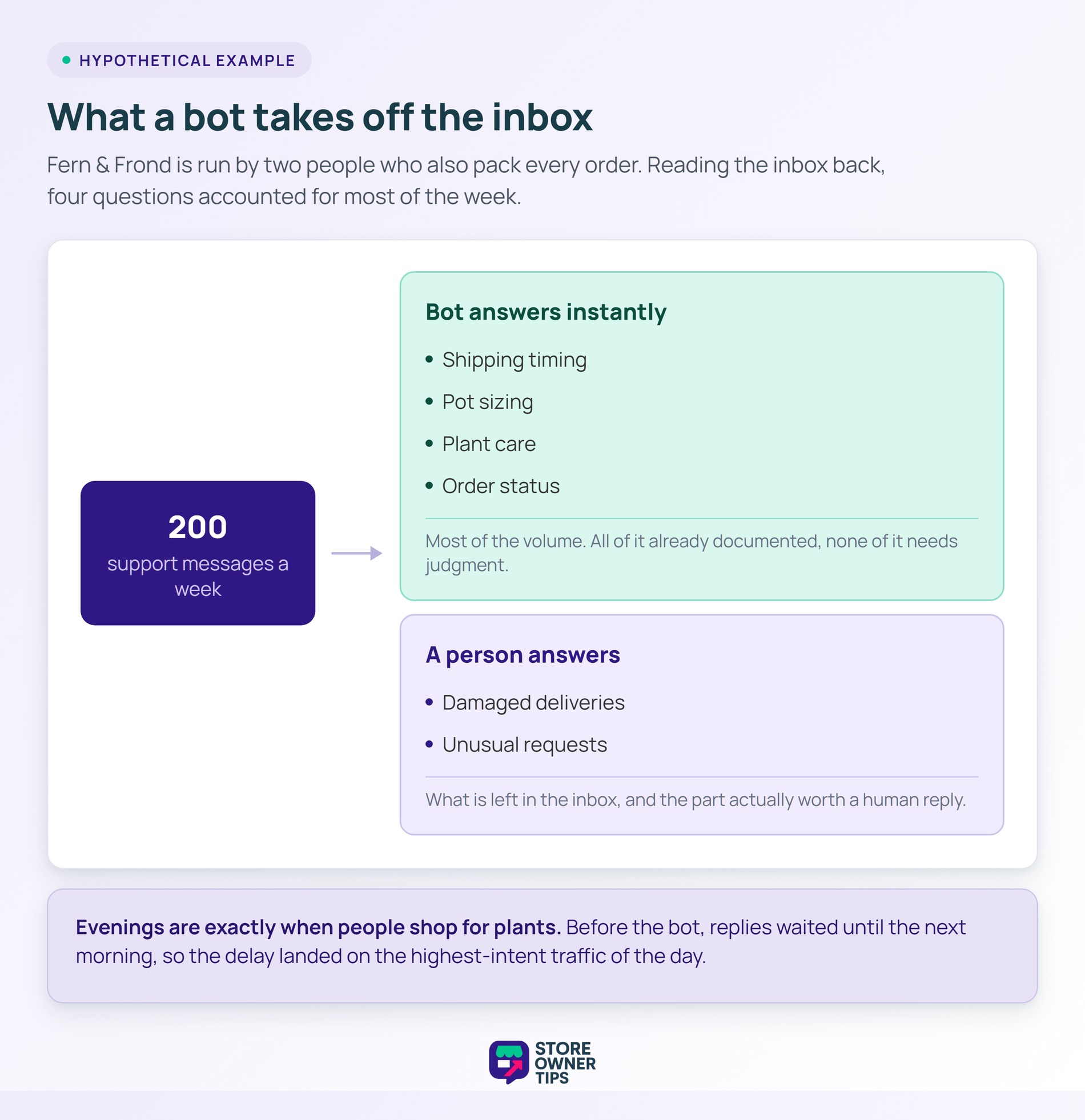
Imagine a store called Fern & Frond that sells houseplants and planters online. It is run by two people who also pack every order. Support email has quietly become the bottleneck.
The inbox gets roughly 200 messages a week. Reading them back, the owners find a pattern they had not noticed. Four questions account for most of the volume.
Those four are shipping timing, pot sizing, plant care, and order status. None of them need judgment, and all of them are already documented somewhere. Meanwhile, replies take until the next morning because nobody works evenings.
Evenings are exactly when people shop for plants. So the delay lands on the highest-intent traffic of the day.
The owners start with content, not software. First, they write proper care guides, a clear sizing chart, and an honest shipping timeline. Only then do they connect a chatbot to that material and to live order data.
The bot is told to answer only from that content. When it cannot, it says so and offers to pass the message on. It also introduces itself as an assistant rather than pretending to be staff.
Now the four common questions get answered at eleven at night. The shopper who wondered whether a pot fits a windowsill gets an answer immediately. Previously, that shopper closed the tab and forgot.
The inbox does not empty, and it was never supposed to. What changes is what is left in it. The remaining messages are damaged deliveries and unusual requests, which are the ones actually worth a human reply.
There is a second benefit the owners did not expect. Every unanswerable question the bot logs is a gap in their documentation. As a result, the transcript becomes a to-do list for the content they still owe shoppers.
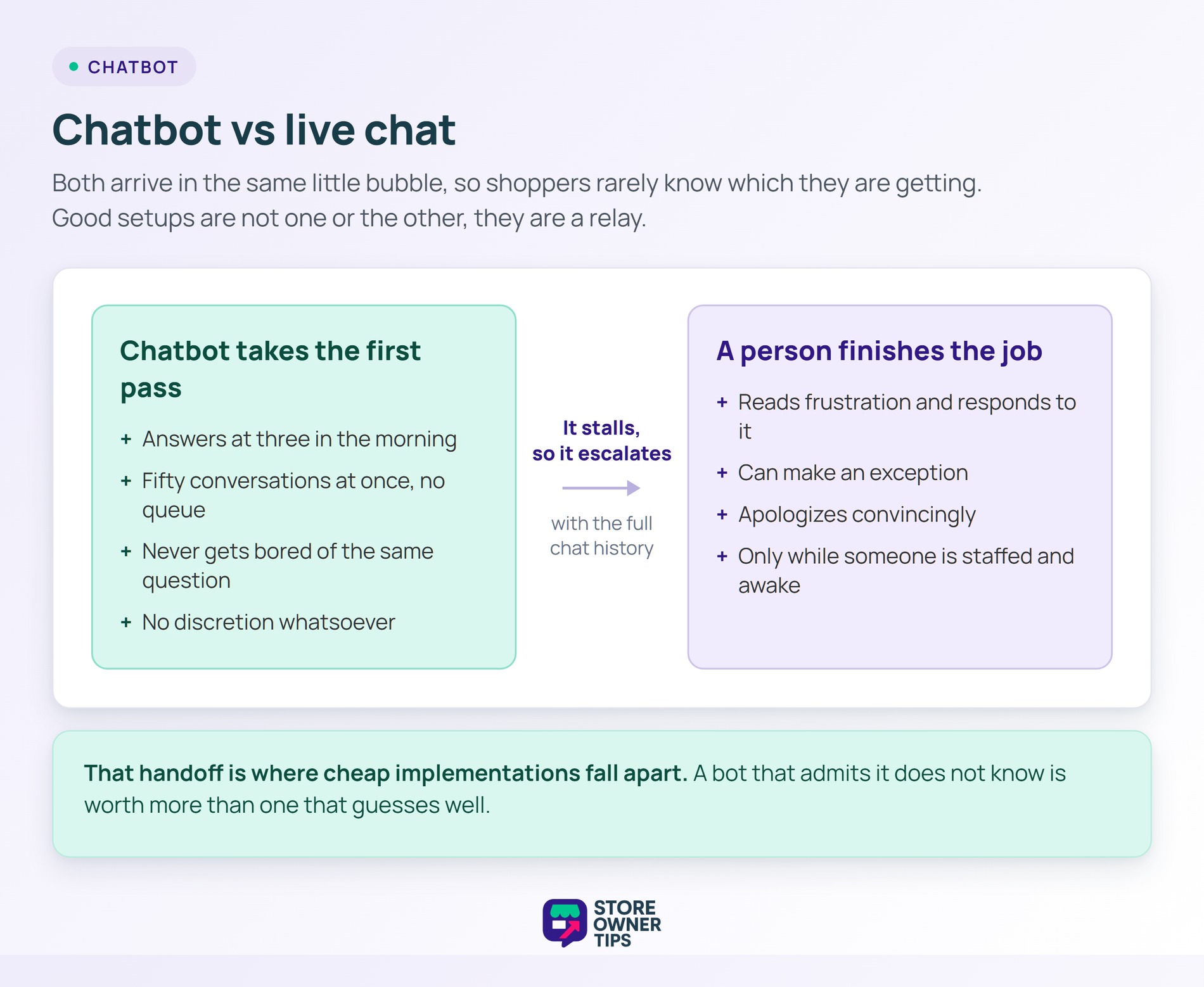
Both appear in the same little bubble, so shoppers rarely know which they are getting. The difference is who is typing. Live chat puts a person on the other end, while a chatbot does not.
Live chat wins on judgment, empathy, and anything unusual. A human can read frustration, make an exception, and apologize convincingly. However, live chat only works while someone is staffed and awake.
Meanwhile, a chatbot wins on availability and volume. It answers at three in the morning and handles fifty shoppers at once without a queue. By contrast, it has no discretion whatsoever.
Most good setups are not one or the other. The bot takes the first pass and escalates cleanly when it stalls. That handoff is the whole design problem, and it is where cheap implementations fall apart.
For a WooCommerce store, that means picking a tool that reads live catalog and order data. One option built for exactly that job is StoreAgent’s WooCommerce AI chatbot.
No, and the research is unusually clear on this. When shoppers know they are talking to a bot, they adjust how they ask things. Then they get better answers, because they stop writing like a letter.
Pretending also creates a trust problem you cannot undo. A shopper who works out the deception mid-conversation stops believing the answers. So name it plainly and say what it can help with.
It reduces repetitive volume, not total effort. The easy, high-frequency questions are the ones a bot removes. Meanwhile, the difficult tickets stay exactly where they were.
That is still a real win for a small team. Answering the same shipping question forty times a week is pure overhead. However, expect to spend the reclaimed time maintaining the content the bot reads.
Admit it immediately and hand over to a person. The worst outcome is a confident wrong answer, because the shopper acts on it. The second worst is a loop that never offers an exit.
Build the escalation before you build the clever answers. A clear route to email, a form, or a human is the safety net. In practice, that single feature separates a useful bot from an infuriating one.
A chatbot is not a replacement for support, it is a filter in front of it. Done well, it answers the small urgent questions instantly and routes everything else to a person.
So invest in the content it reads before you invest in the bot itself. Grounded answers, an honest introduction, and a clean handoff are what make the difference.
Copyright © StoreOwnerTips.com. All Rights Reserved.
