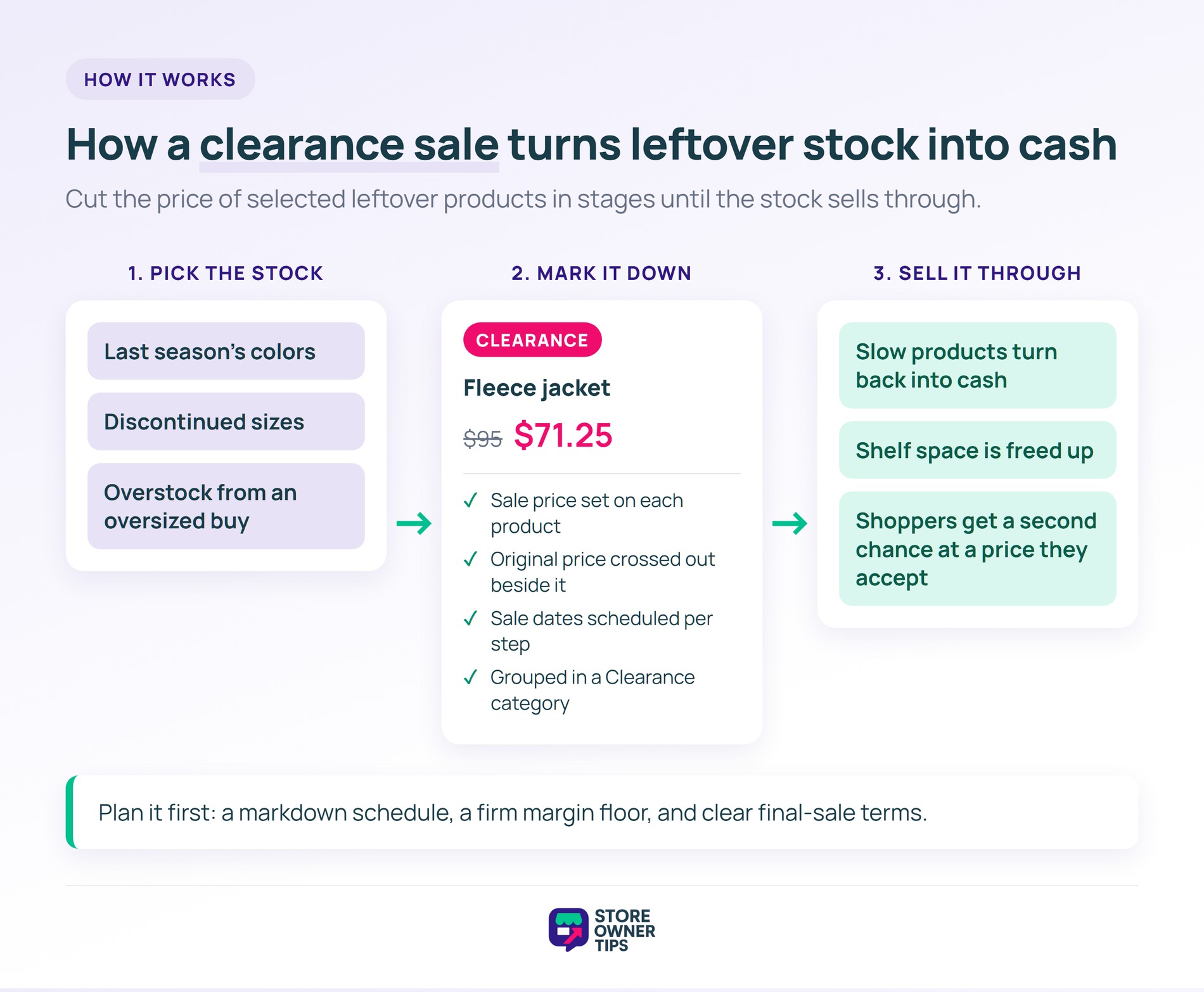
A clearance sale is a markdown event that sells off leftover or end-of-season stock at falling prices until it’s gone. Stores use it to turn slow products back into cash and free up shelf space. The best clearance sales follow a planned markdown schedule, a firm price floor, and clear final-sale terms.
A clearance sale works by cutting the price of selected leftover products in stages until the stock sells through. These are usually known slow sellers: last season’s colors, discontinued sizes, or overstock from an oversized buy.
A clearance sale is a bit like a garage sale with a plan. You start with fair prices, then lower them as the day goes on.
In WooCommerce, the mechanics are simple. You set a sale price on each product, and the store shows the original price crossed out beside it.
You can also schedule sale dates so each markdown step starts and ends on its own. Many stores group these items in a dedicated “Clearance” category. Bargain hunters can then find them in one place.
The psychology behind a clearance sale is simple. A crossed-out price signals a real loss avoided, and a shrinking stock count signals the deal won’t last. Shoppers who passed on an item at full price get a second chance at a price they accept. The store gets cash back for products that would otherwise sit on a shelf.
Markdown cadence is the schedule of price drops in a clearance sale. A common pattern starts with a modest cut, then deepens every week or two. Each step gives hesitant shoppers one more reason to buy before stock runs out. The deepest cuts are saved for whatever is still left at the end.
Timing matters as much as depth. Many stores run clearance in the weeks after the holiday peak, when a year-end sale or January reset is expected. A holiday sales calendar helps you slot clearance where it won’t clash with full-price launches. If you’re coming off a busy November, it also pays to update stock levels after Black Friday first.
A margin floor is the lowest price a clearance item can reach before you stop marking it down. Most stores set it at product cost plus payment fees and shipping. That way every sale still covers its own cost. Your gross margin on the full-price item tells you how much room you have to cut.
Once a product hits its floor and still won’t sell, more markdowns rarely help. Bundle it with a faster seller, sell it in bulk, or donate it for a tax write-off. If you want ready-made ideas for structuring the event itself, here’s how to plan a reduction sale in WooCommerce.
Clearance items are often sold as final sale, which means no returns or exchanges. That rule protects thin clearance margins, and returns are a big cost for retailers.
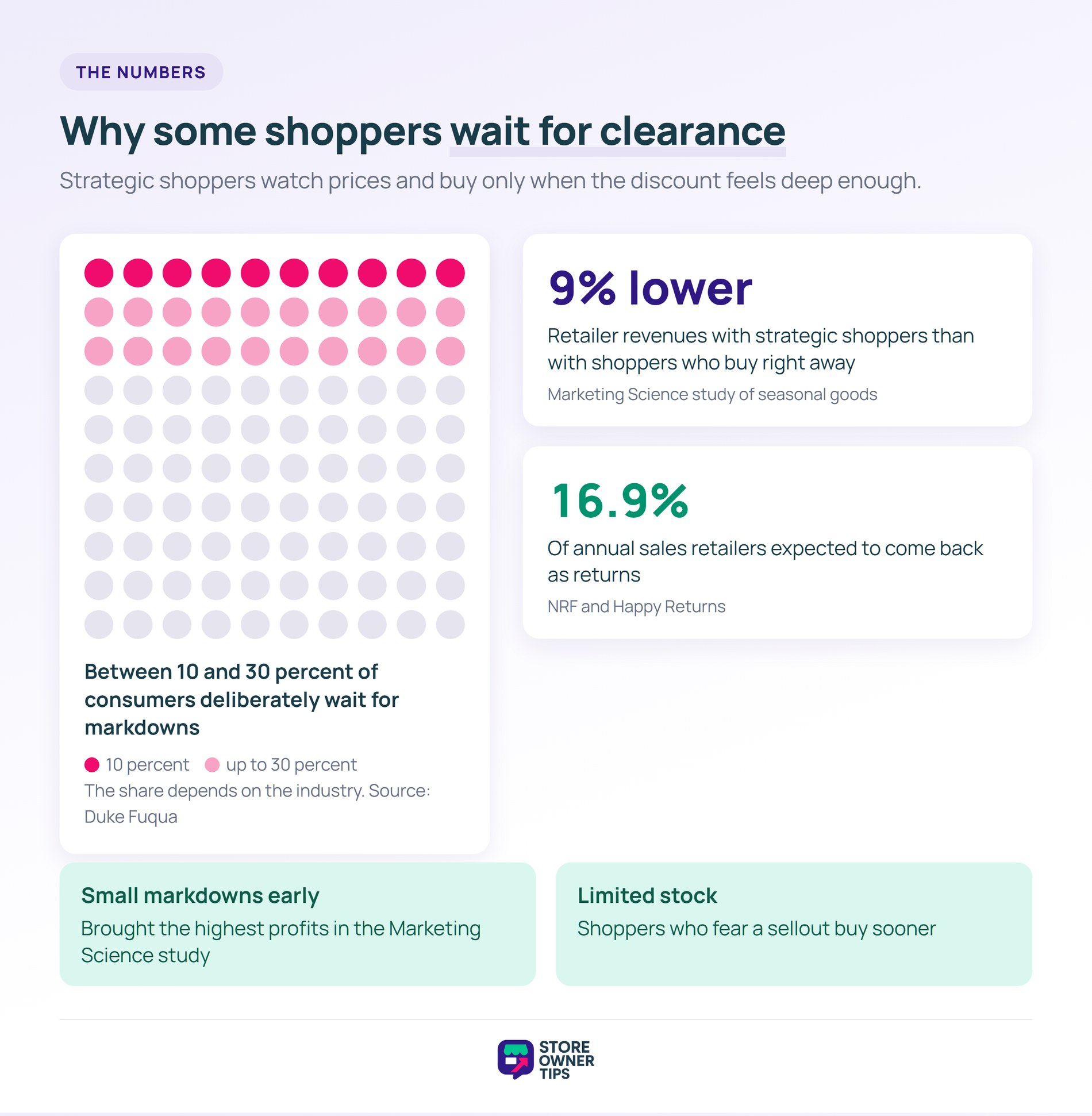
Retailers expected 16.9% of their annual sales to come back as returns, according to NRF and Happy Returns. State final-sale terms on the product page and at checkout, not only in your policy page.
The crossed-out “was” price also needs to be real. US pricing guides ask that a former price be the actual, bona fide price you charged on a regular basis. Never inflate the original price just to make a clearance discount look bigger.
Research on clearance sales shows that some shoppers deliberately wait for markdowns. Duke’s Fuqua School of Business cites evidence that between 10 and 30 percent of consumers behave this way. The share depends on the industry. These strategic shoppers watch prices and buy only when the discount feels deep enough.
A Marketing Science study of seasonal goods measured the cost. It found retailer revenues were 9% lower with strategic shoppers than with shoppers who buy right away.
The Marketing Science study also found the highest profits came from small markdowns early in the season. Limited stock helped too. Shoppers who fear a sellout buy sooner.
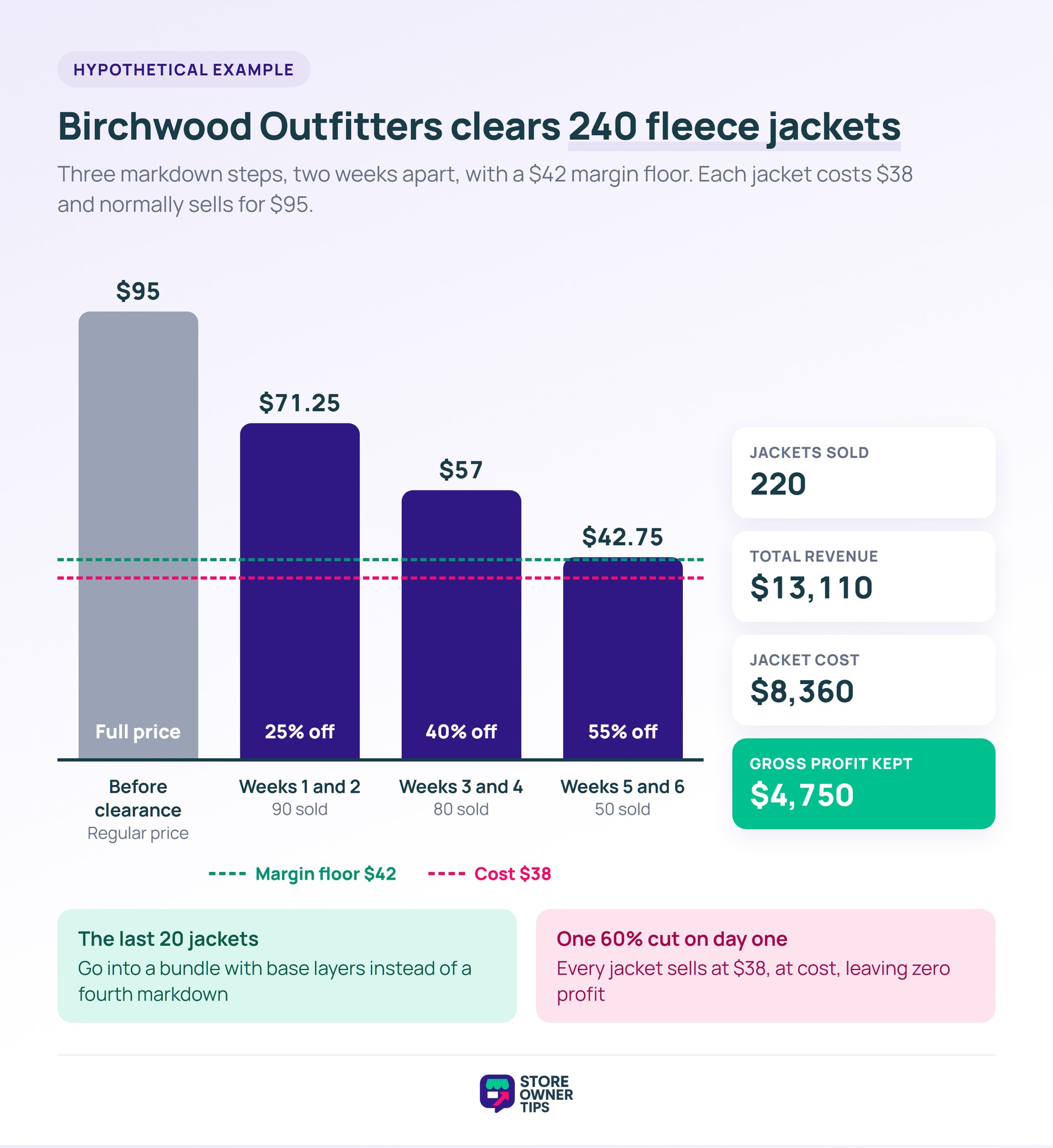
A clearance sale in practice is a short series of planned price drops on one batch of leftover stock. Here’s a hypothetical example. Imagine Birchwood Outfitters, a small outdoor clothing store, finishing winter with 240 fleece jackets still in stock. Each jacket costs $38 to buy and normally sells for $95.
Birchwood sets its margin floor at $42, which covers the jacket cost plus fees. The store then plans three markdown steps, two weeks apart. Step one is 25% off, matching the peak apparel discount of 25% that Adobe Analytics saw on Cyber Monday. Every jacket page also says “Final sale: no returns or exchanges.”
Birchwood moves the jackets into a Clearance category and schedules each sale price ahead of time. The store emails past fleece buyers once at the start of each step. Full-price categories stay untouched, and new spring arrivals launch at regular prices.
Birchwood sells 220 jackets for $13,110 in total revenue. Those jackets cost $8,360, so the store keeps $4,750 in gross profit. The last 20 jackets go into a bundle with base layers instead of a fourth markdown.
Now compare a single 60% cut on day one. At $38, every jacket would sell at cost, leaving zero profit. The staged plan kept clearance to one product line for six weeks. Loyal shoppers had no reason to wait on new arrivals.
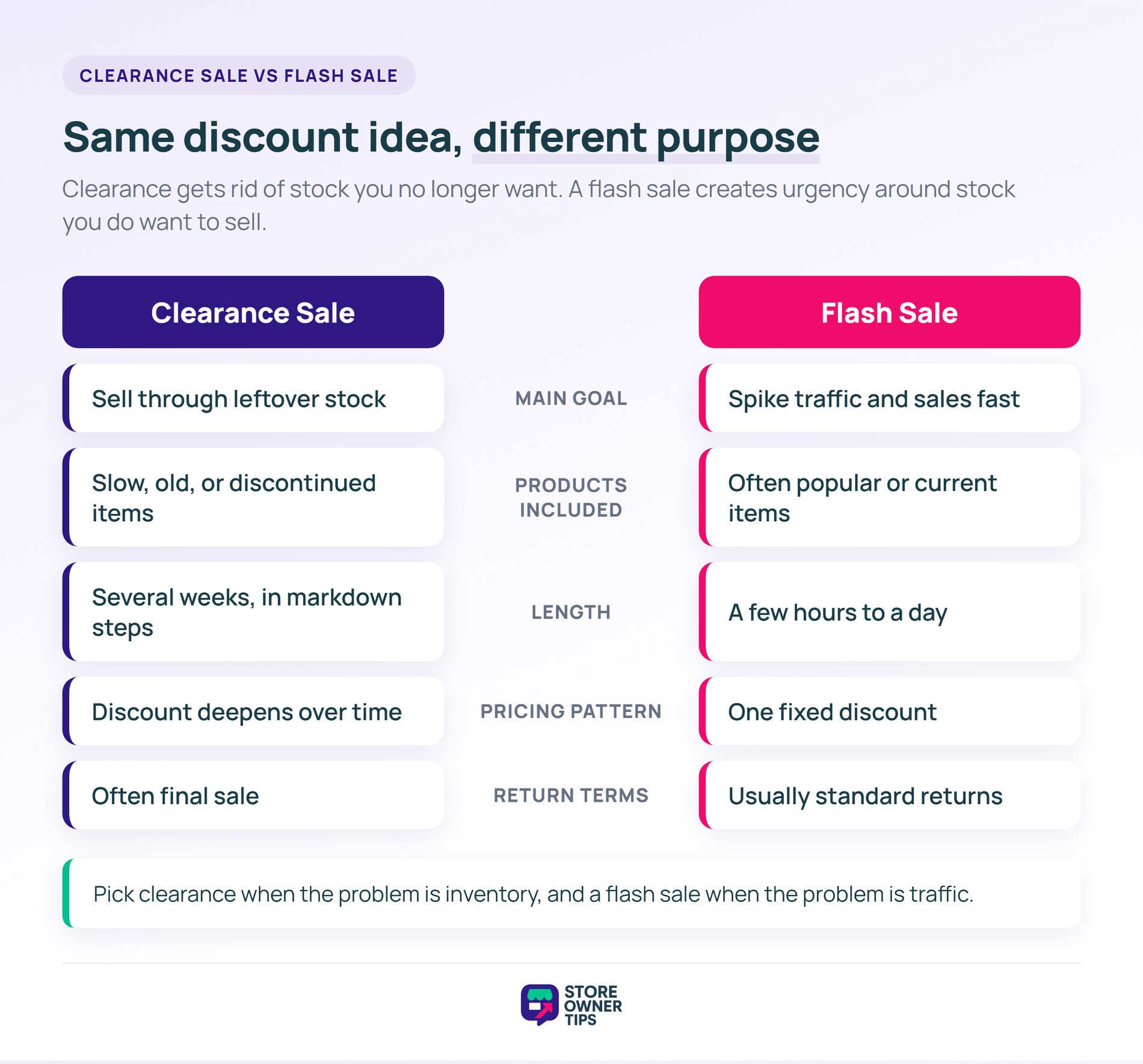
| What you’re comparing | Clearance Sale | Flash Sale |
|---|---|---|
| Main goal | Sell through leftover stock | Spike traffic and sales fast |
| Products included | Slow, old, or discontinued items | Often popular or current items |
| Length | Several weeks, in markdown steps | A few hours to a day |
| Pricing pattern | Discount deepens over time | One fixed discount |
| Return terms | Often final sale | Usually standard returns |
A clearance sale and a flash sale differ mainly in purpose. Clearance gets rid of stock you no longer want. A flash sale creates urgency around stock you do want to sell. Pick clearance when the problem is inventory, and a flash sale when the problem is traffic.
Keep clearance limited to genuinely leftover products, and never put current best sellers on it. Vary the timing so shoppers can’t predict the next event. Some stores skip a public calendar entirely and announce clearance only when it starts.
Keep quantities visible. Limited stock pushes people to buy sooner. Heavy, frequent markdowns are a fast route to discount dependency.
Yes, many stores sell clearance items as final sale with no returns or exchanges. It’s a common way to protect the thin margin left on a marked-down item. The key is to disclose it clearly before purchase.
Put the terms on the product page, in the cart, and in your return policy. Check local consumer laws as well. Some regions require returns for faulty goods regardless.
Most clearance sales start with a modest cut, then deepen in steps. Set your margin floor first, so you know the lowest price you’ll accept. Space two or three markdowns a week or two apart. Stop marking down once a product reaches its floor, and bundle or donate what’s left.
A clearance sale matters because leftover stock ties up cash that your store needs for its next season. Run it with a markdown schedule, a firm floor, and honest terms, and it recovers money without cheapening your brand. Run it carelessly, and it teaches customers to wait for your next discount. The difference comes down to planning before the first markdown goes live.
Copyright © StoreOwnerTips.com. All Rights Reserved.
