Weekly ecommerce tips, deals & news.
Consignment inventory is stock you place with a retailer that they only pay for once it sells. The goods sit in their shop or warehouse, but they legally remain yours until a customer buys them. It is a third supply model, sitting between selling wholesale and shipping every order yourself.
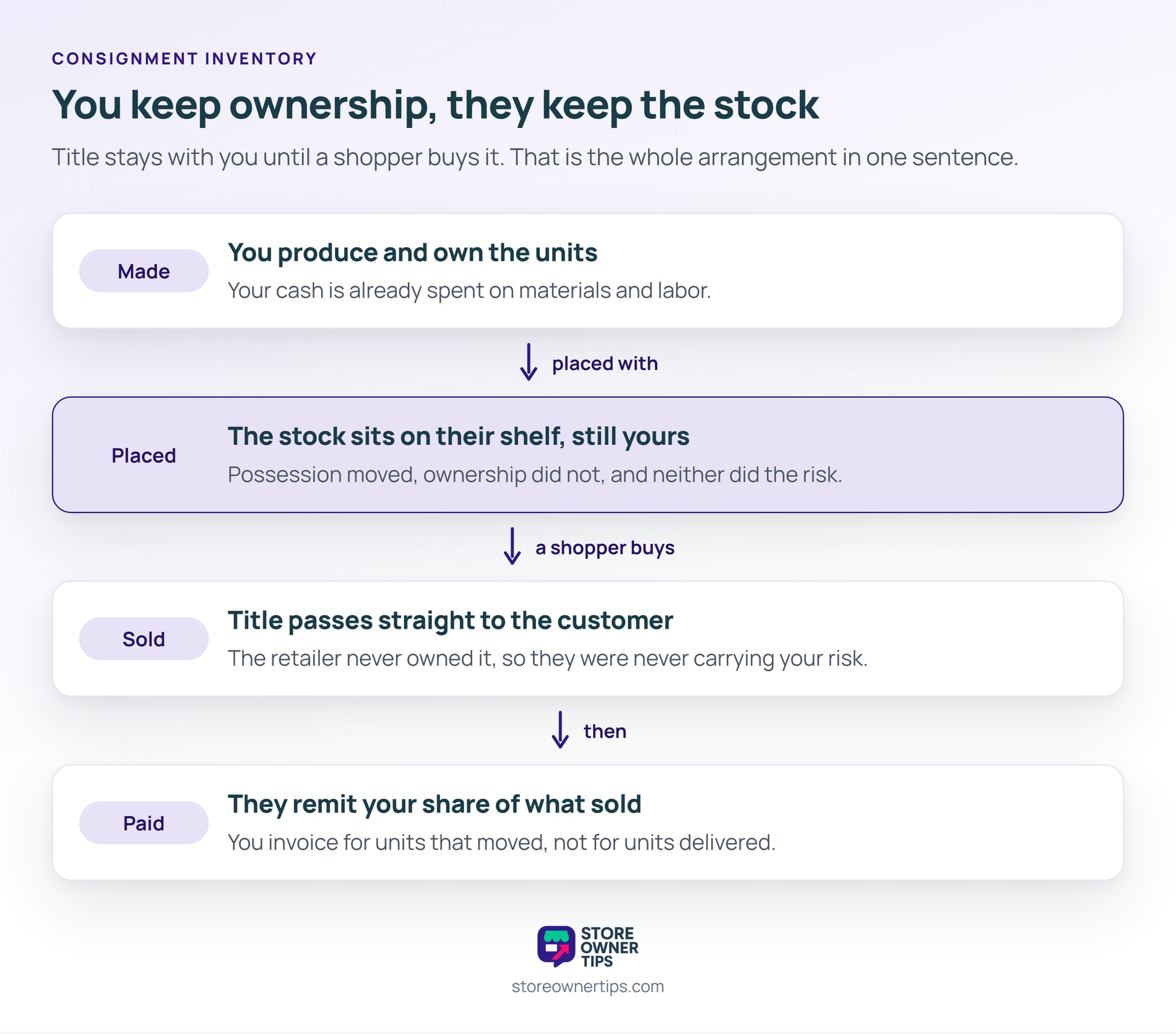
Consignment inventory works by separating possession from ownership, deliberately. First, you ship stock to a retailer, who displays and sells it. Then, only when a unit sells, does the money come back to you and the ownership pass on.
First, imagine leaving your old bike at a friend’s garage sale. The bike sits on their driveway all weekend, priced and visible to everyone walking past.
Still, it is your bike. If it sells, your friend hands you the money minus a cut. If it does not, you take it home again at the end of the day.
So consignment inventory is that arrangement at commercial scale. The retailer supplies the shelf and the footfall. Meanwhile you supply the stock and carry the risk of it not moving.
In practice, consignment inventory changes hands twice, and only the second transfer involves money. That two-step is the whole mechanic, and it is where accounting confusion starts.
Notably, step two catches people out most often. Because the stock is still yours, it still shows in your inventory valuation. Therefore your books can look heavy with stock you cannot physically see.
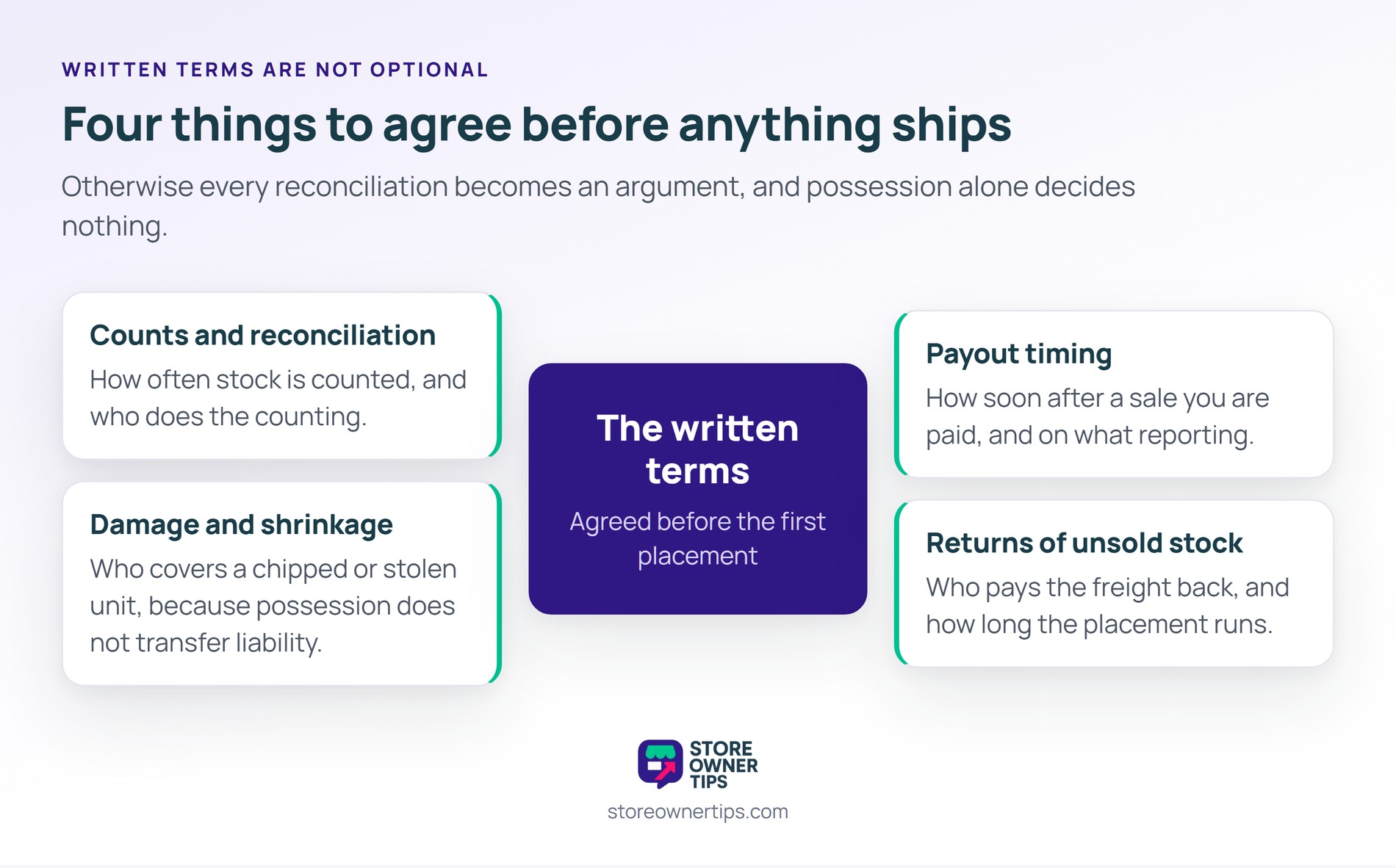
In practice, consignment inventory needs written rules far more than a wholesale order does. Wholesale Suite makes the same point in its guide to consignment inventory for WooCommerce. Clear rules are what protect your margin.
Notably, the discounting clause is the one most often forgotten. A retailer with no downside on unsold stock has little reason to hold your price. So agree in advance whether markdowns need your sign-off.
Consignment inventory delays your revenue while your costs stay exactly where they were. You have already paid to manufacture and ship the goods. However, the payment for them arrives only as units sell, which may be months.
Therefore consignment is treated as an investment rather than a sale. Meanwhile the same stock is unavailable to any other channel. Consequently placing too much on consignment can starve your own store.
Still, watching sell-through rate per retailer is the usual defense. A partner moving 10% of your placed stock a month is a partner. One moving nothing is a warehouse you are paying for.
Consignment sits inside an enormous trade sector, so the model matters at real scale. Digital Commerce 360 reports US manufacturing and wholesale distribution sales of $15.12 trillion in a recent year. Every supply arrangement inside that figure is wholesale, consignment or something close to one of them.
Also, the margin math explains why suppliers consider it at all. Wholesale prices typically run 30-50% below retail price, so a retailer’s cut is substantial either way. Meanwhile Wholesale Suite, our own B2B plugin, reports 20,000+ active installations on its free listing.
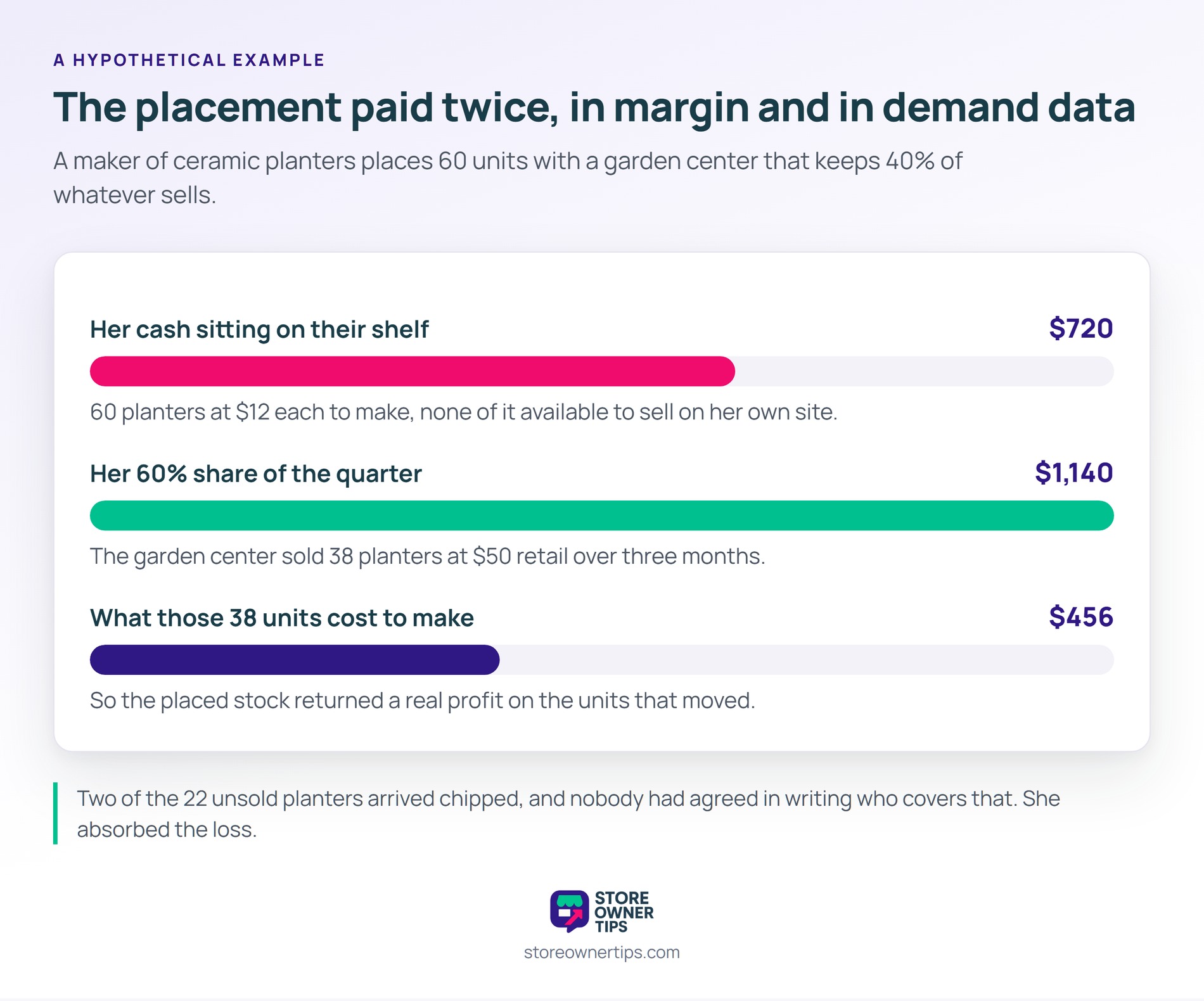
Here’s a hypothetical example. Picture a small maker producing ceramic planters, selling mostly through her own online store.
First, a garden center wants her planters but will not buy them outright. Instead they offer shelf space on consignment, keeping 40% of whatever sells. First she has to decide whether that is worth it.
Then she places 60 planters, which cost her $12 each to make. That is $720 of her own money now sitting in someone else’s shop. Meanwhile none of it is available to sell on her own site.
Over three months, the garden center sells 38 planters at $50 retail. She receives 60% of that, so $1,140 against the $456 those units cost her to produce. So the placed stock returned a real profit.
Meanwhile the remaining 22 planters are the interesting part. Two arrived chipped and nobody agreed in writing who covers that. Consequently she absorbs the loss, because possession alone does not transfer liability.
She also learns something she could not have bought: which glaze sells in a garden center. Therefore the arrangement paid twice, in margin and in demand data. Still, she caps the next placement at 40 units to protect her own stock levels.
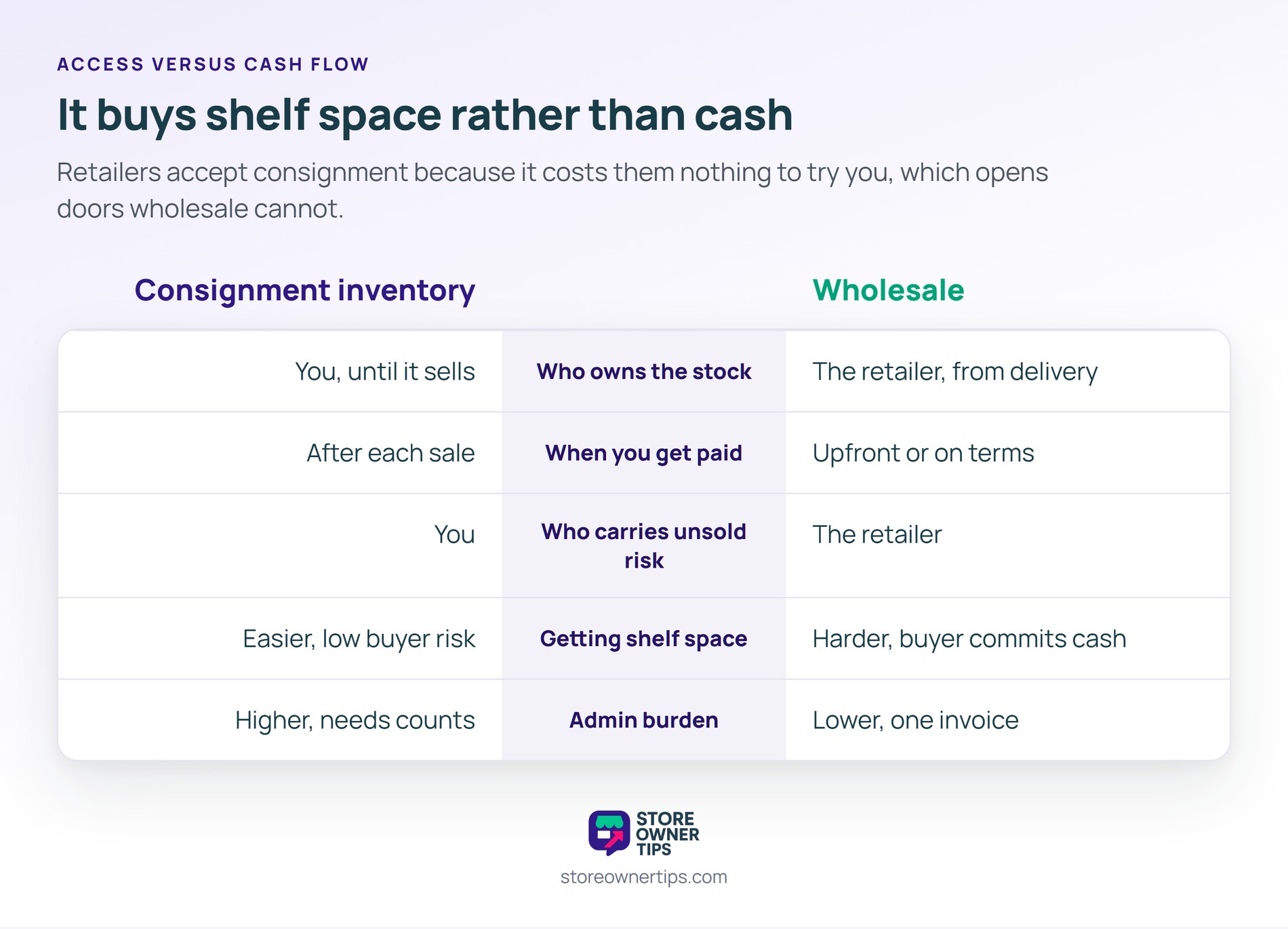
| What you’re comparing | Consignment inventory | Wholesale |
|---|---|---|
| Who owns the stock | You, until it sells | The retailer, from delivery |
| When you get paid | After each sale | Upfront or on terms |
| Who carries unsold risk | You | The retailer |
| Ease of getting shelf space | Easier, low buyer risk | Harder, buyer commits cash |
| Admin burden | Higher, needs counts | Lower, one invoice |
In short, consignment inventory and a wholesale channel move the same goods. Still, they assign the risk in opposite directions. Use consignment to open a door that wholesale cannot, such as a cautious first retailer. Then shift that partner to wholesale once the product proves itself on their shelf.
You do, right up until the moment a customer buys it. The retailer holds your goods but never owns them while they sit unsold. That is why consignment stock stays on your balance sheet and in your inventory turnover figures.
Mainly, the stock sits in different places. With consignment inventory, your goods are physically at the retailer waiting to sell. With dropshipping, they stay with you and you ship each order after it is placed.
Whoever the written agreement says, which is exactly why it needs writing. Because the goods remain yours, the default assumption often falls on you. Therefore agree a damage and shrinkage clause before the first pallet ships.
Consignment inventory matters because it is often the only way a small supplier reaches a shelf. Without it, an unknown product waits for a buyer willing to gamble cash on it.
It trades cash flow for access, which can be the right trade early on. Ultimately, it works when you treat the placed stock as an investment with terms. It is not a sale awaiting payment.
Copyright © StoreOwnerTips.com. All Rights Reserved.
