Weekly ecommerce tips, deals & news.
A duplicate order is the same purchase recorded, charged or shipped more than once. The shopper meant to buy one thing. Your store now believes they bought two.
So a duplicate order is almost never a customer mistake. It is usually your checkout, your gateway or your integrations disagreeing about whether something already happened.
A duplicate order happens whenever an action is repeated because nobody confirmed the first attempt worked. Think of it like posting a letter into a box with no sound. If you cannot hear it land, you check by posting another.
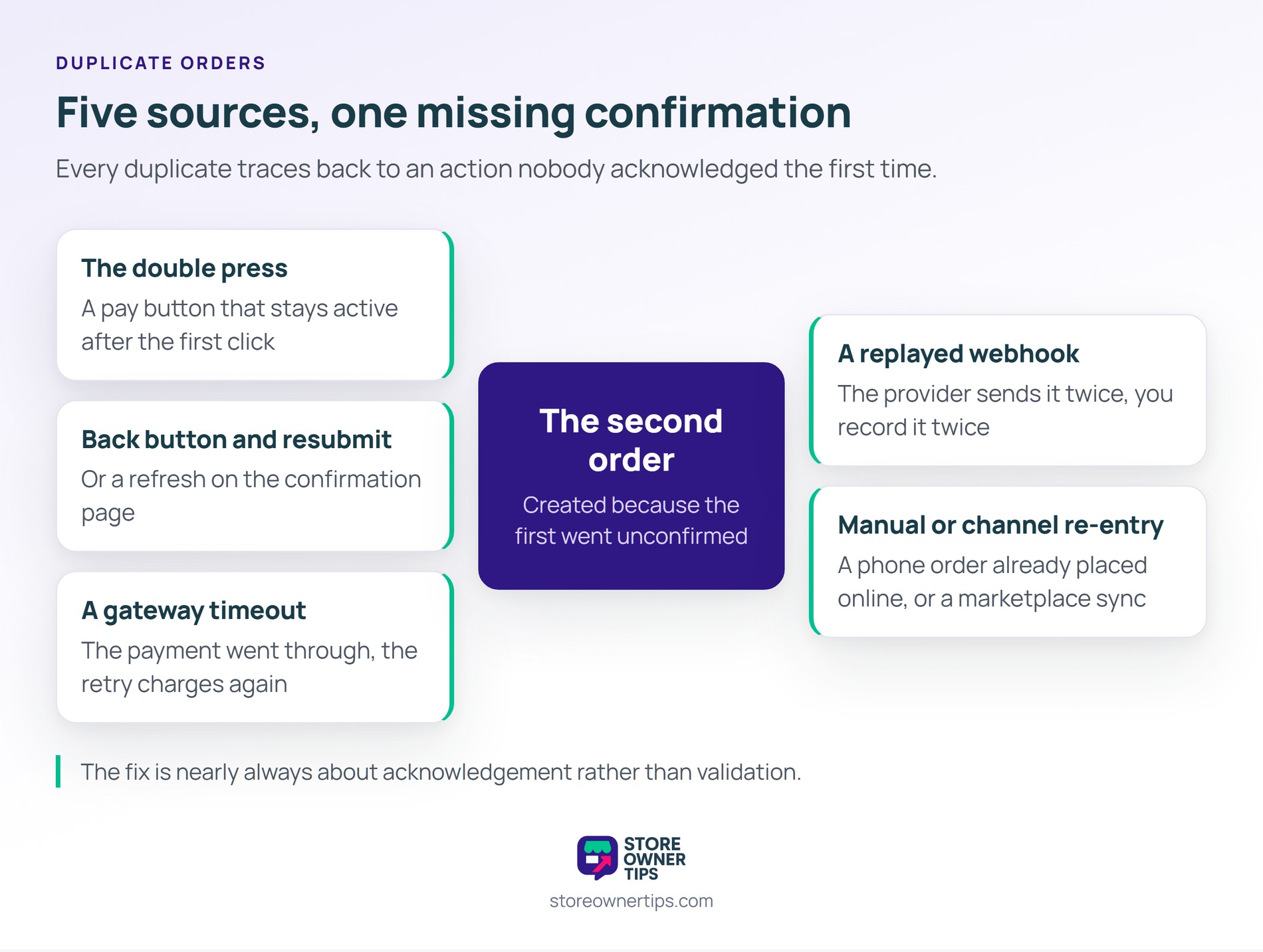
Every duplicate traces back to that missing confirmation. So the fix is nearly always about acknowledgement rather than validation.
Duplicate orders arrive from a short list of predictable sources. First is the double press, where a shopper clicks pay twice because nothing visibly changed. In practice, a button that stays active after the first click invites this.
Next is the browser back button followed by a resubmit. The shopper returns to the payment page, sees the form again, and completes it once more. Meanwhile a refresh on a confirmation page can do the same thing.
Then there are the machine causes, which are quieter and more consistent. A gateway that times out may still have taken the payment, so the retry creates a second charge. A webhook replayed by the payment provider can produce a second order record on its own.
Finally there is manual re-entry and channel import. Somebody keys a phone order that was already placed online, or a marketplace sync brings the same order across twice. In practice, stores selling on several channels see this version most.
Duplicate orders come in three shapes, and mixing them up leads to the wrong fix. The first is two order records against one payment. Your order list looks wrong while the money is correct.
The second is one order carrying two payments. Here the order list looks perfectly normal, so nobody notices until the customer does. That is the version that produces an angry email.
The third is two of everything, which is the honest double purchase. Two records, two payments, two parcels ready to ship. So checking your gateway transactions against your order list separates the three.
Meanwhile each shape has a different cost. A duplicate record wastes picking time, while a duplicate charge risks a chargeback if you are slow to refund it.
Preventing duplicate orders is mostly about removing the shopper’s uncertainty. First, disable the pay button the instant it is pressed and show a clear processing state. As a result, that single change removes the most common cause outright.
Next, make sure a retried payment request carries the same reference as the original. Gateways use that reference to recognise a repeat and refuse to charge twice. Meanwhile treating a timeout as a definite failure is the mistake to avoid, because the charge may have gone through.
Then add a simple detection rule on the store side. Flag any two orders from the same customer with the same total inside a few minutes. That catches the ones your checkout still lets through.
Also review how a failed payment is retried, since that is where double charges begin. Fraud screening guidance on watching for multiple orders in rapid succession uses the same signal for a different purpose.
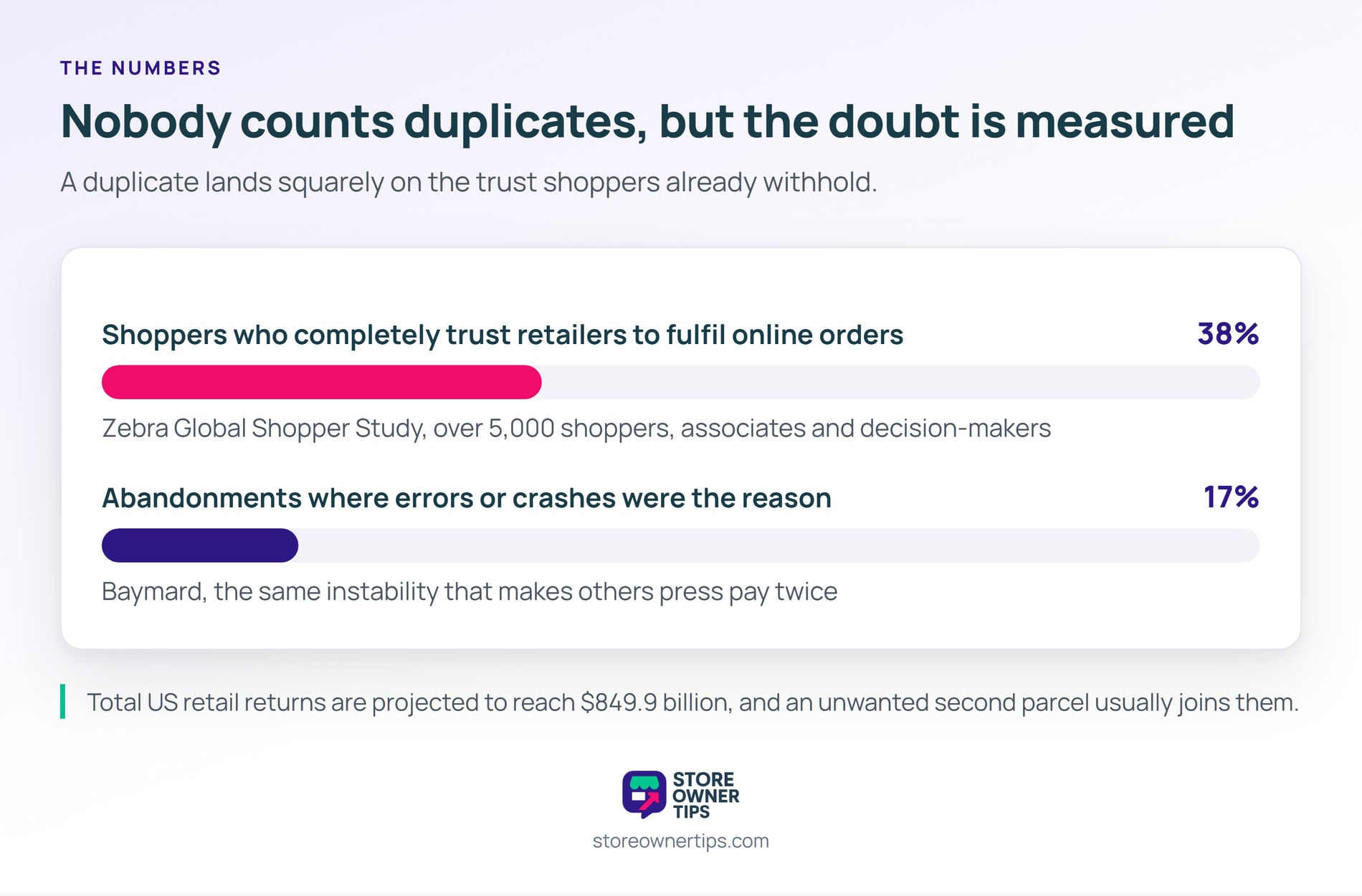
Duplicate orders are not counted centrally, but the trust they damage has been measured. Zebra Technologies runs an annual Global Shopper Study, and one edition surveyed more than 5,000 shoppers, associates and retail decision-makers. Only 38% of shoppers completely trusted retailers to fulfil online orders as promised.
A duplicate lands squarely on that doubt. In practice, two parcels or two charges is the sloppiness shoppers half expect. So the recovery is not just the refund, it is the reassurance.
The technical trigger has a measured footprint too. Baymard finds that a site with errors or crashes is the stated reason for 17% of abandonments. So the same instability that makes people abandon makes others press pay twice.
Then there is the return leg. Total returns across US retail are projected to reach $849.9 billion, and an unwanted second parcel usually joins them.
Duplicate orders in practice cluster around whatever is slowest in your checkout. Here is a hypothetical example. Imagine a store selling board games, with a payment step that takes six seconds to respond.
In this scenario, the pay button stays active while the request is in flight. There is no spinner and no change of wording. In this scenario, the store takes about 900 orders a month.
Then roughly 14 of those turn out to be duplicates. Nine are two records with one payment, and five are genuine double charges. Still, nobody has ever counted them as a category.
Four of the duplicate records get picked and shipped before anyone notices. So the store pays for postage twice and then pays again for the return. Meanwhile the reserved stock made two other titles show as unavailable.
By contrast, the five double charges are worse, because customers find those first. Two open disputes with their banks rather than emailing. As a result the store deals with a refund rate problem and a dispute problem from one root cause.
Meanwhile support treats each case individually and never links them. Still, fourteen a month is a pattern rather than bad luck.
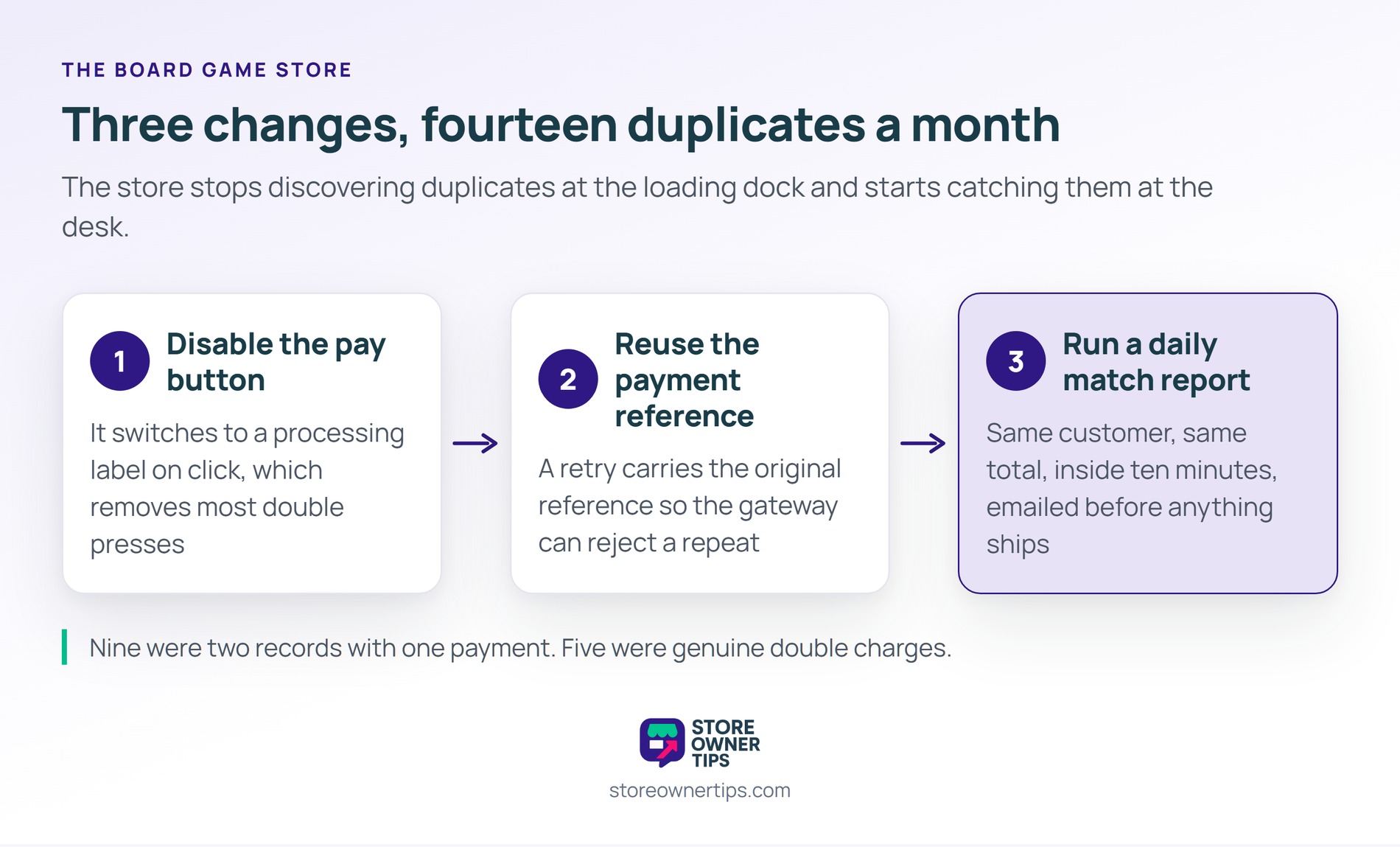
So the store changes the checkout behaviour first. The pay button disables on click and switches to a processing label. That alone removes most of the double presses.
Next, payment retries reuse the original reference so the gateway can reject a repeat. Then a daily report lists any same-customer orders with matching totals within ten minutes. Even so, one or two still slip through each month.
Finally, those get an email before anything ships, asking whether both were intended. In short, the store stops discovering duplicates at the loading dock and starts catching them at the desk.
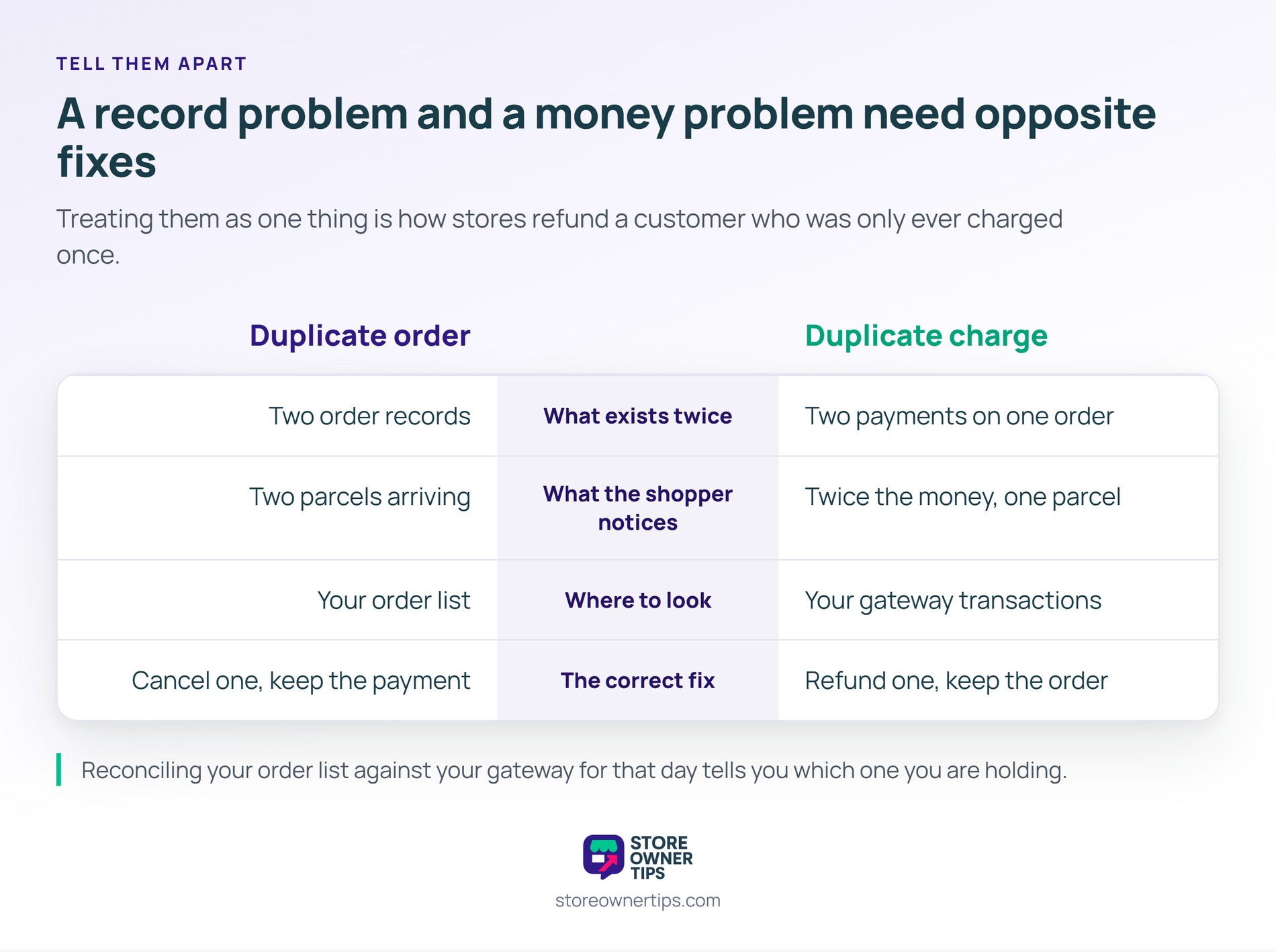
| What you are comparing | Duplicate order | Duplicate charge |
|---|---|---|
| What exists twice | Two order records | Two payments on one order |
| What the shopper notices | Two parcels arriving | Twice the money, one parcel |
| Where to look | Your order list | Your gateway transactions |
| The correct fix | Cancel one, keep the payment | Refund one, keep the order |
A duplicate order is a record problem, while a duplicate charge is a money problem. Treating them as one thing is how stores refund a customer who was only ever charged once.
So check both sides before you act. Reconciling your order list against your gateway for that day takes minutes. It tells you which of the two you are actually holding.
Usually because your checkout gave them no confirmation that the first attempt worked. A slow payment step with an active button reads as a failed click. So they try again to be safe.
Genuine intentional repeats do happen, particularly with gifts and consumables. That is why contacting the shopper beats assuming either way.
Ask before you do either, and ask quickly. A short email confirming whether both orders were intended resolves it in one reply. Cancelling silently annoys the people who meant it.
If you cannot reach them before the dispatch cut-off, hold the second order rather than shipping it. A delayed parcel is easier to fix than a returned one.
Disable the pay button on submit and show a processing state immediately. Then make sure any retry sends the same request reference as the original attempt. Gateways use that reference to refuse a duplicate charge.
Also stop treating a timeout as a confirmed failure. Check the gateway for a successful transaction before you let anything be charged again.
A duplicate order matters because it turns one successful sale into three costs. You pay for a wasted pick, a return, and a customer who now doubts you. Plus the stock it reserved was unavailable to somebody who genuinely wanted it. The fix is a disabled button and a matching reference, not a rebuild.
In short, tell the shopper their click worked and most duplicates never happen.
Copyright © StoreOwnerTips.com. All Rights Reserved.
