Weekly ecommerce tips, deals & news.
A failed payment is any attempt to pay that does not complete, leaving the order unpaid. The shopper wanted to buy. The money never arrived.
Failed payments cover declined cards, timeouts, abandoned authentication steps and gateway errors. In practice, most of them are recoverable. So the trick is knowing where in the chain the payment broke.
A failed payment works like a relay race where somebody drops the baton. First, your checkout hands the card details to a gateway. Then the gateway passes them to the card network, which asks the shopper’s bank for approval.

A failed payment can start at any of four points in that chain. First, the shopper may mistype a number or an expiry date. Next, the payment gateway may time out before it hears back.
Then there is the extra authentication step that many regions require. A shopper who closes that bank pop-up leaves the payment unfinished. Finally, the issuing bank can simply refuse the charge.
WooCommerce records these outcomes differently, which is genuinely useful. An order sitting in pending payment never completed an attempt at all. By contrast, an order marked failed had an attempt refused or left unauthenticated.
That distinction saves hours of guesswork. Pending points at the handoff between your checkout and the gateway. Failed points at the card or the bank behind it. So the status column is the first place to look, not the last.
A failed payment is either temporary or permanent, and the difference decides your next move. Soft failures include insufficient funds, a daily limit, or a bank that could not be reached. In practice, those often clear within days.
Hard failures are refusals that will never succeed. For example, a cancelled card, a closed account or a fraud block belongs here. So retrying a hard failure just annoys the bank and wastes gateway fees.
Stored cards create a slow-burning version of the same problem. Cards expire and get reissued after fraud, so saved credentials quietly go stale. Meanwhile the shopper has no idea their subscription is about to lapse.
For example, a card reissued after a breach keeps the same customer but a new number. So the stored credential fails even though nothing about the relationship changed.
Recovering a failed payment comes down to a retry schedule and an honest email. Automated retries re-attempt the charge at intervals chosen to dodge the original cause. Meanwhile dunning emails ask the customer to update their details.
Timing matters more than persistence. Recurly reports that 90% of recovered transactions happen within the first 10 days. As a result, a slow dunning sequence gives away most of the money it was meant to save.
Recurring billing tools handle much of this automatically. For example, a guide to automatic payments and smart retries covers how the retry and reminder cycle is configured. One-off orders need the same courtesy, usually as a short transactional email with a fresh payment link.
Failed payments show up in the data as involuntary churn. Recurly publishes churn benchmarks from its own subscription billing platform. Across all industries it puts average involuntary churn at 1.25% per month.
Voluntary cancellations run higher in that same data set. Even so, the involuntary share is the part nobody chose. Still, those customers wanted the product, which makes them the cheapest to win back.
Meanwhile one-off stores see the same effect at checkout. Baymard finds a declined card is the stated reason for 10% of abandonments among shoppers who were ready to buy. That is demand you already paid to attract.

A failed payment in practice hides inside a metric nobody watches. Here is a hypothetical example. Picture a specialty tea shop selling a monthly sampler box for $35.
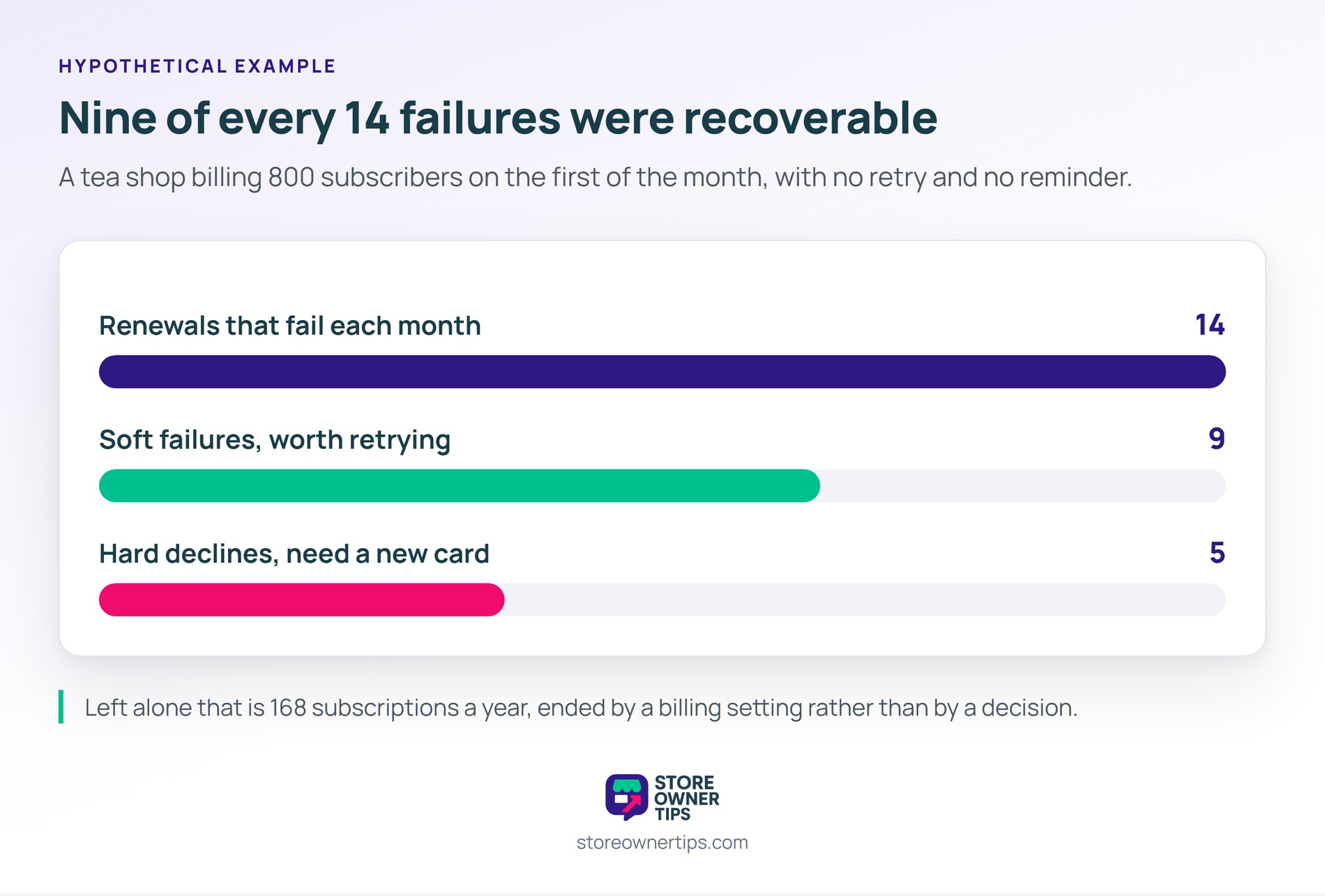
In this scenario, the shop has 800 active subscribers, billed on the first of the month. Renewals run once, with no retry and no reminder. As a result, failed renewals simply cancel the subscription.
Each month about 14 renewals fail. Nine are soft failures, mostly insufficient funds or a reissued card. The other five are genuine dead ends.
Nothing in the admin flags these as payment problems. Instead they land in the same cancelled bucket as people who quit on purpose.
Those 14 cancellations look like ordinary churn on the dashboard. So the owner spends the next quarter rewriting product pages to fix a retention problem. Meanwhile the real cause is a billing setting.
Over a year the shop loses 168 subscriptions this way. At $35 a month, the nine recoverable failures alone represent real recurring revenue. Still, none of it appears as a payment issue in any report.
Winning those subscribers back costs real money. First the shop pays to re-acquire someone it already had. Then it discounts the first box to close the deal. Meanwhile the nine soft failures would have paid full price.
The shop turns on three retries spread across the first eight days. Then each retry pairs with an email that names the problem plainly. Hard failures skip the retries and go straight to a card-update request.
The shop also starts tracking recovery rate as a number in its own right. That way a billing fault stops hiding inside churn rate. Next month the report separates cancellations from failures.
Roughly two thirds of the soft failures now clear without anyone touching them. In short, the same 800 subscribers produce more revenue on identical marketing spend.
| What you are comparing | Failed payment | Declined payment |
|---|---|---|
| What it covers | Any payment that did not complete | One specific refusal by the bank |
| Who says no | Gateway, network or issuer | The card issuer |
| Typical cause | Timeouts, errors, abandoned authentication | No funds, bad card, fraud rules |
| Your next step | Find where the chain broke | Retry it or request a new card |
A declined payment is one kind of failed payment, not a synonym for it. Every decline is a failure, but plenty of failures never reach the bank at all.
Even so, the distinction changes your diagnosis. A rising decline rate points at cards, fraud rules or your payment processor. By contrast, a rising failure rate with steady declines usually points at your checkout.

Pending payment means the order was created but no payment attempt ever finished. Usually the shopper reached the gateway and then closed the tab. For example, bank authentication pop-ups cause a lot of these.
It can also mean the gateway never sent its confirmation back to your store. So check your gateway logs before assuming the shopper walked away.
Three or four attempts inside the first week and a half suits most stores. Also, space them out rather than firing them on consecutive days. A payday often sits between a failure and a success.
Stop retrying once the response says the card is dead. Then switch to asking for new details, because more attempts will not help.
A soft decline is temporary, so the same card may work later. For example, insufficient funds, spending limits and unreachable banks all count. A hard decline is permanent, covering cancelled cards, closed accounts and fraud blocks.
So treat the two differently in your retry rules. Retrying soft declines recovers revenue, while retrying hard declines only adds fees and noise.
A failed payment matters because it loses a customer who had already agreed to buy. Every other conversion problem happens before that decision, which makes this the cheapest leak to plug. Better still, fixing retries and reminders costs a fraction of finding new demand.
Plus the same fix protects your monthly recurring revenue without touching your pricing. In short, treat failed payments as a recoverable queue instead of lost revenue.
Copyright © StoreOwnerTips.com. All Rights Reserved.
