Weekly ecommerce tips, deals & news.
Dynamic pricing is an automated strategy where your store’s product prices change in real-time based on shifting market conditions. Instead of using a fixed price tag, smart software calculates the exact price a shopper is willing to pay at any given moment. This flexible approach helps store owners maximize profits during peak demand and automatically offer targeted discounts to clear out slow-moving inventory.
To truly understand how this works in modern e-commerce, you have to look at the underlying technology and the psychology of your shoppers. At its core, dynamic pricing relies on software Algorithms. Think of an algorithm like an ultra-fast, invisible store manager who constantly checks your competitors’ windows, counts the stock in your back room, and changes the price tags on your floor every few milliseconds. It ingests massive amounts of data, such as your current inventory, website traffic, and competitor sales, to calculate the perfect price.
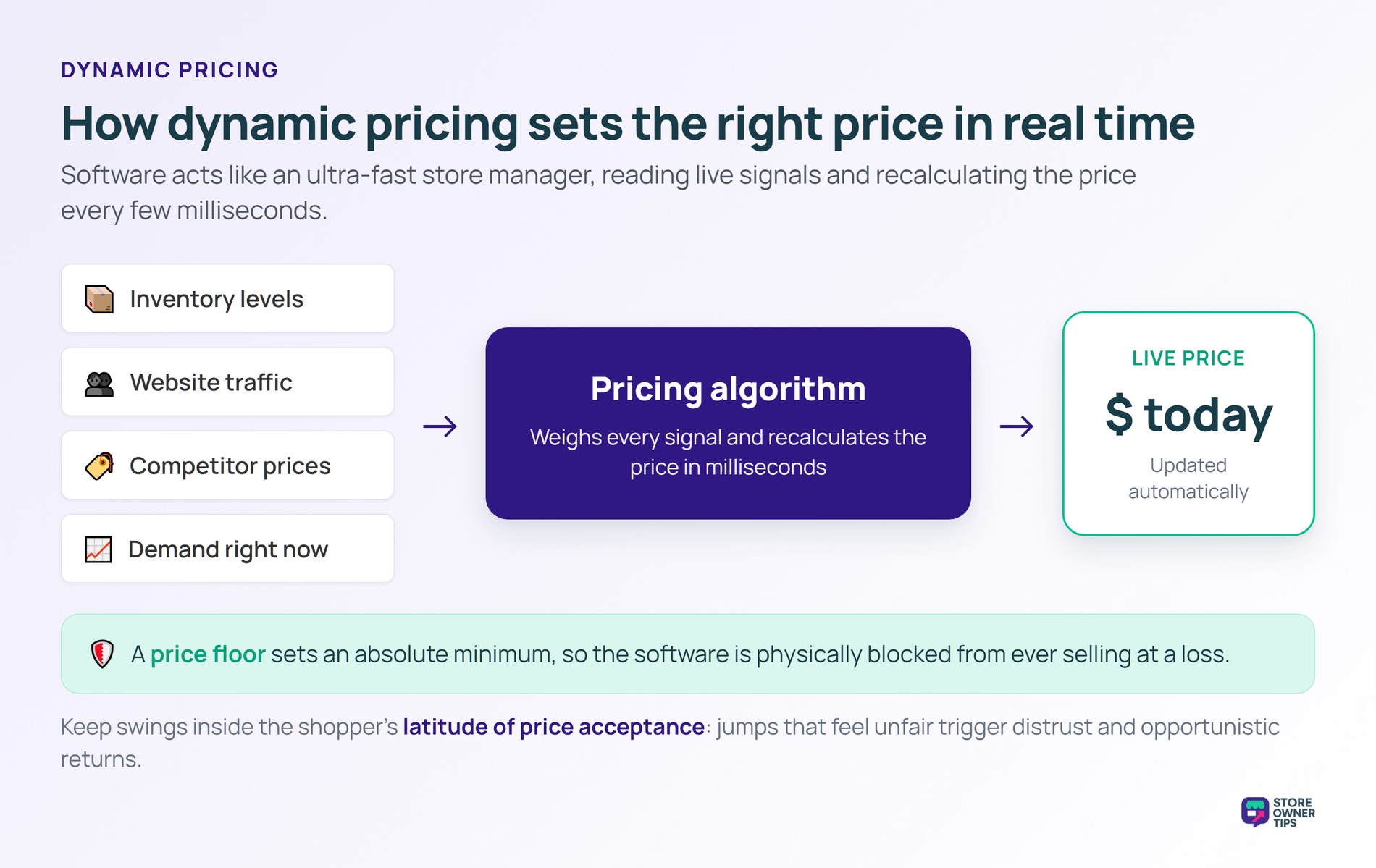
However, throwing fluctuating prices at a consumer introduces complex behavioral psychology. Shoppers have a “Latitude of Price Acceptance.” Think of this as a customer’s internal “gut feeling” about what a fair price should be, based on past experiences. If your automated price goes higher than their gut feeling, it triggers a strong negative reaction. They feel cheated or exploited.
If shoppers are exposed to unpredictable, wild price swings, they develop bad habits. Some will aggressively delay their purchases, knowing your store will eventually drop the price again. Others engage in “opportunistic returns.” This happens when a customer buys a product, sees the price automatically drop the next day, and returns their original item just to buy it again at the cheaper rate. This creates a massive logistical headache for your warehouse.
To make this technology work safely, we rely on advanced platforms. For example, Shopify uses something called Shopify Functions. Think of a Shopify Function as a highly secure, private sandbox right next to your digital checkout line. It can evaluate what is in a shopper’s cart and rapidly change the price right before they swipe their credit card. WooCommerce handles this differently, using specific rule-based plugins that use simple AND/OR logic to decide when a discount is applied. If a shopper meets your specific criteria, the price drops immediate
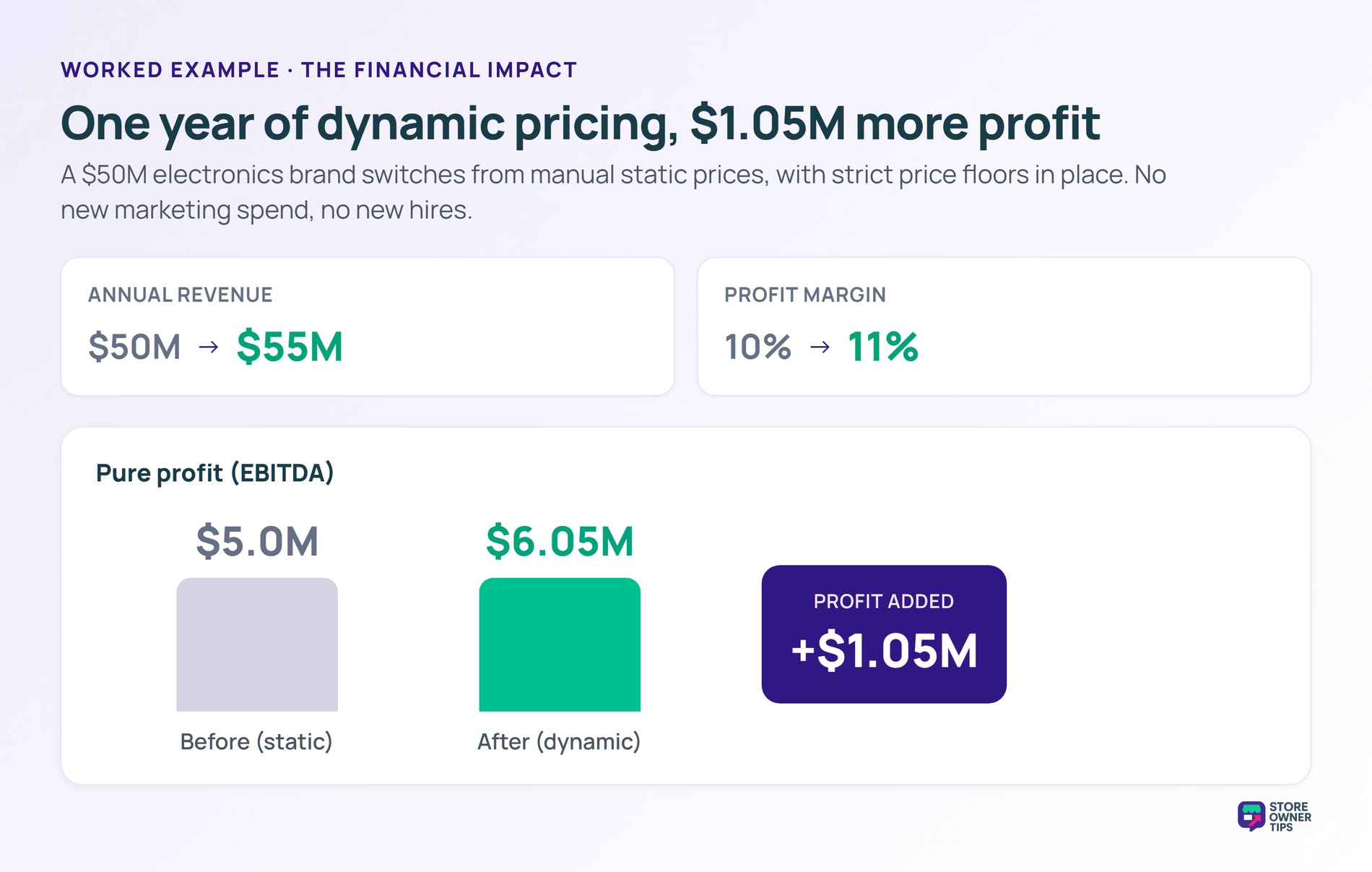
Let’s walk through exactly how this looks in the real world. Imagine a mid-sized consumer electronics brand selling headphones and accessories. They currently bring in $50 million in annual gross revenue. Because they use manual, static pricing, their net profit margin is stuck at 10%. This leaves them with $5 million in pure profit (EBITDA) at the end of the year.
The brand is struggling with rising supply chain costs and cannot afford to manually update 10,000 different product listings every week. So, the executive team decides to install a dynamic pricing app. To protect their business, they configure strict “price floors.” A price floor is an absolute minimum price limit, ensuring the software is physically blocked from ever selling an item at a loss.
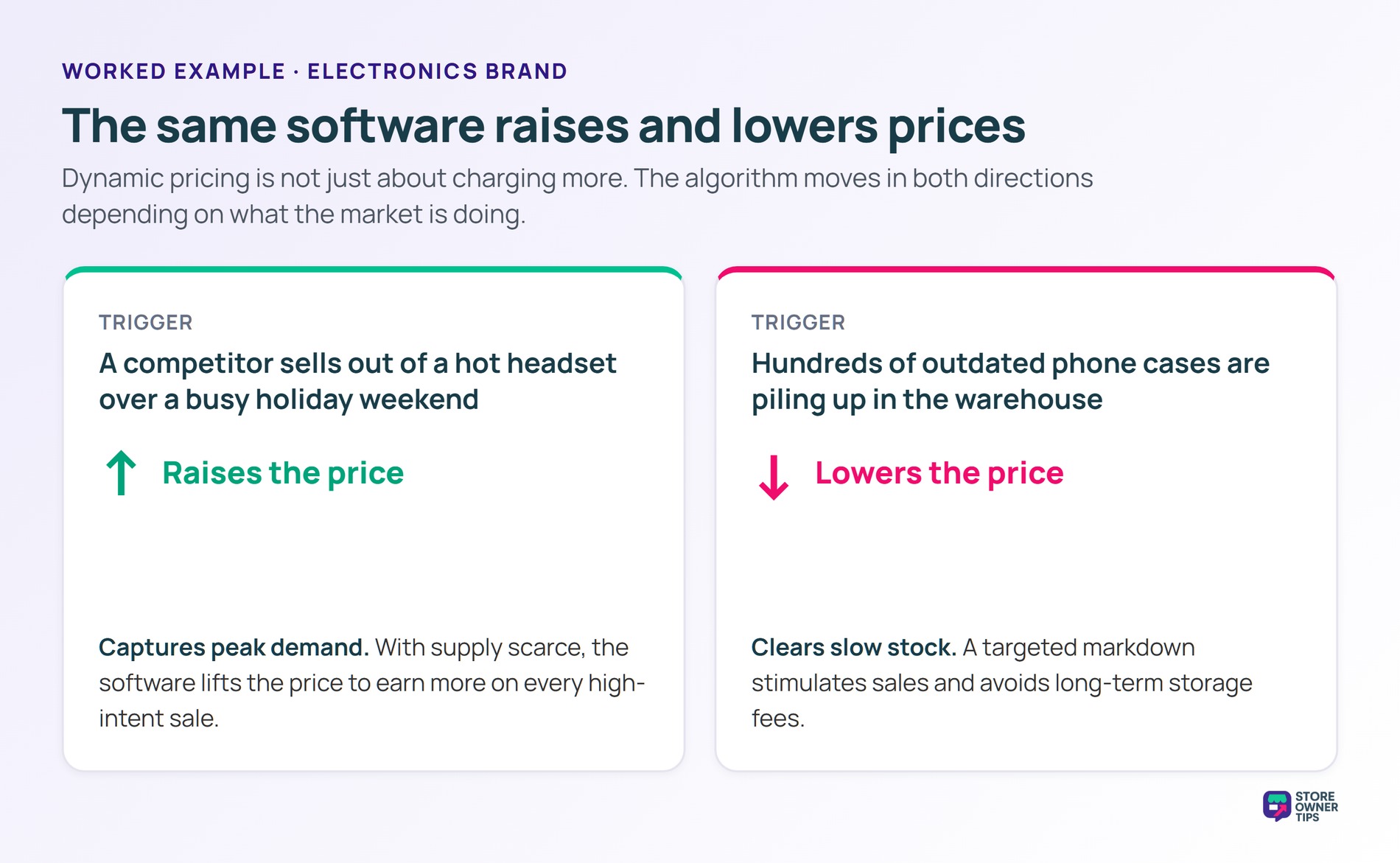
Once activated, the software goes to work. On a busy holiday weekend, the system notices a major competitor has sold out of a highly requested headset. Recognizing the sudden supply shortage, the software automatically raises the brand’s price to capture the peak demand. Later that month, the system realizes there are hundreds of outdated phone cases sitting in the warehouse. It automatically lowers the price to stimulate sales and avoid long-term storage fees.
The final financial results of this shift are staggering. Because the software deployed perfect, micro-targeted discounts, the brand sees a 10% lift in their conversion rate, exactly matching a recent McKinsey & Company benchmark. This bumps their baseline revenue up to $55 million.
Even more importantly, by capturing premium prices during high demand, they hit the upper end of McKinsey’s dynamic pricing benchmark of a 10% boost in profit margins. Their baseline profit margin grows from 10% to 11%. Applied to their newly lifted revenue, the brand’s pure profit jumps from $5 million to $6.05 million. That is a massive $1.05 million injection of profit, requiring zero extra marketing dollars or new employee hires.
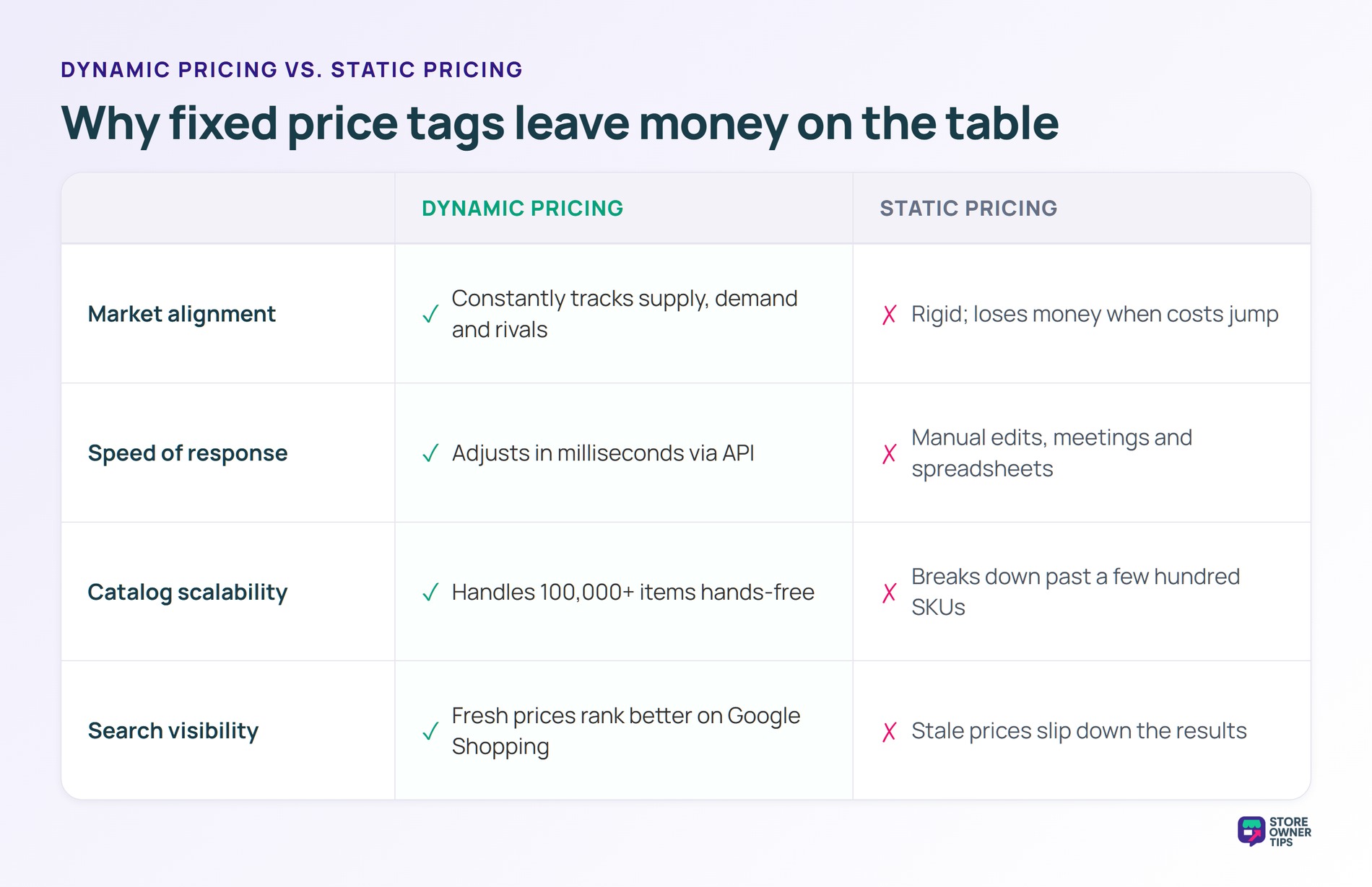
If you aren’t using automated pricing, you are using Static Pricing. Static pricing is the traditional retail model where you manually type a number into your store’s database and leave it there. It is completely blind to what is happening in the real world. While it feels safe, it forces your business to operate at a distinct disadvantage.
Like any powerful tool, handing control of your storefront over to software carries profound benefits and serious risks. You must understand both before turning these systems on.
Transparency is your ultimate safeguard. Consumers are far more willing to accept dynamic pricing when the logic is transparent. You should avoid secretive “surge pricing” and instead frame changes around real market events. For example, explicitly showing “Only 2 left at this price” or using a visible countdown timer anchors the price fluctuation to a logical reason rather than a greedy algorithm. You should also set firm limits, like preventing prices from jumping more than 10% in a single day, to avoid shocking your loyal buyers.
Small and mid-sized stores absolutely have access to this technology. You do not need to build a proprietary system from scratch. Shopify merchants can use native tools or highly rated third-party apps to completely automate inventory-based rules without writing any code. Similarly, WooCommerce store owners can install verified extensions that execute complex, multi-tiered pricing rules automatically.
You solve this by using strict “price floors.” You must configure your software with an absolute minimum profit margin, physically forcing the system to stop discounting once that line is hit. Furthermore, smart algorithms don’t just copy competitors; they monitor competitor stock levels. If your rival has the cheapest price on the internet but they are completely sold out, your system should recognize that and raise your price, optimizing for profit instead of blindly matching an empty shelf.
Dynamic pricing is no longer just a luxury reserved for massive retail corporations; it is a fundamental pillar of modern e-commerce survival. By establishing strict pricing rules, protecting your profit floors, and remaining highly transparent with your customers, you can transform your digital storefront into an automated, profit-generating machine.
Copyright © StoreOwnerTips.com. All Rights Reserved.
