Weekly ecommerce tips, deals & news.
E-E-A-T stands for Experience, Expertise, Authoritativeness, and Trustworthiness. It is the framework Google’s human raters use to judge content quality. The idea is simple: content from a credible, knowledgeable source should outrank thin or shady pages. For stores, strong E-E-A-T means showing why your content and brand deserve trust.
E-E-A-T packs four quality signals into one term. Experience means firsthand, real-world knowledge of a topic. Expertise means deep, skilled understanding of the subject.
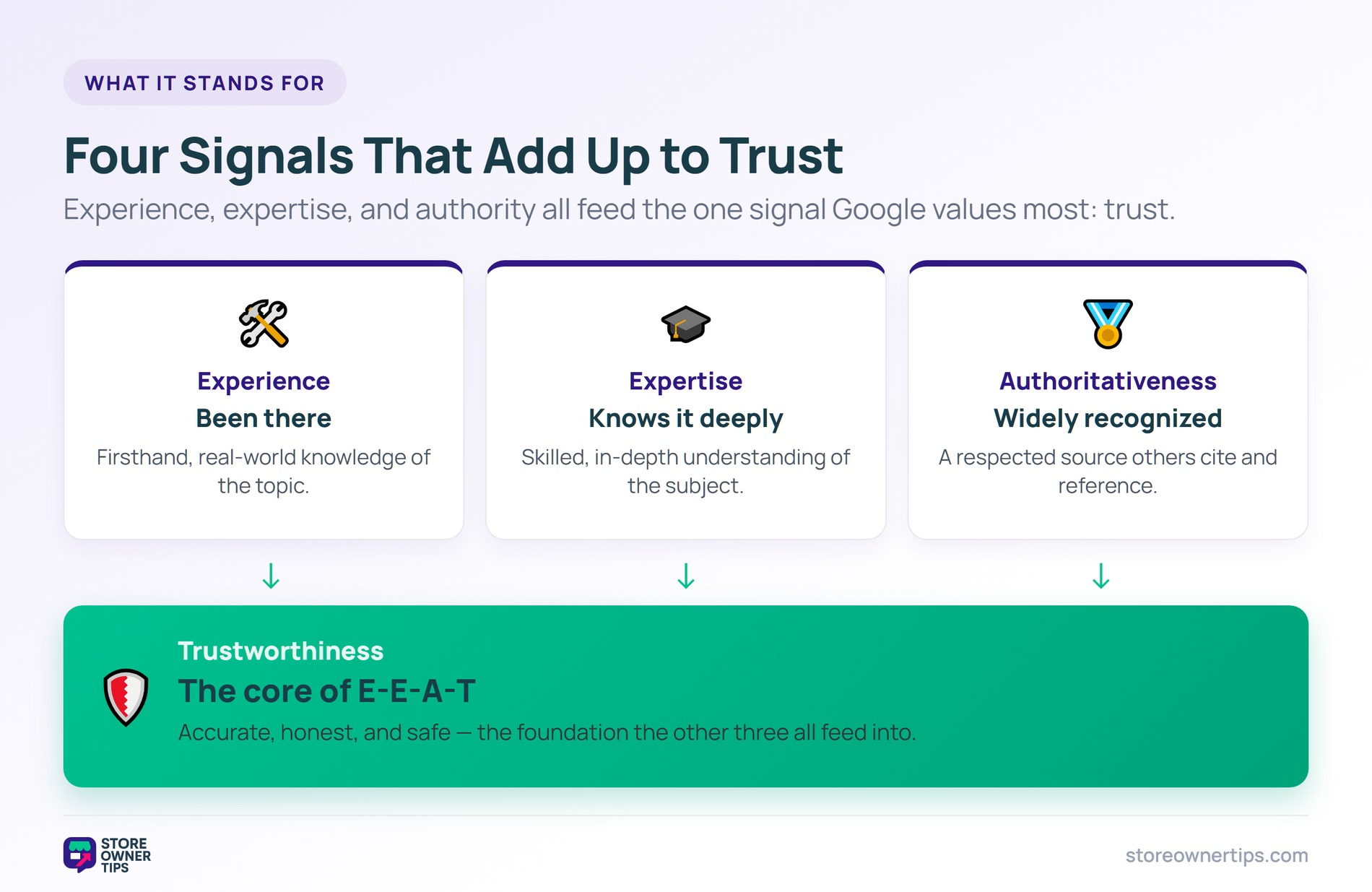
Authoritativeness means being a recognized source others cite. Trustworthiness means being accurate, honest, and safe. Google calls trust the most important of the four.
Think of it like choosing an advisor. You want someone who has done it, knows it, is respected, and is honest. E-E-A-T asks those same questions of a web page.
The four work as a stack, not a checklist. Each one supports the next. Together they paint a picture of credibility.
E-E-A-T lives in Google’s Search Quality Rater Guidelines. Human raters use it to score sample results. Their ratings train and check Google’s ranking systems.
The framework began as E-A-T years ago. Google added the extra E for Experience in 2022. That change rewards real, hands-on knowledge.
So E-E-A-T is not a button Google presses. It is a lens for judging whether content is good. The ranking systems aim to reward what raters value.
E-E-A-T is not a single, direct ranking factor. Google does not assign your page an E-E-A-T score. So you cannot tune one dial and rank higher.
Instead, it guides many signals at once. Google looks for clues that match what raters reward. Those clues add up to better rankings.
This matters most for sensitive topics. Health, money, and safety pages face the highest bar. Google calls these your-money-or-your-life topics.
Strong E-E-A-T helps your content earn its rankings. Google wants to surface sources people can trust. Credible pages tend to rise over time.
Higher rankings then capture more clicks. The top result earns about 27.6% of clicks, the top three over 54%. Trust is the path to that visibility.
It also feeds the largest channel online. Organic search drives 53.3% of all site traffic. Weak trust quietly caps your share of it.
Trust also lifts conversions, not just rankings. A credible page makes shoppers comfortable buying. Doubt is the enemy of a sale.
Google calls trust the heart of E-E-A-T. The other three all feed into it. A page can be expert yet still untrustworthy.
Trust covers accuracy, honesty, and safety. A secure site and honest claims build it. A scammy or sloppy page destroys it fast.
So lead with trust in everything. Clear policies, real reviews, and accurate facts all help. Without trust, the other signals barely matter.
Never fake your trust signals. A planted review or false claim backfires. Real trust is the only kind that lasts.
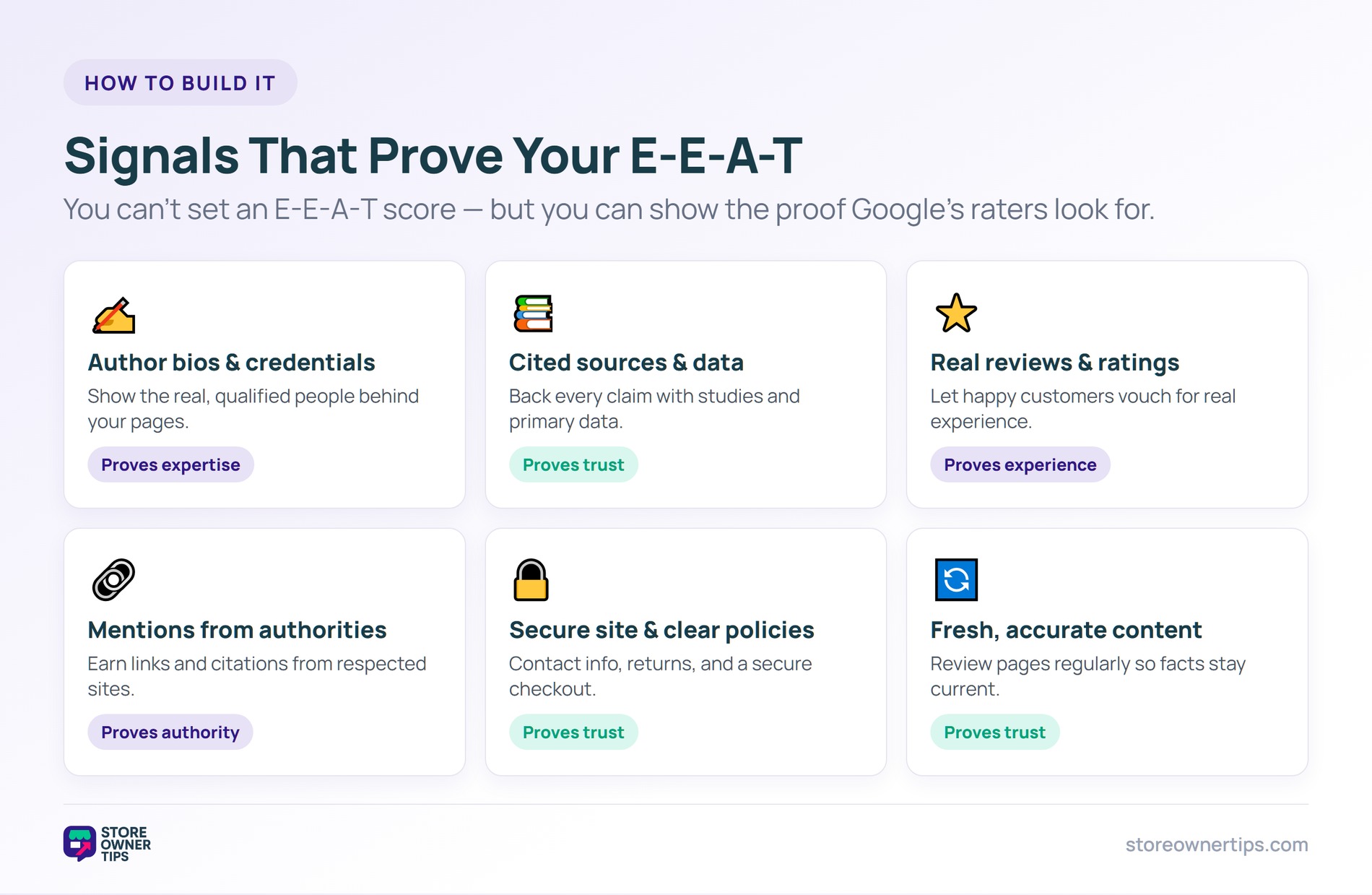
Start by showing who wrote the content. Add author names, bios, and real credentials. A faceless page signals little expertise.
Back your claims with credible sources. Link to studies and primary data, not rumors. Accurate, sourced content reads as trustworthy.
Let happy customers vouch for you. Reviews and ratings are powerful social proof. They show real experience with your brand.
Earn mentions from respected sites too. A link or citation from an authority lifts you. Outside trust reinforces your own.
Keep your content fresh and accurate. Outdated facts erode trust over time. A regular review keeps pages credible.
E-E-A-T is not just for blog posts. Product pages need it just as much. Shoppers and Google both judge their credibility.
Add detailed, honest product information. Real photos, specs, and reviews show experience. Vague pages signal a low-trust store.
Display trust marks where they fit. Secure-checkout badges and clear returns help. They reassure both buyers and search engines.
Customer questions and answers help too. They show a real, engaged community. That activity signals a trustworthy store.
AI engines also favor trustworthy sources. They prefer to cite content that looks credible. So E-E-A-T shapes AI visibility, not just rankings.
Clear authorship and sources help machines trust you. They signal a reliable source worth quoting. This supports your generative engine optimization work.
So building trust pays off everywhere. It lifts classic rankings and AI citations alike. One credible brand wins across every engine.
Answer engines lean hard on trusted sources. They quote pages that read as expert. So answer engine optimization rewards strong E-E-A-T.
A trusted brand gets quoted again and again. Each citation builds more authority. The cycle compounds your visibility.
So the trust you build is never wasted. It earns clicks, citations, and repeat mentions. Credibility is the currency of every engine.
You cannot score E-E-A-T directly. But you can audit the signals behind it. Check authors, sources, reviews, and trust marks.
Read your pages as a skeptical stranger would. Ask if they prove real expertise and honesty. Gaps in that proof are your to-do list.
Compare your pages to the ranking leaders. See what trust signals they show. Then match or beat them honestly.
The first mistake is hiding the author. Anonymous content struggles to prove expertise. Show real people behind your pages.
Another trap is thin, copied content. Pages with no real insight signal low quality. Add firsthand experience and depth instead.
A third slip is ignoring trust basics. Missing contact info, reviews, or secure pages all hurt. Cover the fundamentals that prove you are real.
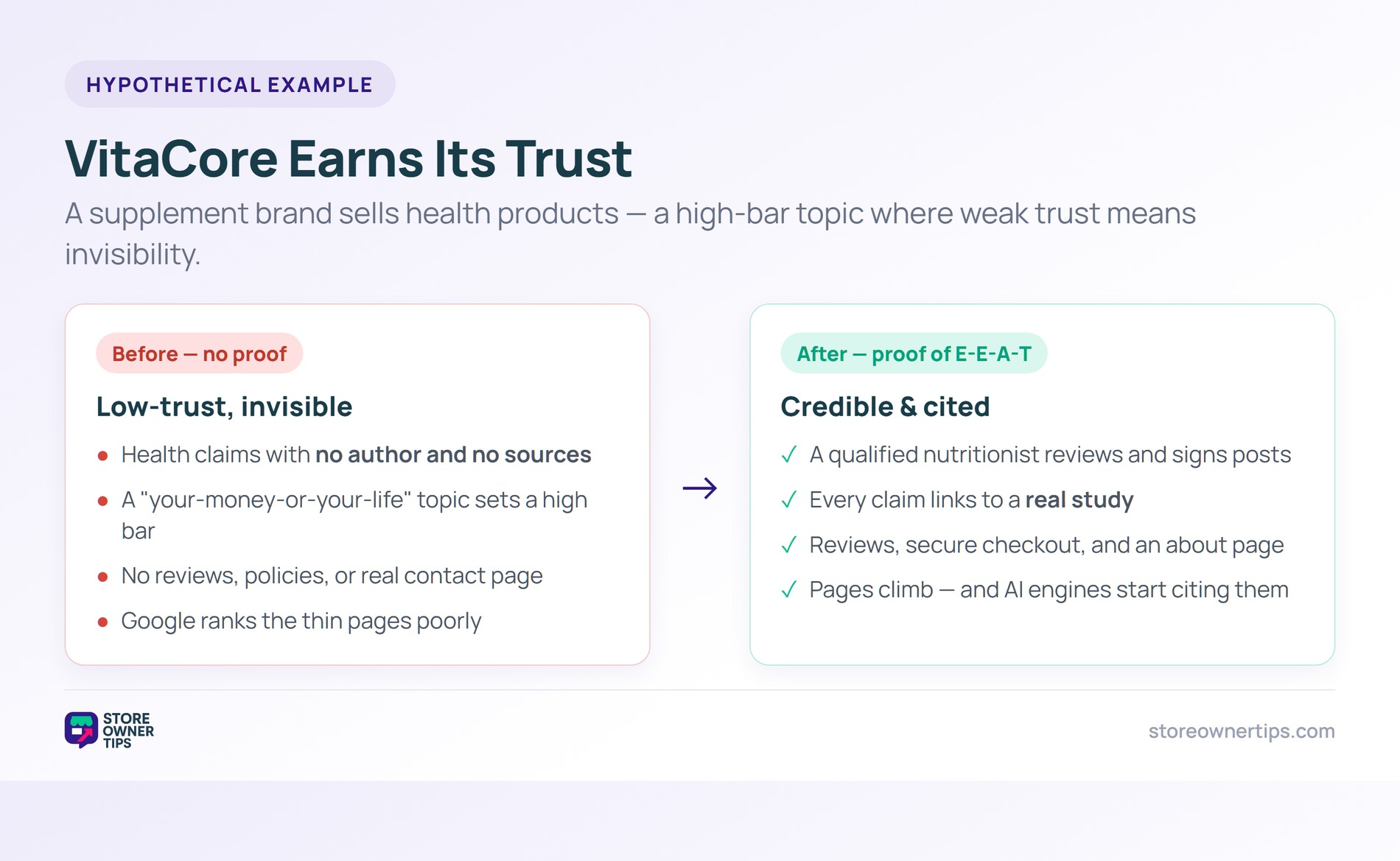
Imagine a supplement brand called VitaCore on WooCommerce. It sells health products, a sensitive topic for Google. Its blog posts have no authors and no sources.
VitaCore’s health claims appear with no backing. No expert name or study supports them. Google treats the pages as low-trust and ranks them poorly.
On a your-money-or-your-life topic, that bar is high. Thin, unsourced claims simply cannot compete. The store stays invisible for valuable terms.
VitaCore also lacks basic trust signals. It has no reviews, no policies, and no real contact page. The site feels risky to buyers and Google alike.
VitaCore adds expert authors to every post. A qualified nutritionist reviews and signs the content. Each claim now links to a real study.
The brand also surfaces customer reviews and credentials. It adds clear contact details and secure checkout. The whole site now signals real trust.
Google rewards the credible, sourced content. VitaCore’s health pages climb the rankings. Shoppers and search engines both trust it more.
VitaCore also adds an about page with its team. The faces and credentials build instant trust. Visitors see real experts behind the brand.
AI engines start citing its expert articles too. The brand becomes a go-to source in its niche. The lesson is clear: trust is the foundation of visibility.
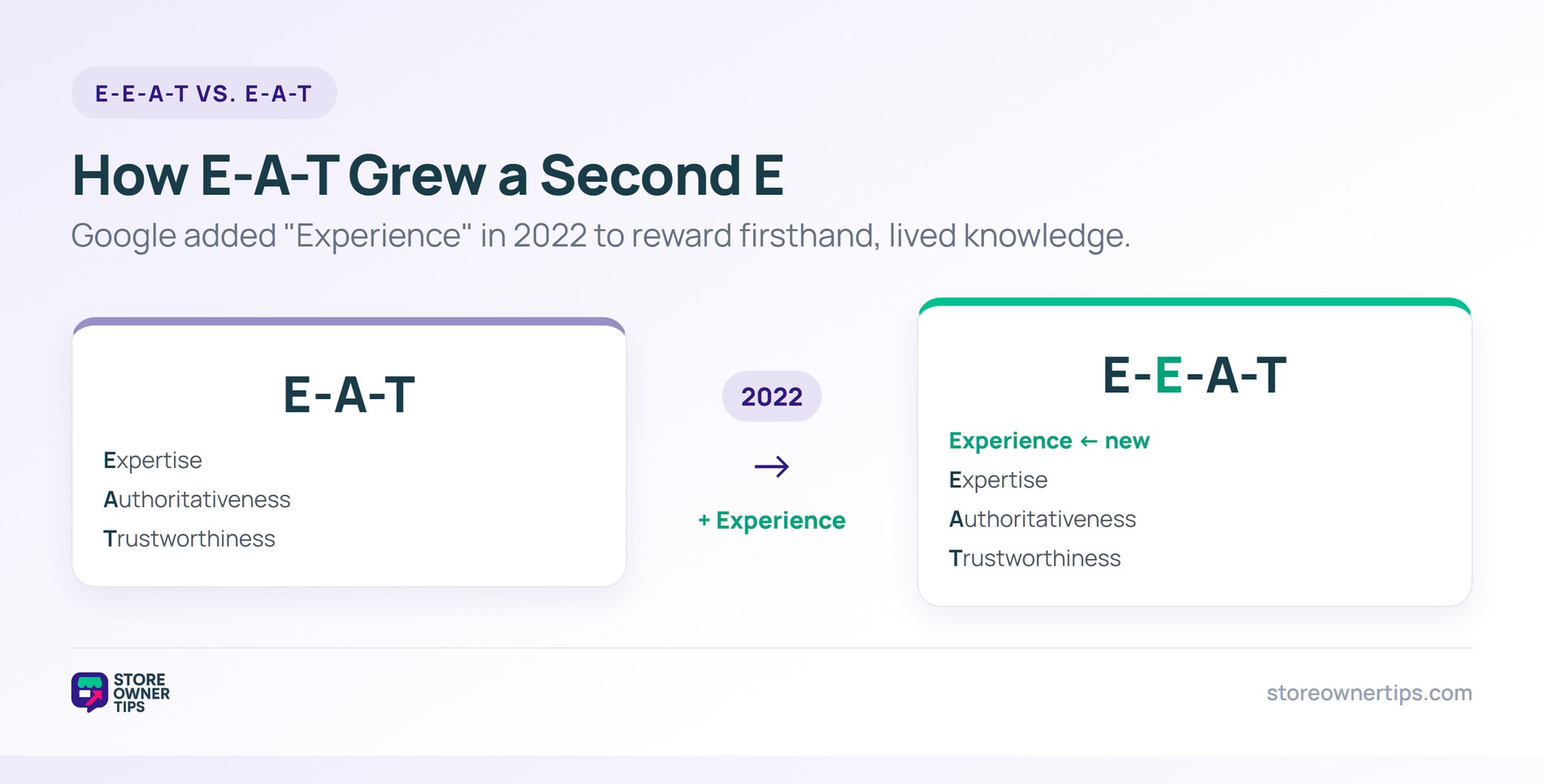
E-A-T was the original framework from Google. It stood for Expertise, Authoritativeness, and Trustworthiness. For years, those three guided quality raters.
In 2022, Google added a second E for Experience. The term became E-E-A-T to reflect it. The change rewards firsthand, lived knowledge.
The shift matters for content creators. A reviewer who actually used a product now counts more. Real experience beats secondhand summaries.
So E-E-A-T is simply E-A-T plus experience. The core idea did not change. Google just made hands-on knowledge explicit.
It stands for Experience, Expertise, Authoritativeness, and Trustworthiness. Google’s raters use it to judge content quality. Trust is the most important of the four.
Not a direct one, since Google assigns no E-E-A-T score. It guides many signals that do affect rankings. So focus on the signals, not a magic number.
Show clear authors with real credentials. Back claims with credible sources and reviews. Start with trust, then prove your expertise.
E-E-A-T is Google’s lens for judging whether content comes from a credible source. It is not a dial you set, but a standard you meet with proof of experience and trust. Show your expertise, cite your sources, and earn real reviews, and both shoppers and search engines will reward you. Earn trust first, and rankings follow.
Copyright © StoreOwnerTips.com. All Rights Reserved.
