Weekly ecommerce tips, deals & news.
Generative Engine Optimization (GEO) is the practice of shaping your content so AI answer tools mention and cite your brand. These tools include ChatGPT, Perplexity, and Google’s AI Overviews. Instead of ranking a list of links, they write a single answer. GEO helps your store become part of that answer when shoppers ask AI instead of searching.
Traditional search shows a list of links and lets you choose. A generative engine reads many sources and writes one answer for you. GEO is about getting your store into that written answer.
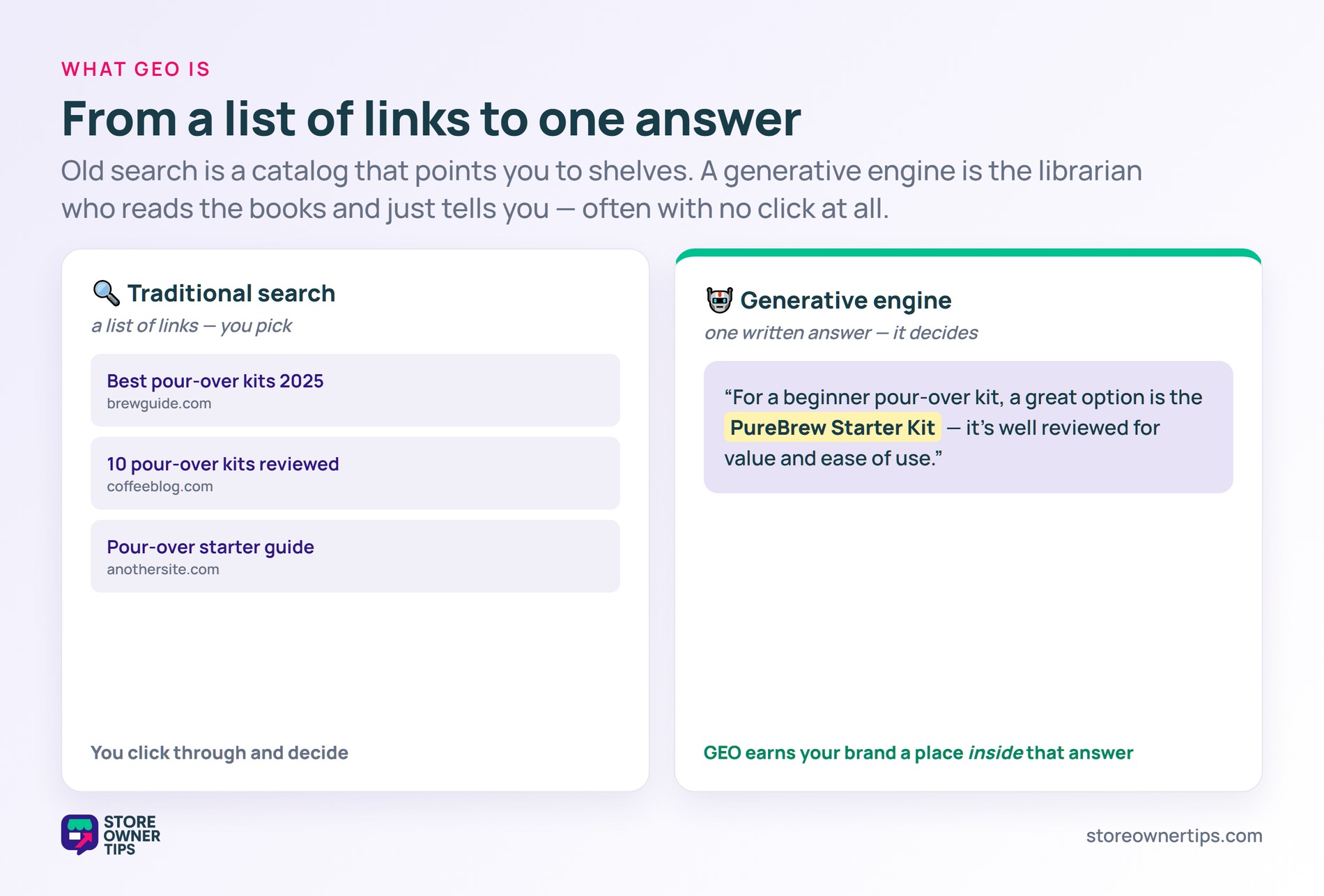
Picture a library to see the difference. Old-style search is the catalog that points you to shelves. A generative engine is a librarian who reads the books and tells you the answer directly.
That shift often means no click at all. The answer appears right in the chat, a pattern known as zero-click commerce. GEO makes sure your brand is named even when no one visits a results page.
AI engines favor content they can read clearly and trust. They lean on pages with facts, sources, and a clear structure. Your job is to make your content easy to quote.
The research backs this up. The original GEO study tested nine tactics on a Bing-style answer engine. The top three were quotation addition, statistics addition, and cite sources.
Those tactics produced a relative visibility lift of 30 to 40% on the paper’s main metric. The authors note gains vary by topic.
So the takeaway is simple. Answer real questions plainly, back claims with data, and quote credible voices.
AI tools have scaled at a pace search never saw. ChatGPT reached 100 million users in about two months, the fastest-growing internet app at the time. Shoppers now treat these tools as a starting point.
That behavior already moves real money. Traffic to U.S. retail sites from generative AI sources jumped 1,200% in February 2025 versus July 2024. The visitors arriving this way are growing fast.
So the stakes are clear for store owners. If shoppers ask AI which product to buy, you want your store in the reply. GEO is how you earn that spot.
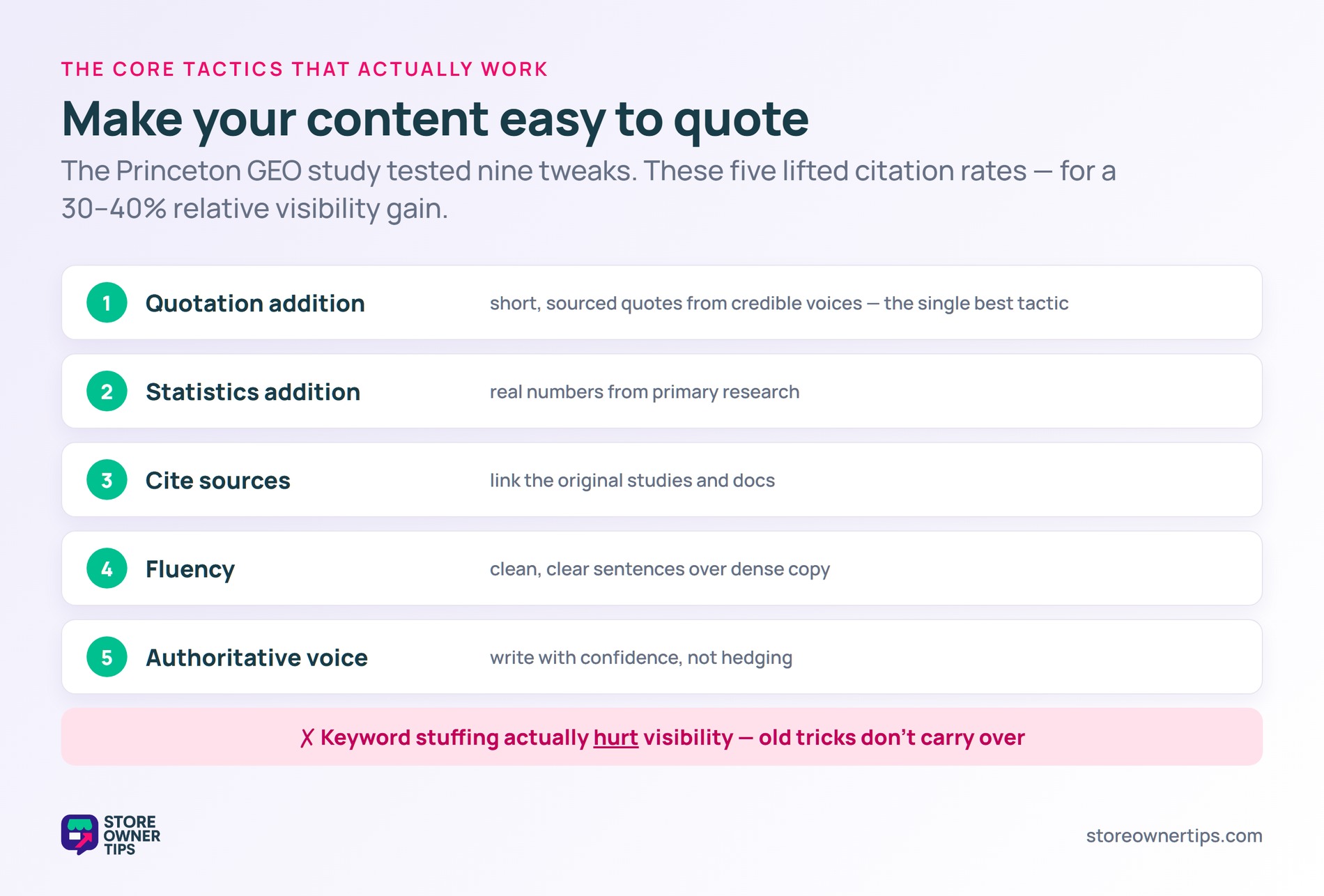
The Princeton GEO paper tested nine content tweaks. Five of them lifted citation rates in a meaningful way. The pattern is clear once you read the list.
Notice what’s missing from that winners’ list. Keyword stuffing actually hurt visibility in the study. Old-school tricks don’t carry over to AI engines.
Content alone isn’t the whole story. AI crawlers also reward clean technical signals. Three are worth focusing on for an ecommerce store.
AI engines build a picture of your brand from many sources. Your site is one input. Reviews, press mentions, and forum posts feed the same picture.
So GEO work spreads past your own pages. Earning a mention on a respected industry blog can boost how often engines name your brand. The same goes for an active Reddit thread or a strong review on a trusted site.
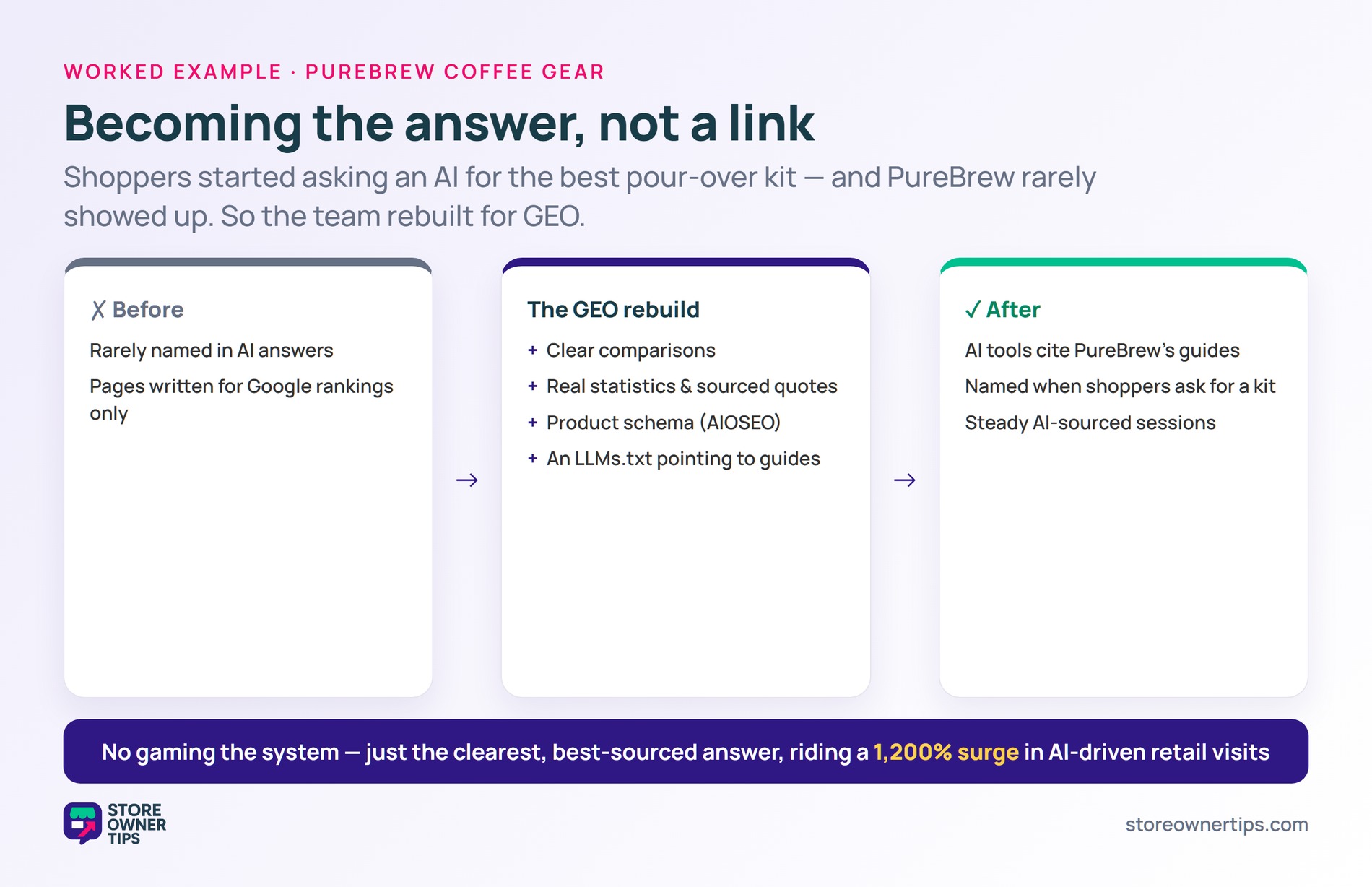
Imagine a WooCommerce store called PureBrew that sells coffee gear. Shoppers used to find it through Google searches. Lately, more of them ask an AI assistant for the best pour-over kit.
PureBrew rarely showed up in those AI answers. So the team rewrites key pages with GEO in mind. They add clear comparisons, real statistics, and sourced expert quotes.
They also ship the technical basics. Product schema goes on every listing through AIOSEO Pro. A short LLMs.txt file points crawlers to the buyer guides.
Over time, AI tools begin citing PureBrew’s guides. When a shopper asks for a beginner pour-over kit, the brand gets named. That mention carries the trust of a direct recommendation.
Some shoppers click through from the AI answer to buy. Others arrive already convinced by the mention. PureBrew starts seeing steady visits it never used to capture.
The math lines up with the wider trend. With AI-driven retail visits up 1,200% in early 2025, even a small slice is meaningful. For PureBrew, a few hundred extra AI-sourced sessions a month adds real revenue.
None of this required gaming the system. PureBrew simply made its content the clearest, best-sourced answer available. The AI engines did the rest.
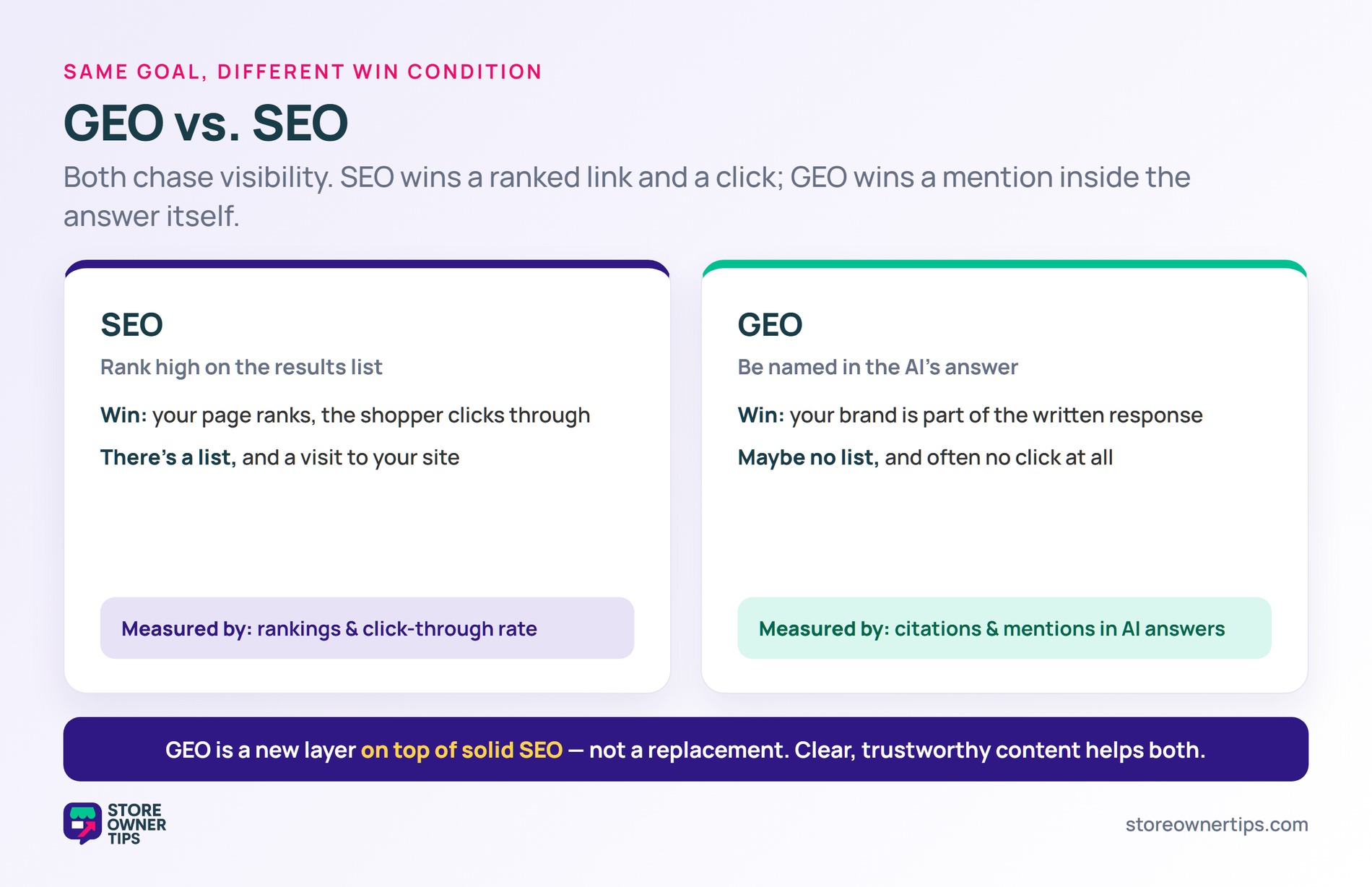
SEO and GEO share the same goal, which is visibility. SEO aims to rank your page high on a search results list. The shopper still clicks through to your site.
GEO aims to get your brand named inside an AI’s answer. There may be no list and no click at all. The win is being part of the response itself.
The good news is they overlap heavily. Clear, trustworthy, well-structured content helps both. GEO is best seen as a new layer on top of solid SEO, not a replacement.
One key difference matters for measurement. SEO is tracked by rankings and click-through. GEO is tracked by citations and mentions inside AI answers, which tools like Ahrefs Brand Radar now surface.
The newness of GEO leads to predictable missteps. Store owners often carry over old habits that no longer pay off. A few patterns come up again and again.
The fix for all four is the same. Build clear, well-cited content, label your brand and products plainly, and let trusted AI crawlers in. Then check the data to see which moves earn mentions.
You can’t improve what you don’t measure. GEO needs its own scoreboard, separate from your Google rankings. A few practical checks cover most stores.
The key is consistency. Run the same prompt audit each month and watch the trend. Small gains compound once your content earns repeated citations.
No, though they are closely related. SEO targets rankings on a search results page. GEO targets mentions inside AI-written answers. The two share many habits, so good content work helps both at once.
Start by writing clear answers to real shopper questions. Back your claims with data and credible sources. Keep product details structured and easy to read. Add schema markup and an LLMs.txt file so crawlers can find your best pages.
It’s early, but the signals are strong. AI tools already send fast-growing traffic to retail sites. Being named in an answer also carries real trust. Treat GEO as a long-term investment in visibility, not an instant sales switch.
Start with the ones your shoppers already use. ChatGPT, Google AI Overviews, and Perplexity cover most buyer queries today. The same content fundamentals work across all three, so you don’t need a separate plan for each.
Generative engine optimization is about earning a place inside the answers AI tools give shoppers. As more people ask instead of search, that place becomes as valuable as a top search ranking once was. Build clear, well-sourced content now, and your store will be ready to be named when shoppers turn to AI.
Copyright © StoreOwnerTips.com. All Rights Reserved.
