Weekly ecommerce tips, deals & news.
FOMO stands for the “fear of missing out.” It’s the anxiety that other people are enjoying experiences, deals, or opportunities you’ll regret skipping. In e-commerce, FOMO drives shoppers to act fast on limited-time offers, low-stock alerts, and exclusive drops. The term comes from psychology research, but it’s now a core lever in modern marketing. Used honestly, it shortens the path from browsing to buying. Used dishonestly, it backfires and breaks trust.
FOMO isn’t a single tactic. It’s a psychological state—literally a fear of missing out—that marketers can trigger, ride, or accidentally amplify. The same impulse that makes someone refresh Instagram drives the rush to checkout. When “only 2 left” shows up next to a product, the shopper feels it instantly. Strip the marketing veneer, and FOMO is just an emotional response to perceived loss.
Andrew Przybylski and his co-authors named FOMO in a 2013 academic paper looking at psychology and mental health. They defined it as a pervasive worry that others might be having rewarding experiences while you’re absent. The team also built the first measurement scale for it.
The concept predates smartphones, but social media supercharged it. A constant feed of other people’s vacations, dinners, and purchases gives the FOMO trigger fuel. It reacts every minute. In short, marketers noticed, and so did academics.
Plus, the Pressat-distributed Eventbrite UK study found that 66% of millennials feel more fulfilled by live experiences than by buying things. Using FOMO in coupon campaigns has since become a staple of modern e-commerce.
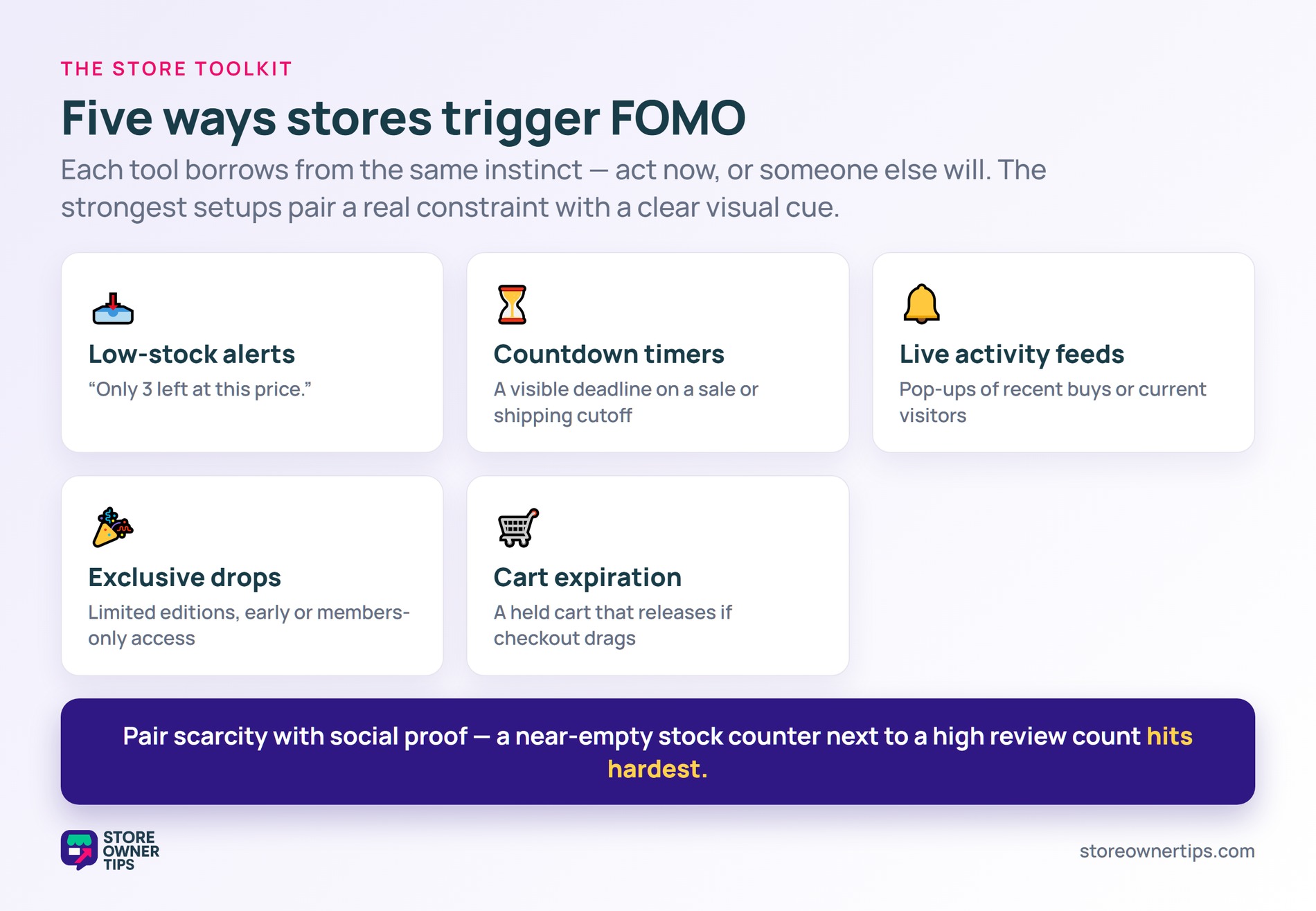
Stores trigger FOMO with a familiar toolkit:
Each one borrows from the same instinct: act now, or someone else will. The strongest examples pair scarcity with social proof. A near-empty stock counter next to a high review count hits hardest.
In practice, the most effective rollouts pair a real constraint with a clear visual cue. A stock counter doesn’t move the needle if the number stays at 99. It works when the number is small and ticks down.
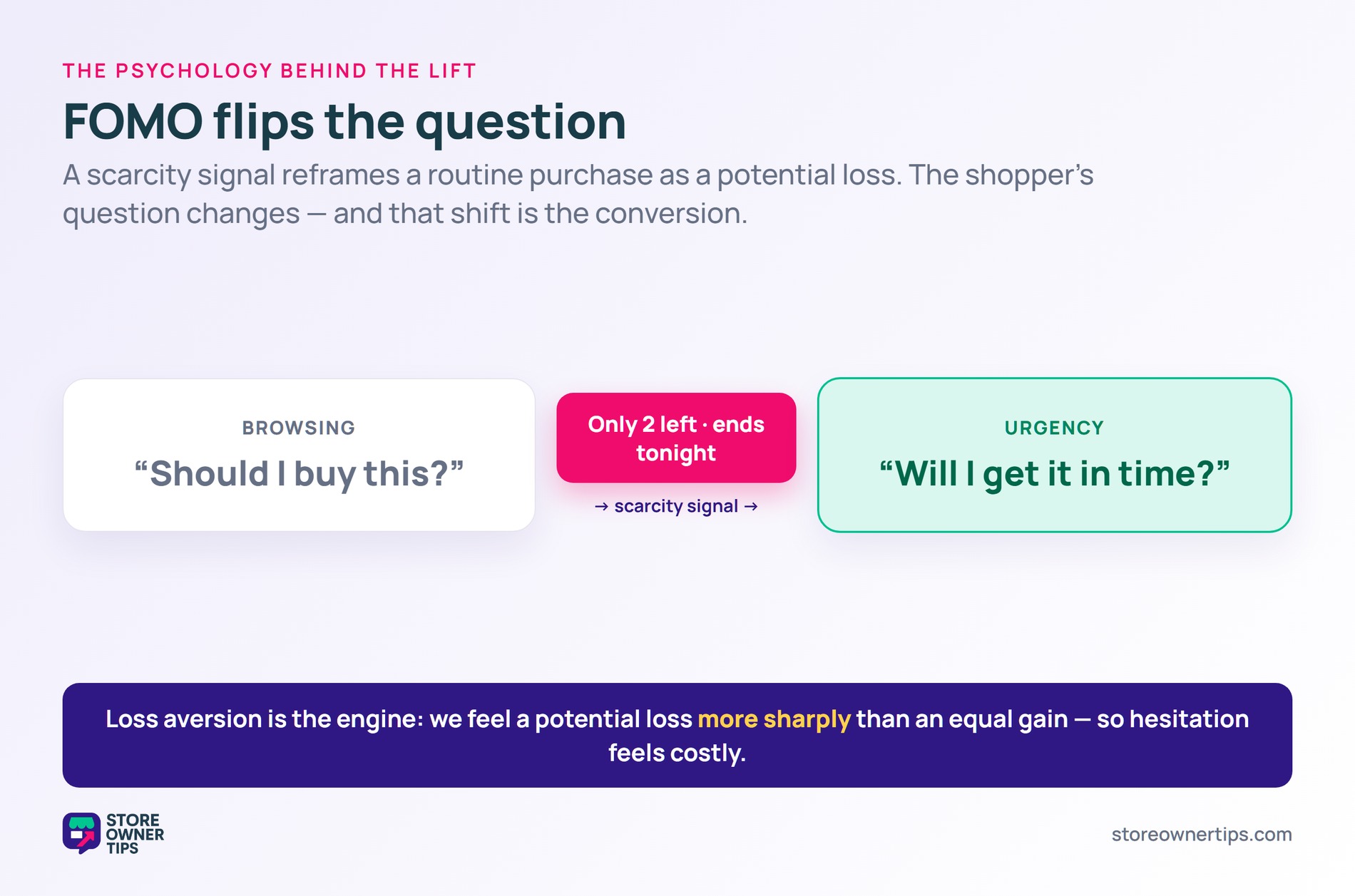
FOMO works because of loss aversion. People feel the pain of losing something more sharply than the pleasure of gaining it. A “limited stock” message reframes a regular purchase as a potential loss.
This is why Cialdini lists scar
However, this instinct isn’t limited to younger shoppers. Even baby boomers admit to feeling FOMO around live events. The principle cuts across age groups, even if the triggers differ.
Walk through a fully hypothetical store rolling out FOMO tactics for the first time. The mechanics and math below borrow from real research, not the store itself.
Imagine a Brisbane-based brand selling small-batch chai blends on WooCommerce. Call it ChaiHaus. The store gets 15,000 sessions a month and converts at 1.8%. Average order value is $35.
That works out to 270 monthly orders and $9,450 in revenue. Most product pages are static. Still, there’s no urgency, no exclusivity, no signal that anyone else is buying.
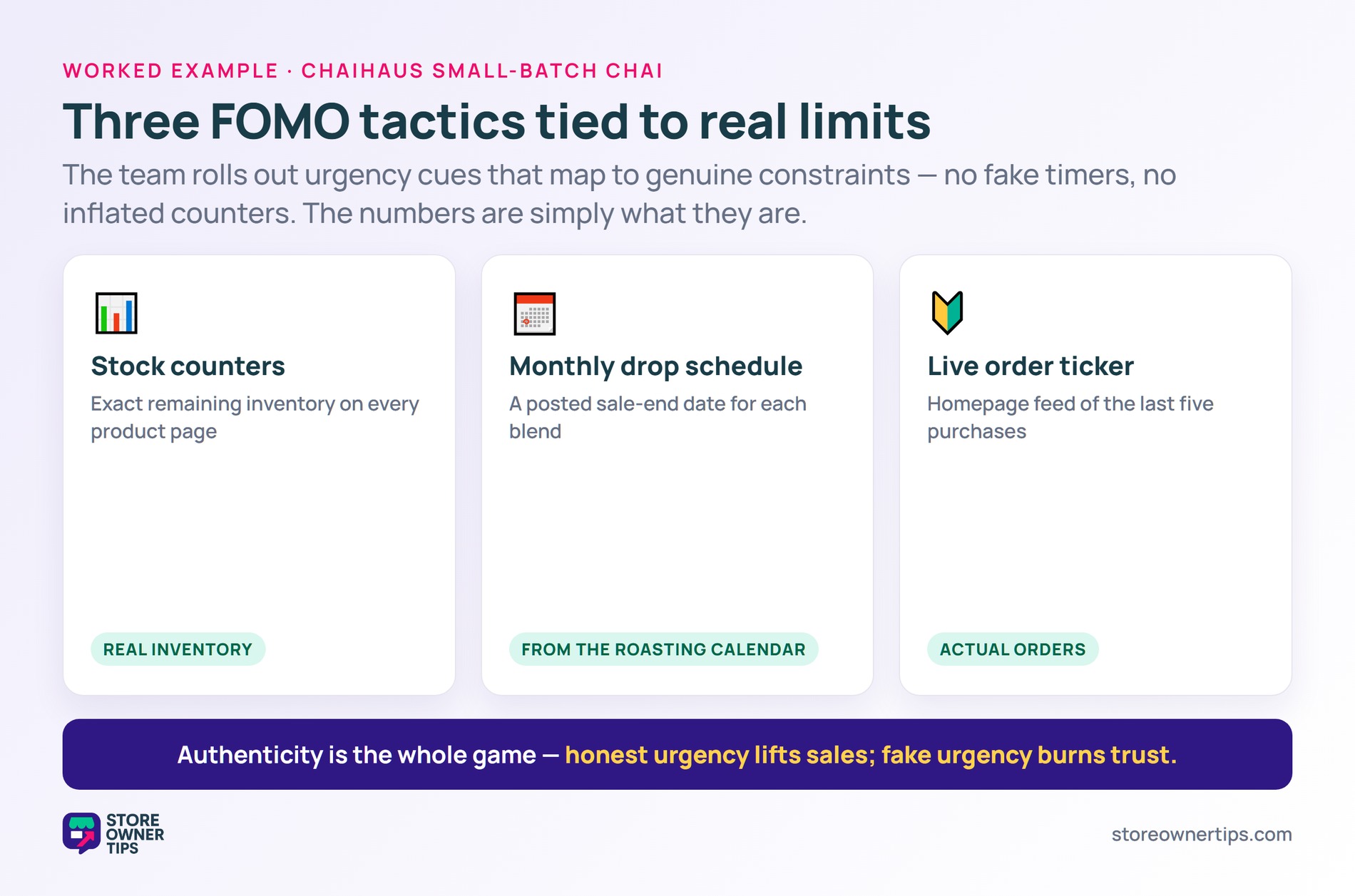
The team picks three FOMO tactics tied to real constraints:
The team explicitly avoids fake timers and inflated low-stock alerts. Inventory is what it actually is. The drop end date is what’s printed in the wholesale roasting schedule.
All three tactics use the existing WooCommerce product page layout. No extra plugins were strictly needed for the basic version.
Conversion rate climbs from 1.8% to 2.4%. Sessions stay flat. Monthly orders move from 270 to 360, and revenue lifts from $9,450 to $12,600.
The lift sits inside the well-documented range for honest urgency tactics. Meanwhile, ChaiHaus also tracks something secondary. Customer complaints about “out of stock by the time I checked out” dropped sharply. The stock counter set accurate expectations.
It depends on whether the urgency is real. A genuine sale-end date or a real stock count is just honest communication. By contrast, a countdown that resets every visit is deception.
The line is drawn at accuracy. On top of that, stores that pair FOMO tactics with truthful inventory and clear deadlines tend to keep customer trust over time. Stores that fake either one tend to see returning customers drop off as shoppers get wise.
A useful test: would you be comfortable explaining the mechanic to the customer in person? If yes, it’s probably ethical. If you’d hide behind the screen, rebuild it.
Many WooCommerce stores set this up with native coupon-expiration and stock-limit features. Both keep the urgency honest by design.
Yes, when the tactic is honest. Real countdown timers and real low-stock alerts increase conversion measurably. Well-run urgency campaigns can lift sales noticeably without permanent discounting.
But the same research shows fake urgency hurts customer lifetime value sharply. The short-term lift comes at the cost of long-term repeat business. That trade is rarely worth it.
FOMO also stops working when it’s overused. A store running a “last chance” sale every week trains its audience to wait it out. Shoppers know another sale is always coming.
The cleanest urgency tactics are those tied to genuine constraints. Real inventory limits, shipping cutoffs, or end-of-quarter deadlines work best.
In short, scarcity is the mechanic. FOMO is the emotion the mechanic triggers. They’re often used interchangeably, but the distinction matters.
Scarcity describes a real or perceived limit on supply or time. Low stock, a sale deadline, a limited edition. FOMO is what the shopper feels when they see one of those signals. It’s the sense that hesitation might mean losing out.
Most successful stores stack both. Real scarcity (the trigger) plus clear messaging that invites a FOMO reaction (the lift). One without the other lands flat.
Practical advice: pick the mechanic that fits your inventory. If you sell limited-run drops, scarcity is built in. If you run regular sales, urgency is your lever. Mix them only when both are genuinely real at the same time.
FOMO is one of the most powerful conversion levers in e-commerce, but also the easiest to break. Real urgency, real scarcity, and real deadlines lift sales without burning trust. Fake versions trade short-term wins for long-term churn, which is almost never the right call.
Copyright © StoreOwnerTips.com. All Rights Reserved.
