Weekly ecommerce tips, deals & news.
Hidden fees are mandatory charges a shopper meets at checkout, after deciding to buy. The price that drew them in was not the price they pay. Nothing about the charge has to be dishonest for it to land badly. The surprise does the damage, not the amount.
Hidden fees work by splitting one price into two moments. The shopper decides at the first number and pays at the second. Everything between those two moments is a chance to lose them.
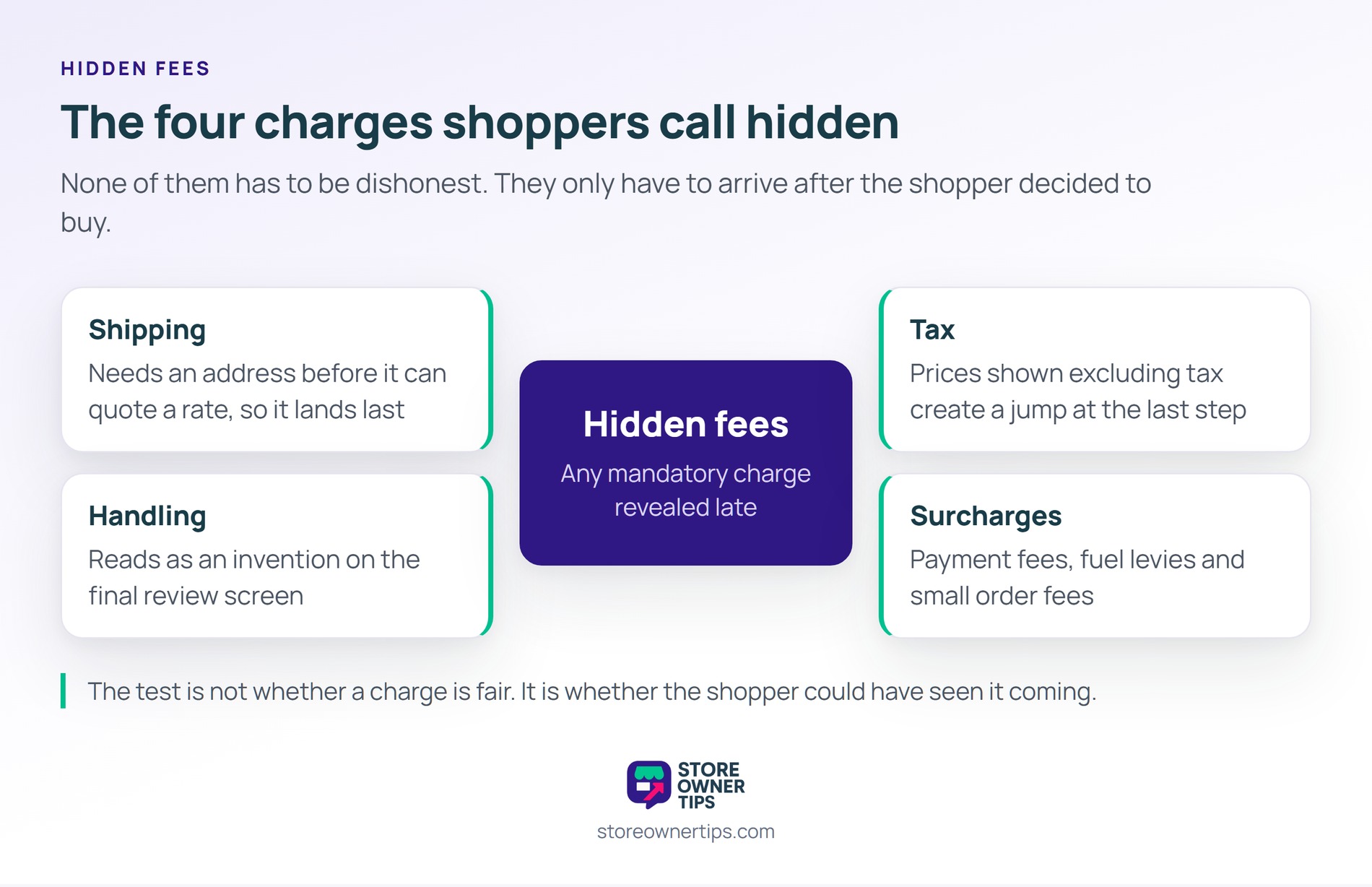
No store sets out to hide anything. The gap usually opens because shipping cannot be calculated until an address exists.
Shipping is the biggest one by a wide margin. It arrives late because your store needs a destination before it can quote a rate. The shopper does not know that, and only sees a number appear.
Handling comes next. A packing charge added at the final review step reads as an invention, even when it covers real work.
Then there is tax. Stores that display prices excluding tax create a jump at the last step that shoppers rarely expect.
Smaller ones do the same job. Payment surcharges, fuel levies, and small order fees all land in the same place. The test is not whether a charge is fair. It is whether the shopper could have seen it coming.
A shopper who reaches your checkout has already spent effort. They chose a product, picked a variation, and filled in an address. The total then moves in the wrong direction.
That reversal costs more than the money. It tells the shopper the advertised price was incomplete. A reasonable person then wonders what else is missing.
Worse, it sends them back to compare. They now weigh your full total against a competitor’s advertised price. That is a comparison you lose on arithmetic alone.
You cannot see this problem in an overall conversion rate. It hides inside one step of the checkout. So you have to look at the steps separately.
Start with the drop between the address step and the payment step. Every store loses some shoppers there. A store with a surprise charge loses a visible chunk.
Then read your support inbox for a week. Count the messages asking why a total came out higher than expected. Those people are the vocal edge of a much larger group.
Last, buy something from your own store on a phone. Note the first moment you see the real total. Anything after the cart is too late.
The practice now has a formal name in US law. The Federal Trade Commission’s Rule on Unfair or Deceptive Fees took effect on May 12, 2025. It requires the total price, including mandatory fees, to be shown up front.
Read the scope carefully before you panic or relax. The rule covers live-event ticketing and short-term lodging only. A store selling physical products is not covered by it.
What it does tell you is the direction of travel. A regulator has now defined late fee disclosure as a deceptive act. Shoppers were already treating it that way.
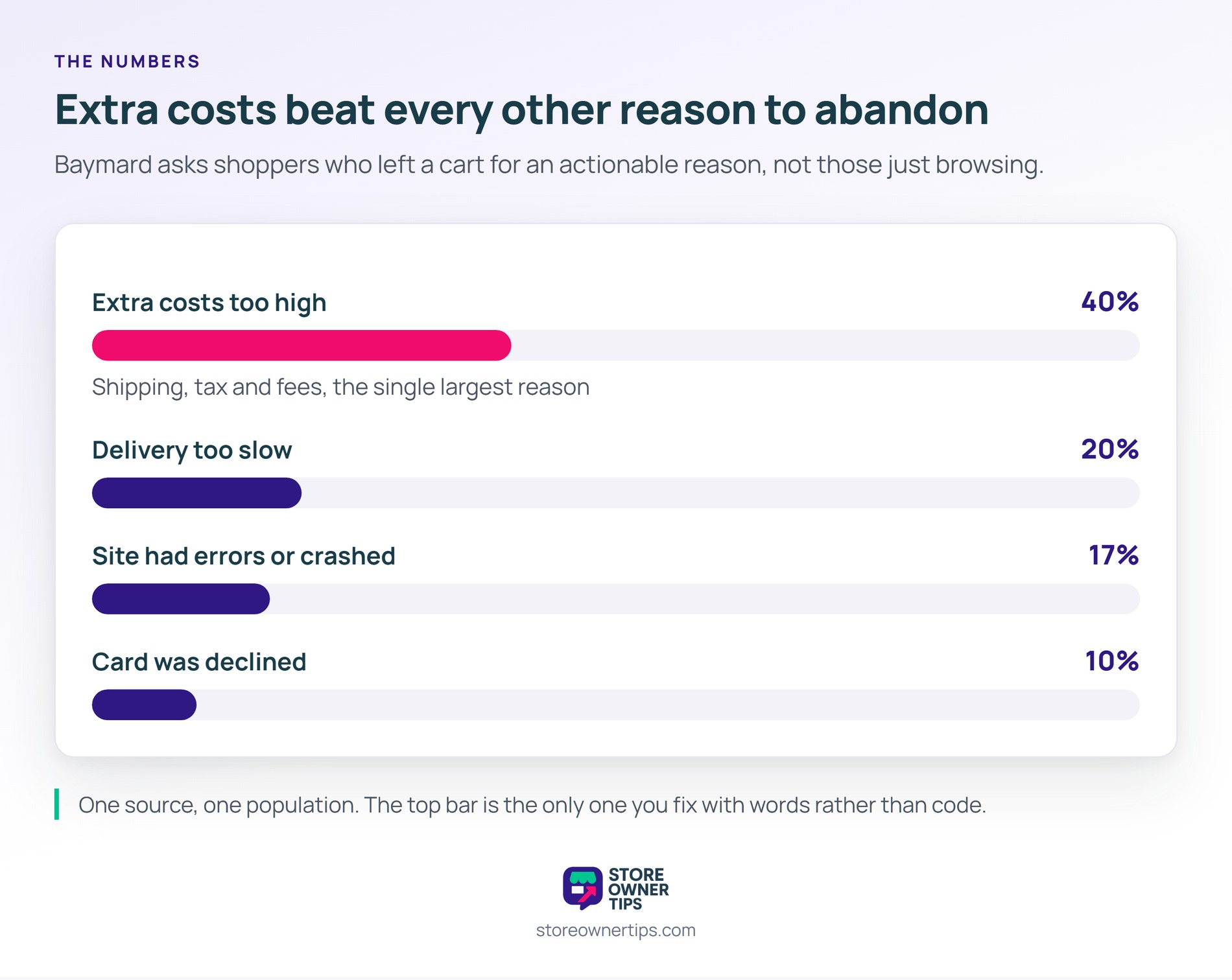
This is one of the better measured problems in e-commerce. Baymard surveys shoppers who abandoned a cart for an actionable reason, rather than those browsing.
In that list of reasons, 40% picked extra costs being too high. Shipping, tax and fees sit at the top, ahead of every other cause.
Checkout friction of any kind is expensive. Deloitte found that a 0.1 second speed gain lifted retail conversions 8.4%. A surprise charge is friction with a number attached.
Hidden fees show up as a checkout that leaks at one specific step. Here is a hypothetical example. Imagine a coffee equipment store with an average order around seventy dollars.
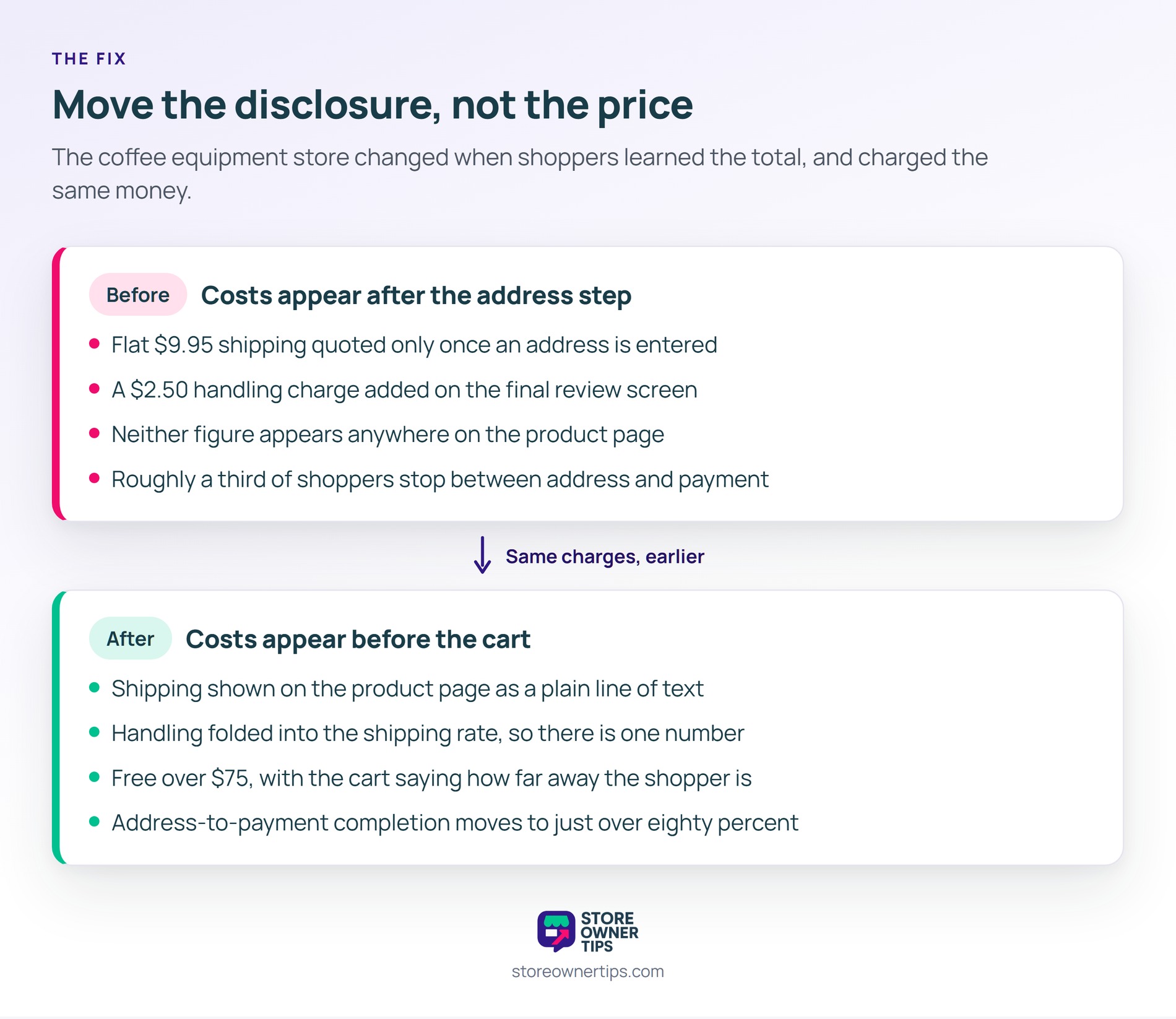
In this scenario the store charges flat shipping of $9.95. That rate only appears once the shopper enters an address. A separate handling charge of $2.50 is added on the final review screen.
Both charges are honest. Together they cover packing a fragile item properly. Neither appears anywhere on the product page.
The store’s cart page converts normally, so the dashboard looks healthy. The collapse happens between the address step and the payment step. Roughly a third of shoppers stop there.
Support starts hearing the same question. People email asking why a $69.95 grinder costs $82.40. The team explains the shipping each time, politely, one customer at a time.
Nobody connects the two facts for months. The emails read as individual complaints rather than a pattern. Meanwhile the abandoned shoppers say nothing at all.
The quiet ones are the expensive ones. For every shopper who writes in, many more simply close the tab.
So the store moves the disclosure earlier rather than cutting the charges. Shipping now appears on the product page as a plain line of text. The handling charge is folded into the shipping rate.
Next comes a threshold. Orders above $75 ship free, and the cart says how far away the shopper is. Advanced Coupons covers the setup in its guide to free shipping over a set amount.
The team also starts watching one number every week. It is the share of shoppers who reach the address step and then pay. That figure moves from roughly two thirds to just over eighty percent.
On about 400 orders a month, the arithmetic is worth doing. Recovering even a tenth of the lost shoppers adds close to $2,800 in monthly revenue. Nothing was discounted to earn it.
The total never changed for most orders. What changed is when the shopper learned it. In short, the store stopped being surprising and started being expensive on purpose.
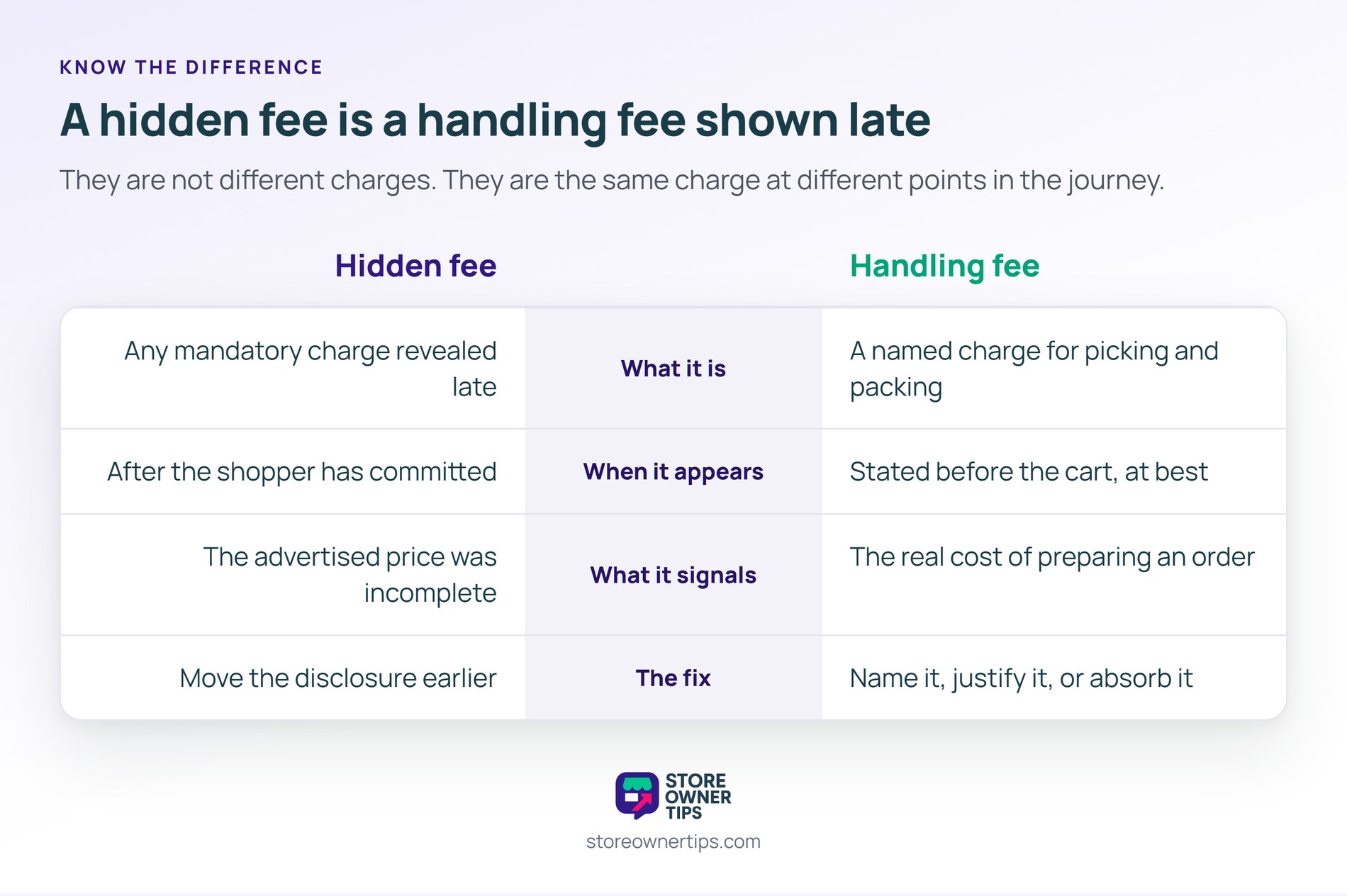
| What you’re comparing | Hidden fee | Handling fee |
|---|---|---|
| What it is | Any mandatory charge revealed late | A named charge for picking and packing |
| When it appears | After the shopper has committed | Stated before the cart, at best |
| What it signals | The advertised price was incomplete | The real cost of preparing an order |
| The fix | Move the disclosure earlier | Name it, justify it, or absorb it |
A handling fee becomes a hidden fee the moment you show it late. The two are not different charges, and they are the same charge at different points in the journey. So a store can charge for handling all day without offending anyone. It just has to say so before the shopper has picked a delivery date.
Often yes, and it depends on how much your shipping varies. A store with predictable parcel sizes can raise prices and advertise free delivery. That removes the surprise entirely.
It works less well when weights and destinations vary a lot. Then you would overcharge light orders to subsidize heavy ones. Showing the real rate early is the better trade.
It depends entirely on whether the shopper already knew the range. A rate that appears with no prior warning behaves like a hidden fee. One that confirms a figure quoted earlier does not.
Give a range on the product page if you cannot give a number. Something as plain as shipping from $6 removes most of the shock.
Only if the shopper learns about it before the cart. A threshold nobody knows about is another late surprise. Put it in the cart, the header, and the product page.
Say how far away they are, not just that the offer exists. A cart that says spend $12 more for free shipping does two jobs at once.
Hidden fees matter because they lose the shoppers you already paid to attract. The cost sits at the very end of the funnel, where every other investment has already been made. In short, the cheapest conversion work available to most stores is telling people the real total sooner.
Copyright © StoreOwnerTips.com. All Rights Reserved.
