Weekly ecommerce tips, deals & news.
Journey-based discounting is a smart pricing strategy that gives personalized, real-time offers to shoppers based on their exact behavior on your site. Instead of blasting a universal coupon to everyone, the system works in the background to spot hesitant buyers and offers them a specific deal right when they are about to leave. This approach saves your profit margins because it avoids giving unnecessary discounts to customers who are already willing to pay full price.
To truly grasp how journey-based discounting works, you have to look at both the hidden technology powering your store and the hidden psychology driving your customers. In older online stores, giving out a discount was an “all or nothing” event. You ran a site-wide sale, and everyone got it. But that destroys your profit margins. You end up subsidizing purchases for loyal fans who were going to buy your product anyway.
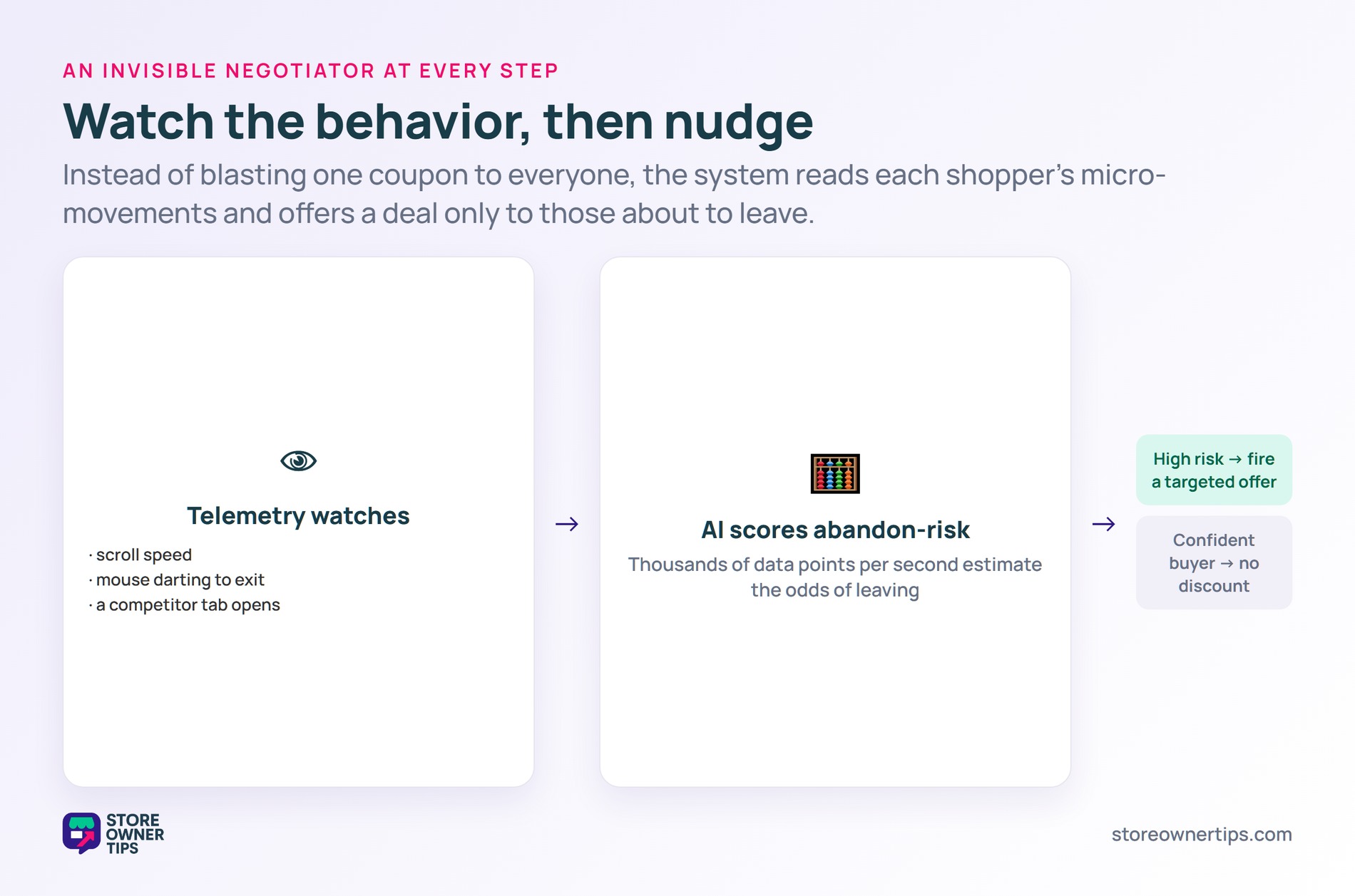
Journey-based discounting fixes this by acting as an invisible negotiator at every step of the customer journey. It uses in-session telemetry to track a shopper’s micro-movements. Telemetry is the collection of real-time, non-personal data, like how fast someone scrolls, if they highlight text, or if their mouse darts toward the exit button.
Think of telemetry like a seasoned salesperson watching a customer’s body language in a physical retail store. If the customer looks confused or turns toward the door, the salesperson instantly steps in to offer help.
For this to work without slowing down your website, the technology must be incredibly fast. On platforms like Shopify, developers use the Shopify Functions API to inject custom math directly into the checkout process. To keep things moving quickly, they use WebAssembly (Wasm).
Think of WebAssembly as a pre-cooked meal at a restaurant. Instead of preparing the ingredients from scratch when you order (which takes time), the meal is already prepped and simply heated up, delivering complex instructions to the browser in under 5 milliseconds.
This system relies on GraphQL Input Queries to pull exactly what it needs from the shopper’s cart.
Think of a GraphQL query like a highly specific drive-thru order. Instead of being handed the entire restaurant menu to read, you ask the window specifically for “one burger with no pickles,” and that is exactly what you get, saving massive amounts of time.
On open-source platforms like WooCommerce, developers use PHP “hooks” to issue journey-based discounts and change prices on the fly.
Think of a PHP hook like a toll booth on a highway. It briefly stops the data, checks a rule—like whether the user is a wholesale buyer or just added a specific item to the cart—and then alters the price before letting the data continue down the road. Advanced artificial intelligence tools like Namogoo and Wandz.ai also plug into this system. They read thousands of data points per second to calculate the exact mathematical probability that a shopper will abandon their cart.
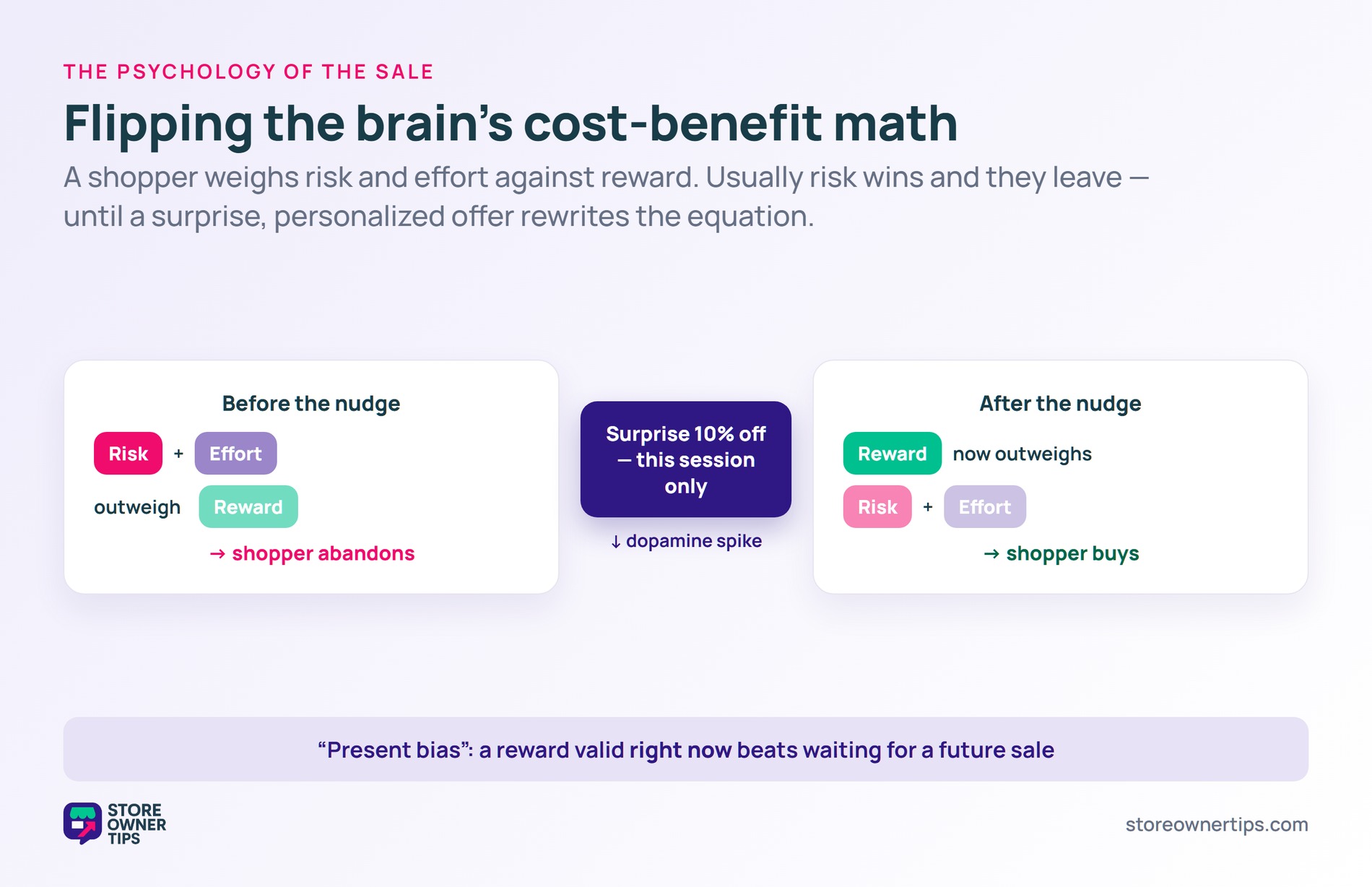
All this technology exists simply to trigger a specific reaction in the human brain. When a shopper decides to buy something, their brain runs a cost-benefit analysis. The brain’s anterior insula processes the financial risk, while the midcingulate cortex calculates the effort required to type in credit card details. Usually, the perceived risk and effort outweigh the reward, so the shopper leaves.
Journey-based discounting forcefully changes this calculation. By suddenly popping up a personalized, unexpected discount right when the shopper hesitates, the brain releases dopamine. This sudden spike of pleasure completely overrides the brain’s risk assessment.
It also weaponizes a psychological concept called “present bias.” Humans naturally place a huge amount of value on immediate, guaranteed rewards over future possibilities. By giving the shopper a personalized deal that is only valid for their current session, they feel intense pressure to buy right now. They stop waiting around for a future holiday sale because the reward is staring them in the face.
Imagine a mid-sized online apparel brand called “Urban Threads.” Like many retailers, Urban Threads is struggling with a massive baseline problem: a 69.99% overall cart abandonment rate. When they dive into the data, they realize that 58.6% of those abandoned carts belong to people who are “just browsing.”
Historically, Urban Threads tried to fix this by blasting out massive site-wide sales. During peak seasons, their average advertised discounts reached as high as 43%. This strategy was bleeding their bank accounts dry. Furthermore, market data shows that 40% of consumers now actually expect fewer broad, site-wide discounts anyway.
Urban Threads decides to install a journey-based discounting system powered by AI.
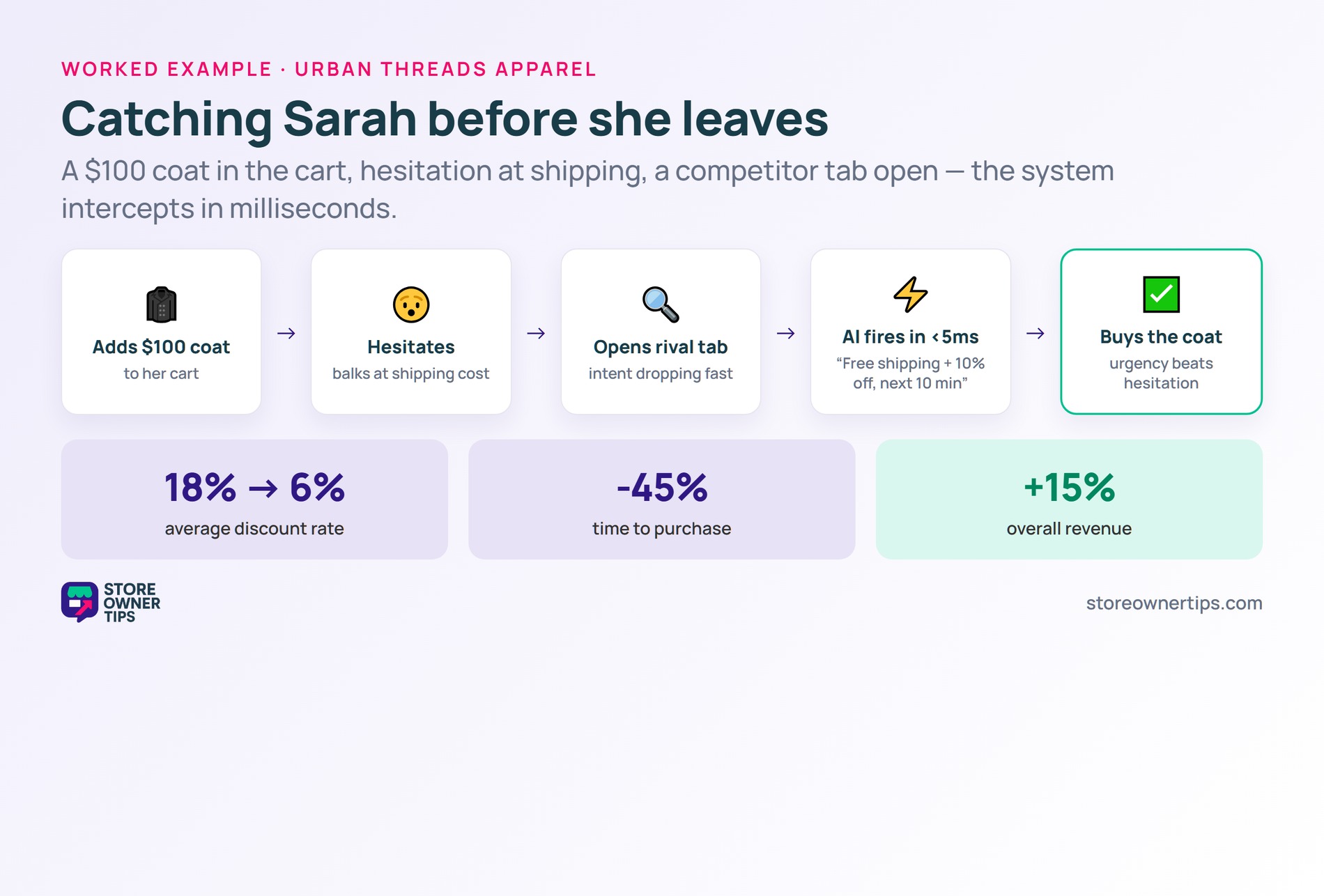
A new customer, Sarah, visits the site and adds a $100 winter coat to her cart. She clicks over to the checkout page but hesitates when she sees the shipping cost. She opens a new browser tab to check a competitor’s price. The AI instantly catches this behavior (telemetry). It calculates that her intent to purchase is dropping rapidly.
Before Sarah can close the Urban Threads tab, the system’s WebAssembly code fires in under 5 milliseconds. It triggers a small, polite pop-up offering her a dynamic discount: “Unlock free shipping and 10% off if you complete your order in the next 10 minutes.”
Because this is a personalized, unexpected reward perfectly timed within her customer journey, Sarah’s brain gets a dopamine spike. The sudden urgency cuts through her hesitation. She buys the coat. By using these exact behavioral nudges across their entire store, Urban Threads sees incredible results. Their average time-to-purchase drops by a massive 45%. Because they are no longer handing out blanket coupons to every single visitor, their overall average discount rate shrinks from 18% down to just 6%. This saves a fortune in profit margins.
Urban Threads also takes this strategy to mobile. They start sending dynamic discount codes via automated SMS to shoppers who leave the site on their phones. Because SMS messages have a staggering 98% open rate, almost every shopper sees the targeted offer. This simple mobile strategy yields a solid 3.64% average click-to-conversion rate, pulling lost shoppers right back to the checkout line. Ultimately, combining these journey-based tactics hands Urban Threads a sustained 15% overall revenue boost.
It helps to compare this modern strategy with its direct opposite: Static Discounting (also known as blanket discounting).
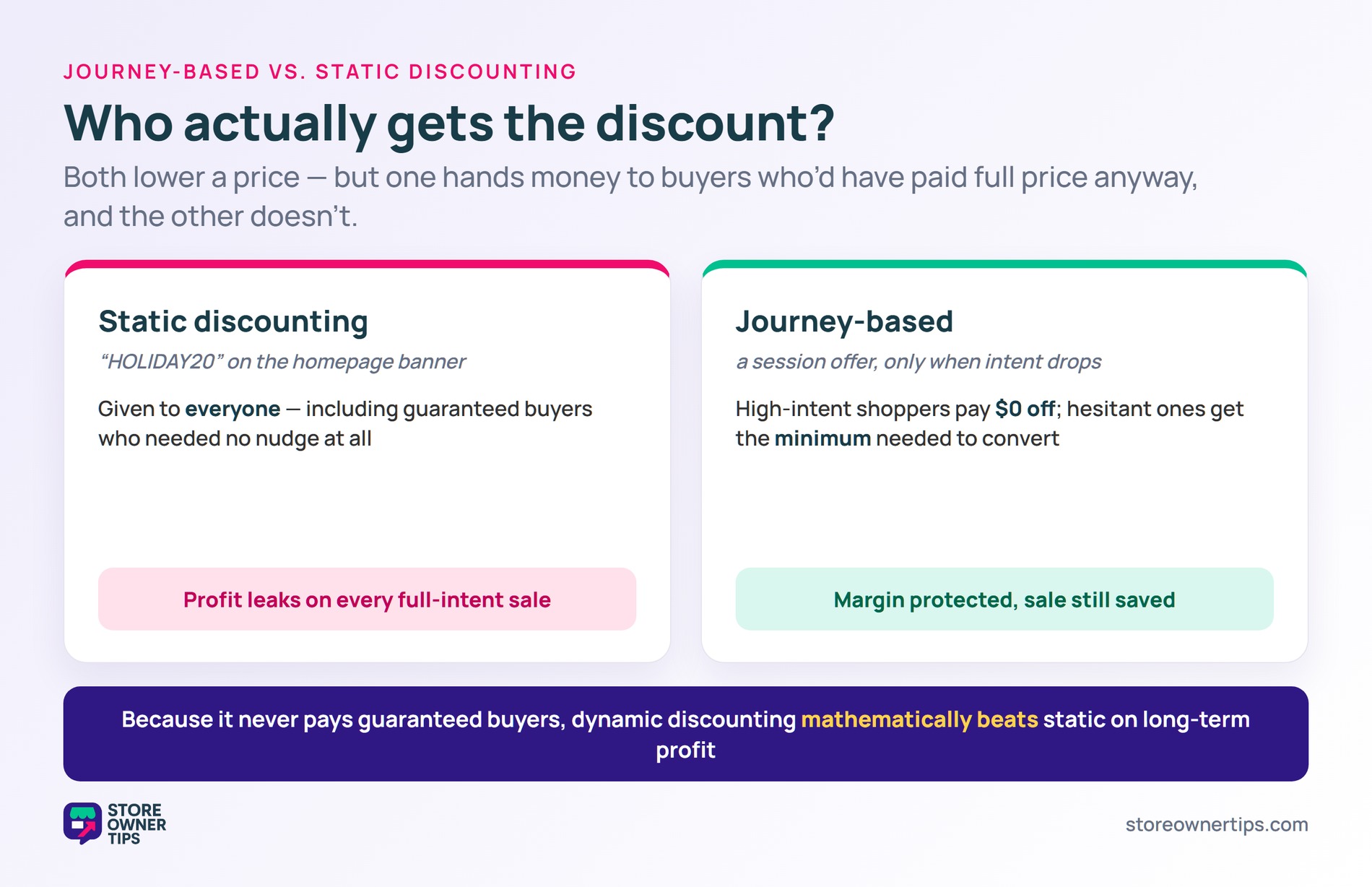
Static discounting is a rigid, universal promotion. Think of a standard “HOLIDAY20” code prominently displayed on the homepage banner. It is available to all incoming traffic, completely ignoring whether the shopper actually needed the discount to be convinced to buy.
We can clearly see the difference when we look at the math. Let $P$ represent the base retail price of your product, and $C$ represent your Cost of Goods Sold.
In a static model, the discount ($D_s$) is given to absolutely everyone. Your profit ($\pi_s$) looks like this:
$$\pi_s = (P – D_s) – C$$
In a dynamic, journey-based model, the discount ($D_d$) changes based on the user. For high-intent shoppers, the discount is literally zero. For hesitant shoppers, the system calculates the absolute minimum discount needed. Therefore, your dynamic profit ($\pi_d$) looks like this:
$$\pi_d = (P – D_d) – C$$
Because the dynamic system prevents you from giving away money to guaranteed buyers, your total long-term profit will always mathematically beat a static discounting strategy. Relying on static discounts is like eating fast food; it gives you a quick, satisfying spike in sales, but it slowly ruins the long-term health of your business.
Like any advanced e-commerce strategy, switching to a journey-based discounting system comes with clear advantages and distinct risks.
You will typically see initial statistical indicators within 2 to 4 weeks after deployment. During this time, the machine learning models are actively studying your shoppers’ behavior. However, the most significant improvements to your conversion rates and profit margins usually happen after 60 to 90 days, once the AI has collected enough data to predict purchase intent accurately without human help.
No, not if you use modern infrastructure. While old Javascript widgets used to slow things down, modern server-side tools (like Shopify Functions using WebAssembly) execute in under 5 milliseconds. In fact, research shows that contextually relevant, personalized discounts actually improve the user experience by reducing the mental friction of price discovery.
You must move away from generic discounts and build targeted lifecycle funnels that map to the entire customer journey. By segmenting your audience database, you can automatically trigger tailored win-back discounts based on a customer’s past purchases. Additionally, if you run a subscription model, you can use dynamic discounts to automatically reward active subscribers with a markdown after they hit a certain number of billing cycles, effectively preventing churn.
While dynamic discounting happens on your actual website, it shares the exact same core philosophy as journey-based advertising. Both strategies rely on tracking user intent—advertising brings hesitant shoppers back to your store with highly targeted off-site ads, while dynamic discounting mathematically ensures they convert once they arrive.
Journey-based discounting transforms your storefront from a passive catalog into an active, intelligent negotiator that constantly adapts to the individual customer journey. By perfectly timing personalized financial incentives, you can dramatically boost your conversion rates while aggressively defending your baseline profit margins.
Copyright © StoreOwnerTips.com. All Rights Reserved.
