Weekly ecommerce tips, deals & news.
LLMs.txt is a simple text file you place at the root of your website to guide AI language models. It points them to your most important content in a clean, easy-to-read format. Think of it like a welcome map made just for AI. For online stores, it helps AI tools understand and describe your products correctly.
LLMs.txt is a markdown file that lives at your site root, like example.com/llms.txt. It was proposed by Jeremy Howard in September 2024 as a simple standard for AI. The idea is to hand AI a clear guide instead of making it dig.
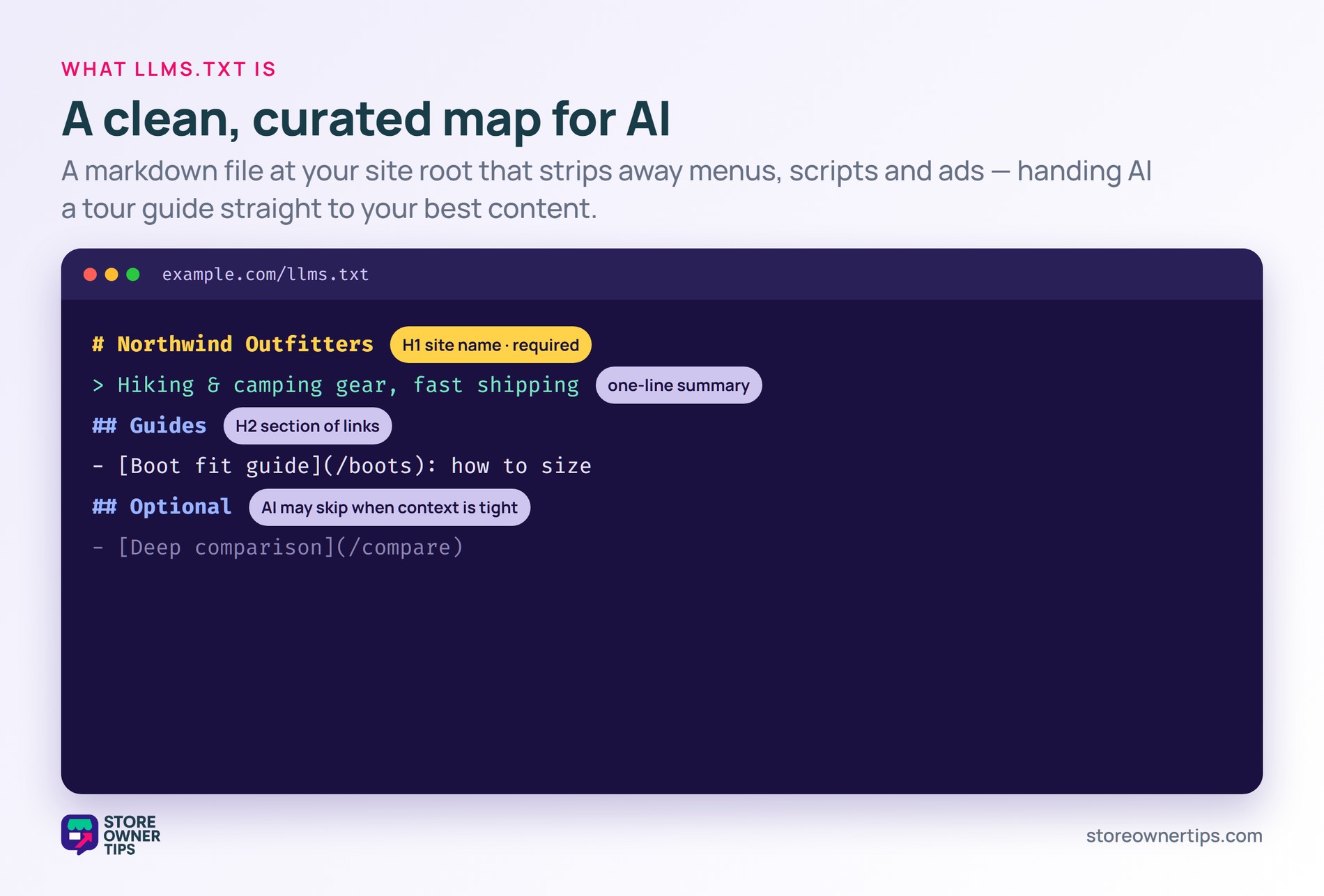
Normal web pages are messy for machines. They carry menus, scripts, ads, and pop-ups around the real content. LLMs.txt strips that away and offers clean, focused text.
Think of it like a tour guide at a big museum. Instead of wandering every hall, the guide walks you straight to the highlights. The file does the same for AI visiting your store.
The llmstxt.org spec defines a tight, ordered structure in markdown. The only required piece is an H1 with your project or site name. Everything after that is optional but follows a set order.
Right after the H1, you can add a blockquote with a short summary of your site. Then you may include free markdown content for extra context. After that come H2 sections, each holding a list of linked pages.
Each link follows a simple format: a markdown hyperlink followed by an optional colon and short notes. A special “Optional” H2 section can hold links that AI may skip when context is tight. This keeps the file flexible without breaking the rules.
The content is short and human-readable. It usually starts with your store name and a one-line summary. Then it lists your most important pages with brief notes.
For a store, that might mean key category pages, top guides, and policies. You can link clean markdown versions of those pages for easy reading. This is similar in spirit to a structured XML product feed, but written for AI to understand.
The goal is curation, not volume. You highlight what matters most, in plain language. That makes it more likely AI describes your store accurately.
AI tools are now a real path to your products. ChatGPT reached 100 million users in about two months, the fastest-growing internet app at the time. More shoppers ask AI before they ever search.
That traffic is already arriving. Visits to U.S. retail sites from generative AI sources jumped 1,200% in early 2025 versus mid-2024. Helping AI read you correctly protects that channel.
Clear content also gets used more. Research on optimizing for AI answers found clean, sourced content can lift visibility by up to 40%. LLMs.txt is one more way to feed AI that clarity. It pairs well with broader generative engine optimization work.
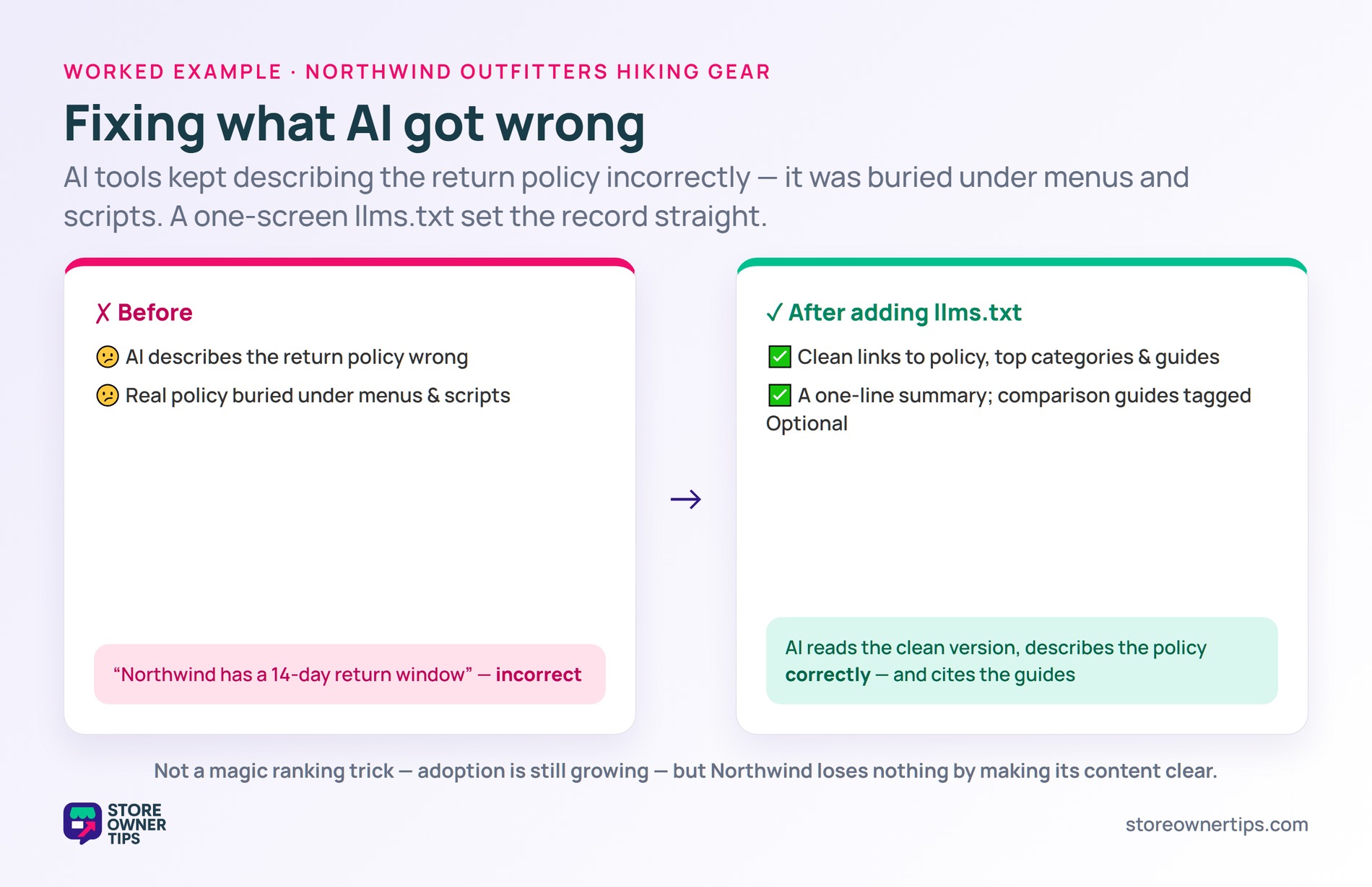
Imagine a WooCommerce store called Northwind Outfitters that sells hiking gear. AI tools sometimes describe its return policy wrong. The real policy is buried under menus and scripts.
To fix this, Northwind adds an llms.txt file. It lists clean links to the policy, top categories, and best buying guides. Each entry has a short, plain summary.
The team also adds a one-line site summary near the top. They tag a few comparison guides as “Optional” so AI can skip them under tight context. The whole file fits on a single screen.
AI tools that respect the file now read the clean versions. They start describing the return policy correctly. Shoppers get accurate answers about Northwind.
The store also guides AI toward its best guides. Those pages get cited more often in answers. Accurate, flattering mentions build trust with new shoppers.
This is not a magic ranking trick. Adoption of the standard is still growing, so results vary by tool. Even so, Northwind loses nothing by making its content clear.
Both files sit at your site root and speak to machines. That is where the similarity ends. They solve very different problems.
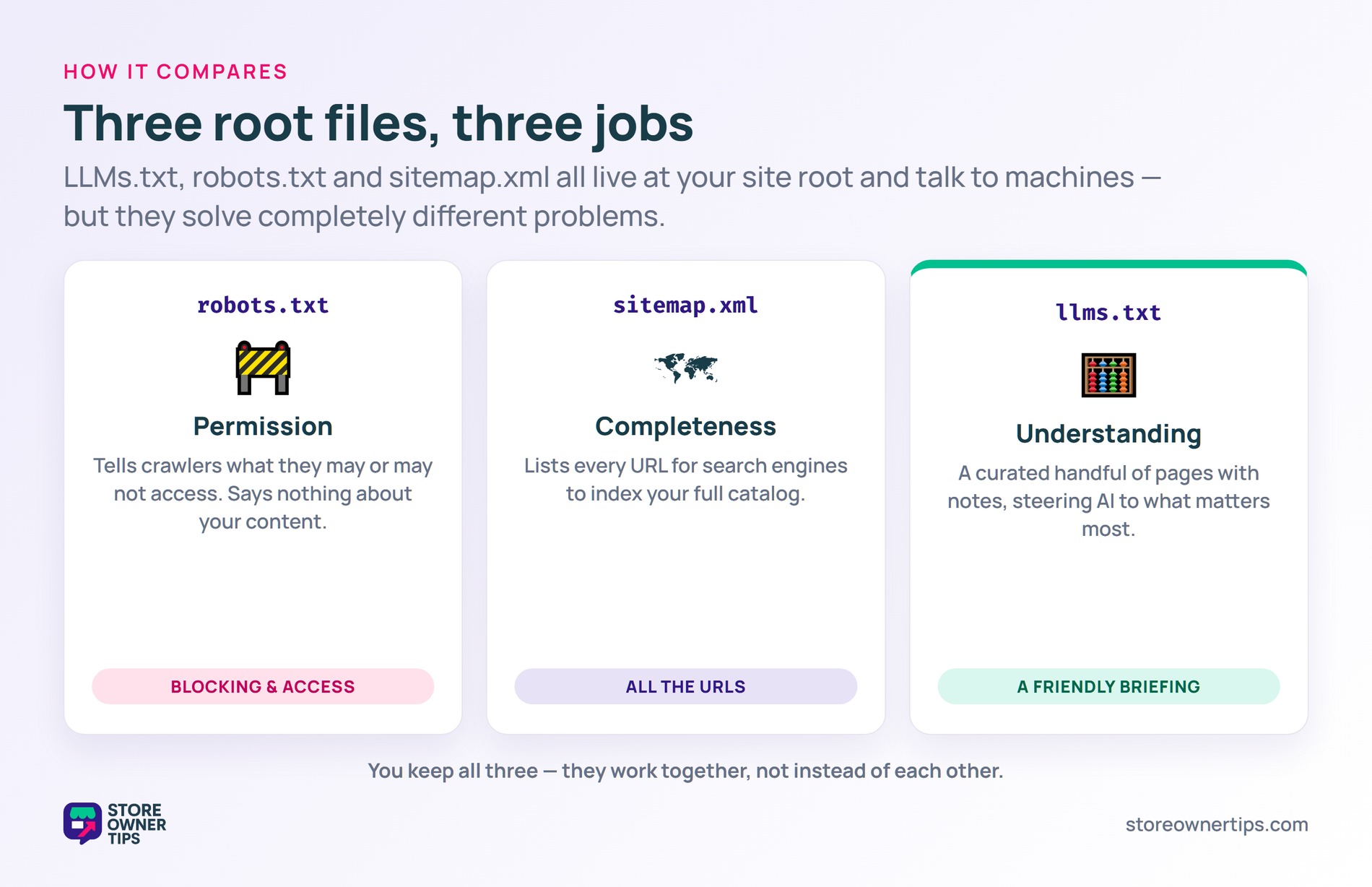
Robots.txt tells crawlers what they may or may not access. It is about permission and blocking. It does not explain your content at all.
LLMs.txt is about understanding, not permission. It hands AI a curated guide to your best content. One sets boundaries, while the other offers a helpful map.
A sitemap.xml lists every URL you want search engines to find. It aims for completeness, not curation. Crawlers use it to index your full catalog.
LLMs.txt does the opposite. It highlights only a curated handful of pages with notes. The point is to steer AI toward the content you most want surfaced.
In practice, you keep both. Sitemap.xml feeds search crawlers a full URL list. LLMs.txt feeds AI a short, friendly briefing on top of that.
You do not need to hand-write llms.txt on WordPress. AIOSEO ships a built-in LLMs.txt generator that creates and hosts the file for you. It is on by default once you update the plugin.
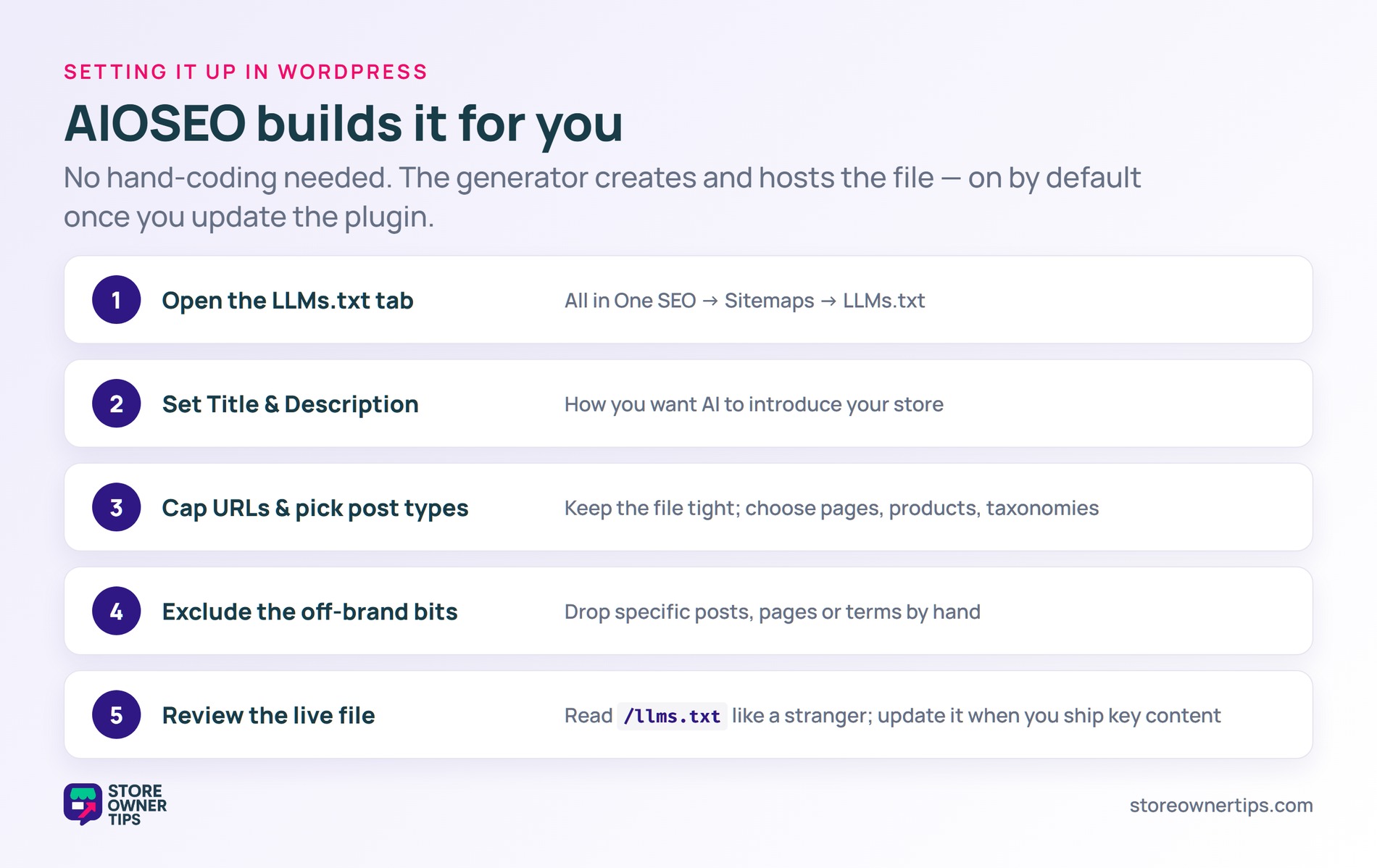
You find it under All in One SEO, then Sitemaps, then the LLMs.txt tab. From there you can toggle the file on or off and open it in a browser tab. The plugin also offers a longer llms-full.txt version for tools that want more detail.
The UI exposes a small set of controls. You set the file Title and the Description that appear at the top. You also cap the URL count per post type and pick which post types and taxonomies to include. From there, you can exclude specific posts, pages, or taxonomy terms by hand.
That is most of what the average store needs. For more control over the exact text on each linked page, you may need a developer or custom filters.
Start small. Turn the file on, set a clear Title and Description that match how you want AI to introduce you. Limit the URL count per post type to keep the file tight.
Then review the live file at /llms.txt and read it like a stranger would. Cut anything off-brand or low value. Update the file when you ship important new content.
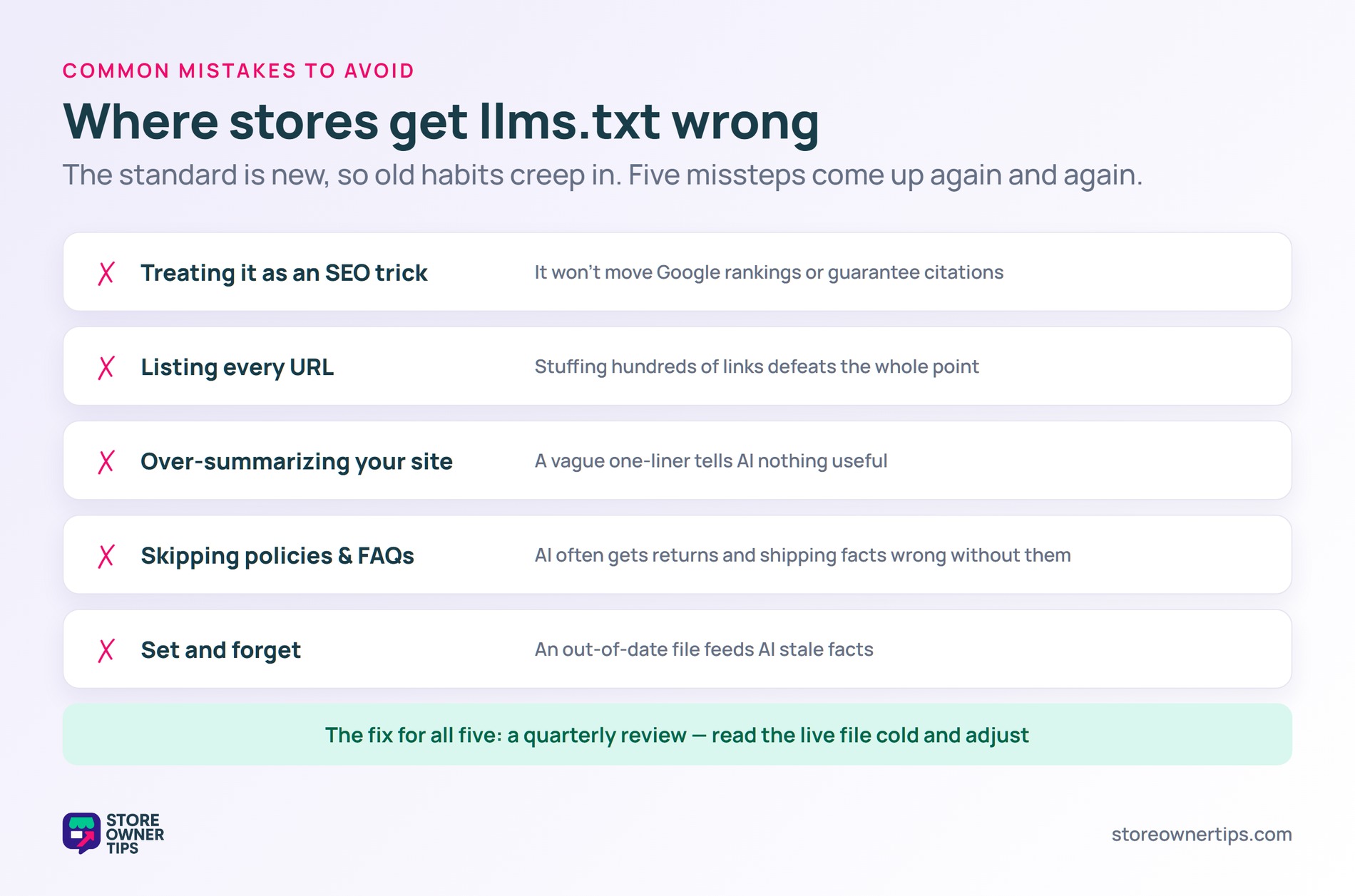
The cleanest fix for most of these is a quarterly review. Open the live file, read it cold, and ask whether it still reflects your store. Adjust the AIOSEO settings, then save.
Support is still growing and not universal. The standard is proposed, not officially endorsed by major AI providers. No vendor has publicly confirmed they fetch and weight the file in answers. Adding it is low effort and low risk, so it positions your store well as adoption spreads.
Not quite, though both list important pages. A sitemap helps search crawlers find every URL. LLMs.txt curates a smaller set of pages and explains them in plain language for AI. It favors clarity over completeness.
On WordPress, the easiest path is a plugin like AIOSEO that generates the file for you. You can also write one by hand as plain markdown. Either way, host it at your site root so it loads at /llms.txt. Keep it updated as your important pages change.
No, the file is not a search ranking signal. It targets AI answer engines, not classic search results. Its job is helping AI describe your store accurately. View it as part of broader AI visibility work, not SEO.
LLMs.txt is a low-cost way to hand AI a clean, curated view of your store. As shoppers lean on AI tools, helping those tools read you correctly protects your brand and your traffic. The standard is still young, but adding the file is easy and sets your store up for an AI-first future.
Copyright © StoreOwnerTips.com. All Rights Reserved.
