Weekly ecommerce tips, deals & news.
Loss aversion is a behavioral economics principle. People feel the pain of losing something far more strongly than the pleasure of gaining something equal. The effect is roughly two to two-and-a-half times stronger for losses than gains. In e-commerce, loss aversion drives sticky free trials, fear of missing out, and the magnetic pull of “Save $20 today.” Used carefully, it lifts conversion. Used clumsily, it triggers regret and refunds.
Loss aversion isn’t a fringe psychology idea. It’s the backbone of how people make financial decisions, and it shows up in nearly every shopping moment. Once you see it, you’ll spot it on every product page, cart page, and checkout flow.
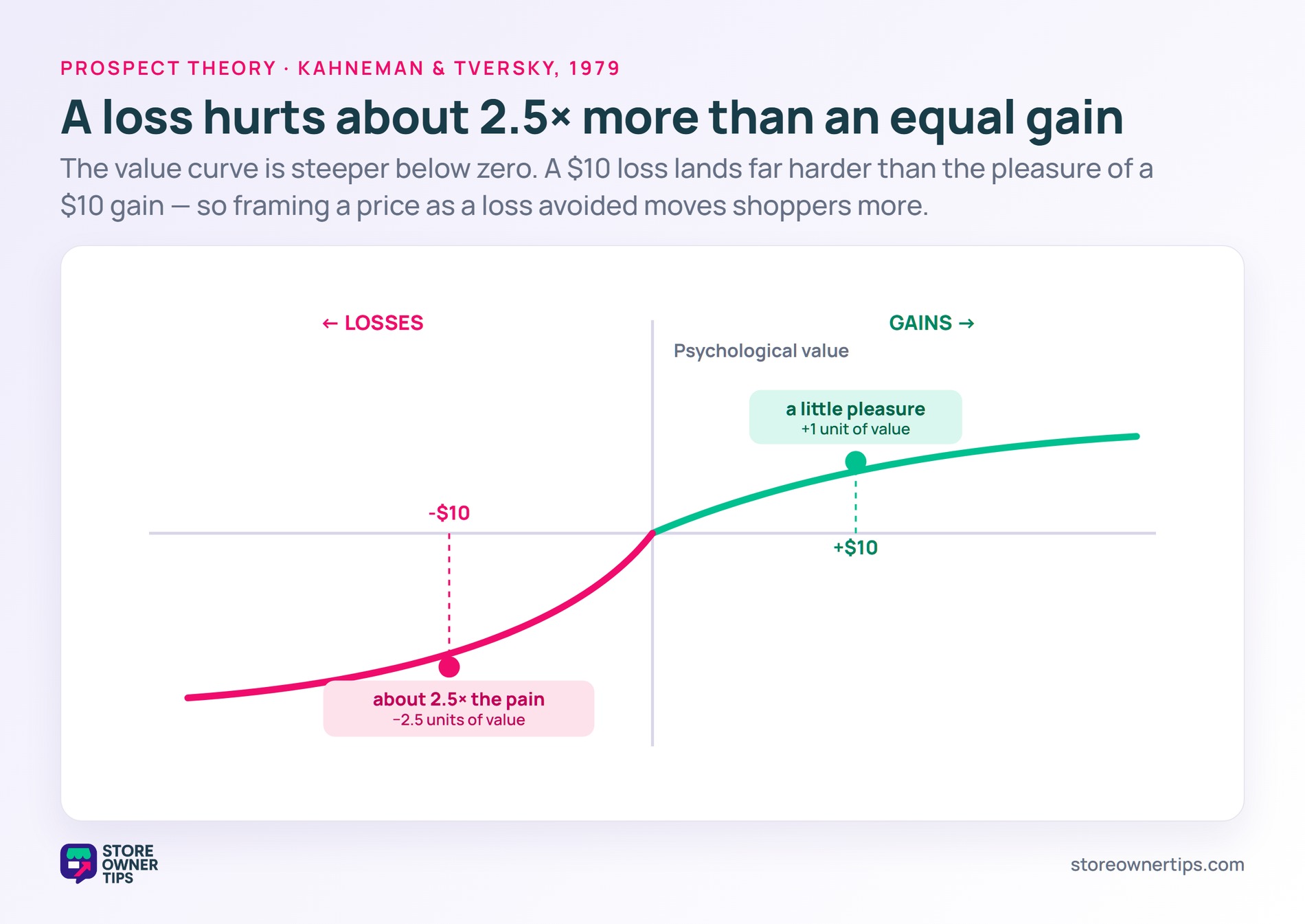
Daniel Kahneman and Amos Tversky introduced loss aversion in 1979 as part of prospect theory. The paper showed that people don’t evaluate outcomes in absolute terms. Instead, they compare each outcome to a reference point and weight losses more heavily than gains.
Kahneman later won the Nobel Prize in Economics partly for this work. Britannica summarizes the core finding plainly. People need offers about two-and-a-half times the size of a potential loss. Only then will they accept the same risk for a chance at gain.
Loss aversion isn’t just an academic concept. Stores apply pricing psychology tactics built on it constantly, often without naming the principle:
Each tactic reframes the purchase decision. The shopper stops asking “is this worth $X?” and starts asking “am I about to lose something?” The choice of framing matters more than people realize. The same discount described two different ways converts at different rates.
The trick is to find the framing that maps to the shopper’s existing mental model. A shopper expects to pay for shipping but resents it. So “unlock free shipping” lands well. They don’t expect to pay full price for an item on sale, so “save” lands too.
The cleanest e-commerce example is free shipping. Shipping fees aren’t a normal cost in the shopper’s head. They feel like a tax bolted onto the price at the last minute.
That’s why surprise extra costs are the leading driver behind 70.22% average cart abandonment across e-commerce. Stores that bury shipping until checkout pay the price.
A free-shipping threshold flips the script. Instead of paying a $9 shipping fee, the shopper adds a $14 product to unlock free shipping. They spend more, feel like they won, and the store still gets the margin.
Free shipping is one of the highest-leverage applications of loss aversion. Stores that crack the threshold math see lift on both AOV and conversion at the same time.
Loss aversion has a close cousin: the endowment effect. Once people feel they own something, they value it more than before they had it. Free trials lean on this directly. After 14 days of using a product, returning it feels like losing something, not refusing to buy something new.
This is why free-trial conversion often beats discount-based offers. The shopper doesn’t compare “$0 today vs $20 today.” They compare “what I already have vs giving it up.” Loss aversion makes the choice feel obvious.
Walk through a fully hypothetical store using loss-aversion framing on a single feature. The mechanics borrow from real research, not the store itself.
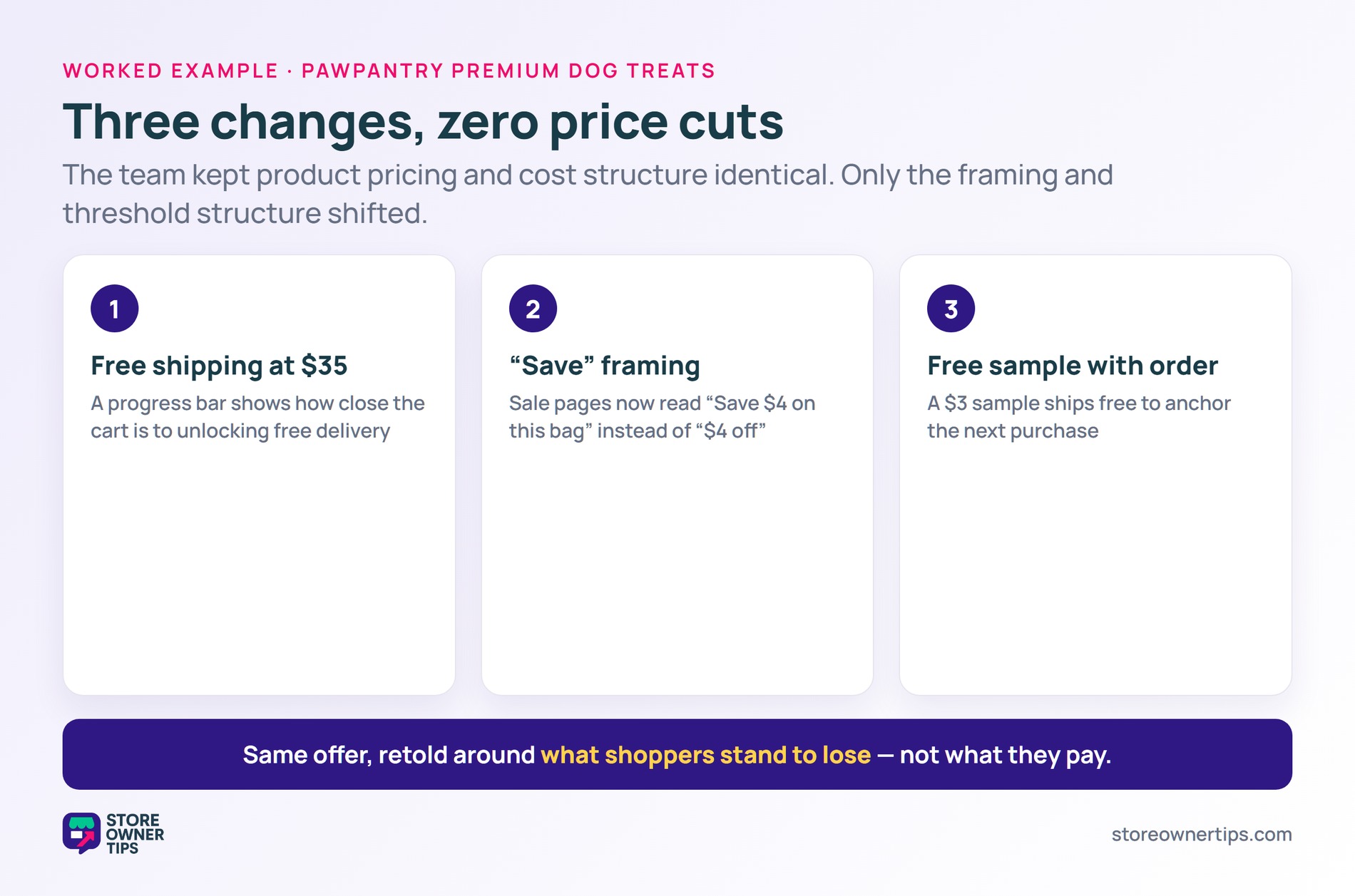
Imagine a small online retailer selling premium dog treats on WooCommerce. Call it PawPantry. The shop runs 25,000 monthly sessions and converts at 1.5%. Average order value is $28.
That works out to 375 orders and $10,500 in revenue each month. The store currently charges flat $7.95 shipping on every order. Cart abandonment sits around 75%, slightly worse than industry average.
The team picks three small changes, all leaning on loss-aversion framing:
The team doesn’t change product pricing. The cost structure stays identical. Only the framing and threshold structure shift.
After 90 days, the picture changes. Average order value moves from $28 to $3
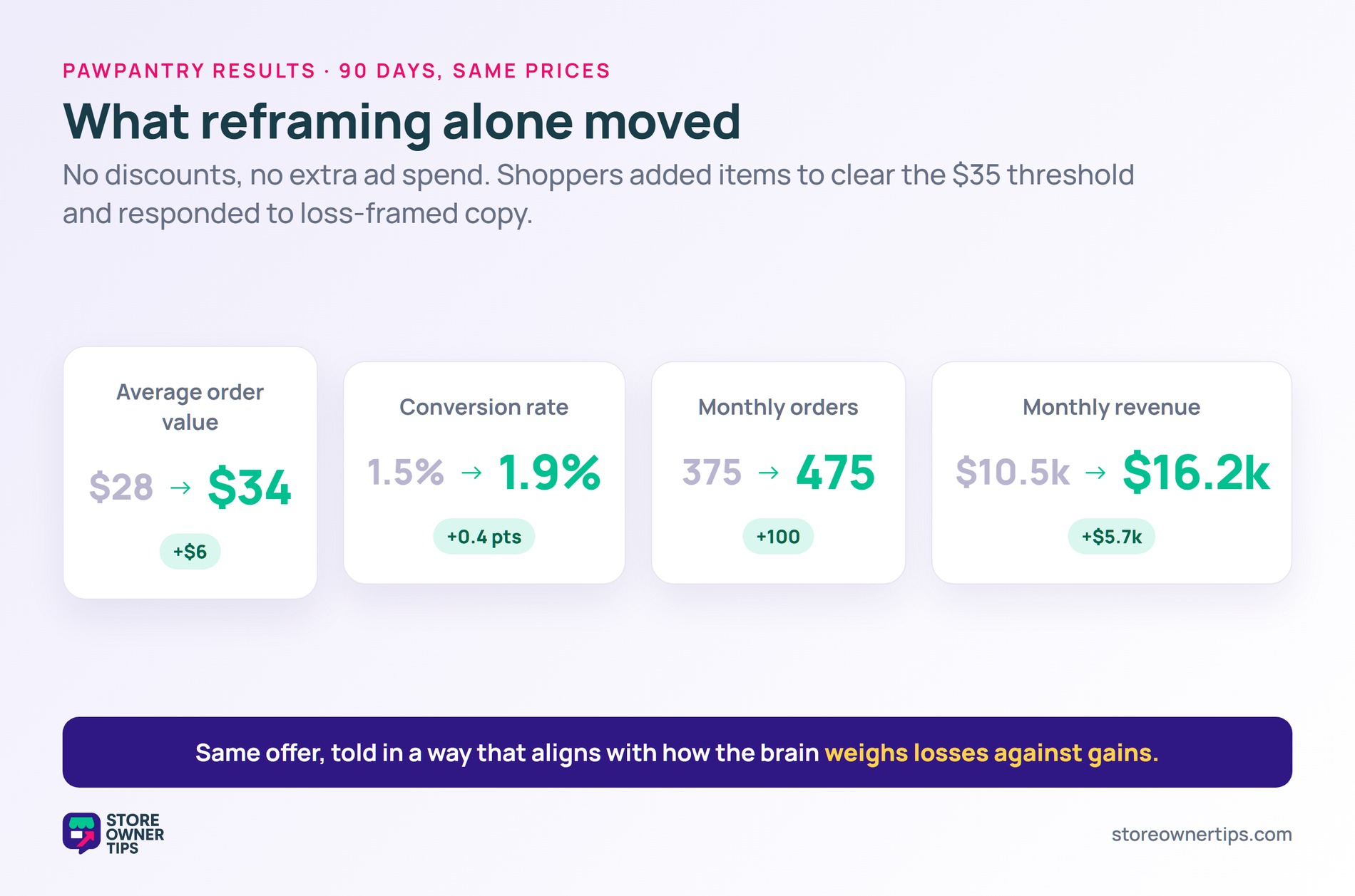
Conversion rate climbs from 1.5% to 1.9%. Monthly orders rise from 375 to 475. Revenue jumps from $10,500 to $16,150.
The lift sits well inside the documented range for honest loss-aversion framing. PawPantry didn’t drop prices. They just told the same offer in a way that aligned with shopper psychology. The brain still weighs gains and losses asymmetrically, just like Kahneman and Tversky showed.
Loss aversion is the principle. FOMO is one specific application of it. Loss aversion describes why losses hurt more than gains. FOMO describes the emotional state shoppers feel when scarcity signals trigger that asymmetry.
Loss aversion applies to any decision involving potential loss, not just trending or popular products. FOMO is narrower. It usually requires a social or scarcity element, like a limited drop or a deadline tied to an event.
In e-commerce, the two often stack. A countdown timer creates FOMO. The fear that drives it traces back to loss aversion.
It depends on whether the loss is real. A genuine sale deadline, real shipping cost, or actual stock limit is honest framing. Made-up losses are manipulation.
The same logic applies to “save” framing. “Save $20 today” is fine when the deadline and original price are accurate. It crosses the line when the higher original price was never charged.
A useful test: would the framing still be true if the customer asked directly? If yes, it’s ethical loss-aversion framing. If you’d have to dodge the question, rebuild it.
Start with the framing audit. Look at every place your store presents a price, a discount, or a comparison. Ask: am I describing a gain or a loss?
Two of the highest-leverage moves:
Both changes take an afternoon to implement and cost nothing. The lift comes from changing wording and structure, not pricing or inventory.
Loss aversion is one of the highest-leverage psychology principles in e-commerce. It costs nothing to apply and works on existing traffic. Stores that reframe offers around what shoppers stand to lose tend to outperform competitors. Audit your store’s copy this week. Switch one discount label from “off” to “save” and measure the lift.
Copyright © StoreOwnerTips.com. All Rights Reserved.
